
What Drives Tree Removal in Auburn
Three things generate most Auburn removals: dead and dying pine, hazard oaks over structures, and fire-driven cleanup around homes. All three get worse the longer they wait — a standing dead ponderosa is a harder, more expensive removal at year two than at month six.
- Beetle-killed ponderosa and gray pine — drought-stressed pine that faded to red and then gray. Dead pine loses structural integrity fast, which changes how (and how safely) it can be climbed.
- Hazard oaks — interior live oaks and blue oaks with decay, dieback, or a new lean over houses in Old Town, downtown, and the older neighborhoods off Auburn Folsom Road.
- Fire-fuel removals — dead trees and heavy conifers inside the 0–30 foot zone around homes, especially on the canyon side of town.
- Storm failures — foothill wind and saturated winter soil bring down shallow-rooted pine and oak every season; see our emergency service for active hazards.
Steep Lots and Canyon-Rim Access
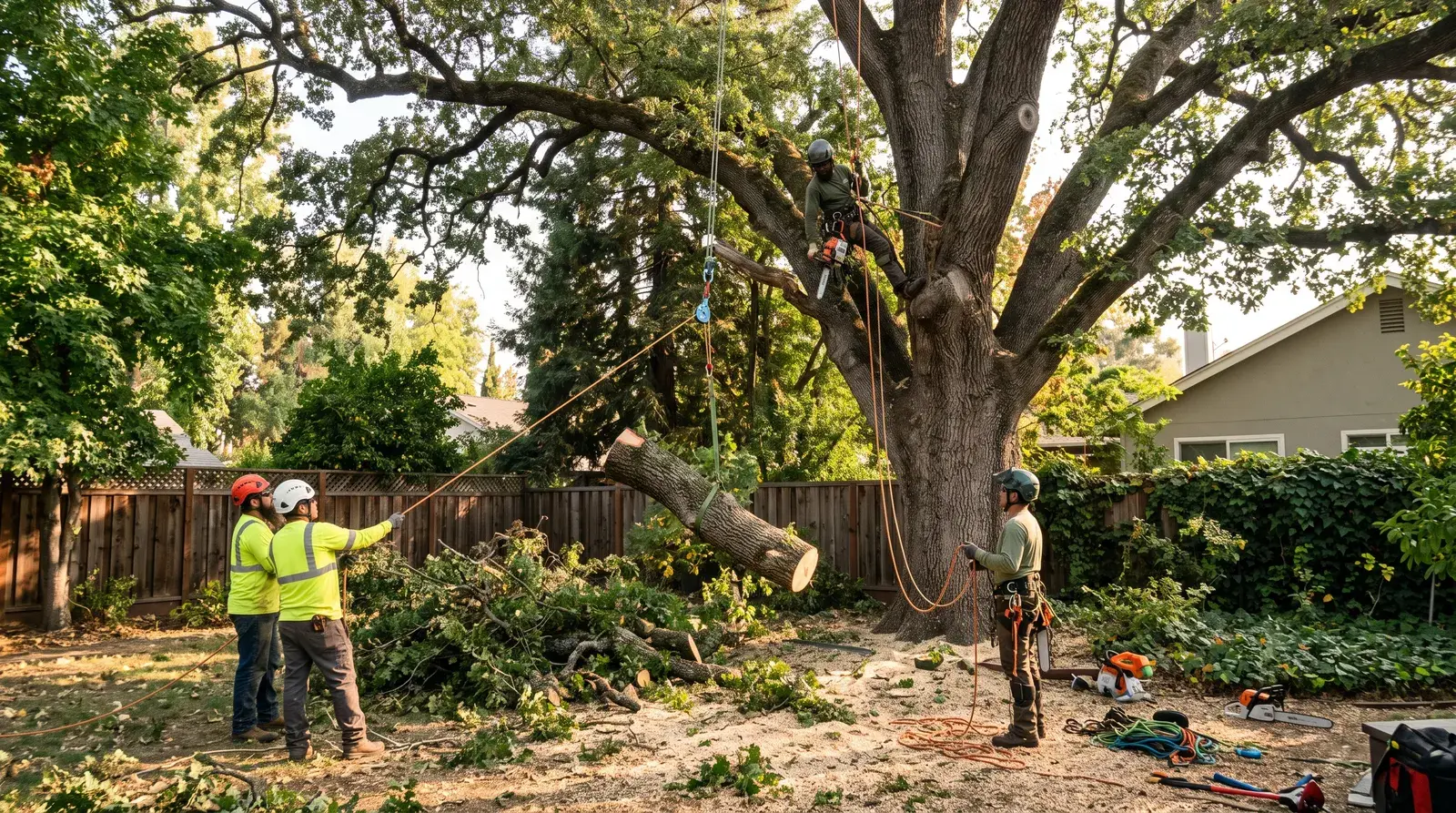
Access is the defining variable in Auburn. Lots dropping toward the North and Middle Fork canyons, tiered hillside yards, and long shared gravel drives mean equipment often can't reach the trunk — so wood moves by rigging, winch, or many trips by hand.
- Downhill-side trees get rigged and lowered uphill in smaller pieces — slower and more labor, but the only controlled option on a grade.
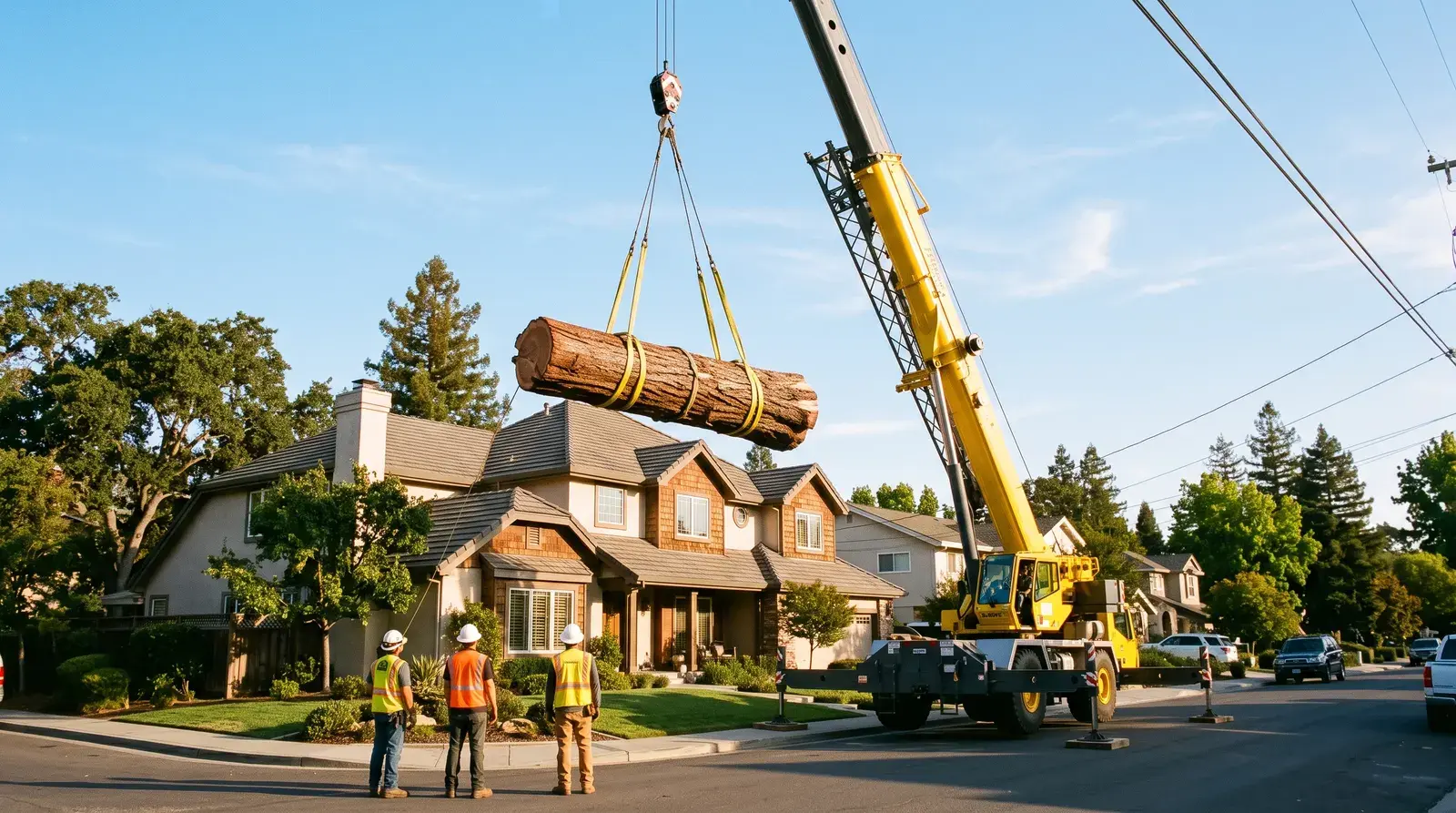
- Where a crane can set up on the road above, big trees come out over the house instead of through the yard; on the right lot it's cheaper than it sounds.
- Soft or narrow drives limit chip trucks and loaders — tell us about bridges, culverts, and gate widths when you call so the bid matches reality.
- On large canyon-rim parcels, leaving bucked rounds and chips on-site cuts haul-off cost substantially.
Tree Removal in Auburn — free, site-specific estimates.
Permits: Auburn City Limits vs. Unincorporated Placer County
The rules change at the city line, and Auburn's line wanders. Inside the City of Auburn, city tree regulations apply; the neighborhoods beyond — North Auburn, the canyon rim, most of the acreage — fall under Placer County, where native oaks get particular attention.
- Verify with the City of Auburn before removing significant trees inside city limits, especially native oaks and anything street-adjacent in Old Town.
- Unincorporated parcels follow Placer County requirements for native oak removal — valley oak, blue oak, interior live oak.
- Dead and hazardous trees generally have a faster path, but photograph the tree's condition first; documentation gets requested after the fact.
- 916 Trees checks the jurisdiction and ordinance question on every estimate and can provide an arborist letter when an application needs one.
Dead Pine: Why It Can't Wait
A dead ponderosa or gray pine is not a stable object. Within a year or two of dying, the wood dries, checks, and loses the strength a climber depends on — and the top starts shedding in wind. The removal only gets more dangerous and more expensive with time.
- Fresh-dead pine can often be climbed and rigged conventionally; long-dead pine frequently requires a lift or crane because climbing it is no longer safe.
- Gray pine (foothill pine) adds its own hazard: heavy, sap-loaded cones and a naturally leaning, multi-top habit that fails unpredictably.
- Standing dead pine next to a house is both a strike hazard and concentrated fire fuel — in Auburn's fire severity zone, it's usually the first tree we'd remove on any property.
- If you're watching a pine fade from green to red, get it assessed now — removal while it still holds needles is the cheap version of this job.
Need tree removal in Auburn?
Share the address and project details — we'll come back with a scoped, site-specific estimate.
What Tree Removal Costs in Auburn
Broad regional figures: small trees $500–$900, mid-size $900–$2,500, and large conifers, hazard oaks, or steep-access work $2,500–$10,000+. Auburn skews higher than valley cities because the trees are bigger and the ground is steeper — access drives the bid.
The honest answer is that no two Auburn lots price alike. A 90-foot ponderosa with a crane pad on the street can cost less than a 50-foot oak rigged piece-by-piece over a hillside deck. We quote from a site walk, write down exactly what's included — takedown, haul-off, and stump grinding as a separate line — and the estimate is free.
The same crew from estimate to cleanup.
No juggling separate contractors for one tree. Tell us the address and what you're dealing with, and we'll come back with a written, site-specific number.
- Removal, trimming, stumps, and cleanup handled by one crew
- Free, site-specific estimates — priced to your tree, not a flat rate
- Sacramento, Placer, El Dorado, and Yolo counties

After Removal on a Foothill Lot
On Auburn properties, what happens after the tree is down matters for fire compliance as much as looks. Slash left on a slope is ladder fuel; a ground stump can host regrowth or fungus. Decide the endgame before the crew mobilizes.
- Chip and scatter, chip and haul, or leave firewood rounds — spelled out in the quote so nothing ambiguous stays on the slope.
- Stump grinding 8–12 inches below grade standard; on defensible-space jobs, low-cut stumps are sometimes acceptable — we'll tell you which applies.
- Removing a dead pine often reveals the next problem tree behind it; a quick walk of the rest of the property while we're there costs nothing.
- Replanting on foothill lots means fire-smart spacing and species — our planting service can map that out.
Related guides
Do You Need a Permit to Remove a Tree in Sacramento?
Which Sacramento trees need a removal permit, how city and county rules differ, and how to check before the saw comes out.
How Much Does Tree Removal Cost in Sacramento? (2026)
Typical 2026 Sacramento tree removal price ranges by tree size, the factors that move the number, and how to read a quote before you sign it.
9 Signs a Tree Needs to Come Down
Nine warning signs a tree is hazardous or dying — and when removal is safer than trying to save it.
What tree removal costs — and what Auburn allows
Regional ranges, local permit rules, and the alternatives worth weighing before tree removal in Auburn.
Emergency Tree Service Cost in Sacramento (2026)
Regional range $800–$8,000 — and what moves the number on a real job.
Do You Need a Tree Removal Permit in Auburn?
Where Auburn draws the line before a tree comes down, and who to check with.
Tree Pruning vs. Removal: When to Save a Tree and When to Take It Down
Pruning or Removal — how to tell which one the tree actually needs.
Tree Service in Placer County, CA
Placer County spans flat valley suburbia in Roseville and Rocklin and rises through the oak-woodland foothills to ponde…
Crane-Assisted Tree Removal Cost in Sacramento (2026)
Regional range $2,500–$12,000 — and what moves the number on a real job.
Do You Need a Permit to Remove a Tree in Sacramento?
Which Sacramento trees need a removal permit, how city and county rules differ, and how to check before the saw comes out.
Want a sense of the work first? See the kinds of tree removal jobs we take on and who shows up to do them.
Frequently asked questions
How much does it cost to remove a dead pine tree in Auburn?
As a broad regional range, mid-size removals run $900–$2,500 and large conifers $2,500–$10,000+, and dead ponderosa or gray pine trends toward the upper end because dead wood is more dangerous to work. The single biggest cost factor is timing: fresh-dead pine can often be climbed and rigged normally, while long-dead pine may require a lift or crane. If your pine has faded to red, get the estimate now — it's free, and the job only gets more expensive standing.
Do I need a permit to remove a tree in Auburn, CA?
It depends on the tree and which side of the city line you're on. Inside Auburn city limits, verify with the City of Auburn before removing significant trees. On unincorporated land — North Auburn, the canyon-rim parcels, most acreage — Placer County rules apply, and native oaks like blue oak and interior live oak get particular protection. Dead and hazardous trees usually have a faster path but still warrant photos for documentation. We check jurisdiction and ordinance on every estimate.
Can you remove trees on a steep canyon-rim lot?
Yes — steep ground is normal work in Auburn. Trees on the downhill side get rigged and lowered uphill in sections rather than dropped, and where a road sits above the house we sometimes stage a crane and lift wood out over the structure. It's slower and more labor than a flat valley lot, which the bid reflects. Tell us about your drive, gates, bridges, and slope when you call so the estimate matches what the crew will actually face.
Does removing dead trees count toward my defensible space requirements?
Yes. Under California PRC 4291, dead and dying trees within 100 feet of a structure are exactly the fuel the law targets — Zone 1 (0–30 feet) should be lean, clean, and green, and Zone 2 (30–100 feet) needs reduced fuel loads. A standing dead pine near the house is typically the highest-priority item on an Auburn defensible space inspection. We handle dead-tree removal and broader zone clearing together; see our defensible space service for the full scope.
My oak is leaning over my house in Old Town — does it have to come out?
Not necessarily. Interior live oaks often grow with a natural lean and stay sound for decades; the question is whether the lean is new, whether the root plate is lifting, and whether there's decay at the base. A new lean after a storm is an emergency; an old lean with solid roots may only need end-weight reduction or cabling. We'll give you an honest read during a free assessment — preserving a sound heritage-age oak beats billing for an unnecessary removal.