Post-War Trees at the End of the Line
North Highlands grew rapidly in the late 1940s and 1950s to house workers and families tied to McClellan AFB, and the trees planted along those streets and in those yards are now aging out together. When a neighborhood's canopy all goes in the ground at the same time, it ages out at the same time — and North Highlands is in that window now.
- Modesto ash was the default street tree of this era throughout Sacramento County, and it's failing on schedule: crown dieback from the top, limb drop without warning, and internal heartwood decay that advances faster than the exterior shows.
- Chinese elm — planted widely in the 1950s and 1960s — reaches advanced age with aggressive surface roots that lift driveways, crack sidewalks, and wrap around buried utilities. Many are past cost-effective preservation.
- Valley oaks that were preserved or planted at the time are now imposing mature trees. Sound oaks are worth keeping; those with root plate issues, major trunk decay, or failing scaffold limbs generate the area's most complex removals.
- Silver maple and box elder were also common mid-century plantings — both weak-wooded species that don't age gracefully and that generate limb failure before full canopy death.
- Standing dead trees of any species drop limbs without wind and should not wait for the next storm season to schedule. In an older neighborhood like North Highlands, storm damage from a standing dead tree is foreseeable and preventable.
Unincorporated Sacramento County: The Permit Authority That Applies
North Highlands has no city government. It is unincorporated Sacramento County, which means Sacramento County's planning and code enforcement departments govern tree removal — not a city's urban forestry program. Residents sometimes assume they're under the City of Sacramento's rules, or that no rules apply because there's no city hall. Neither is accurate.
- Sacramento County's native oak ordinance protects valley oak, interior live oak, and blue oak on private residential parcels in unincorporated areas. Removing a protected native oak without county authorization is a code violation.
- The ordinance has size thresholds — not every oak sapling triggers review, but mature oaks of any real size generally do. When in doubt, assume the ordinance applies and verify with the county before cutting.
- Dead and structurally hazardous oaks typically have a faster review path, but documentation matters: photos of the failure, the decay, or the structural defect support the application and protect you if the removal is questioned later.
- Street trees in the county right-of-way belong to Sacramento County's transportation or parks division, not to the adjacent property owner. Removing a county street tree without authorization — even when it's dead or hazardous — requires county coordination.
- 916 Trees confirms jurisdiction and permit status on every North Highlands estimate. We point you to the correct county process and can support applications with condition documentation.
Tree Removal in North Highlands — free, site-specific estimates.
McClellan Park Boundary and Adjacent Properties
McClellan Air Force Base closed under the 1995 Base Realignment and Closure (BRAC) process and has been redeveloped as McClellan Park — now a business, industrial, and aviation campus operated by the County of Sacramento. The site's perimeter and the transition zones between the business park and residential neighborhoods have their own tree conditions worth knowing about.
Residential lots immediately adjacent to McClellan Park sometimes have mature trees near the property line whose canopies or root systems extend into the business park side — or vice versa. Work on trees near that boundary warrants clarity about which parcel the tree trunk sits on and who authorizes the removal. McClellan Park itself is managed by the County of Sacramento's Department of Airports and Development Services, and trees within the park boundary are the county's concern. For residential properties abutting the park, the standard unincorporated Sacramento County process applies to trees on your side of the line — but we flag boundary-adjacent situations at the estimate so nothing gets cut on the wrong authorization.
Need tree removal in North Highlands?
Share the address and project details — we'll come back with a scoped, site-specific estimate.
Dry Creek Corridor and Drainage-Adjacent Trees
Dry Creek runs through and near North Highlands, and properties close to the creek or its drainage tributaries may have riparian trees — willows, cottonwoods, and California sycamores — whose removal involves review beyond the basic oak ordinance. Riparian vegetation along waterways is regulated under state and county guidelines.
- Trees within the Dry Creek corridor or along drainage channels that cross residential lots may be regulated as riparian vegetation under Sacramento County and state waterway rules — separate from the native oak ordinance.
- A tree physically on your property may still require creek-adjacent review if its root system extends into the riparian setback or its canopy overhangs a regulated waterway.
- Willows and cottonwoods growing along drainage channels are common in North Highlands backyards. These grow fast, root aggressively, and often end up in conflict with fences, foundations, and drainage infrastructure.
- 916 Trees identifies creek-adjacent and drainage-adjacent trees at the estimate and flags when additional county review should happen before work begins.
The same crew from estimate to cleanup.
No juggling separate contractors for one tree. Tell us the address and what you're dealing with, and we'll come back with a written, site-specific number.
- Removal, trimming, stumps, and cleanup handled by one crew
- Free, site-specific estimates — priced to your tree, not a flat rate
- Sacramento, Placer, El Dorado, and Yolo counties
What Tree Removal Costs in North Highlands
As broad regional figures, most residential removals run $500–$2,500. North Highlands' aging mid-century canopy produces more work at the upper end of that range than a newer subdivision would — mature ash and elm with advanced decay, wide-canopy oaks over rooflines, and access constraints on older lots with narrow side yards.
- Tree size and wood volume set the baseline. A 70-year-old Chinese elm with a four-foot trunk diameter is a different job than a 25-foot ornamental tree.
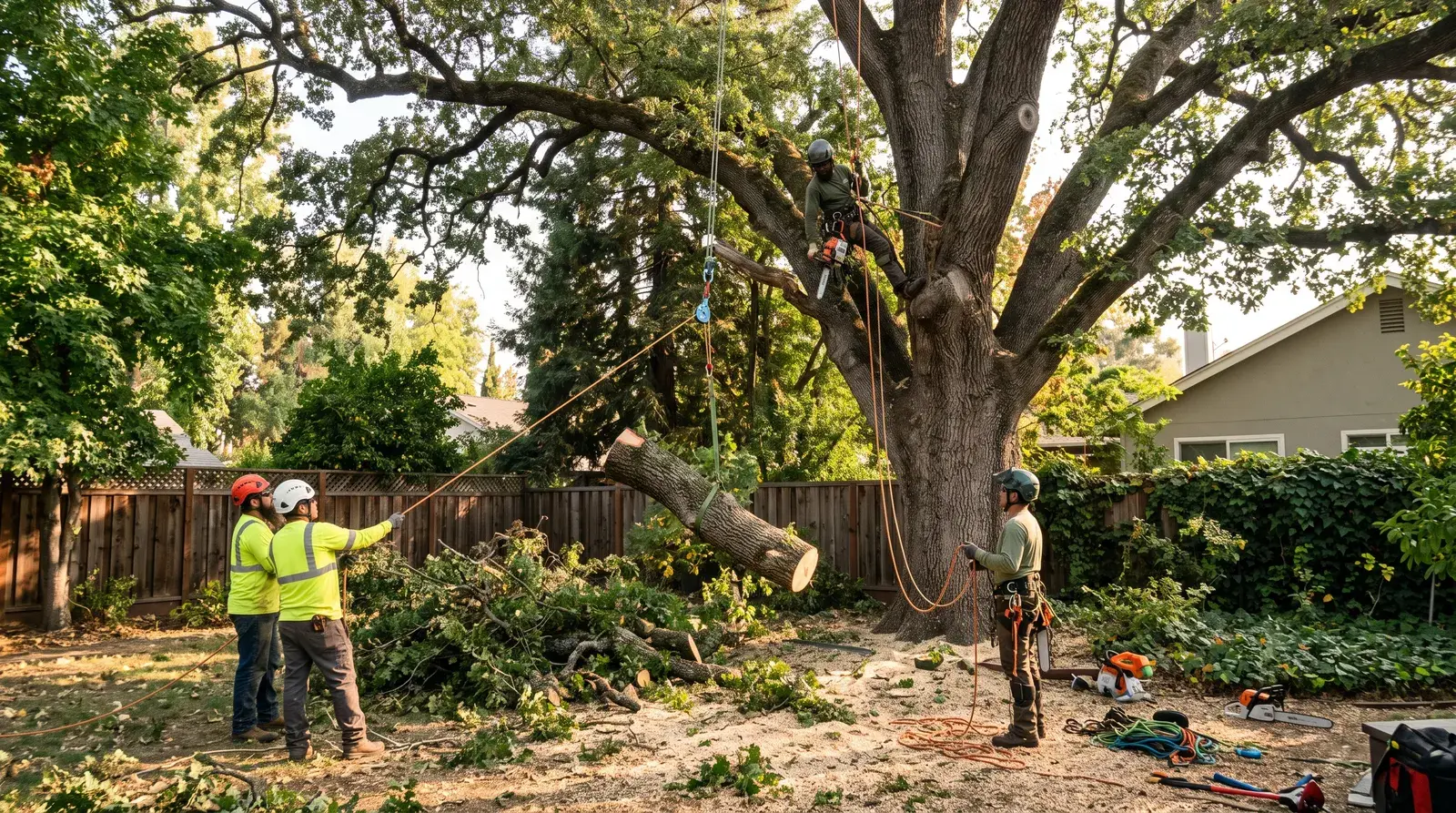
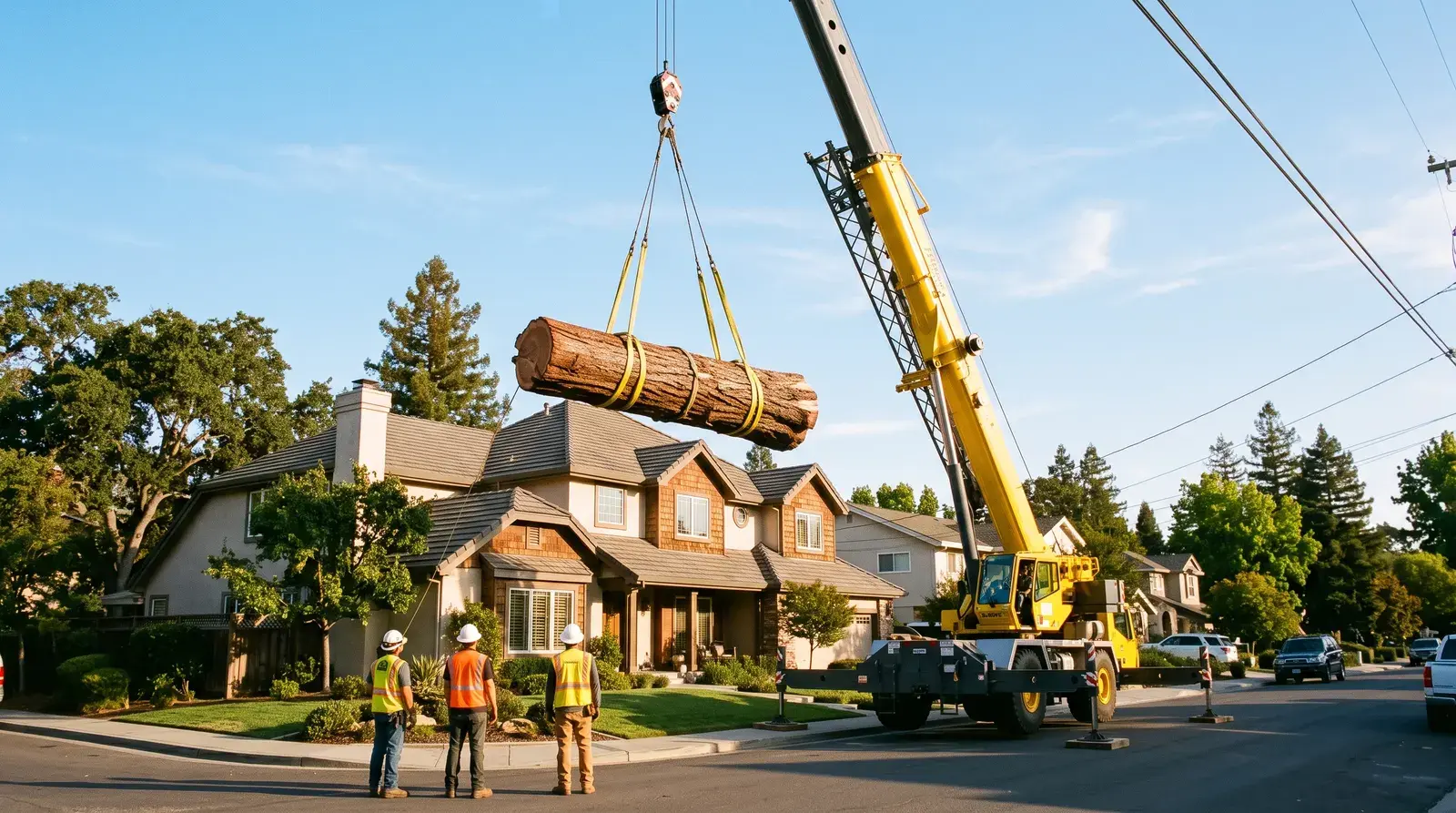
- Decay complicates the work and the cost: rotten heartwood means a tree can't always be climbed safely, pushing toward a crane or aerial lift for the upper sections.
- Access on older North Highlands lots varies — narrow side yards, overhead utility lines, and short driveways can limit equipment options and add labor.
- Targets below the canopy — rooftops, fences, vehicles, pool decks — require rigged, controlled removals rather than straight drop cuts.
- County permit costs and arborist report fees apply when a protected native oak is involved — we include those in the estimate so the full cost is visible before any paperwork starts.
- Estimates are free and written. A site visit is the only accurate basis for a quote on mature mid-century trees.
Related guides
Do You Need a Permit to Remove a Tree in Sacramento?
Which Sacramento trees need a removal permit, how city and county rules differ, and how to check before the saw comes out.
How Much Does Tree Removal Cost in Sacramento? (2026)
Typical 2026 Sacramento tree removal price ranges by tree size, the factors that move the number, and how to read a quote before you sign it.
9 Signs a Tree Needs to Come Down
Nine warning signs a tree is hazardous or dying — and when removal is safer than trying to save it.
What tree removal costs — and what North Highlands allows
Regional ranges, local permit rules, and the alternatives worth weighing before tree removal in North Highlands.
Emergency Tree Service Cost in Sacramento (2026)
Regional range $800–$8,000 — and what moves the number on a real job.
Do You Need a Permit to Remove a Tree in Sacramento?
Which Sacramento trees need a removal permit, how city and county rules differ, and how to check before the saw comes out.
Tree Pruning vs. Removal: When to Save a Tree and When to Take It Down
Pruning or Removal — how to tell which one the tree actually needs.
Tree Service in Sacramento County, CA
Tree work in Sacramento County ranges from removing aging valley oaks in East Sacramento to grinding stumps on new-buil…
Crane-Assisted Tree Removal Cost in Sacramento (2026)
Regional range $2,500–$12,000 — and what moves the number on a real job.
Do You Need a Tree Removal Permit in Elk Grove?
Where Elk Grove draws the line before a tree comes down, and who to check with.
Want a sense of the work first? See the kinds of tree removal jobs we take on and who shows up to do them.
Frequently asked questions
Who issues tree removal permits in North Highlands — Sacramento County or the City of Sacramento?
Sacramento County. North Highlands is unincorporated — there is no city government, and the City of Sacramento's tree ordinance does not apply here. Sacramento County's native oak ordinance covers valley oaks, interior live oaks, and blue oaks on private property in the unincorporated area, and the county's planning and code departments handle permit applications. If you're not sure whether your property is in the city or the county, Sacramento County's parcel lookup tool will tell you. We check jurisdiction at every estimate and make sure you're pointed at the right process.
How much does tree removal cost in North Highlands?
As a broad regional range, most residential removals run $500–$2,500. North Highlands trees skew older and larger than newer subdivision trees — mature Modesto ash, Chinese elm, and valley oaks produce jobs in the middle-to-upper end of that range, and large oaks over structures or decayed trees requiring crane work can exceed $5,000. Protected native oaks may also carry county permit and arborist report costs. Every estimate is free and based on a site visit, not a phone estimate or photo.
My old Modesto ash is losing its top and dropping limbs. What are the options?
Assess it first. Some Modesto ash with sound structure from the branch collar down can be maintained safely with deadwood removal and crown reduction for several more years. More often, trees showing crown dieback from the top and internal decay are past the point where pruning extends their safe life — the decay continues inward regardless of what's removed from outside. A tree health assessment gives you an honest answer about which situation you're in. Standing dead or near-dead ash drops limbs without warning, so this one shouldn't wait for the next storm season to schedule.
There's a street tree in front of my house that's dead and I'm worried about it. Who do I call?
Sacramento County. Street trees in the right-of-way — the planting strip between your sidewalk and the curb — belong to the county, not to you, even though you may maintain the strip. Removing a county street tree without authorization is a code issue regardless of its condition. The right move for a dead or hazardous street tree is reporting it to Sacramento County's transportation or parks department with photos documenting the condition. We can help document the tree's condition to support that request, but the removal authorization has to come from the county for trees in their right-of-way.
My tree is near Dry Creek. Does that affect the removal process?
It can. Riparian trees — willows, cottonwoods, California sycamores — growing along Dry Creek or its drainage tributaries may be subject to creek-adjacent review under Sacramento County and state waterway guidelines, separate from the native oak ordinance. The relevant question is whether the tree is within the riparian setback or its roots extend into a regulated drainage area. We identify creek-adjacent situations at the estimate and flag when additional county coordination belongs in the process before any cutting is scheduled.