
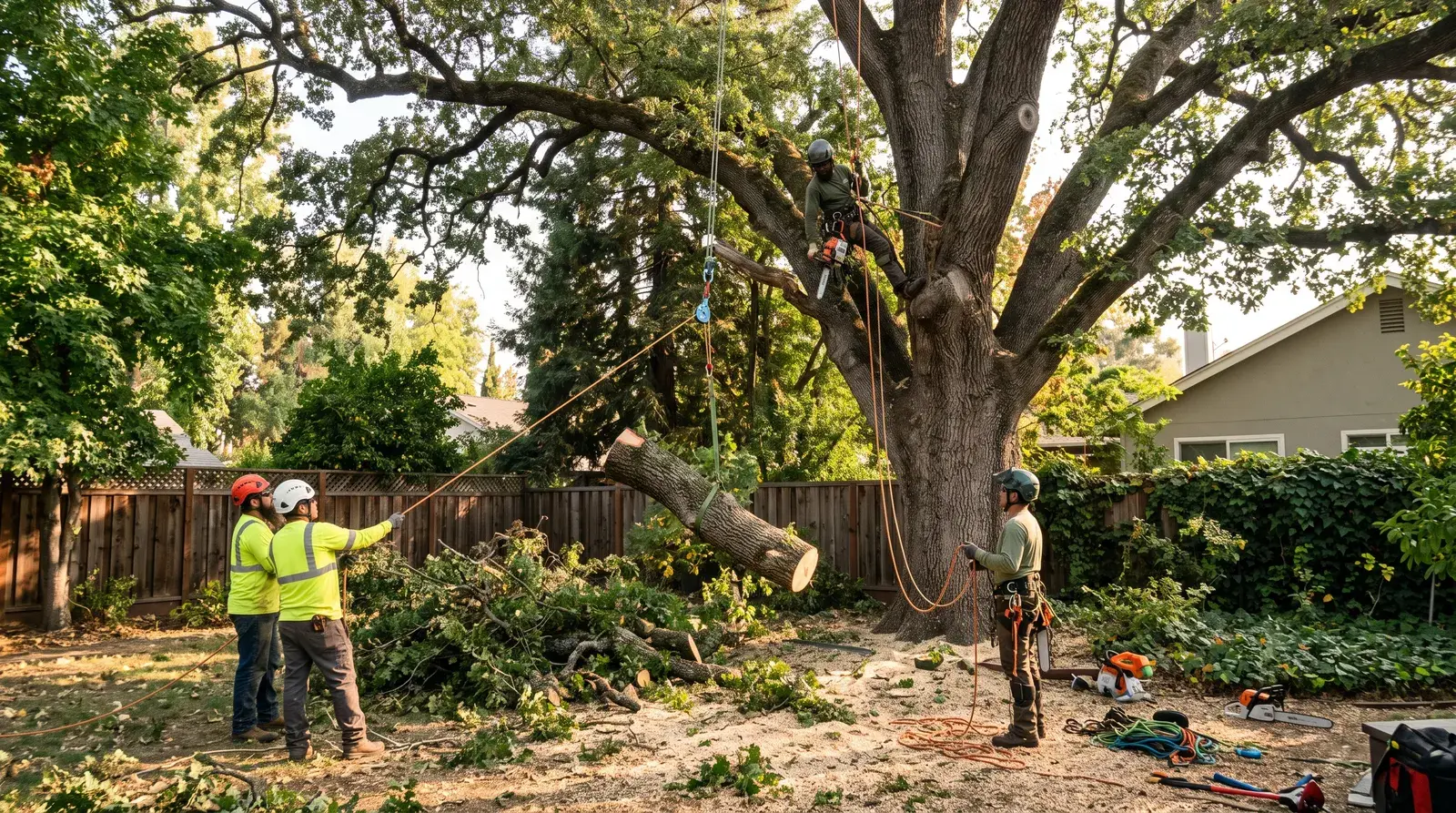
Loomis Oaks: Large Lots, Open Drops, High Stakes
Loomis's rural zoning means trees here have room to grow to full size — and full-size oaks on acreage are a different category of removal than a suburban backyard tree. The interior live oaks and blue oaks across Horseshoe Bar Road, King Road, and Barton Road regularly top 50–70 feet with canopy spreads that cover barns, arenas, fencing, and buried irrigation.
- Interior live oak is the dominant canopy species in the Loomis Basin — evergreen, dense, and long-lived; mature specimens carry enormous limb loads that fail when trees are stressed or pruned incorrectly.
- Blue oak grows on the drier ground at the edges of parcels and along fence lines; slower-growing, dryland-adapted, and worth preserving whenever it's structurally sound.
- Valley oak shows up on the richer, deeper soils near seasonal drainages — the most protected species under the Town of Loomis ordinance and the least common of the three.
- Open pasture drops are the Loomis upside: unlike a tight suburban yard, a tree with clear surroundings can often be directionally felled without rigging — faster and less expensive than a piece-by-piece takedown.
- The downside is access infrastructure: long private driveways, gates, wells, and buried equestrian water lines create routing and equipment constraints that have to be scoped before the job starts.
- Mature oaks over barns, hay storage, or equipment sheds are the highest-stakes removals — these are major rigging jobs where every cut is planned before anything moves.
Town of Loomis Tree Ordinance: The Permit Question
Loomis is incorporated — it has its own town government, distinct from Placer County — and it protects native oaks under its own tree preservation ordinance. Any oak removal on a Loomis residential property should be checked against current town requirements before the saw comes out.
- The ordinance covers interior live oak, blue oak, and valley oak above specified trunk-diameter thresholds on private property — not just trees in the public right-of-way.
- Removal generally requires town approval; the application process for hazardous or dead trees is typically faster than routine removal, but documentation (photos, condition description, or an arborist report) supports the file.
- Non-native trees — ornamental landscape trees, old orchard plum and pear — don't fall under the oak ordinance, so legacy fruit trees can typically be removed without a permit.
- The ordinance may require replacement plantings as a condition of removal approval; budget that into the project if the tree is protected.
- Street trees and any trees in the town right-of-way belong to the town regardless of which side of the curb they sit on — those need town authorization before any work.
- We verify the ordinance question during every Loomis estimate and direct you to the town for the current application process; requirements should always be confirmed directly with the Town of Loomis.
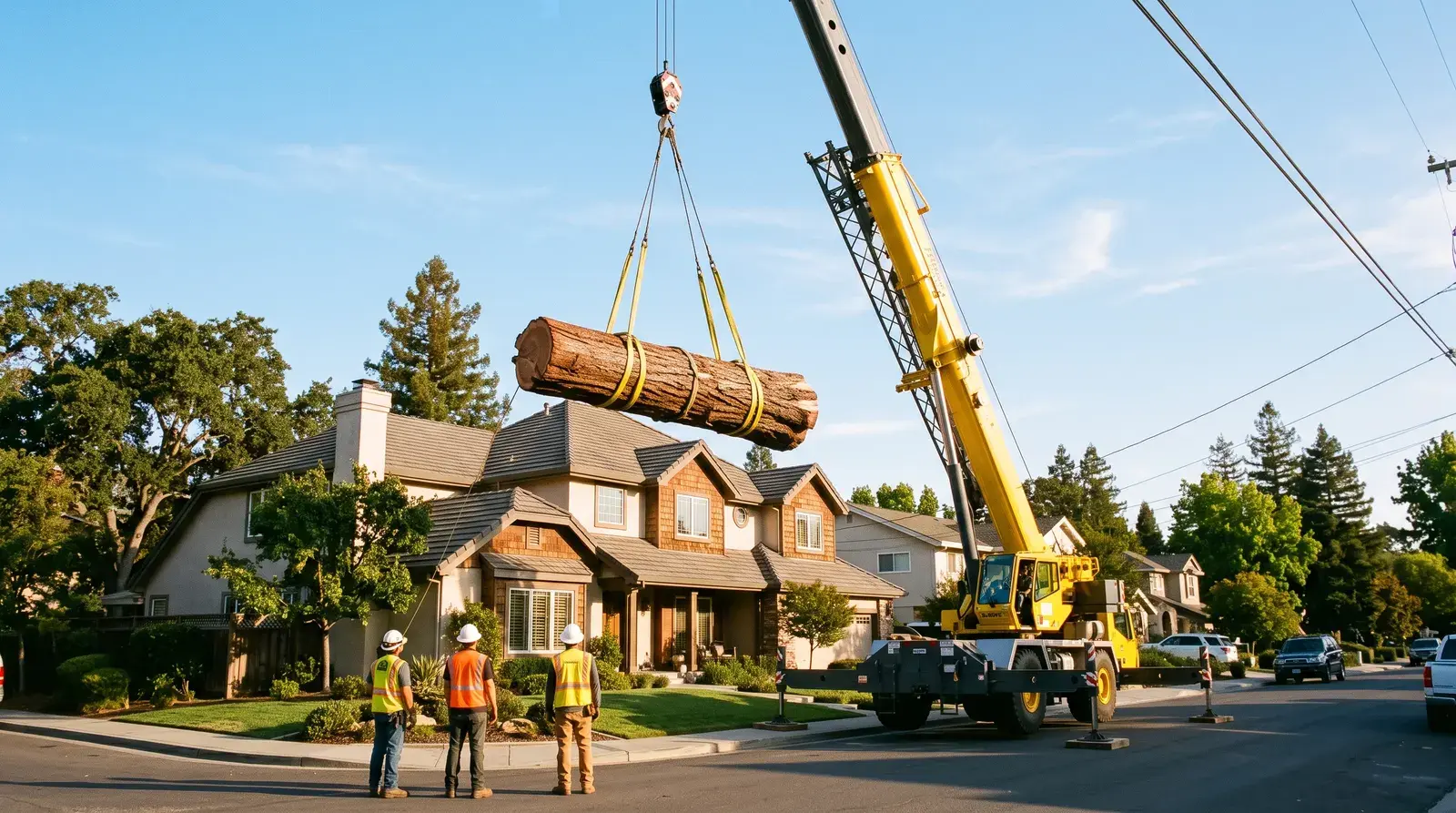
Tree Removal in Loomis — free, site-specific estimates.
Old Orchard Trees: From Fruit Rows to Liability
A century ago the Loomis Basin was orchard country. The packing sheds along Taylor Road loaded plum and pear by the railcar. Plenty of Loomis parcels still carry the remnants of that era — aging orchard rows that outlasted their productive use by decades.
Most of these trees are 60 to 80 years old, often structurally hollow, dropping large limbs, and providing little benefit beyond shade that comes with real hazard. A half-dead orchard plum leaning over a horse paddock or a fence line is a liability waiting for a wind event — and wilted stone-fruit foliage can be hazardous to horses, so leaving debris in pastures isn't an option. The decision tree is straightforward: if the trunk is sound and the structure is manageable, we prune old orchard trees hard for safety — not for fruit production. If the wood is hollow, rotten at the base, or the tree is split, removal and stump grinding is the honest answer. Old fruit-tree stumps resprout aggressively for years; grinding ends that at the source and gets the ground usable again for pasture, irrigated hay, or replanting. Because these are non-native trees, no town permit applies — the decision is yours, and we'll give you a straight read on each tree during the estimate.
Need tree removal in Loomis?
Share the address and project details — we'll come back with a scoped, site-specific estimate.
Working Around Horses, Fences, and Pasture
A significant share of tree work in Loomis is on horse properties, and that means planning the job around animal safety, fence integrity, and the pasture itself — not treating those as afterthoughts.
- Animals are moved or securely stalled before any felling, chipping, or heavy equipment operation — horse behavior around chainsaws and falling wood is unpredictable.
- Fence lines are protected during drops: limbs are rigged or cut to fall clear of rails, posts, and wire rather than across them, which turns a tree removal into a fence repair on top.
- Equipment stays off soft or irrigated pasture when soil conditions would cause ruts — we use ground protection when tracks need to cross lawn or irrigated areas.
- Oak leaves and wilted stone-fruit foliage can be hazardous to horses and some other livestock; debris is chipped or hauled promptly rather than left in piles near paddocks.
- Long debris hauls on gravel or dirt drives are factored into the quote — what's a 10-minute chip-truck run from a suburban driveway can be a 30-minute round trip from the back of a Horseshoe Bar Road parcel.
- Tell us about animals, pasture conditions, and any buried infrastructure (well heads, septic risers, irrigation manifolds) when you schedule the estimate — the more we know in advance, the cleaner the job plan.
The same crew from estimate to cleanup.
No juggling separate contractors for one tree. Tell us the address and what you're dealing with, and we'll come back with a written, site-specific number.
- Removal, trimming, stumps, and cleanup handled by one crew
- Free, site-specific estimates — priced to your tree, not a flat rate
- Sacramento, Placer, El Dorado, and Yolo counties

What Tree Removal Costs in Loomis
Most residential removals across the Sacramento region run $500–$2,500 as a broad range. Loomis jobs skew toward the middle and upper end of that range because the trees are generally larger — Loomis Basin oaks are mature specimens, not 15-year-old subdivision trees. Large oak removals over structures can exceed $5,000–$10,000+.
- Size is the primary driver: a 60-foot interior live oak carries many times the wood volume of a standard residential tree, and the cutting, rigging, chipping, and hauling scale with it.
- Access works both ways on rural lots: open pasture with room to fell directionally can keep a big-tree job cheaper than expected; a tight backyard situation in a suburban property. Loomis's rural lots often provide the drop room that suburban jobs lack.
- Structures and targets beneath the canopy — barn roofs, arena fencing, stored equipment, propane tanks — force slow, rigged, piece-by-piece takedowns that add labor hours.
- Debris haul-off distance matters on long rural drives; alternatively, we buck firewood rounds and leave them stacked, which is often a no-cost option and a popular choice on wood-burning Loomis properties.
- Town permit costs (application fees, any required arborist report, replacement trees) apply to protected native oaks — we flag these at the estimate, not after the fact.
- Every estimate is free, site-specific, and based on an in-person visit, not a photo.
Related guides
Do You Need a Permit to Remove a Tree in Sacramento?
Which Sacramento trees need a removal permit, how city and county rules differ, and how to check before the saw comes out.
How Much Does Tree Removal Cost in Sacramento? (2026)
Typical 2026 Sacramento tree removal price ranges by tree size, the factors that move the number, and how to read a quote before you sign it.
9 Signs a Tree Needs to Come Down
Nine warning signs a tree is hazardous or dying — and when removal is safer than trying to save it.
What tree removal costs — and what Loomis allows
Regional ranges, local permit rules, and the alternatives worth weighing before tree removal in Loomis.
Emergency Tree Service Cost in Sacramento (2026)
Regional range $800–$8,000 — and what moves the number on a real job.
Do You Need a Tree Removal Permit in Citrus Heights?
Where Citrus Heights draws the line before a tree comes down, and who to check with.
Tree Pruning vs. Removal: When to Save a Tree and When to Take It Down
Pruning or Removal — how to tell which one the tree actually needs.
Tree Service in Placer County, CA
Placer County spans flat valley suburbia in Roseville and Rocklin and rises through the oak-woodland foothills to ponde…
Crane-Assisted Tree Removal Cost in Sacramento (2026)
Regional range $2,500–$12,000 — and what moves the number on a real job.
Do You Need a Tree Removal Permit in Rancho Cordova?
Where Rancho Cordova draws the line before a tree comes down, and who to check with.
Want a sense of the work first? See the kinds of tree removal jobs we take on and who shows up to do them.
Frequently asked questions
Do I need a permit to remove an oak tree in Loomis?
Yes, in most cases. The Town of Loomis is an incorporated municipality with its own tree preservation ordinance protecting native oaks — interior live oak, blue oak, and valley oak — above certain size thresholds on private property. Even hazardous or dead oaks typically go through a documentation process before removal, though that path is generally faster with photos and a condition report. Non-native trees including old orchard plum and pear don't require a permit. We identify and measure the tree during the free estimate and tell you whether it triggers the ordinance. Always confirm current requirements directly with the Town of Loomis, as thresholds and procedures can change.
How much does tree removal cost in Loomis?
Most residential removals fall in the $500–$2,500 range as a broad regional figure. Loomis tends toward the higher end because the dominant oaks are mature, full-canopy trees — not the young subdivision-era trees common in West Roseville or Rocklin. Large interior live oaks over barns, arenas, or equipment come in as multi-thousand-dollar jobs, and crane-assisted work can exceed $5,000–$10,000+. Rural factors that affect pricing include driveway length, whether a directional fell is possible, livestock logistics, and debris haul distance. Every estimate is free and based on a site visit.
Can you remove old orchard trees on my Loomis property?
Yes, and it doesn't require a town permit because orchard plum and pear are non-native trees not covered by the oak ordinance. Most legacy orchard trees on Loomis Basin parcels are 60 to 80 years old, often hollow or splitting, and present a real limb-drop hazard near paddocks and livestock areas. We assess each tree and give you a straight answer: some are worth pruning for safety, most at that age are removal candidates. Stump grinding is almost always worth adding — old stone-fruit stumps resprout aggressively for years, and grinding gets the ground back to usable pasture.
Can you work on a horse property or around livestock?
A large portion of our Loomis work is on equestrian properties, and the plan reflects that from the start. Animals are moved or stalled before any cutting or chipping starts, fence lines are protected during drops, and debris — particularly oak leaves and stone-fruit foliage — is chipped or hauled rather than left in pastures where animals can get into it. Equipment stays off wet or irrigated pasture when conditions warrant. When you schedule, mention what animals are on the property, where the well head and septic are, and any buried irrigation lines we should know about.
When should I have my Loomis oaks trimmed or assessed?
Native oak pruning is best done in the dry season or winter dormancy — late summer through early winter. Wet-season pruning cuts on live oak and blue oak invite disease, and heavy live-canopy removal on a heat-stressed oak in July adds stress the tree doesn't need. For hazard assessment — a leaning tree, storm damage, visible decay or root plate movement — any time of year is the right time; don't wait for a calendar window if the tree poses an active risk. A professional assessment gives you an honest read on whether the tree needs trimming, cabling, or removal before you spend money on the wrong option.