
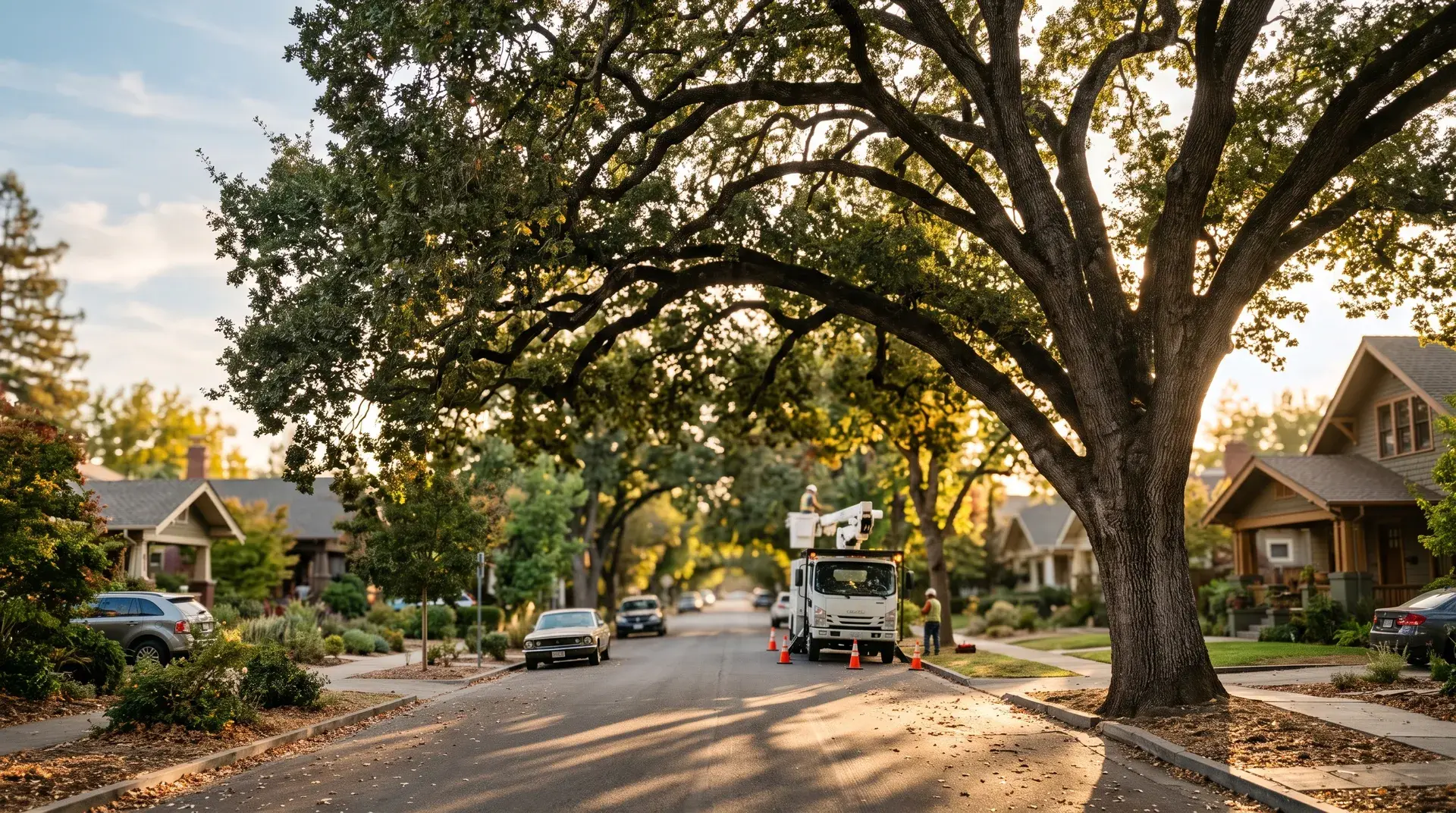
Historic Folsom vs. the Master-Planned Oak Neighborhoods
Folsom runs from a Gold Rush railroad town to some of the region's most carefully oak-planned subdivisions, and the tree work changes with it.
In the master-planned neighborhoods especially, the protected oak is often within feet of the structure — which makes both the permit and the rigging part of the job, not an afterthought.
| Area | Character | Typical trees | What they need |
|---|---|---|---|
| Historic Folsom / Sutter Street | Older core | Mature shade and ornamental trees around the old town | Maintenance pruning, deadwood, storm cleanup |
| Empire Ranch, Broadstone, American River Canyon | 1990s–2000s master-planned | Preserved native live oaks tight against homes, pools, fences | Compliant pruning, wind-sail reduction, permit-guided removals |
| Folsom Ranch (south of Hwy 50) | 2010s–present | Young planted trees, some preserved oak | Early structural pruning |
Folsom's Oak Ordinance Is the Real Deal
Folsom takes its native oaks seriously, and the ordinance has teeth. On protected-oak work, the paperwork is genuinely half the job.
- The city's tree preservation ordinance protects interior live oak, blue oak, valley oak, and other natives above set size thresholds; removal generally requires a city permit.
- Approved removals often come with replacement planting or an in-lieu fee — costs the city sets, not the tree service.
- Dead or hazardous trees follow a separate, documented path.
- HOAs in the master-planned neighborhoods frequently add their own review on top of the city's. Confirm current rules with the City of Folsom Community Development Department before removal.
Wind Off the Lake and Up the Canyon
Folsom's wind is its own hazard. Afternoon breezes off Folsom Lake and winter storms funneling up the American River canyon load up oak canopies and gray pines, and an unthinned tree carries heavy, over-extended limbs straight into a saturated-soil failure. American River Canyon and Briggs Ranch see this every season. Interior live oaks add a second problem — sudden summer limb drop in extreme heat, on limbs that looked fine. Selective thinning and crown reduction every few years cuts the wind-sail dramatically, and it's a fraction of the cost of a limb through the roof.
Need a Folsom tree estimate?
Share the Folsom address and what you need done — we'll come back with a scoped, site-specific number.
Granite Ground Changes Stump and Root Work
Folsom sits at the valley-to-foothill edge, and the soil shows it: granite and rocky ground are common, especially the closer you get to the lake and the canyon. That matters for the parts of the job that happen below grade. Stump grinding in rocky, granitic soil is slower and harder on equipment than grinding a stump in valley loam, and root work near foundations runs into rock as often as roots. We factor the ground conditions into the estimate rather than discovering them halfway through — another reason Folsom jobs get quoted from a site visit, never a photo.
The same crew from estimate to cleanup.
No juggling separate contractors for one tree. Tell us the address and what you're dealing with, and we'll come back with a written, site-specific number.
- Removal, trimming, stumps, and cleanup handled by one crew
- Free, site-specific estimates — priced to your tree, not a flat rate
- Sacramento, Placer, El Dorado, and Yolo counties

Timing in Folsom
- Native oaks: dry season or winter dormancy; light hands in summer, since heat-stressed oaks respond poorly to heavy warm-season cuts and wet-weather pruning raises disease risk.
- Most live oaks and valley oaks here do well with deadwooding plus selective thinning every 3–5 years.
- Do the thinning before winter storm season so the canopy sheds wind instead of catching it.
- Near Folsom Lake open space, keep it framed as fuel reduction and defensible space — never as making anything fireproof.