
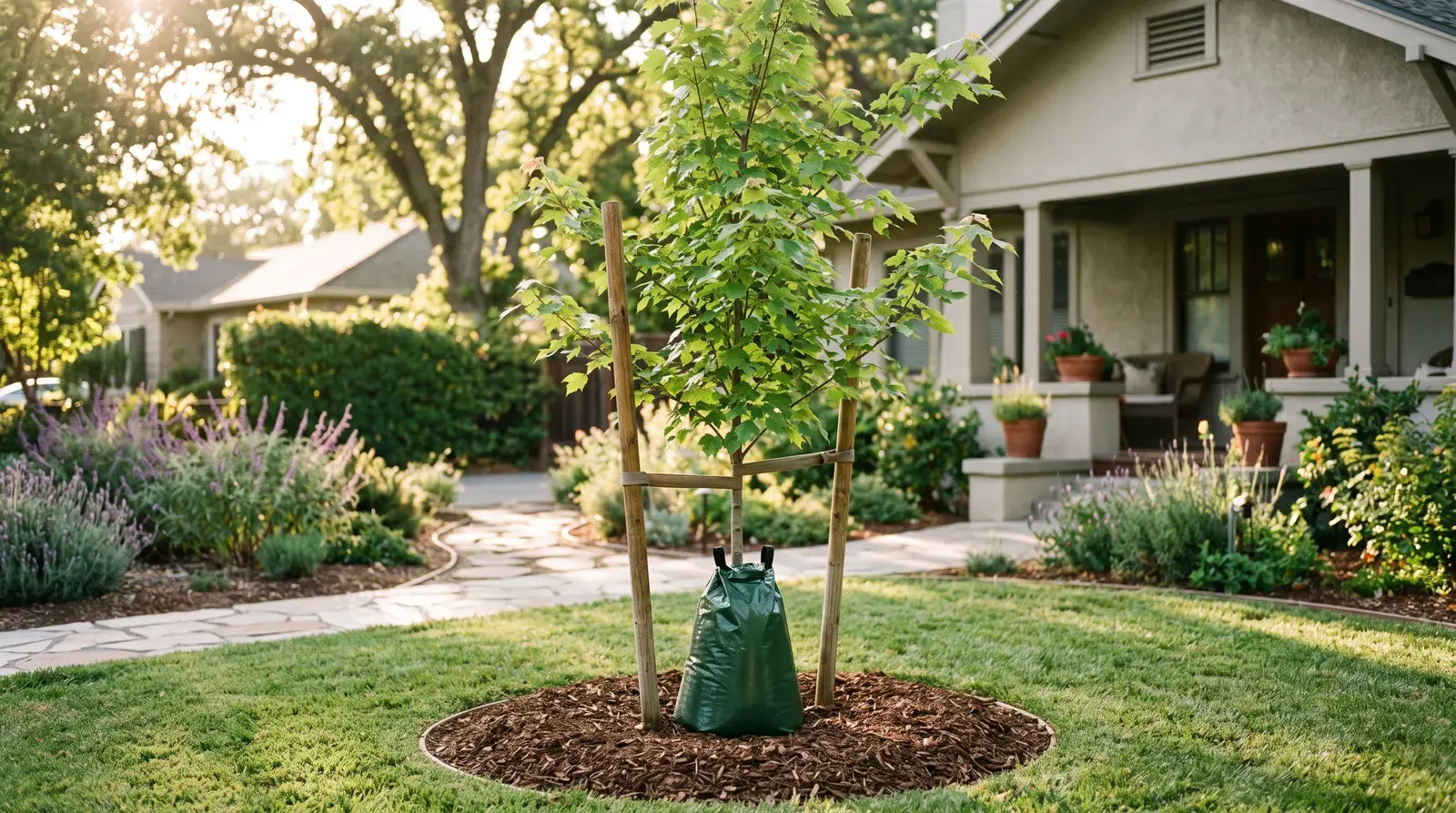
Right Tree, Right Place
Most tree problems we get paid to fix twenty years later — lifted sidewalks, limbs on rooflines, trees topped under power lines — were planting decisions. Choosing the right species for the actual space costs nothing extra now and saves thousands later.
- Mature size first — a valley oak wants 60+ feet of spread; putting one 8 feet off a patio guarantees future conflict
- Overhead lines — only small-stature trees belong under distribution lines; utilities prune anything that grows into them
- Root space — vigorous rooters near sidewalks, driveways, pools, and sewer laterals become root-management problems
- Water needs — match the tree to the irrigation you'll actually provide, not the irrigation you intend to
- Purpose — west-side afternoon shade, screening, fall color, and street presence each point to different species
Species That Work in the Sacramento Valley
Sacramento is USDA zone 9b with brutal dry summers, mild wet winters, and heavy clay soil across much of the region. The trees that thrive here are the ones built for exactly that — and several popular nursery trees are not.
The 'City of Trees' canopy in East Sac, Land Park, and Curtis Park is mostly a hundred-year-old bet on planes, oaks, and elms. Some of those bets aged well, some didn't — the replacement generation being planted now leans on pistache, zelkova, and natives for a reason.
- Native oaks — valley oak, interior live oak, blue oak in the foothills: the gold standard for longevity and low summer water once established
- Chinese pistache — tough, heat-proof, reliable fall color, well-behaved size; a workhorse Sacramento street tree
- Crape myrtle — small-stature summer bloom, fine under lines and in tight yards
- Zelkova and Chinese hackberry — vase-shaped canopy trees that tolerate heat and urban soil
- Desert willow and western redbud — low-water natives and near-natives for small spaces
- Think twice — coast redwood (browns out in Valley heat without heavy water), European birch (short-lived here), Modesto ash (mistletoe and anthracnose magnet), fruitless mulberry (aggressive roots)
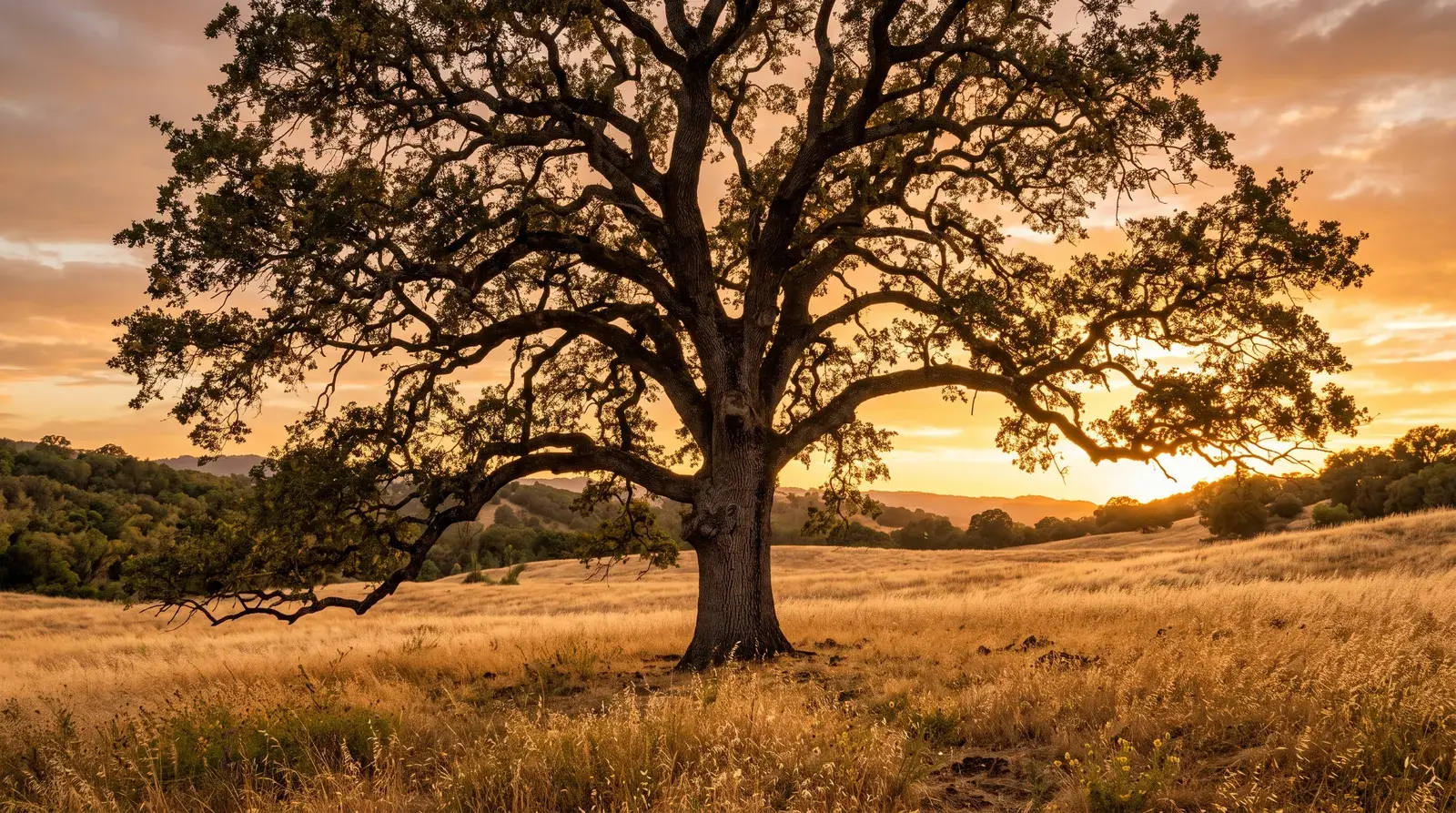
Tree Planting & Replacement across Sacramento, Placer, El Dorado, and Yolo counties.
Why Shade Trees Pay for Themselves Here
In a climate with weeks above 95 degrees, a mature shade tree on the west side of a house does real mechanical work — shading walls and windows during peak afternoon load. That's why Sacramento's utility literally gives shade trees away.
Sacramento Shade is a genuinely good resource and we point homeowners to it. Where we come in: larger box stock, species outside the program list, tight or difficult sites, permit-required replacements, and jobs where the planting needs to be done right the first time by a crew.
- Cooling — well-placed shade trees measurably cut summer air-conditioning demand; west and southwest placement matters most
- SMUD Sacramento Shade — free shade trees for SMUD customers via the Sacramento Tree Foundation, with placement guidance; check sactree.org or SMUD's site
- Property value — mature canopy is a consistent price premium in Sacramento neighborhoods
- Surface temps — shaded pavement and roofs run dramatically cooler, easing the urban heat island block by block
Replacement Planting After a Removal
Removal permits for protected trees commonly carry replacement conditions — plant a specified number of trees, of a minimum size, sometimes from an approved species list, within a set window. Meeting the condition properly is part of finishing the removal, not an afterthought.
When we pull a permit-required removal, we flag the replacement condition up front and can price the replacement planting into the same job — including grinding the old stump low enough, or siting the new tree far enough away, that old roots don't fight the new tree.
- City of Sacramento — Heritage Tree and City Tree permits under City Code Chapter 12.56 frequently include replacement or in-lieu requirements
- Sacramento County — the native oak ordinance ties removals to mitigation planting or payment in unincorporated areas
- Ratios vary — some jurisdictions require multiple replacements per tree removed, scaled to the size of what came down
- Species and size — approved lists and minimum container sizes are common; a one-gallon whip usually doesn't satisfy the condition
- Documentation — planting within the deadline, sometimes with proof, closes out the permit
Need tree planting & replacement on your property?
Share the address and project details — we'll come back with a scoped, site-specific estimate.
How We Plant
Most planting failures in Sacramento clay trace to three mistakes: dug too deep, watered too shallow, and staked forever. Proper planting is unglamorous and it's most of what determines whether the tree is thriving or dead at year three.
- Wide, shallow hole — two to three times the root ball width, no deeper than the root ball; the root flare finishes at or slightly above grade
- Native backfill — clay soil gets loosened native soil back, not a bathtub of amendment that roots never leave
- Circling roots corrected — container stock gets root-pruned at planting so girdling roots don't strangle the trunk later
- Mulch, not turf — 3–4 inches of chips out to the drip line, kept off the trunk; no lawn against a young tree
- Minimal staking — loose stakes only if the tree can't stand alone, removed within a year so the trunk builds its own strength
- Deep, infrequent water — a slow soak on a widening basin, not daily sprinkler mist; critical through the first two Sacramento summers
The same crew from estimate to cleanup.
No juggling separate contractors for one tree. Tell us the address and what you're dealing with, and we'll come back with a written, site-specific number.
- Removal, trimming, stumps, and cleanup handled by one crew
- Free, site-specific estimates — priced to your tree, not a flat rate
- Sacramento, Placer, El Dorado, and Yolo counties
Timing and the First Two Summers
Plant in fall, keep it watered through two summers, and stay out of its way — that's the recipe. The Sacramento planting calendar is driven entirely by our dry season: roots need to be established before the tree meets July.
We can set up young trees on a training-pruning cycle after planting — a few small cuts in the early years prevent the co-dominant stems and poor unions that turn into cabling and removal jobs decades later. Estimates for planting, replacement work, or a full replant plan are free and site-specific.
- October–January — prime window; rain does much of the irrigation work while roots establish
- February–April — good second choice; commit to consistent summer watering
- May–September — plantable with discipline, but transplant stress plus 100-degree heat is the hard way to start a tree
- Years one and two — deep weekly soaks in summer, tapering as the tree establishes; most young-tree deaths here are simple underwatering
- Year two or three — a first structural pruning pass sets up good architecture cheaply, while cuts are small
Related services
Stump Grinding & Removal
Grinding stumps below grade so you can replant, pave, or reclaim the space — chips and surface roots handled.
Tree Health Assessment
Diagnosing disease, pests, and structural risk — with an honest plan to treat, monitor, or remove.
Root Pruning & Root Barriers
Managing roots that lift sidewalks, driveways, and foundations — targeted root pruning and barrier installation done without killing the tree.
Related guides
Best Shade Trees for Sacramento Yards
The shade trees that actually thrive in Sacramento heat and clay soil — valley oak, Chinese pistache, zelkova, and more — plus spacing rules and species to skip near homes.
Keeping Trees Alive Through Sacramento Summers
Deep watering at the dripline, real mulch, and the heat-stress signs that matter — how Sacramento trees survive months of triple-digit heat.
Do You Need a Permit to Remove a Tree in Sacramento?
Which Sacramento trees need a removal permit, how city and county rules differ, and how to check before the saw comes out.
Before you book tree planting & replacement
What it runs, where permits bite, and how tree planting & replacement stacks up against the alternatives.
Stump Grinding Cost Guide (2026)
What stump grinding costs in the Sacramento region in 2026 — pricing by diameter, what a standard grind includes, and where the extra charges come from.
Tree Removal vs. Transplanting: Can You Move a Tree Instead?
Removal or Transplanting — how to tell which one the tree actually needs.
Want to see what this looks like on a real property? Browse the tree planting & replacement jobs we take on, or read how our crew scopes and prices work before you call anyone out.
Frequently asked questions
What are the best trees to plant in Sacramento?
For big long-term shade: valley oak and interior live oak — natives built for dry summers and clay soil. For medium yards: Chinese pistache, crape myrtle, zelkova, and desert willow handle heat with modest water. London planes deliver classic canopy but drop anthracnose-damaged leaves and demand room. Skip coast redwoods and birches unless you'll irrigate them forever — both struggle in Valley heat. The honest answer is site-specific: soil, space, sun, and what's overhead decide it.
When is the best time to plant a tree in Sacramento?
Fall through early winter — roughly October to January. The tree roots into moist, still-warm soil through the rainy season and arrives at its first Sacramento summer established instead of shocked. Late winter works too. Spring plantings survive with attentive watering, but a tree planted in May faces 100-degree heat within weeks of transplant. If you can wait for fall, wait.
Do I have to plant a replacement tree after a removal?
Often, yes. Permits to remove protected trees — Heritage Trees in the City of Sacramento, native oaks in unincorporated Sacramento County, protected species in surrounding cities — commonly come with replacement conditions: a set number of trees, a minimum size, sometimes a specific species list, planted within a deadline. We track the condition on permits for removals we perform and handle the replacement planting so you close out the permit cleanly.
Are there free shade trees in Sacramento?
Yes. SMUD's Sacramento Shade program, run with the Sacramento Tree Foundation, provides free shade trees to SMUD customers, with guidance on placement for maximum cooling benefit. It's one of the longest-running utility shade programs in the country and worth checking before you buy trees for an open, sunny yard. Where you want larger stock, specific species, difficult sites, or professional planting, that's where a paid planting service comes in — the two aren't mutually exclusive.
How far from my house should I plant a shade tree?
For a large canopy tree like a valley oak or plane tree, roughly 15 to 20 feet or more from the foundation; medium trees, 10 to 15 feet. Planting for afternoon shade means placing trees to the west and southwest of the house. Also check what's above and below: no large species under power lines — utilities prune anything that grows into distribution lines — and keep vigorous rooters away from sewer laterals, pools, and sidewalks.