
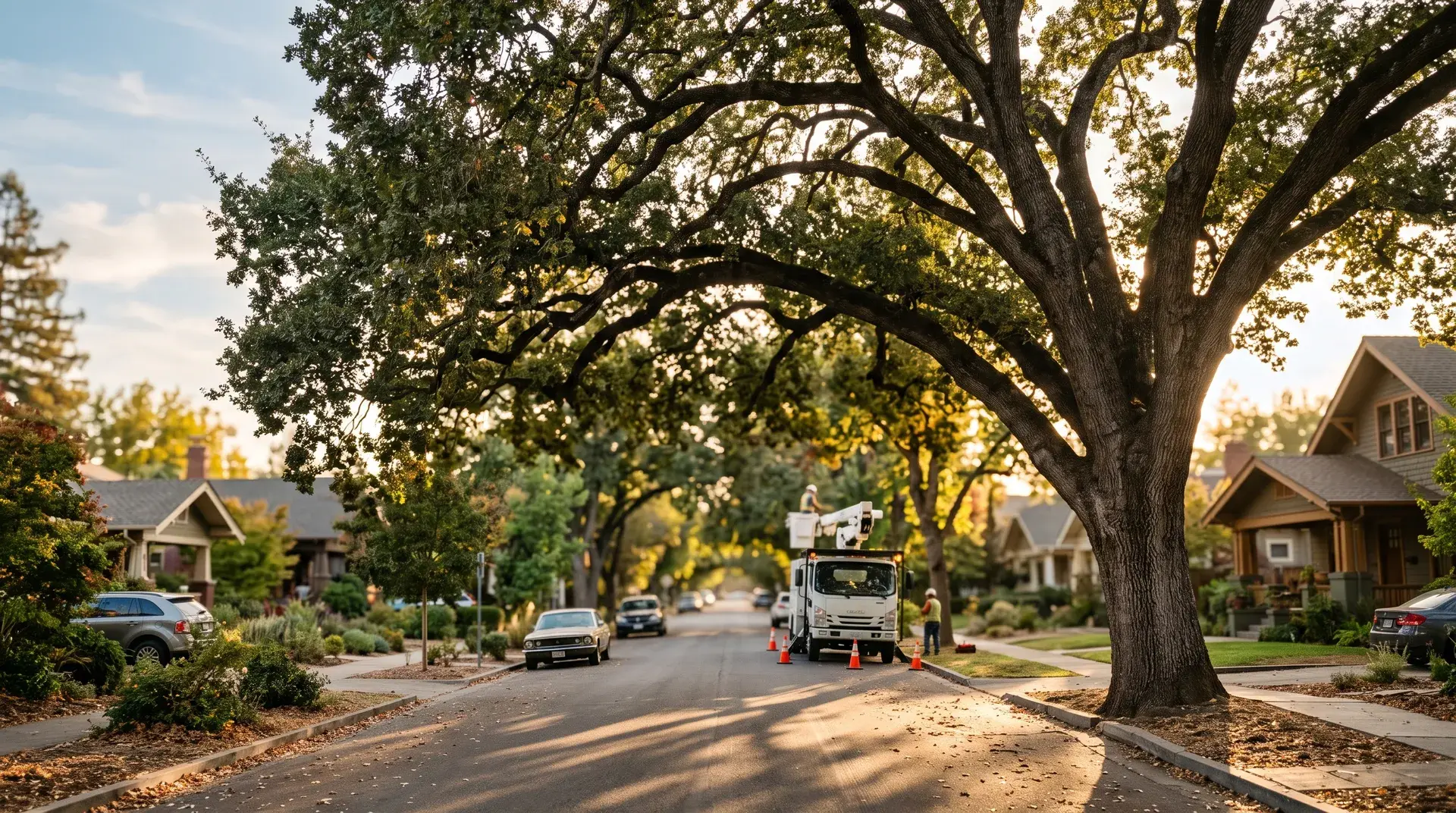
What Kind of Tree Work Is Normal in Shingle Springs?
Parcel-scale work. Shingle Springs is a foothill community of larger lots along Highway 50, so the job is rarely one tree. It is a dead pine here, a fence-line oak there, and a driveway the fire engine has to be able to use.
The estimate starts with walking the property line, not standing in a front yard.
- Blue oak and black oak on open ground, gray pine on dry slopes, ponderosa creeping in toward the higher parcels.
- House-side work: oak trimming, hazard removals over shops and driveways, and stump grinding.
- Parcel-wide work: brush clearing, lot clearing for pads, barns and arenas, and defensible space across the whole property.
- Storm response: see emergency tree service in Shingle Springs.
Who Governs Tree Removal in Shingle Springs?
Shingle Springs is unincorporated, so El Dorado County rules apply, not a city ordinance. The county oak ordinance covers native oaks on private land below 4,000 feet, and Shingle Springs sits well under that line at roughly 1,400 feet.
Removing oaks without a permit when one is required can bring fines the county sets at up to three times replacement value for individual oaks and up to nine times for heritage trees. Ask before the first cut. Older county FAQs described a small-parcel exemption, but the county amended the ordinance in July 2025, so don't assume any lot is exempt. Our El Dorado County oak permit guide walks through the current rules.
| Situation | What the county says | Next step |
|---|---|---|
| Trimming a native oak | Allowed without a permit if the cuts do not destroy the tree | Oak tree care |
| Dead, dying or diseased oak | Exempt from mitigation with written documentation from a qualifying arborist or forester, including a reason other fixes will not work | County oak permit guide |
| Oaks cleared for a home, barn or pad | A removal permit and mitigation unless an exemption applies | El Dorado County Planning, (530) 621-5355 |
| Heritage oak (36 inches or wider) or valley oak | Not exempt, with or without a development permit | County oak permit guide |
| Fire-safe work under an approved Fire Safe Plan | Listed as an exemption for existing structures | Defensible space |
Which Trees Cause the Problems Out Here?
Dead pines, mostly. Drought and bark beetles take gray pine and ponderosa first, and a dead pine over a fence, driveway or roofline is the call that cannot wait for next month.
Dead trees are also the clean case under the county oak ordinance, but only with the right paperwork. The county's FAQ says a dead, dying or diseased oak is exempt from mitigation when it is documented in writing by a qualifying arborist or Registered Professional Forester before removal, and a diseased tree needs a real reason pruning or treatment will not work. Pines are not oaks, so the oak ordinance does not govern them, but we still look at what else stands near them.
- Gray pine and ponderosa: brittle once dead, and a hazard to power lines, fences and access roads. The bark beetle pine mortality guide shows the signs to look for.
- Black oak: large deadwood and mistletoe-heavy limbs that drop in wind.
- Blue oak: tough, but still worth dry-season deadwooding near buildings.
- Trees near utility lines: leave those to the right people. Read the PG&E and SMUD line clearance guide before you pick up a saw.
Need a Shingle Springs tree estimate?
Share the Shingle Springs address and what you need done — we'll come back with a scoped, site-specific number.
How Do You Get a Large Parcel Ready for Fire Season?
Work from the structures outward: PRC 4291 Zone 0 within 5 feet, Zone 1 to 30 feet, Zone 2 to 100 feet, then driveway and access clearance. On acreage that is a phased job, not a weekend.
This is fuel reduction and defensible space prep, not a guarantee against fire. The foothill ember guide explains why ember exposure drives most losses. Current standards are posted at readyforwildfire.org, and CAL FIRE publishes the hazard severity zone maps.
- Zone 0: keep the first 5 feet around structures free of combustible material.
- Zone 1: lean, clean and green, with limbs off the roof.
- Zone 2: reduced fuel, dead trees out, ladder fuels cut so ground fire cannot climb.
- Access: engines need overhead and side clearance on the driveway.
The same crew from estimate to cleanup.
No juggling separate contractors for one tree. Tell us the address and what you're dealing with, and we'll come back with a written, site-specific number.
- Removal, trimming, stumps, and cleanup handled by one crew
- Free, site-specific estimates — priced to your tree, not a flat rate
- Sacramento, Placer, El Dorado, and Yolo counties

What Does a Shingle Springs Estimate Include?
A free, written, site-specific quote after a property walk. You get the tree list, what the county or your insurer may care about, and whether the work should be phased across seasons.
As a broad regional range, most Sacramento-area removals run $500 to $2,500, and large or crane-assisted jobs run more. Open drop zones can help on acreage; steep or remote ground pushes the other way. For a single tree see tree removal in Shingle Springs. Call (916) 888-8347 or use the estimate form.