
Tree Service in Sacramento, CA

Tree removal, trimming, pruning, stump grinding, and emergency response for Sacramento and the surrounding Sacramento County. Free, site-specific estimates.

Tree service in Sacramento, Sacramento County — 916 Trees

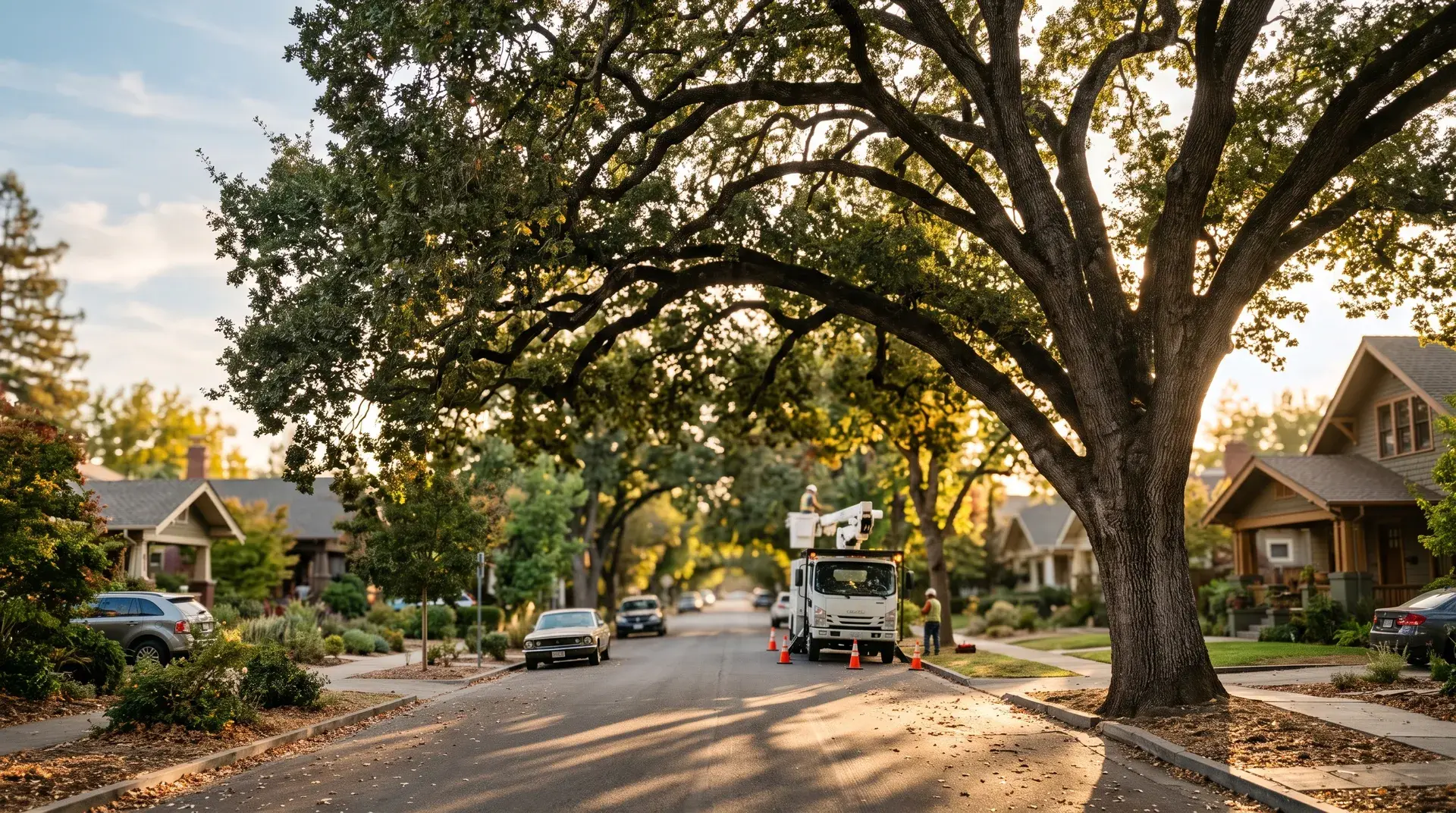
Sacramento's canopy is old, dense, and regulated — three things that change how tree work gets done here. The London planes and sycamores planted along midtown's numbered streets are City Trees, meaning the city, not the homeowner, controls what happens to them. East Sacramento, Land Park, and Curtis Park carry some of the heaviest private canopy in the region: 80-year-old camphors heaving sidewalks, Modesto ash splitting at weak crotches, and valley oaks that qualify as Heritage Trees under City Code Chapter 12.56. Add the pattern that drives most of our winter calls — long dry summers that stress root systems, then saturated soil and windstorms off the Delta that push whole trees over — and it pays to work with a crew that knows which tree needs a permit, which needs a crane, and which just needs a proper prune. We handle all of it and walk you through the city process before anything protected comes down.

01

Sacramento's Canopy Changes Block to Block

There is no single "Sacramento tree job." What a property needs depends heavily on when the neighborhood was built and what got planted. The oldest neighborhoods carry the heaviest, most regulated canopy; the newest carry young trees just reaching the age where problems start. Knowing which is which before we quote is half the job.

We keep neighborhood pages for East Sacramento, Land Park, Curtis Park, Midtown, Oak Park, Pocket-Greenhaven, Natomas, and Tahoe Park with the local detail for each. The short version: an 80-year-old camphor over a Fabulous Forties bungalow and a 20-year-old ash in Natomas are different trades, and pricing one like the other is how homeowners get surprised.

How tree work varies across Sacramento neighborhoods
AreaEraCanopy characterTypical work
East Sacramento / the Fabulous FortiesPre-1940Grand old camphors, elms, and valley oaks over historic homesCareful rigging over rooflines, Heritage Tree permits, structural pruning of aging giants
Land Park1920s–40sMature elms and oaks around William Land ParkLarge-tree pruning, deadwood removal, storm cleanup
Curtis Park1905–1930Streetcar-era Craftsman lots under old sycamores and oaksTight-lot rigging, Heritage Tree checks, stump grinding
MidtownVictorian–1920sDense grid of City street trees, London planes over narrow lotsUtility-aware pruning, street-parking coordination, permit work
Oak Park1880s–1910sSacramento's oldest suburb, aging and sometimes neglected canopyHazard assessment, removal of failing old trees, restoration pruning
Pocket-Greenhaven1970s–80sRiver-bend homes with now-mature landscape treesMaturing-tree pruning, river-adjacent removals
Natomas1990s–2000sYoung subdivision trees on former floodplain, flat and wind-exposedStructural pruning of maturing trees, wind-damage work
Tahoe Park1940s–50sPost-war street trees near Sac State now reaching declineMid-century-tree management, removals and replacements
02

The Trees We Work On Most Here

Sacramento's planting history means a handful of species show up on most jobs, each with its own habits and failure modes:

  • Valley oak (Quercus lobata)the region's signature native, wide-spreading and often Heritage-protected. Slow, heavy, permit-sensitive work; adapted to dry summers, so lawn irrigation against the trunk is a common cause of decline.
  • Interior and coast live oakdense evergreen natives, also protected; prune in the dry season to avoid disease.
  • London plane and sycamorethe backbone of Midtown's street grid, mostly City Trees; prone to anthracnose and heavy limb drop.
  • Camphorbig, dense East Sac and Land Park shade trees with aggressive surface roots that lift sidewalks and foundations.
  • Modesto ashplanted everywhere mid-century, now aging out; classic weak crotch splits, especially in wind.
  • Liquidambar (sweetgum)aggressive shallow roots that heave sidewalks and drop spiky gumballs.
  • Crape myrtle and fruitless mulberrysmaller ornamentals; mulberries are the ones people 'top,' which is a mistake we correct with proper crown reduction.
03

Permits, City Trees, and Heritage Trees

In much of Sacramento, the permit question comes before the price question. Getting it wrong on a protected tree can mean fines that dwarf the cost of the removal.

We check the ordinance picture as part of every estimate. If a company bidding your big backyard oak shrugs at the permit question, that tells you how they will handle everything else.

  • Street trees are City Trees. The tree in the planting strip in front of your house is maintained by the city's urban forestry programyou generally cannot remove or heavily prune it without going through the city.
  • Heritage Trees are protected under City Code Chapter 12.56. Trees over certain trunk-size thresholds, including native oaks on private property, need a city permit before removal. Confirm current thresholds at cityofsacramento.gov.
  • Just outside city limitsArden-Arcade, Carmichael, Fair Oaks, Orangevale — the Sacramento County native oak ordinance applies instead, and the rules differ. It is a common and costly mistake to cite city rules for a county parcel.
  • Dead and genuinely hazardous trees usually have a faster path, but still want documentationphotos and, in some cases, an arborist assessment.
04

Sacramento's Seasons Set the Schedule

The valley's climate — long hot dry summers, then wet, windy winters — drives when different work should happen.

  • Native oaks: prune in the dry season or winter dormancy. Avoid heavy summer pruning (heat stress and sun-scald on newly exposed bark) and wet-season cuts (disease spreads through fresh wounds in the rain).
  • London planes, camphors, and most shade trees: structure them in late fall through winter when the framework is visible.
  • Summer: keep established native oaks' root zones drysummer lawn watering against an oak trunk promotes root rot. Watch for drought-stressed limbs.
  • Winter: saturated soil plus a strong Delta wind is Sacramento's classic failure combination. Dead or cracked limbs found in fall should come off before the first big front, not after they're on the roof.

Free estimate

Need a Sacramento tree estimate?

Share the Sacramento address and what you need done — we'll come back with a scoped, site-specific number.

05

What Moves the Price on a Sacramento Job

Size gets the attention, but on Sacramento lots, access and targets usually decide the final number. These are the factors that move a quote up or down — all as broad ranges, never a fixed price until we see the tree.

  • Accessa chip truck that can reach the trunk moves wood fast; a big oak behind a 36-inch East Sac side gate means everything comes out by hand. Alley access in the older grid can help or hurt.
  • Targets under the canopyroofs, fences, pools, and the neighbor's property on tight Midtown and Curtis Park lots force slow sectional rigging instead of larger cuts.
  • Species and conditiona dense, heavy valley oak or a standing-dead ash prices higher than a healthy tree of the same height.
  • Power linestrees into SMUD conductors require coordination and careful sequencing.
  • Permitsa protected Heritage Tree or native oak can add arborist documentation and lead time to the project.

Talk to the crew

The same crew from estimate to cleanup.

No juggling separate contractors for one tree. Tell us the address and what you're dealing with, and we'll come back with a written, site-specific number.

  • Removal, trimming, stumps, and cleanup handled by one crew
  • Free, site-specific estimates — priced to your tree, not a flat rate
  • Sacramento, Placer, El Dorado, and Yolo counties
06

Why a Sacramento Crew, Not Just Any Crew

The difference between a good outcome and an expensive one in Sacramento usually comes down to local knowledge: knowing that the street tree isn't yours to cut, that the backyard oak is probably a Heritage Tree, that the camphor's roots are the reason the sidewalk is lifting, that the ash should have been reduced years before it split. We quote every job from a site visit — species, condition, access, targets, and the permit picture all get looked at before a number goes on paper. Estimates are free and site-specific, and if a tree that worries you can be saved with pruning or cabling instead of removed, we'll tell you.

Tree services in Sacramento

Every 916 Trees service is available across Sacramento County.

Tree Removal

Safe removal of hazardous, dead, or unwanted trees — including permit help, cleanup, and haul-off across the Sacramento region.

Emergency Tree Service

Fast response for storm-damaged, fallen, or hazardous trees threatening homes, cars, and power lines across the Sacramento area.

Crane-Assisted Tree Removal

Crane-assisted removal for large, dead, or hazardous trees where tight access or overhead risk rules out a conventional takedown.

Palm Tree Removal

Removal and haul-off of Mexican fan palms and other species — including the tall, heavy palms common in older Sacramento neighborhoods.

Storm Damage Cleanup

Cleanup after winter windstorms — split limbs, uprooted trees, and yard debris removed so your property is safe and clear again.

Tree Trimming

Trimming for clearance, appearance, and long-term health — deadwood removal, canopy shaping, and structure on a sensible cycle.

Structural Tree Pruning

Structural pruning that builds sound branch architecture — training young trees and correcting weak, crowded, or co-dominant limbs.

Crown Reduction & Thinning

Reducing height, spread, and wind-sail on overgrown or heavy canopies — proper reduction cuts, never topping.

Palm Tree Trimming & Skinning

Annual frond and seed-pod removal plus trunk skinning — keeping Sacramento's fan palms clean, safe, and tidy.

Oak Tree Care

Specialized care for native valley, blue, and interior live oaks — dry-season pruning and heritage-tree compliance guidance.

Stump Grinding & Removal

Grinding stumps below grade so you can replant, pave, or reclaim the space — chips and surface roots handled.

Root Pruning & Root Barriers

Managing roots that lift sidewalks, driveways, and foundations — targeted root pruning and barrier installation done without killing the tree.

Lot & Land Clearing

Clearing trees, brush, and undergrowth from building sites and overgrown parcels — including ADU-prep tie-ins.

Brush & Vegetation Clearing

Cutting back overgrown brush, weeds, and undergrowth for access, code compliance, and reduced fire fuel.

Defensible Space Clearing

PRC 4291 fuel reduction — limbing up, thinning, and clearing the defensible space zones around foothill homes.

Tree Health Assessment

Diagnosing disease, pests, and structural risk — with an honest plan to treat, monitor, or remove.

Arborist Reports & Permit Support

Documentation for permits, development, and real estate — including protected and heritage tree review support.

Tree Cabling & Bracing

Structural support for co-dominant stems and heavy limbs — hardware that helps preserve mature, valued trees.

Tree Planting & Replacement

Right-tree, right-place planting and replacement — good species choices for Sacramento's heat, soils, and space.

Commercial & HOA Tree Service

Scheduled trimming, removals, and cleanup for property managers, HOAs, and commercial sites — one crew, one clear scope, clean invoicing.

Wood Chipping & Debris Hauling

On-site chipping plus haul-off of logs, chips, and green waste — the cleanup half of any tree job, done to a clean-site standard.

Nearby service areas in Sacramento County

Sacramento is part of our Sacramento County tree service area — see county-wide permit rules, species, and terrain notes.

Sacramento neighborhoods we serve

Neighborhood-specific pages with housing era, canopy, and local detail:

Frequently asked questions

Do I need a permit to remove a tree in Sacramento?

Often, yes. Inside city limits, street trees are City Trees and cannot be removed or heavily pruned without city authorization. Heritage Trees — trees over certain trunk-size thresholds, including native oaks on private property — are protected under City Code Chapter 12.56 and require a permit before removal. Smaller, non-protected trees on private property generally do not. The rules and thresholds live at cityofsacramento.gov; we confirm what applies to your specific tree during a free estimate before any work is scheduled.

Who is responsible for the street tree in front of my house?

In the City of Sacramento, trees in the planting strip between sidewalk and curb are City Trees maintained under the city's urban forestry program. You should not remove one or hire private pruning beyond what the city allows without going through the city first. If a City Tree is dropping limbs or lifting your sidewalk, report it to the city — and if a permit or city authorization is issued for private work, we can perform it to the required standard.

How much does tree removal cost in Sacramento?

Most Sacramento tree removals run $500–$2,500 depending on height, trunk diameter, condition, and access. Large or hazardous trees — a full-size valley oak over a house in East Sac, or anything needing a crane on midtown's tight lots — can exceed $5,000–$10,000+. Alley access, power lines, and protected-tree permitting all move the number. Those are broad regional ranges, not quotes; every job is priced from a free on-site look at the actual tree.

When is the best time to trim trees in Sacramento?

For native oaks, prune during the dry season or dormancy and avoid heavy pruning in peak summer, when heat stress is highest, or during wet winter weather, when disease spreads through fresh cuts. London planes, camphors, and most other shade trees are best structured in late fall through winter. Dead, cracked, or hanging limbs are the exception — those come off whenever they're found, because Sacramento's winter windstorms will find them first.

What happens when a tree fails during a Sacramento windstorm?

Call us — emergency response is available for trees on houses, cars, fences, or blocking driveways. If the tree or limb involves power lines, call SMUD first and keep everyone clear. We stabilize and remove the hazard, then handle the remaining trunk and debris. If the failed tree was a City Tree or a protected Heritage Tree, documentation matters for the city and your insurer, so we photograph the failure before cutting.

Next step

Request a Sacramento tree service estimate

Send your Sacramento property details — the address and scope — and we'll come back with a scoped, site-specific number.

EmailFree Estimate