
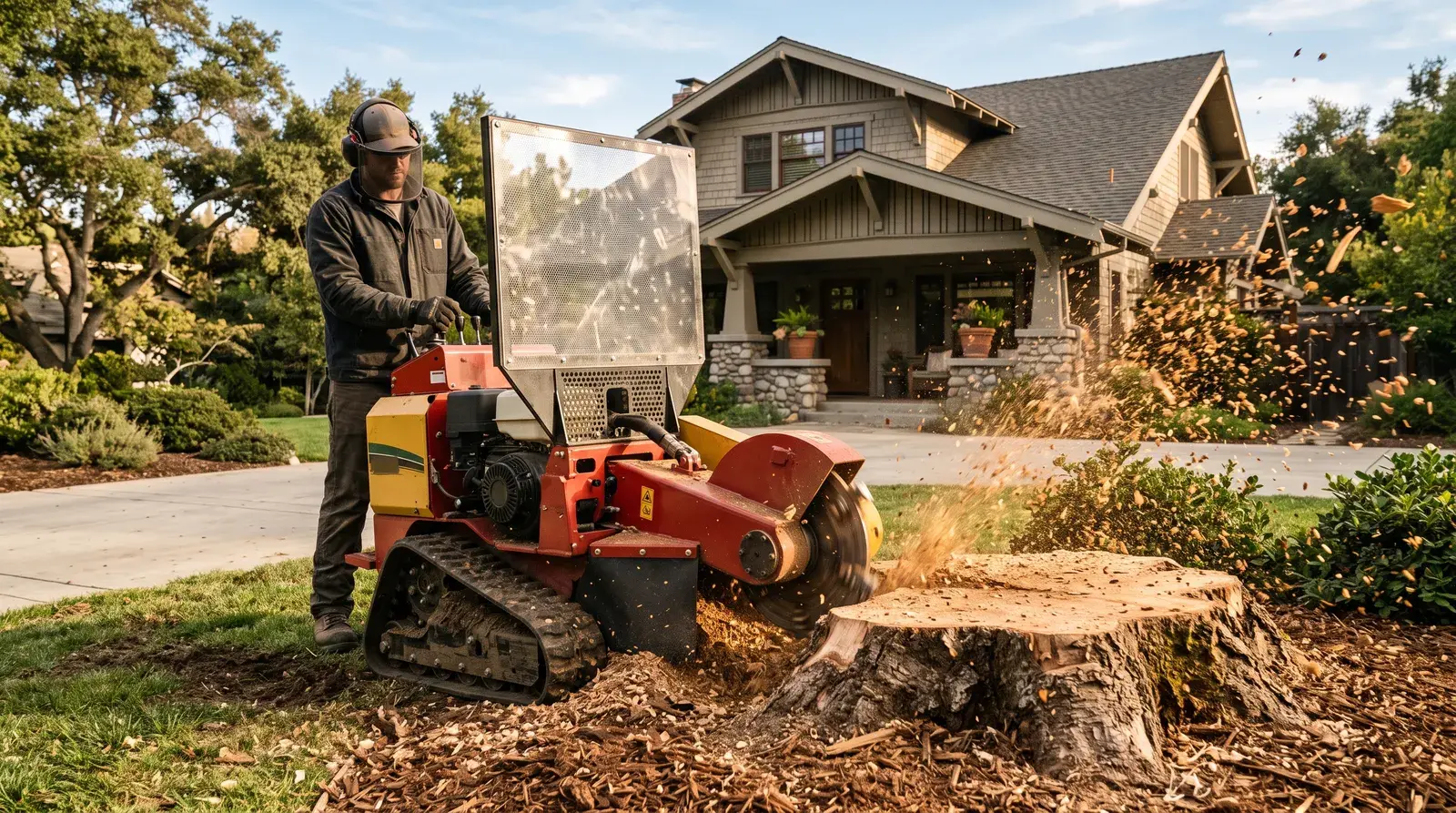
How Stump Grinding Works
A stump grinder is a machine with a spinning carbide-toothed wheel that sweeps across the stump, shaving it into chips a layer at a time until the wood sits well below grade. It's controlled, fast, and doesn't require digging up your yard.
Machine size matters. A self-propelled grinder fits through a 36-inch gate for backyard stumps, while big front-yard oak stumps go faster with a larger tow-behind unit. Access is part of every quote — a stump behind a narrow side yard takes longer than the same stump at the curb.
- We measure the stump at the root flare — the widest point at the ground — not the trunk, because that's what actually gets ground.
- Rocks, old fence hardware, and landscape edging get cleared from around the stump; steel embedded in old wood destroys grinder teeth and stops the job.
- The wheel works across the stump in passes, cutting from one side to the other and stepping down until the target depth is reached.
- Surface roots radiating from the stump get chased and ground where they lift lawn or hardscape, usually a few feet out from the flare.
- The chips stay in the hole, go into your beds as mulch, or get hauled off with topsoil backfill — your call, priced up front.
Grind Depth: Surface vs. Deep Grinding
The right grind depth depends entirely on what you're doing with the spot afterward. Grinding deeper costs a bit more, but grinding too shallow for your plans costs a lot more to fix later.
Say what the space is for when you get the estimate. Grinding an extra 8 inches while the machine is already on the stump is cheap; bringing it back after the concrete cracked is not.
- 6–8 inches (standard) — enough for sod, seed, mulch, groundcover, or a flower bed. This is the default for most lawn stumps.
- 12–18 inches (deep grind) — the minimum if you're replanting a tree or shrub in or near the same hole, since a new root ball needs clean soil, not rotting wood.
- 18+ inches (hardscape prep) — for concrete, pavers, retaining walls, or footings over the spot. Buried wood decomposes and settles, and settling under a slab means cracks.
- Root chasing — lateral surface roots from species like camphor and Modesto ash often need grinding several feet beyond the stump so they don't keep lifting turf.
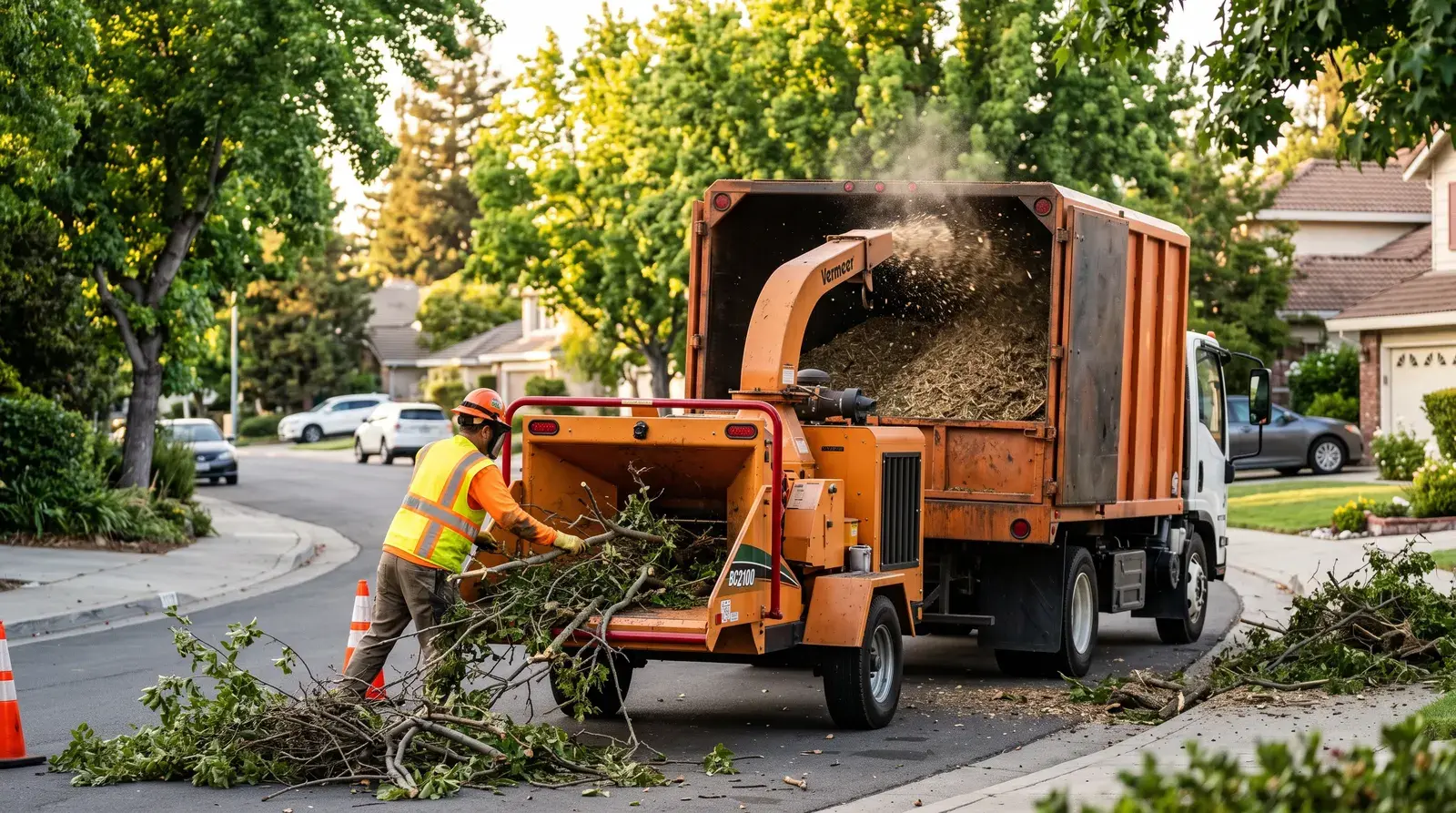
Stump Grinding & Removal across Sacramento, Placer, El Dorado, and Yolo counties.
Chips, Backfill, and What the Spot Looks Like After
Grinding produces a surprising amount of material — a mound of wood chips and soil roughly two to three times the volume of the visible stump. Deciding what happens to it is half the job.
- Keep the chips — free mulch for beds, paths, and around established trees. Let them age a few months before piling them against anything you want to grow fast.
- Rake back into the hole — the cheapest option. The chips settle as they decompose, so expect a shallow dip for a year or two and plan to top it off.
- Haul-off with topsoil backfill — the right choice for lawn repair and replanting. We remove the chip pile, backfill with clean soil, and leave the spot level and ready to seed or sod.
- Nitrogen note — decomposing wood chips pull nitrogen from surrounding soil, which is why grass seeded straight into a chip-filled hole comes in yellow and thin.
Underground Utilities and the 811 Call
The main hazard in stump grinding isn't the machine — it's what's buried next to the stump. Gas services, irrigation mains, low-voltage lighting, and old sewer laterals all share ground with roots, especially on street-side stumps.
- USA North 811 is California's free utility-locate service. Deep grinds and any stump within a few feet of meters, cleanouts, or the parkway strip get a locate before we cut.
- Locates mark public utilities to the meter. Private lines — irrigation, landscape lighting, a line to a detached garage — aren't marked, so tell us what you know is out there.
- Roots and pipes travel together. Trees planted over or near a sewer lateral often have roots wrapped around it, and grinding blind through that zone is how laterals get holed.
- The locate takes about two business days, and we build it into scheduling so it doesn't hold up your job.
Need stump grinding & removal on your property?
Share the address and project details — we'll come back with a scoped, site-specific estimate.
Stump Grinding vs. Full Stump Removal
Grinding shaves the stump down below grade and leaves the deeper roots to decompose. Full removal excavates the stump and root ball entirely. For nearly every residential yard, grinding wins on cost, speed, and mess — excavation is a construction-site tool.
- Grinding — an hour or two per stump, a modest machine footprint, and a level spot when it's done. Remaining roots rot harmlessly over 5–10 years.
- Full removal — an excavator, a hole several feet deep and wide, truckloads of spoils, and a repair bill for the surrounding lawn and irrigation.
- When excavation makes sense — building pads, pool digs, grading projects, and lots being cleared for construction where no root mass can remain. See our lot clearing service; when the dig itself is the job, NorCal Earthworks runs the excavation.
- Regrowth — most Sacramento trees don't resprout after grinding, but a few (tree of heaven, some elms and poplars) sucker from remaining roots. We'll tell you if your species is one of them.
What Stump Grinding Costs in the Sacramento Area
Stump diameter at the root flare is the biggest cost driver, followed by depth, access, and count. As a broad regional range, most residential stumps run $100–$400, and the price per stump drops when we grind several in one trip.
Treat those figures as orientation, not a quote. Every estimate is free, written, and specific to your stump and your access.
- Small stumps (under 12" flare) — crape myrtle, fruit trees, ornamentals — sit at the low end of the range.
- Mid-size stumps (12–24") — Modesto ash, birch, most street trees — land in the middle.
- Large stumps (24"+) — valley oak, camphor, sycamore, and old Mexican fan palms with dense fibrous root masses — run to the top of the range and beyond.
- Adders — deep grinding for replant or hardscape, chip haul-off with backfill, tight backyard access, and root chasing beyond the flare each add a line item.
- Bundling — grinding is cheapest when quoted with a tree removal, since the crew and equipment are already on site.
The same crew from estimate to cleanup.
No juggling separate contractors for one tree. Tell us the address and what you're dealing with, and we'll come back with a written, site-specific number.
- Removal, trimming, stumps, and cleanup handled by one crew
- Free, site-specific estimates — priced to your tree, not a flat rate
- Sacramento, Placer, El Dorado, and Yolo counties

Old Stumps, Palm Stumps, and Other Special Cases
Not every stump grinds the same. Species, age, and what grew up around the stump all change the job, and a few cases are worth knowing about before you call.
- Palm stumps — Mexican fan palm stumps are a dense, wet, fibrous mass rather than solid wood. They grind slowly and produce a stringy spoil pile, which is why palms often price higher than a hardwood stump of the same size.
- Old rotted stumps — a stump that's been sitting for a decade grinds fast, but the soft wood often hides a bigger root flare underground than what shows on the surface.
- Oak stumps — valley oak and interior live oak are dense and wide-flared; they take longer per inch than softer species. If the tree itself is still standing and protected, permits come before any cutting — see the tree removal page for ordinance details.
- Stumps in hardscape — stumps that grew tight against sidewalks, curbs, or patios get ground carefully to avoid throwing chips at concrete edges, and lifted slabs may point to a root problem next door; our root management service handles that side.
Related services
Tree Removal
Safe removal of hazardous, dead, or unwanted trees — including permit help, cleanup, and haul-off across the Sacramento region.
Root Pruning & Root Barriers
Managing roots that lift sidewalks, driveways, and foundations — targeted root pruning and barrier installation done without killing the tree.
Tree Planting & Replacement
Right-tree, right-place planting and replacement — good species choices for Sacramento's heat, soils, and space.
Before you book stump grinding & removal
What it runs, where permits bite, and how stump grinding & removal stacks up against the alternatives.
Stump Grinding Cost Guide (2026)
What stump grinding costs in the Sacramento region in 2026 — pricing by diameter, what a standard grind includes, and where the extra charges come from.
Do You Need a Tree Removal Permit in Roseville?
Where Roseville draws the line before a tree comes down, and who to check with.
How Much Does Tree Removal Cost in Sacramento? (2026)
Typical 2026 Sacramento tree removal price ranges by tree size, the factors that move the number, and how to read a quote before you sign it.
Do You Need a Tree Removal Permit in Folsom?
Where Folsom draws the line before a tree comes down, and who to check with.
Want to see what this looks like on a real property? Browse the stump grinding & removal jobs we take on, or read how our crew scopes and prices work before you call anyone out.
Frequently asked questions
How deep does stump grinding go?
A standard grind runs 6–8 inches below grade — enough to lay sod, spread mulch, or plant groundcover over the spot. If you plan to replant a tree, run irrigation, or pour a driveway, patio, or foundation over the area, ask for a deep grind of 12–18 inches or more so leftover wood doesn't rot, settle, and crack whatever sits on top. Tell us what the space is for and we'll grind to match.
How much does stump grinding cost in Sacramento?
As a broad regional range, most residential stumps run $100–$400 to grind. Small ornamental stumps sit at the low end; a mature valley oak or camphor stump with a wide root flare can run several hundred dollars or more. Diameter measured at the widest point of the flare, grind depth, access, and the number of stumps drive the price. Grinding several stumps in one trip is cheaper per stump than separate visits. Estimates are free.
What happens to the wood chips after grinding?
Grinding turns the stump into a mound of chips mixed with soil — usually a pile two to three times the stump's visible volume. You can keep them as free mulch for beds and paths, rake them back into the hole and let them settle, or have us haul them and backfill with topsoil. If you're planting grass or a new tree in the same spot, haul-off plus clean backfill is the right choice, because decomposing chips tie up nitrogen and cause settling.
Do you call 811 before grinding a stump?
Utility locating matters any time we're cutting 12 or more inches into the ground. Shallow grinds over a known-clear lawn are usually low risk, but deep grinds — and any stump near a gas meter, irrigation main, or the strip between sidewalk and street — get a USA North 811 locate first. It's a free service and takes a couple of business days. We flag it during the estimate so the schedule accounts for it.
Is stump grinding better than full stump removal?
For most yards, yes. Grinding takes an hour or two, costs a fraction of excavation, and leaves the ground level. Full removal — digging out the stump and root ball with an excavator — makes sense mainly on construction and grading projects where the entire root mass has to go, like a building pad or new pool. Excavation tears up a much larger area and usually costs several times what grinding does. If you just want the stump gone, grind it.