
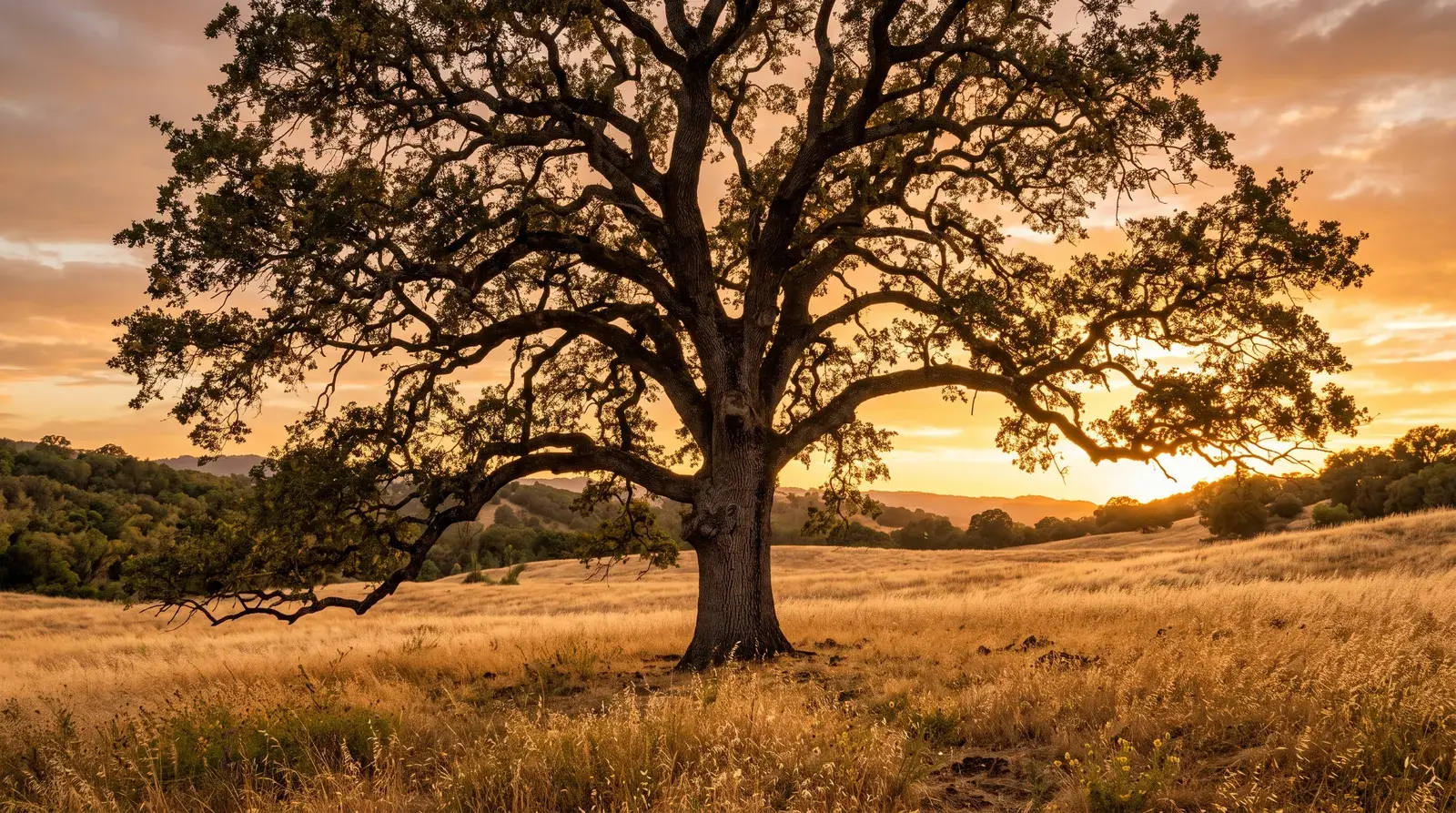
Sacramento's Native Oaks
Three native oaks define the region's canopy, and they're not interchangeable: valley oak on the deep valley soils, interior live oak along rivers and lower foothills, and blue oak on the dry foothill slopes. Knowing which one you have changes how — and how much — it should be pruned.
Old oaks are the most valuable trees on most properties they stand on — for shade, property value, and habitat — and the least forgiving of bad work. The core of oak care is restraint applied at the right time of year.
- Valley oak (Quercus lobata): the giant deciduous oak of the valley floor — massive spreading limbs, capable of living centuries; the signature tree of Land Park, Fair Oaks, and the American River Parkway
- Interior live oak (Quercus wislizeni): evergreen, dense, dark-canopied; common from Carmichael and Fair Oaks up through Folsom and Granite Bay
- Blue oak (Quercus douglasii): the drought-tough deciduous oak of foothill slopes around Auburn, Newcastle, and Cameron Park — slow-growing and intolerant of heavy cutting or summer water
- Non-natives you'll also see: cork oak, holly oak, and pin oak as street and yard trees, each with more conventional pruning tolerance
Dry-Season Pruning: Why Timing Is the Whole Game
Prune native oaks in the dry season or winter dormancy. Fresh cuts made in cool, wet conditions are open doors for fungal pathogens that spread in exactly that weather, and several oak diseases ride insects that fly most in mild, moist months. Sacramento's bone-dry summers are the safe window.
We keep this general on purpose: pruning timing and technique are our lane; oak pesticide and fungicide decisions are not something to take from a web page. If a disease is suspected, the right move is a proper assessment — see tree health assessment.
- June–October: primary pruning window — low disease pressure, cuts dry and seal cleanly
- December–February: acceptable for deciduous valley and blue oaks in full dormancy, with structure visible
- Late winter through spring: avoid planned pruning — sap flow, active pathogens, and nesting season all argue for waiting
- Storm damage is the exception: broken limbs get proper cuts promptly in any season, because a torn stub is worse than a well-made wet-season cut
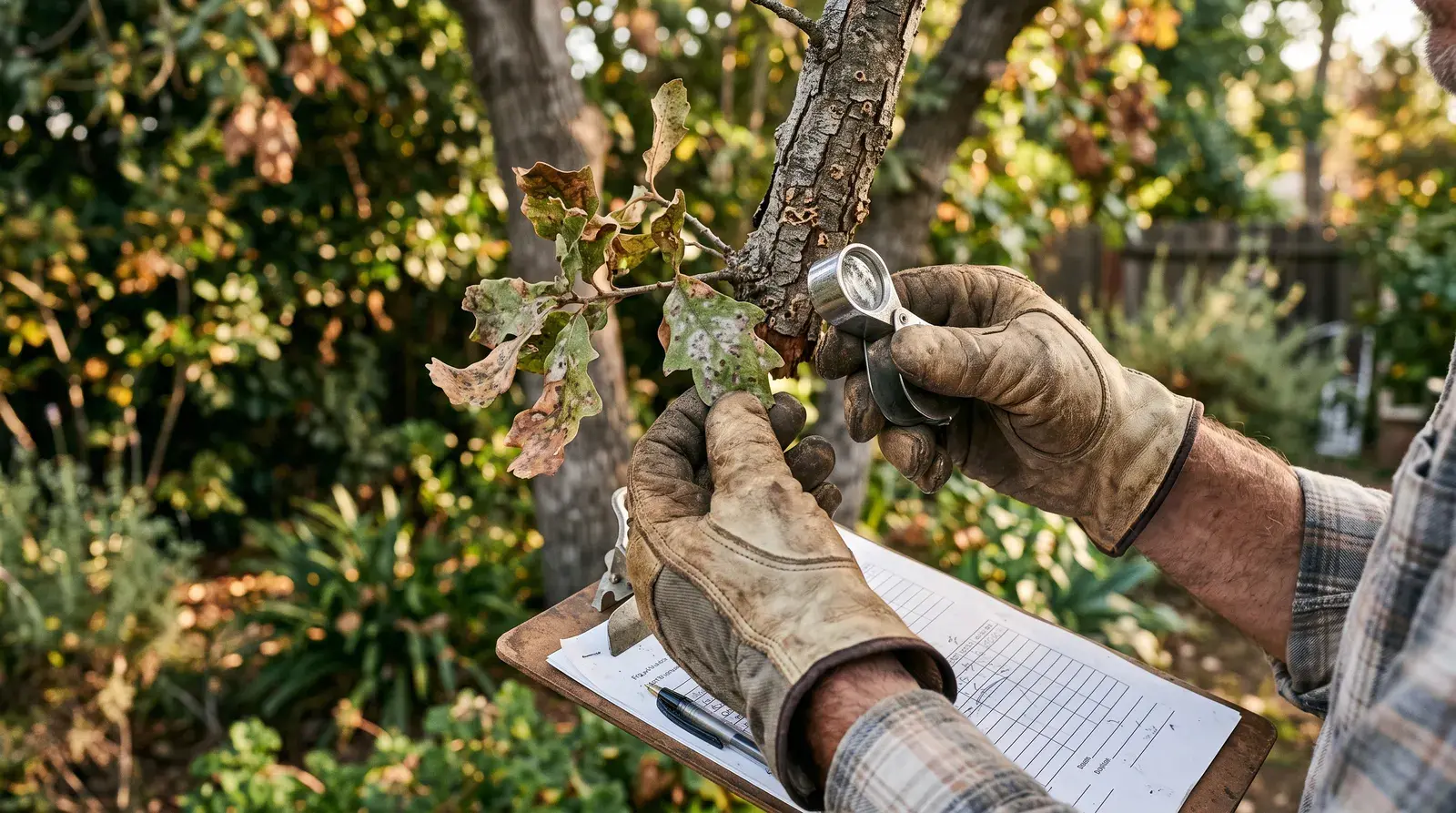
Oak Tree Care across Sacramento, Placer, El Dorado, and Yolo counties.
How We Prune Oaks
Mature oak pruning is mostly subtraction of the right dead and overextended wood — not reshaping. We target deadwood, end-heavy limbs over targets, clearance, and mistletoe, keep live-canopy removal to roughly 10–15% in a year, and make every cut at the branch collar so the oak can compartmentalize it.
- Crown cleaning: deadwood out first — big oaks shed dead limbs in winter storms and, notoriously, on hot still summer days
- End-weight reduction: long horizontal limbs over roofs, driveways, and patios shortened to strong live laterals — see crown reduction & thinning
- Clearance: measured cuts for structures and walkways, not blanket raising that guts the lower canopy
- No topping, no lion-tailing, ever — both are especially destructive on oaks
- Cabling and bracing where a heavy union needs mechanical support instead of more cutting — see tree cabling & bracing
- Young oaks are the exception to restraint: they take structural training well, and early visits build the next century's tree — see structural tree pruning
Heritage Trees and Native-Oak Ordinances
Before major work on an oak, confirm whether it's protected — many in the region are. The City of Sacramento protects Heritage Trees under City Code Chapter 12.56 and controls all work on City Trees in the right-of-way; Sacramento County's Tree Preservation and Protection Ordinance covers native oaks in unincorporated areas.
The fines for unpermitted work on protected trees are real, and "the contractor said it was fine" is not a defense. We flag likely permit situations at the estimate and won't start regulated work without the paperwork sorted.
- City of Sacramento: Heritage Tree removal or major pruning requires a permit — verify current criteria at cityofsacramento.gov
- Street trees are City Trees regardless of species; homeowners can't contract work on them directly
- Unincorporated county (Carmichael, Fair Oaks, Orangevale, Arden-Arcade and beyond): native oak protections apply — check with the county before removal-scale work
- Placer and El Dorado County communities have their own tree rules — always verify with the local jurisdiction
- Development sites: protected oaks usually mean an arborist report and a tree protection plan — see arborist reports & permit support
Need oak tree care on your property?
Share the address and project details — we'll come back with a scoped, site-specific estimate.
The Watering Problem: How Sacramento Kills Its Oaks
More mature native oaks die from summer irrigation than from anything a chainsaw does. Valley, blue, and interior live oaks evolved for bone-dry summers; lawns and drip lines soaking the root zone through July feed the root-rot fungi that literally undermine the tree.
If an oak on your property shares ground with heavy irrigation, that's worth a conversation during any pruning visit — sometimes rerouting a valve does more for the tree than the whole day's cutting.
- Keep regular irrigation out of the root zone of established native oaks — especially against the trunk and inner canopy area
- A lawn planted under an old valley oak is a slow-motion conflict; mulch under the canopy is the better ground plan
- Mushrooms or conks at the base, dark staining, or bleeding on the lower trunk warrant an assessment before the next storm season
- Occasional deep winter-style watering in extreme multi-year drought is a different, defensible call — the poison is frequent shallow summer water
Mistletoe, Pests, and What to Watch For
Sacramento oaks carry a familiar set of problems: broadleaf mistletoe visible as evergreen clumps in bare winter canopies, drought stress showing as summer leaf drop and dieback, and — worth watching, not panicking about — invasive borers like GSOB spreading through California in moved firewood.
- Mistletoe: prune infested limbs well below the attachment during regular dry-season work; heavy loads stress drought-hit trees
- Sudden branch drop: large oaks can shed big green limbs on hot, calm days — end-weight reduction on long horizontal limbs is the practical mitigation
- Goldspotted oak borer: not established here, but the buy-it-where-you-burn-it firewood rule is the region's main defense
- General decline signs — thinning crown, dead top, bark staining, exit holes: assess first, prune second — see tree health assessment
- We don't dispense chemical treatment advice from a service page; treatment decisions belong to a proper on-site diagnosis
The same crew from estimate to cleanup.
No juggling separate contractors for one tree. Tell us the address and what you're dealing with, and we'll come back with a written, site-specific number.
- Removal, trimming, stumps, and cleanup handled by one crew
- Free, site-specific estimates — priced to your tree, not a flat rate
- Sacramento, Placer, El Dorado, and Yolo counties
What Oak Work Costs
Broad Sacramento-region ranges: routine deadwooding and clearance on a mid-size oak often runs $400–$900; full crown cleaning with end-weight reduction on a large mature valley oak commonly lands $1,000–$2,500+, driven by size, rigging over structures, and how many years since the last visit.
Estimates are free and site-specific. On a healthy oak we'll often recommend less work than you expected — with oaks, that's usually the right answer.
- Size and age: a 200-year valley oak is a full-crew day; a young live oak is an hour
- Deferred maintenance: a decade of deadwood takes longer than a three-year cycle's worth
- Rigging: limbs over the house come down on ropes, not gravity
- Permit support: Heritage Tree paperwork or an arborist report adds scope when required
Related services
Structural Tree Pruning
Structural pruning that builds sound branch architecture — training young trees and correcting weak, crowded, or co-dominant limbs.
Tree Health Assessment
Diagnosing disease, pests, and structural risk — with an honest plan to treat, monitor, or remove.
Arborist Reports & Permit Support
Documentation for permits, development, and real estate — including protected and heritage tree review support.
Tree Trimming
Trimming for clearance, appearance, and long-term health — deadwood removal, canopy shaping, and structure on a sensible cycle.
Related guides
When to Trim Oak Trees in California
The best window to prune native California oaks, why dry-season timing cuts disease risk, and the pruning mistakes that shorten an oak's life.
Sacramento's Heritage Tree Ordinance, Explained
What makes a Sacramento tree a Heritage Tree, what City Code Chapter 12.56 protects, and how to get pruning or removal approved.
Do You Need a Permit to Remove a Tree in Sacramento?
Which Sacramento trees need a removal permit, how city and county rules differ, and how to check before the saw comes out.
Before you book oak tree care
What it runs, where permits bite, and how oak tree care stacks up against the alternatives.
Arborist Report Cost in Sacramento (2026)
Regional range $300–$1,500 — and what moves the number on a real job.
Do You Need a Tree Removal Permit in Folsom?
Where Folsom draws the line before a tree comes down, and who to check with.
Deep-Root Fertilization vs. Surface Feeding: What Trees Actually Need
Deep-Root Fertilization or Surface Feeding — how to tell which one the tree actually needs.
How Much Does Tree Trimming Cost in Sacramento? (2026)
Regional range $300–$2,500 — and what moves the number on a real job.
Do You Need a Permit to Remove a Tree in Sacramento?
Which Sacramento trees need a removal permit, how city and county rules differ, and how to check before the saw comes out.
Removing vs. Preserving a Native Oak in the Sacramento Region
Oak Removal or Preservation — how to tell which one the tree actually needs.
Want to see what this looks like on a real property? Browse the oak tree care jobs we take on, or read how our crew scopes and prices work before you call anyone out.
Frequently asked questions
When is the best time to prune oak trees in Sacramento?
The dry season — roughly June through October — or winter dormancy. Dry-season pruning matters because the pathogens that infect fresh cuts, and the beetles that carry some of them, are most active in wet, mild conditions. Winter works for deciduous valley and blue oaks once they're bare. What to avoid: heavy pruning in spring when sap is running and disease pressure is up, and stripping shade off a stressed tree in a 105-degree August week.
Do I need a permit to prune or remove an oak in Sacramento?
Often, yes — it depends on the tree and the jurisdiction. In the City of Sacramento, Heritage Trees are protected under City Code Chapter 12.56 and need a city permit before removal or major work, and street trees are City Trees under city control; check cityofsacramento.gov. Unincorporated Sacramento County protects native oaks under its Tree Preservation and Protection Ordinance. Roseville, Folsom, Elk Grove, and the El Dorado County foothill communities each have their own rules. We help confirm before any cut.
How much of an oak can be pruned at once?
Less than most trees. A practical ceiling for mature native oaks is around 10–15% of live canopy in a year — well under the general 25% rule of thumb — because old oaks respond poorly to sudden canopy loss and heavy interior exposure. Most of what an oak actually needs is deadwood removal, end-weight reduction on overextended limbs, and clearance cuts. If an oak needs more than that, the work gets staged over multiple seasons.
Is mistletoe killing my oak, and should it be removed?
Broadleaf mistletoe is a parasite that taps the branch it grows on for water and nutrients. A few clumps won't kill a healthy oak, but heavy infestations stress trees — especially in drought years — and infested limbs fail more often. Removal means pruning infested branches back at least a foot below the attachment where practical; simply pulling the visible clumps only slows it, since it regrows from tissue inside the branch. It's routine work best bundled with a regular prune.
What is goldspotted oak borer (GSOB) and should Sacramento worry?
GSOB is an invasive beetle that has killed large numbers of oaks in Southern California, attacking mainly coast live oak, canyon live oak, and California black oak. It spreads primarily in moved firewood, which is why the standing advice is buy it where you burn it. It isn't established in the Sacramento region, but the firewood pathway means vigilance matters. If an oak shows crown thinning, bark staining, or D-shaped exit holes, get it assessed and reported rather than guessing.