Palms in the Sacramento Valley: What We're Removing
Sacramento's palms are mostly a legacy of earlier landscaping eras — towering Mexican fan palms lining older streets and standing in pairs in front yards from Land Park to Carmichael. A handful of species account for nearly every palm removal call we get.
- Mexican fan palm (Washingtonia robusta) — the skinny 60–100 foot skyline palm, and the most-removed species; too tall to maintain affordably, and a fire and rat-harborage concern when the skirt of dead fronds builds up.
- California fan palm (Washingtonia filifera) — thicker-trunked, heavier cousin; shorter but substantially more weight per foot.
- Canary Island date palm — massive trunks and huge frond crowns; among the heaviest removals per foot of height in the region.
- Mediterranean fan palm — multi-trunk clumping palm, usually a small-crew removal rather than a rigging job.
- Queen palm — common in 1990s–2000s subdivisions in Elk Grove and Roseville; frost- and stress-damaged specimens drive most removals.
Why Homeowners Remove Palms
Most palm removals aren't about a dying tree — they're about cost and risk that compound every year the palm gets taller. Once a fan palm outgrows what a ladder or pole saw can reach, every year of maintenance means a climber or a lift.
- Runaway maintenance cost — annual trimming on a very tall palm costs more each year as it grows; removal eventually beats a decade of climbing bills.
- Fire risk — dead frond skirts are notorious ember catchers and burn intensely; palms near structures are a real defensible-space consideration.
- Falling fronds — dry fan-palm fronds are heavy, rigid, and edged with spines; they do real damage to cars, roofs, and anyone below.
- Pests — untrimmed frond skirts are classic harborage for roof rats in Sacramento neighborhoods.
- Structural crowding — palms planted a few feet from foundations, pools, and fences in the 1970s are now immovable columns in the wrong spot.
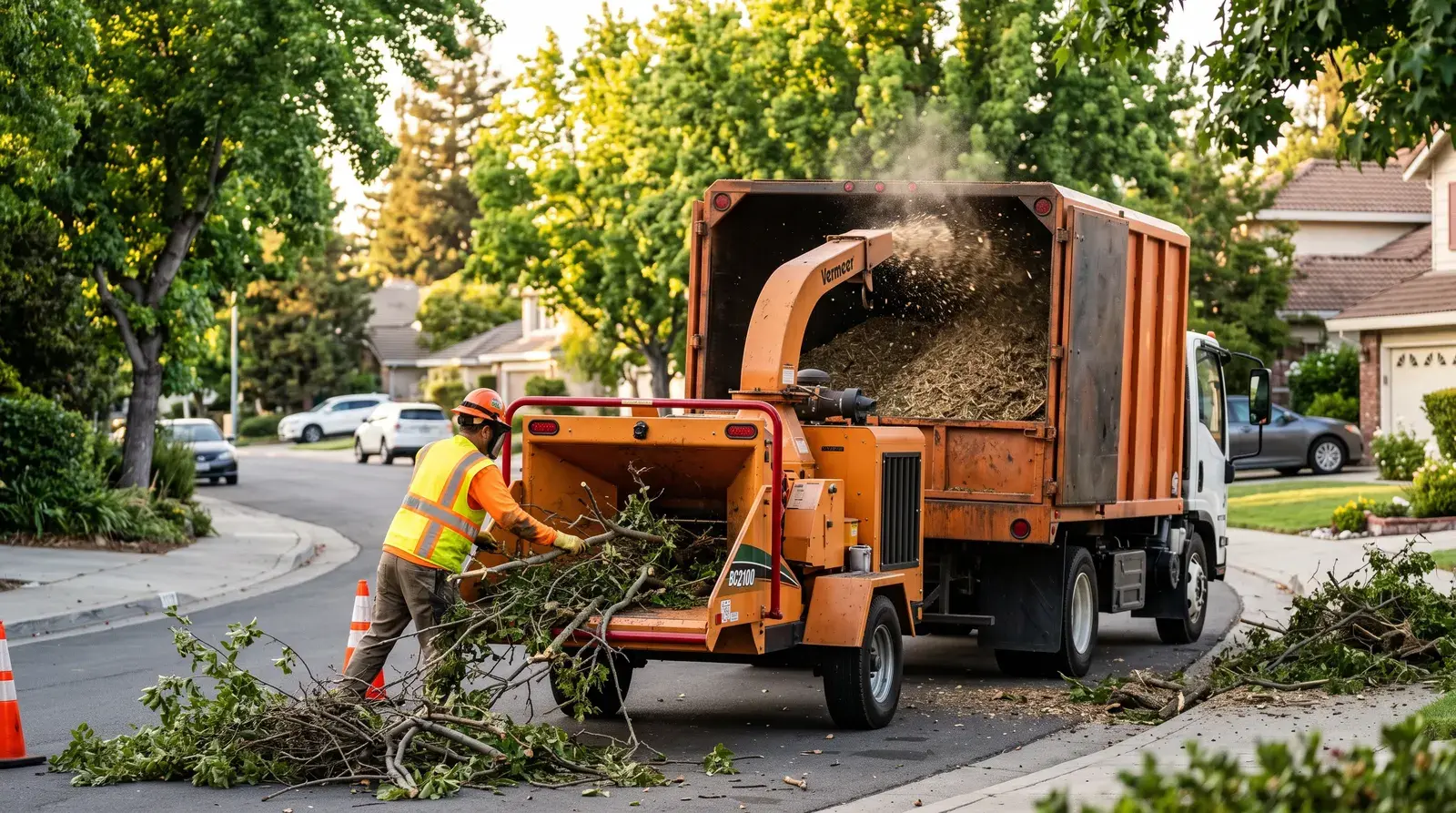
Palm Tree Removal across Sacramento, Placer, El Dorado, and Yolo counties.
How We Take a Palm Down
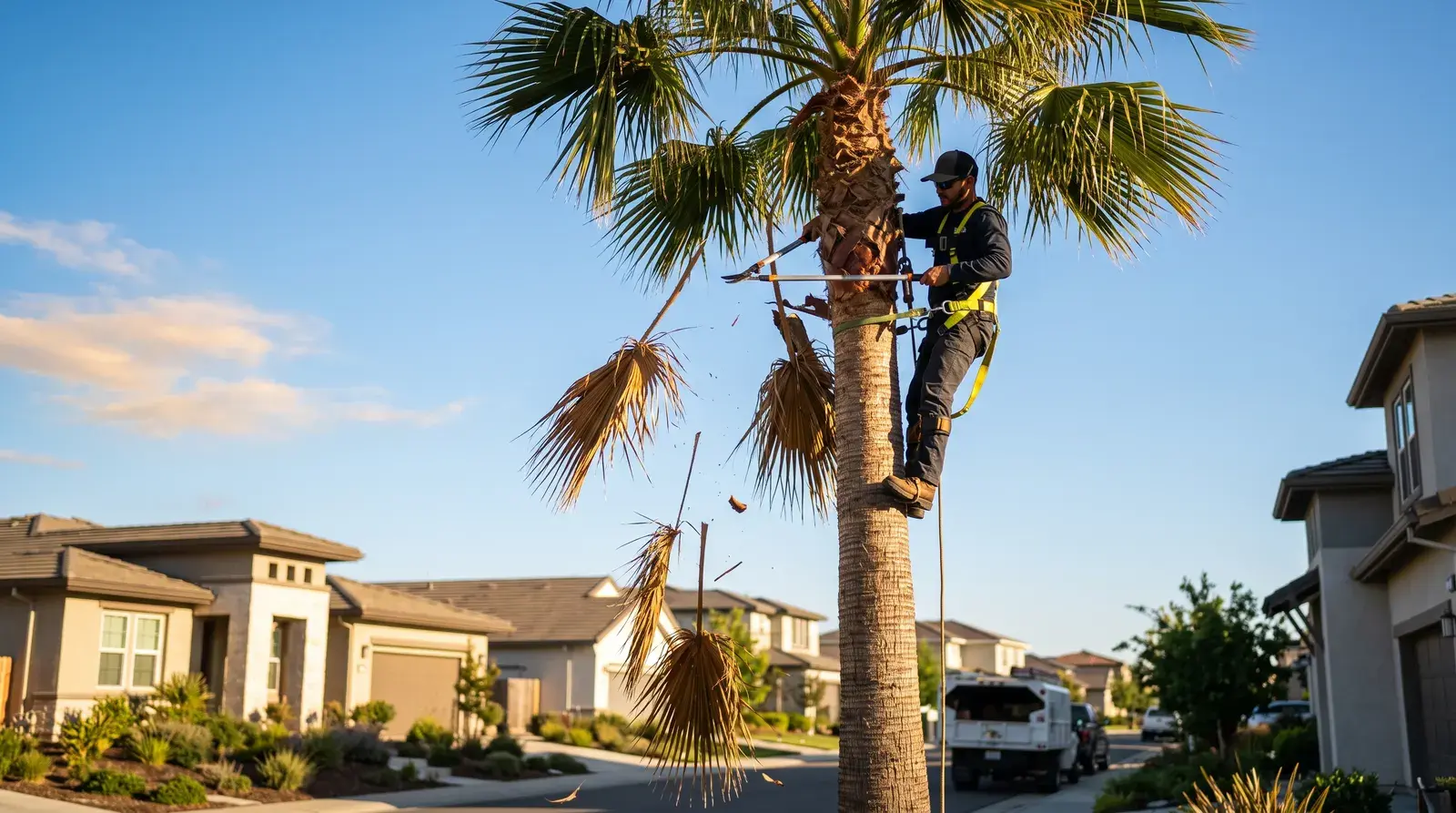
Palms come down from the top in short trunk sections, because the weight leaves no other safe option. There's no canopy to rig through — just a crown of fronds and a dense column of trunk — so the method is straightforward but unforgiving of shortcuts.
- Crown first — the climber or lift operator removes the frond crown and skirt, controlling the debris path so spiny fronds don't rain onto the yard.
- Short sections — the trunk comes down in rounds sized to what can be safely controlled; on tall palms near structures, sections are roped down or craned out rather than dropped.
- Climb, lift, or crane — sound palms in open ground can be climbed; palms over roofs, pools, or tight side yards usually call for an aerial lift or a crane pick.
- Protected drop zone — plywood or mats where sections land, because a few hundred pounds of wet palm trunk will crater a lawn or crack concrete.
- Full haul-off — trunk rounds are loaded and hauled, not chipped; we leave the site raked clean.
What Drives the Price of a Palm Removal
Height is the headline number, but three other factors move a palm bid as much as the tape measure: what's under the palm, how close a truck can get, and where the wood goes when it's down. Ask any bidder to spell out all four.
As broad regional guidance, most Sacramento-area palm removals land between a few hundred dollars and $3,000+, with crane-assisted or very tall specimens above that. Treat ranges as orientation only — palm pricing is exactly where a free, in-person estimate earns its keep.
- Height — more trunk means more sections, more time aloft, and more weight to move; the 60-foot-plus fan palms are a different job class than a 15-foot Mediterranean.
- Access — a palm at the driveway loads straight into the truck; a palm behind the pool means every section gets wheeled or carried out by hand.
- Targets below — palms planted against houses and over pool decks need every section controlled, which adds rigging or crane time.
- Disposal — palm doesn't chip and many facilities surcharge it; complete haul-off is a legitimate cost, and bids that ignore it usually mean the trunk stays at your curb.
- Stump — grinding a palm stump and removing the fibrous grindings is its own line item; get it on the same quote.
Need palm tree removal on your property?
Share the address and project details — we'll come back with a scoped, site-specific estimate.
Dead Palms Don't Wait Well
A dead palm deteriorates differently than a dead oak: the fibrous trunk absorbs water, softens from the top down, and becomes progressively more dangerous to climb. A palm that could be climbed cheaply this year may need a lift or crane next year.
- Trunk softening — dead palm fiber loses the strength that holds climbing spikes and rigging; crews have to assume the top is unreliable.
- Crown drop — the dead crown and skirt can release without warning in wind, which matters when the palm stands over a driveway or sidewalk.
- Cost trajectory — removal cost generally rises as a dead palm ages, because the safe-access options narrow. If it's dead, schedule it.
- Disease — dying Canary Island date palms in particular should come out promptly, with pruning tools sanitized between palms, to limit the spread of fusarium wilt.
The same crew from estimate to cleanup.
No juggling separate contractors for one tree. Tell us the address and what you're dealing with, and we'll come back with a written, site-specific number.
- Removal, trimming, stumps, and cleanup handled by one crew
- Free, site-specific estimates — priced to your tree, not a flat rate
- Sacramento, Placer, El Dorado, and Yolo counties
After the Palm: Stump, Fiber, and Replanting
Plan the whole footprint before takedown day. Palm stumps and root masses are shallow but wide and stubbornly fibrous, and the spot usually needs real cleanup before anything else can grow there.
- Stump grinding — we grind below grade and haul the stringy palm grindings, which don't break down like wood chips and shouldn't be left as backfill under new planting.
- Root mass — palms grow thousands of pencil-thick roots rather than a few large ones; the mass decays in place without heaving hardscape the way oak roots do.
- Replanting — if you want shade instead of another column, our tree planting service can match a species to the spot for Sacramento's hot, dry summers.
- Keeping other palms — annual trimming and skinning through our palm trimming service keeps the palms you keep safe, clean, and rat-free.
Related services
Tree Removal
Safe removal of hazardous, dead, or unwanted trees — including permit help, cleanup, and haul-off across the Sacramento region.
Palm Tree Trimming & Skinning
Annual frond and seed-pod removal plus trunk skinning — keeping Sacramento's fan palms clean, safe, and tidy.
Stump Grinding & Removal
Grinding stumps below grade so you can replant, pave, or reclaim the space — chips and surface roots handled.
Related guides
Palm Tree Care in the Sacramento Valley
How to keep Sacramento Valley palms healthy — species, annual trimming cycles, skinning pros and cons, fusarium wilt, and when removal beats another trim.
How Much Does Tree Removal Cost in Sacramento? (2026)
Typical 2026 Sacramento tree removal price ranges by tree size, the factors that move the number, and how to read a quote before you sign it.
Stump Grinding vs. Stump Removal
The difference between grinding and full stump removal, what each costs, and which one you actually need.
Before you book palm tree removal
What it runs, where permits bite, and how palm tree removal stacks up against the alternatives.
How Much Does Tree Removal Cost in Sacramento? (2026)
Typical 2026 Sacramento tree removal price ranges by tree size, the factors that move the number, and how to read a quote before you sign it.
Stump Grinding Cost Guide (2026)
What stump grinding costs in the Sacramento region in 2026 — pricing by diameter, what a standard grind includes, and where the extra charges come from.
Want to see what this looks like on a real property? Browse the palm tree removal jobs we take on, or read how our crew scopes and prices work before you call anyone out.
Frequently asked questions
How much does it cost to remove a palm tree in Sacramento?
Broad regional ranges: short palms (under 20 feet) often run $300–$800; mid-height palms $800–$1,500; and tall Mexican fan palms in the 50–80 foot class typically $1,500–$3,000+, with tight-access or crane-assisted palms above that. Height sets the baseline, but access and disposal drive the spread — palm wood can't go through a chipper like ordinary brush, so hauling the trunk is a genuine cost. Every 916 Trees estimate is free and quoted from your actual tree.
Why are palm removal bids so different between companies?
Because the hidden cost is disposal, and companies handle it differently. Palm trunks are fibrous and saturated with water — most chippers can't process them and many green-waste facilities charge extra or refuse palm entirely. A bid that seems cheap may exclude haul-off, leave the trunk sections at the curb, or skip the stump. Compare bids on the full scope: takedown, complete haul-off, and stump grinding, in writing. That's how we quote.
How heavy is a palm tree, really?
Much heavier than it looks. Palm trunks don't have rings of dry structural wood — they're bundles of water-filled fiber, so a cut section is dramatically denser than the same-size log from a pine or ash. A trunk round two feet thick and three feet long can weigh several hundred pounds, and a full-height Mexican fan palm trunk can total several tons. That weight is why palms come down in short sections and why removal near structures takes real rigging or a crane.
Can you grind a palm stump?
Yes. Palm stumps grind quickly — the fiber tears out easily — but they produce a large volume of wet, stringy mulch that doesn't decompose like wood chips and usually should be hauled off rather than left in the hole. If you plan to replant or re-landscape the spot, we grind below grade, remove the palm fiber, and backfill. Ask for the grind as a line item on the removal quote.
Do I need a permit to remove a palm tree?
Usually not on private property, since local protections in the Sacramento region focus on native species like valley oak and on designated heritage or street trees. Two exceptions to check: palms in the city right-of-way strip (the City of Sacramento treats street trees as City Trees), and any palm that has been individually designated as protected. We confirm the jurisdiction question as part of the estimate — it takes minutes and prevents surprises.