
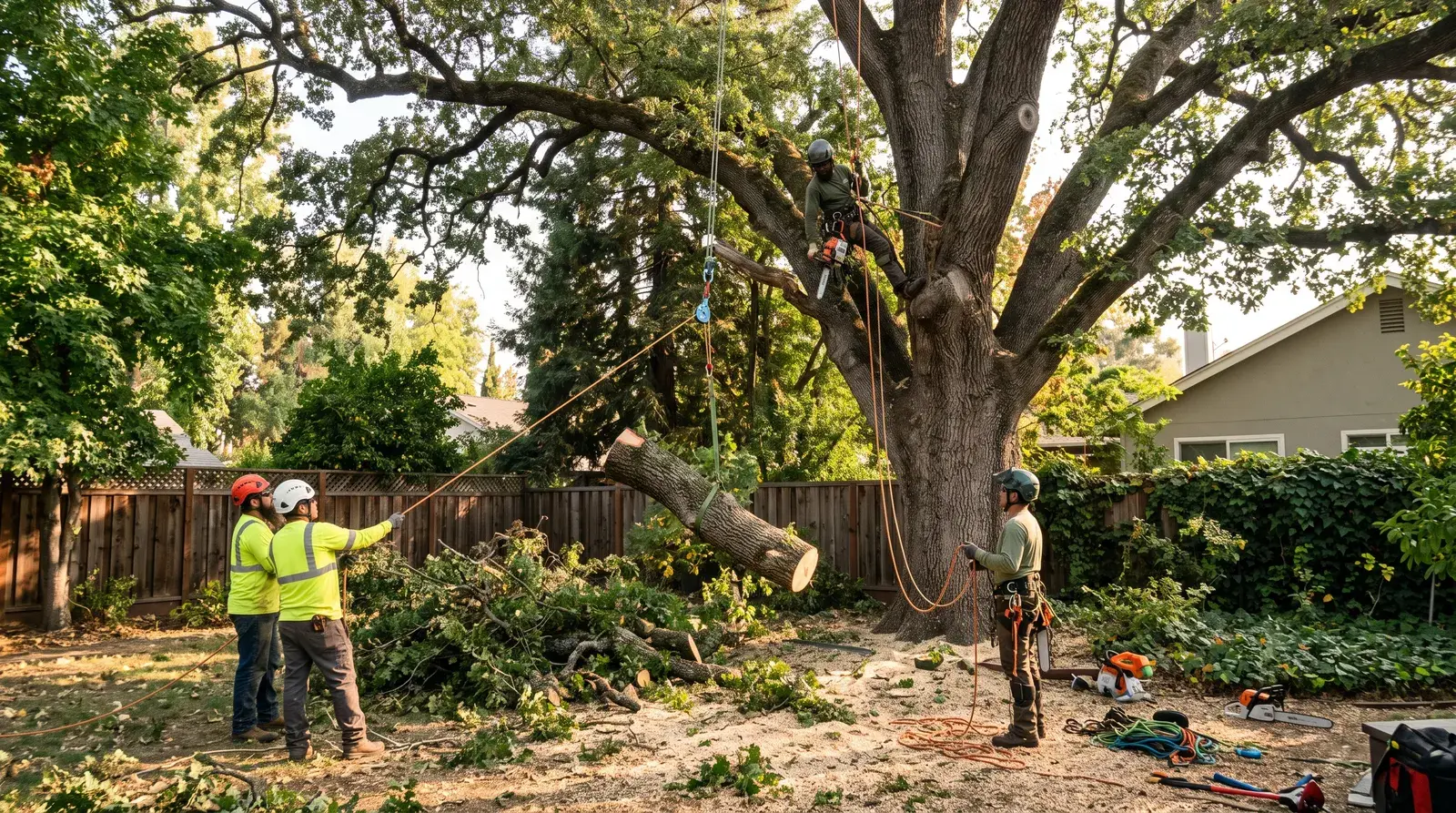
Big Trees, Big Lots, Big Rigging
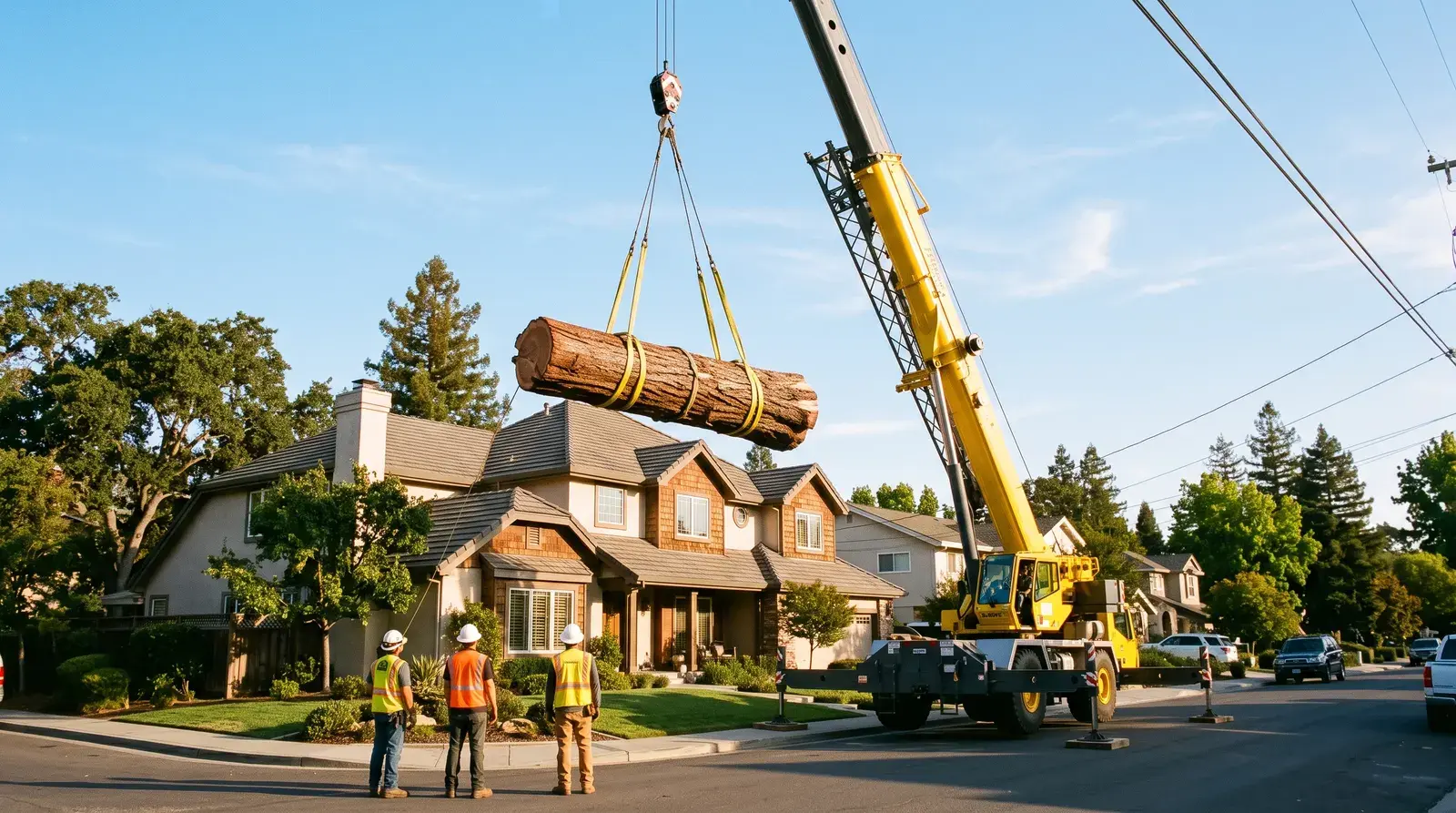
Carmichael removals skew large. Half-acre lots from Fair Oaks Boulevard down to the river parkway carry oaks and cedars that were mature before the houses went in, and taking one down safely is a full rigging operation — sometimes a crane pick over the roof.
- Valley oaks with 3–4 foot trunks come down in sections, every major limb roped or lifted, never free-felled near a structure.
- Deodar cedars and tall pines near Jesuit and along Fair Oaks Boulevard often justify a crane — faster on-site and safer than climbing decayed wood.
- Bluff-edge trees above the American River Parkway get extra planning: no dropping anything downslope, and equipment stays off unstable edges.
- Estate lots usually have the access advantage — room for a chip truck, loader, and crane that tight suburbs lack — which helps the price on big jobs.
Protected Oaks: The County Ordinance Comes First
Carmichael is unincorporated Sacramento County, which means the county's Tree Preservation and Protection Ordinance applies. Native oaks — valley oak, interior live oak, blue oak — are protected, and removing one typically requires a county permit before the first cut.
Dead and hazardous oaks usually have a faster path, but the county still expects documentation: photos of the defect, and often an arborist letter explaining why the tree cannot be retained. We handle this on every Carmichael oak estimate — we photograph the condition, tell you plainly whether the permit question applies, and can prepare the arborist report most applications require. Cutting a protected oak without checking can mean fines and mandatory replacement plantings, and the county does enforce it. Verify current requirements with Sacramento County before removing any native oak.
Tree Removal in Carmichael — free, site-specific estimates.
What We Remove Most in Carmichael
The removal mix here reflects an older, richer canopy than most Sacramento suburbs: fewer tract-home ornamentals, more genuinely large trees at the end of their structural life.
- Valley oak and interior live oak — removed when dead, hollow, or structurally failed, always after the permit check.
- Coast redwood — planted heavily in the 1970s, now browning and dying back in Sacramento's heat and drought; dead tops over houses drive many calls.
- Deodar cedar — beautiful until the top dies out or a co-dominant stem splits; heavy wood that demands cranes or careful rigging.
- Modesto ash — the same brittle mid-century failures seen across the region, common in Carmichael's 1950s–60s sections.
- Silver maple and fruitless mulberry — fast-growing shade trees now decayed at old topping wounds and shedding limbs.
Need tree removal in Carmichael?
Share the address and project details — we'll come back with a scoped, site-specific estimate.
What Tree Removal Costs in Carmichael
As a broad regional range, most Sacramento-area removals run $500–$2,500, with large or crane-assisted jobs exceeding $5,000–$10,000+. Carmichael skews toward the upper end simply because the trees are bigger — a mature valley oak over a house is a multi-day job with serious equipment.
Those figures are orientation, not a quote. Every estimate is free, written, and based on a site visit.
- Size and species drive the base price — dense oak logs weigh far more per foot than pine or ash.
- Decay pushes jobs toward crane or lift work, because a hollow trunk is not safe to climb.
- Good estate-lot access works in your favor; bluff-edge or backyard-locked trees work against it.
- Stump grinding, firewood bucking, and haul-off are quoted as separate line items on the same written estimate.
The same crew from estimate to cleanup.
No juggling separate contractors for one tree. Tell us the address and what you're dealing with, and we'll come back with a written, site-specific number.
- Removal, trimming, stumps, and cleanup handled by one crew
- Free, site-specific estimates — priced to your tree, not a flat rate
- Sacramento, Placer, El Dorado, and Yolo counties
Removal Is Not Always the Answer
Carmichael's mature oaks are the reason the neighborhood looks the way it does, and a healthy oak with a manageable defect is usually worth saving. Crown reduction, cabling co-dominant stems, or a tree health assessment often solves the problem for a fraction of removal cost — and keeps you out of the permit process entirely. We would rather preserve a saveable oak than bill for an unnecessary takedown, and we will tell you which situation you have.
Related guides
Do You Need a Permit to Remove a Tree in Sacramento?
Which Sacramento trees need a removal permit, how city and county rules differ, and how to check before the saw comes out.
How Much Does Tree Removal Cost in Sacramento? (2026)
Typical 2026 Sacramento tree removal price ranges by tree size, the factors that move the number, and how to read a quote before you sign it.
9 Signs a Tree Needs to Come Down
Nine warning signs a tree is hazardous or dying — and when removal is safer than trying to save it.
What tree removal costs — and what Carmichael allows
Regional ranges, local permit rules, and the alternatives worth weighing before tree removal in Carmichael.
Emergency Tree Service Cost in Sacramento (2026)
Regional range $800–$8,000 — and what moves the number on a real job.
Do You Need a Tree Removal Permit in Folsom?
Where Folsom draws the line before a tree comes down, and who to check with.
Tree Pruning vs. Removal: When to Save a Tree and When to Take It Down
Pruning or Removal — how to tell which one the tree actually needs.
Tree Service in Sacramento County, CA
Tree work in Sacramento County ranges from removing aging valley oaks in East Sacramento to grinding stumps on new-buil…
Crane-Assisted Tree Removal Cost in Sacramento (2026)
Regional range $2,500–$12,000 — and what moves the number on a real job.
Do You Need a Tree Removal Permit in Citrus Heights?
Where Citrus Heights draws the line before a tree comes down, and who to check with.
Want a sense of the work first? See the kinds of tree removal jobs we take on and who shows up to do them.
Frequently asked questions
Do I need a permit to remove an oak tree in Carmichael?
Usually, yes. Carmichael is unincorporated Sacramento County, and the county's Tree Preservation and Protection Ordinance protects native oaks — valley oak, interior live oak, and blue oak. Removal typically requires a county permit, with a faster documented path for dead or hazardous trees. Non-native species generally do not need a permit on private property. We check the ordinance question during the free estimate and can prepare the arborist documentation applications ask for.
How much does it cost to remove a large oak in Carmichael?
Large oak removals commonly run into the thousands — as a broad regional range, big or crane-assisted removals can exceed $5,000–$10,000+, while mid-size trees run $900–$2,500. Oak is dense, heavy wood, and a mature valley oak over a house means a day or more of sectional rigging plus haul-off. Good estate-lot access helps the price. We quote from a site visit, and estimates are free.
My 1970s redwood is browning and dying back. Does it need to come out?
Often, eventually. Coast redwoods planted across Carmichael in the 60s and 70s are struggling in Sacramento's heat and drought — thinning canopies, dead tops, browning from the top down. A dead top over a roof is a real hazard and should come out even if the tree stays. Some trees recover with deep watering; many decline for good. An assessment tells you whether you are buying the tree time or scheduling its removal.
Can you remove a tree on the bluff above the American River Parkway?
Yes, with extra planning. Bluff-edge removals near Ancil Hoffman and the Del Dayo river frontage mean no dropping wood downslope, rigging everything back toward the yard, and keeping heavy equipment off unstable edges. If the tree stands on parkway land rather than your parcel, it belongs to the county and is not yours to remove — we help sort out the property-line question before quoting.
Do you use a crane, and does that cost more?
We use cranes when the tree is too decayed to climb or there is no safe drop zone — common with Carmichael's big cedars and dead oaks over houses. A crane adds an equipment line but often reduces total cost on large removals because the tree comes apart in hours instead of days, with less risk to what is underneath. The estimate compares both approaches when either would work.