
Rocklin's Oak Rules Come Before the Chainsaw
Rocklin has its own oak tree preservation rules, separate from Placer County's and its neighbors'. Native oaks over the city's size threshold are protected on private property, and the blue oaks scattered through Whitney Oaks, Clover Valley, and older Rocklin lots are exactly the trees the ordinance was written for.
916 Trees checks the ordinance on every Rocklin estimate and can prepare the arborist documentation most applications require.
- Protected natives include blue oak, interior live oak, and valley oak — the trees that predate every subdivision in town.
- Dead and hazardous oaks have a faster path, but the city still expects documentation; photos and an arborist letter keep it clean.
- Developers preserved oaks inside lots and along greenbelts throughout Whitney Oaks and Whitney Ranch, so a backyard oak in a 2005 subdivision is very likely still covered.
- Verify current thresholds and process with the City of Rocklin before cutting — the penalty for an unpermitted oak removal dwarfs the cost of doing it right.
What Fails in Rocklin — and Why Granite Matters
Rocklin's signature growing condition is shallow soil over granite. Blue oaks handle it fine; the landscape trees planted over the top of it often do not, growing shallow, plate-like root systems that lose their grip in saturated winter ground.
- Blue oaks — slow-declining natives; most removals are dead or ordinance-documented hazard trees. A blue oak surrounded by new irrigated lawn is a common casualty.
- Interior live oaks — big evergreen canopies that drop heavy limbs; whole-tree removal only when decay or root failure ends the argument.
- 1990s builder trees — ornamental pears, fruitless mulberries, and ash in Stanford Ranch and Sunset Whitney, now 30+ years old, splitting at weak unions and heaving driveways.
- Shallow-rooted pines and redwoods — planted over thin soil on granite, these are Rocklin's classic windstorm uprooting; the root ball peels up like a hinge.
Tree Removal in Rocklin — free, site-specific estimates.
How a Rocklin Removal Goes
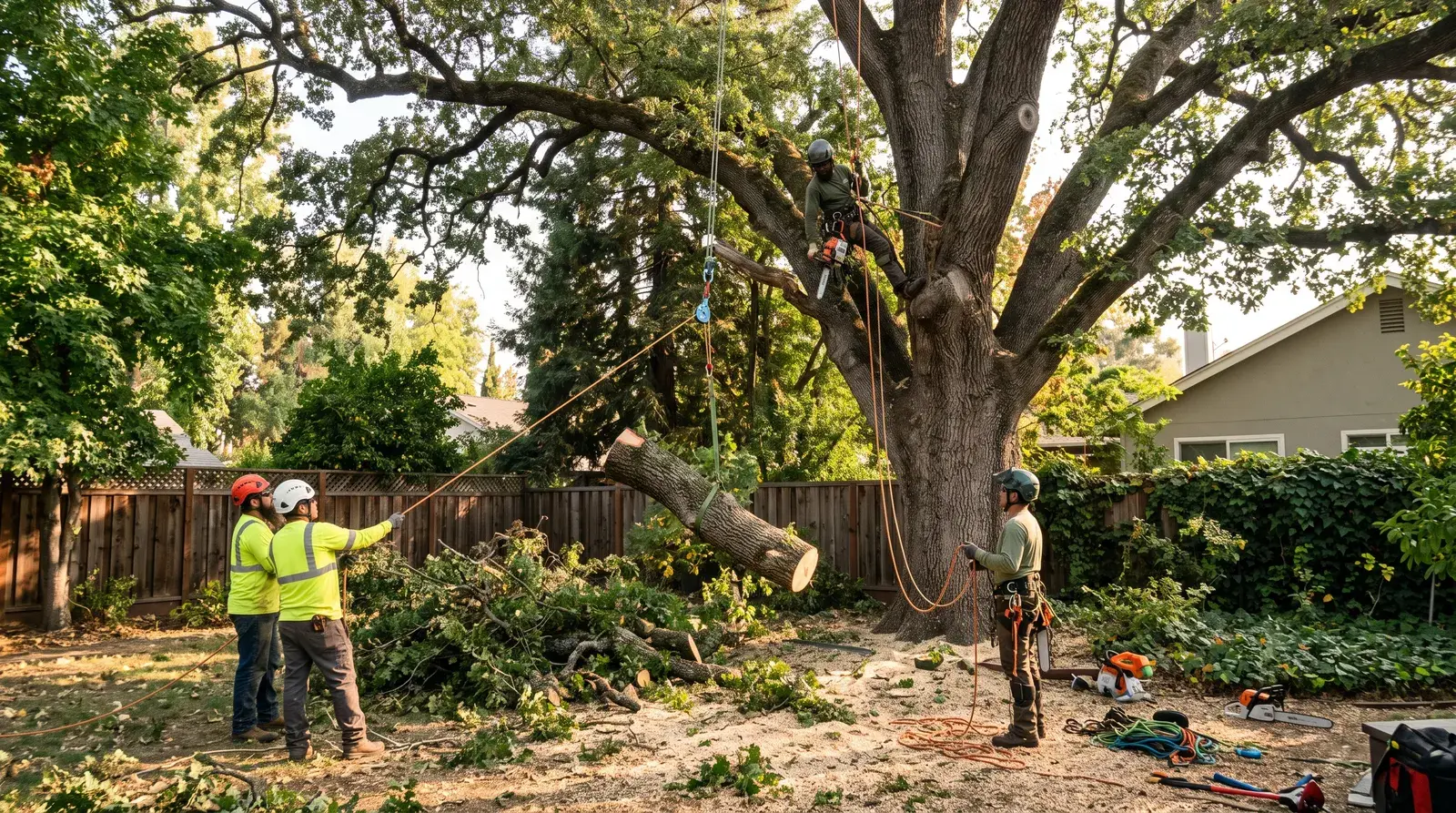
Most Rocklin removals are sectional. Lot lines in Stanford Ranch and Whitney Ranch put trees within falling distance of roofs, pools, and neighbor fences, so limbs come down on ropes, not on faith.
- Assessment and ordinance check at the free estimate — species, lean, decay, targets, and access.
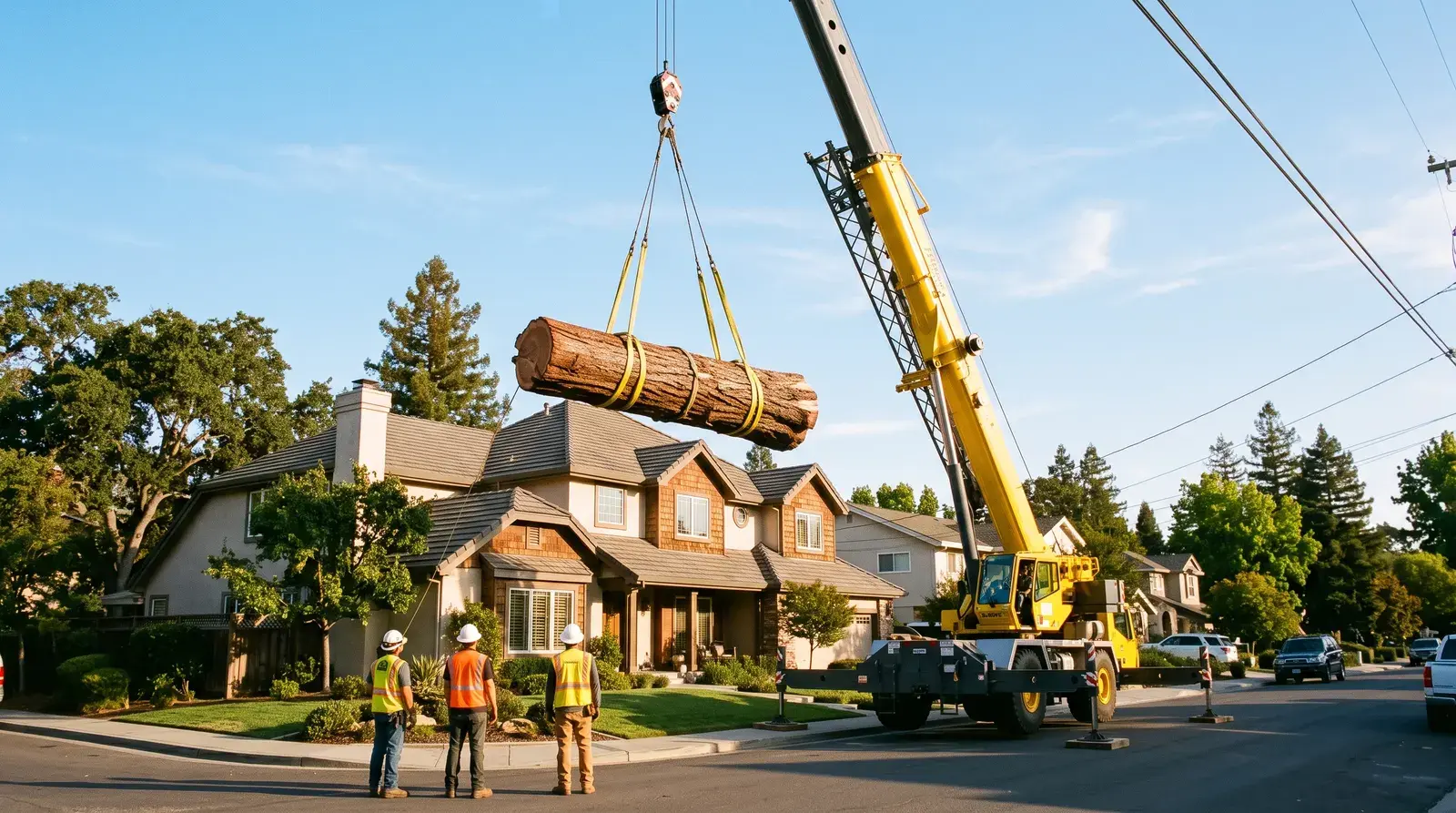
- Rigging before cutting — lowering ropes and friction devices on every limb near a target; a crane when there is no safe drop zone or the tree is too decayed to climb.
- Sectional takedown — limbs roped down, trunk bucked into logs sized for what can reach your yard.
- Cleanup — brush chipped, wood hauled or left as firewood if you want it, yard raked. Stump grinding quoted as its own line item.
Need tree removal in Rocklin?
Share the address and project details — we'll come back with a scoped, site-specific estimate.
What Tree Removal Costs in Rocklin
As broad regional figures, most residential removals run $500–$2,500, with large or crane-assisted jobs exceeding $5,000–$10,000+. In Rocklin the price movers are backyard access, oak density, and whether the tree can be climbed safely.
- Fenced backyards in Whitney Ranch and Stanford Ranch often mean carrying every log through a gate — more labor, higher number.
- Live oak and blue oak are heavy, dense wood; a same-size pine rigs and hauls for less.
- Dead or decayed trees may force a lift or crane instead of a climber, which changes the quote.
- Ordinance documentation adds a little lead time but protects you from a violation. Every estimate is free, written, and site-specific.
The same crew from estimate to cleanup.
No juggling separate contractors for one tree. Tell us the address and what you're dealing with, and we'll come back with a written, site-specific number.
- Removal, trimming, stumps, and cleanup handled by one crew
- Free, site-specific estimates — priced to your tree, not a flat rate
- Sacramento, Placer, El Dorado, and Yolo counties
Keep the Oak If You Can
A mature blue oak took a century or more to grow on Rocklin granite and cannot be replaced in your lifetime. When the tree is healthy and the problem is weight, shade, or mess, pruning solves it for a fraction of removal cost — and keeps you clear of the ordinance entirely.
We quote preservation options alongside removal whenever a tree is saveable: deadwood pruning, end-weight reduction, or cabling co-dominant stems. If you are not sure which side of the line your tree is on, start with an assessment, not a removal bid.
Related guides
Do You Need a Permit to Remove a Tree in Sacramento?
Which Sacramento trees need a removal permit, how city and county rules differ, and how to check before the saw comes out.
How Much Does Tree Removal Cost in Sacramento? (2026)
Typical 2026 Sacramento tree removal price ranges by tree size, the factors that move the number, and how to read a quote before you sign it.
9 Signs a Tree Needs to Come Down
Nine warning signs a tree is hazardous or dying — and when removal is safer than trying to save it.
What tree removal costs — and what Rocklin allows
Regional ranges, local permit rules, and the alternatives worth weighing before tree removal in Rocklin.
Emergency Tree Service Cost in Sacramento (2026)
Regional range $800–$8,000 — and what moves the number on a real job.
Do You Need a Tree Removal Permit in Elk Grove?
Where Elk Grove draws the line before a tree comes down, and who to check with.
Tree Pruning vs. Removal: When to Save a Tree and When to Take It Down
Pruning or Removal — how to tell which one the tree actually needs.
Tree Service in Placer County, CA
Placer County spans flat valley suburbia in Roseville and Rocklin and rises through the oak-woodland foothills to ponde…
Crane-Assisted Tree Removal Cost in Sacramento (2026)
Regional range $2,500–$12,000 — and what moves the number on a real job.
Do You Need a Tree Removal Permit in Roseville?
Where Roseville draws the line before a tree comes down, and who to check with.
Want a sense of the work first? See the kinds of tree removal jobs we take on and who shows up to do them.
Frequently asked questions
Do I need a permit to remove a tree in Rocklin?
For native oaks — blue oak, interior live oak, or valley oak over the city's size threshold — assume yes. Rocklin's oak preservation rules apply on private residential lots, including subdivisions where builders preserved oaks during grading. Non-native landscape trees like ornamental pears and redwoods generally need no approval, but verify with the City of Rocklin first. We flag the ordinance question on every free estimate.
How much does tree removal cost in Rocklin?
As a broad regional range, most removals run $500–$2,500. A small ornamental pear in an open Whitney Ranch front yard sits near the low end; a mature live oak over a Stanford Ranch roofline runs several thousand. Decayed, tight-access, or crane-assisted removals can exceed $5,000–$10,000+. Size, species, condition, and gate access drive the number, so we quote from a free site visit.
Why do trees uproot so easily in parts of Rocklin?
Shallow soil over granite. Much of Rocklin has bedrock close to the surface — the quarry town was named for it — so landscape trees grow wide, shallow root plates instead of deep anchors. When winter storms saturate that thin soil layer, pines, redwoods, and overwatered ornamentals can tip whole. If a tree developed a new lean after a storm, treat it as urgent and get it assessed.
The builder left a blue oak in my yard and it looks half dead. Can I remove it?
Not without checking the ordinance first — preserved oaks in Whitney Oaks, Whitney Ranch, and Clover Valley are typically still protected. But get an assessment before assuming it is dying: blue oaks are naturally sparse and drop leaves early in drought years, which owners often misread as decline. If it is genuinely dead or hazardous, we document the condition and support the city process for removal.
Do you haul away the wood and debris?
Yes — haul-off of trunk wood and brush is included in our removal quotes unless you want to keep firewood rounds or chips, which we leave at no charge. Oak makes excellent firewood if you have a place to season it. Stump grinding is quoted separately on the same estimate, so you can price the whole job in one visit and one mobilization.