Which Rocklin Trees Need Trimming, and How Often?
Most Rocklin trims fall into three groups: mature native oaks, 1990s builder trees now past 30 years old, and young trees still being trained. Each group has its own cycle, and treating them all the same is the most common way to waste money or damage a tree.
The granite under Rocklin lots limits how deep roots go, which is why oaks here spread wide and shallow. That is a reason to be gentle with the canopy and careful about heavy equipment over the root zone, not a reason to avoid trimming altogether. A balanced, deadwood-free oak carries wind and a wet winter better than a neglected one, and a short visit every few years usually costs less than one emergency call. For crown work that goes beyond a trim, see our crown reduction and oak tree care services.
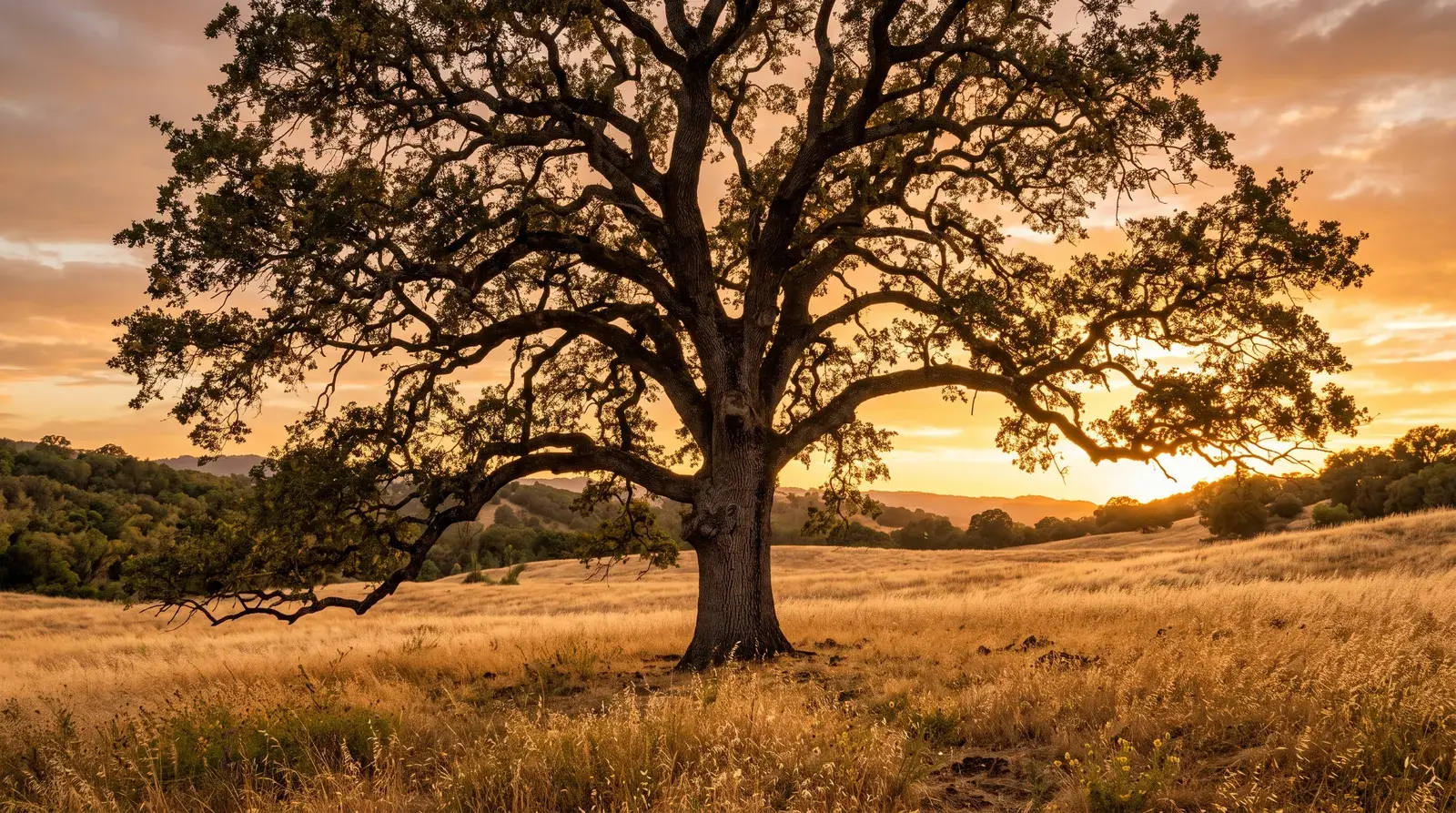
- Mature blue and interior live oaks — usually a deadwood and clearance visit every few years. Blue oaks are naturally sparse and drop leaves early in dry years, so thin does not always mean unhealthy.
- Valley oaks on the larger lots — heavy lateral limbs and mistletoe are the main concerns, and reduction is done in small stages.
- Ornamental pear, ash, and fruitless mulberry — the builder trees in Stanford Ranch and Sunset West. They split at weak unions, so end-weight relief and removal of crossing limbs help before the next big storm.
- Young street and yard trees in Whitney Ranch — pick a leader, remove rubbing limbs while they are thin, and keep them on a longer cycle. Annual trimming of young trees is usually wasted.
- Pines and redwoods on thin soil — shallow roots over rock mean wind sail matters. A trim can reduce the load, but a tree that has started to lean is a separate assessment.
Mature Oak Trim or Young-Tree Training: What Is the Difference?
These are different jobs with different goals. A mature oak trim protects what is already there, and young-tree training decides what the tree becomes. The cuts, the timing, and the price all differ, so we scope them separately and tell you which one your tree is actually getting before work starts.
If a tree is dead, leaning after a storm, or rotten at the base, trimming will not fix it. In that case we point you to tree removal in Rocklin and, if the stump needs to go, stump grinding.
Mature oak trim
Keep the tree, reduce the risk
- Dead and broken limbs removed
- Clearance over roofs, driveways, and play areas
- Light end-weight relief on long limbs
- Dry season or winter dormancy
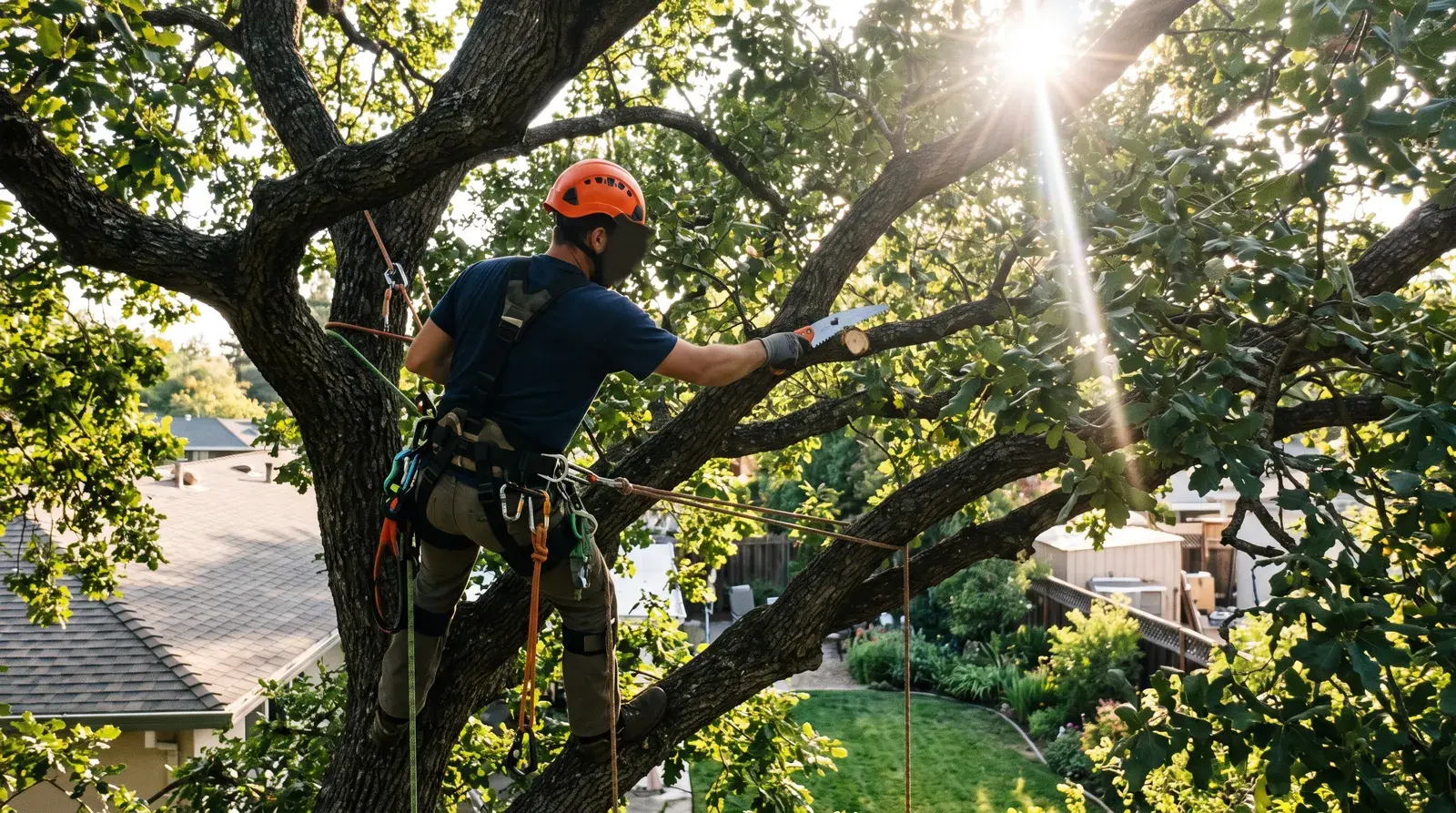
- Climbed or lifted, roped over targets
Tree Trimming in Rocklin — free, site-specific estimates.
How We Trim a Mature Oak Without Hurting It
The goal on a native oak is to leave the tree looking like we were never there. That means fewer, smaller cuts in the right places, made in the right season. Here is the order we work in on a typical Rocklin oak, from the first look to the final rake.
A typical oak trim takes a half day to a full day depending on size. You do not have to be home once the scope is agreed, though we are glad to walk the tree with you at the end. If you spot a limb we missed, tell us and we will take care of it.
Identify the species and measure
Blue oak, interior live oak, and valley oak are handled differently. We note the trunk diameter, since Rocklin's oak rules use size to decide what is protected.
Read the canopy
We look for dead limbs, cracks at unions, mistletoe, and long limbs with heavy ends, and decide what comes off and what stays.
Set the limit before climbing
On mature native oaks we keep live-canopy removal well under the 25% general limit, and usually far less.
Deadwood first
Dead limbs over a roof or patio are the priority. They can drop without wind.
Clearance and end-weight cuts
Every cut goes back to a live lateral or branch collar. No stubs, no topping, no lion-tailing.
Rig over targets
Limbs above a roof, fence, or pool are roped and lowered. The yard and the neighbor's fence are protected.
Clean up and walk it
Brush is chipped, wood is hauled or left stacked, and the roof and patio are blown clean.
Need tree trimming in Rocklin?
Share the address and project details — we'll come back with a scoped, site-specific estimate.
Do You Need a Permit to Trim an Oak in Rocklin?
Removal is the clear trigger: an oak 6 inches or larger needs a city permit before it comes down. Routine pruning is a different question, and heavy cuts that kill or badly damage an oak can turn into a removal problem, so check with the city's Planning Division before major work on a protected oak.
Rules change, so confirm current details with the City of Rocklin Planning Division. We check the species and size on every estimate and tell you if a trim could trigger anything. If a neighbor or an HOA sends a notice about an overhanging limb, bring it to the estimate and we will quote the exact scope it asks for. Ask for the scope in writing so you have a record of what was cut and why.
- Chapter 17.77 — Rocklin's Oak Tree Preservation chapter of the municipal code protects native oaks. The city's permit page says a permit is required before removing an oak 6 inches or larger in diameter at 4.5 feet above the root crown.
- Heritage-size oaks — the city treats oaks 24 inches or larger as heritage trees with higher mitigation. This matters if a bad trim causes a decline.
- Over-pruning is the risk — Heavy cuts that kill or fatally weaken an oak can turn into a removal problem. Stay within the guidelines and keep cuts small.
- Public trees — trees in the public right-of-way are managed by the city. Ask the city before paying for work on a street tree.
- HOA and design review — some Rocklin neighborhoods have HOA landscape rules, so check your CC&Rs and any violation letter.
- PG&E — Rocklin is served by PG&E. Limbs on primary lines are utility work, and our line clearance guide explains who to call.
The same crew from estimate to cleanup.
No juggling separate contractors for one tree. Tell us the address and what you're dealing with, and we'll come back with a written, site-specific number.
- Removal, trimming, stumps, and cleanup handled by one crew
- Free, site-specific estimates — priced to your tree, not a flat rate
- Sacramento, Placer, El Dorado, and Yolo counties
What Does Tree Trimming Cost in Rocklin, and When Is the Best Time?
As a broad regional guide, small ornamentals often run $150 to $450, mid-size trees $400 to $900, and large mature trees $900 to $2,500+. The right time is the dry season or winter dormancy for oaks, and winter for most deciduous trees.
Trimming usually costs far less than the problems it prevents: a dead limb through a roof, a split union over a fence, or a stressed oak that has to come out. These are ranges, not quotes. See our tree trimming cost guide and when to trim oak trees in California for more. For the full list of work we do in town, start at Rocklin tree service. Estimates are free, written, and site-specific.
- Size and height — a mature oak over a two-story roof takes more rigging than a young pear at the curb.
- Access — fenced Whitney Ranch backyards often mean carrying everything through a gate.
- Deadwood volume — years of deferred maintenance take longer to clear.
- Number of trees — trimming several trees in one visit lowers the per-tree cost.
- Season — late summer into winter for oaks; winter for deciduous structure work; deadwood over a target any time.
- Debris — chips left on site cost less than full haul-off, and oak rounds make good firewood if you want them stacked.
Related guides
When to Trim Oak Trees in California
The best window to prune native California oaks, why dry-season timing cuts disease risk, and the pruning mistakes that shorten an oak's life.
Keeping Trees Alive Through Sacramento Summers
Deep watering at the dripline, real mulch, and the heat-stress signs that matter — how Sacramento trees survive months of triple-digit heat.
Sacramento's Heritage Tree Ordinance, Explained
What makes a Sacramento tree a Heritage Tree, what City Code Chapter 12.56 protects, and how to get pruning or removal approved.
What tree trimming costs — and what Rocklin allows
Regional ranges, local permit rules, and the alternatives worth weighing before tree trimming in Rocklin.
How Much Does Tree Trimming Cost in Sacramento? (2026)
Regional range $300–$2,500 — and what moves the number on a real job.
Do You Need a Tree Removal Permit in Folsom?
Where Folsom draws the line before a tree comes down, and who to check with.
Crown Reduction vs. Topping: What's the Difference?
Crown Reduction or Topping — how to tell which one the tree actually needs.
Tree Service in Placer County, CA
Placer County spans flat valley suburbia in Roseville and Rocklin and rises through the oak-woodland foothills to ponde…
Crown Reduction Cost in the Sacramento Region (2026)
Regional range $500–$4,000 — and what moves the number on a real job.
Do You Need a Tree Removal Permit in Citrus Heights?
Where Citrus Heights draws the line before a tree comes down, and who to check with.
Want a sense of the work first? See the kinds of tree trimming jobs we take on and who shows up to do them.
Frequently asked questions
Do I need a permit to trim a tree in Rocklin?
Removing an oak 6 inches or larger in diameter needs a permit under Chapter 17.77. Light, routine pruning is a different matter, but confirm with the city's Planning Division before heavy work on a protected oak. Heavy cuts that kill an oak can create a removal problem, so we keep trims within the city's guidelines. Confirm current rules with the city.
How much of an oak can be trimmed at one time?
Less than most people think. Mature native oaks do best with light cuts, well under the 25% general limit for other trees. Deadwood, clearance, and light end-weight relief cover most jobs. Heavy thinning stresses an oak and can shorten its life, so we recommend staged work instead of one big cut.
When should I trim oaks in Rocklin?
Dry season or winter dormancy. Avoid wet weather, when fresh cuts are most open to disease, and avoid heavy canopy removal in peak summer heat. Deadwood over a roof or patio can be taken out any time, because dead limbs do not wait for a season. For bigger oak work, late summer through winter is our usual window.
Why are my Whitney Ranch trees splitting at the branches?
Weak unions. Young trees often grow two competing leaders, and bark gets trapped between them, so the union cannot hold in wind. Ornamental pear is the classic case. Small corrective cuts while limbs are still thin fix most of it. If a union has already cracked, a trim, cable, or removal may be needed, and we assess it during the free estimate.
Can you trim a tree near the power line to my house?
Yes for roof clearance and the service line to your home, with care. Rocklin is PG&E territory, and limbs on higher-voltage lines are for line-clearance-qualified crews or the utility. If a limb is on the primary lines, call PG&E first. We will tell you which is which when we walk the tree.