
Why El Dorado Hills Removals Are Different
The short answer: slope and oaks. El Dorado Hills lots drop away fast behind the pad, and the trees are heavy native hardwoods, not landscape ornamentals. That combination changes rigging, equipment, and price compared to a flat Sacramento yard.
- Steep rear yards — many homes in Serrano, Highland View, and along Green Valley Road sit on pads with the trees downslope. Wood has to be rigged uphill or winched, not just dropped and carried.
- Blue oak and interior live oak — dense, heavy wood with wide, low canopies. Live oaks especially carry big lateral limbs over roofs and pool decks.
- Gray pine — tall, top-heavy, and prone to snapping in wind; a common emergency call after winter storms.
- Gated access — Serrano and Blackstone gate codes, HOA notice, and street-parking rules get sorted before the crew shows up.
- Fire-season pressure — dead oaks and beetle-hit pines draw attention during defensible-space inspections, so summer removal calendars fill early.
El Dorado County Oak Rules Come First
El Dorado County has adopted oak woodland management rules, and larger projects that remove native oaks can trigger mitigation requirements. Single hazardous or dead trees are usually a simpler path, but verify before cutting — we flag the question on every estimate.
- Native oaks — blue oak, interior live oak, and valley oak are the species the county's oak framework cares about most.
- Dead and hazardous trees — generally the easiest case, but keep photos and documentation of the tree's condition before removal.
- Development and grading — removing multiple oaks for a project is a different conversation than one hazard tree; talk to El Dorado County Planning first.
- HOA layer — Serrano and other managed communities often want their own approval on top of anything the county requires.
- We put the ordinance and HOA answer in writing with the estimate so nothing gets cut on a bad assumption.
Tree Removal in El Dorado Hills — free, site-specific estimates.
How We Take Down Oaks on Sloped Lots
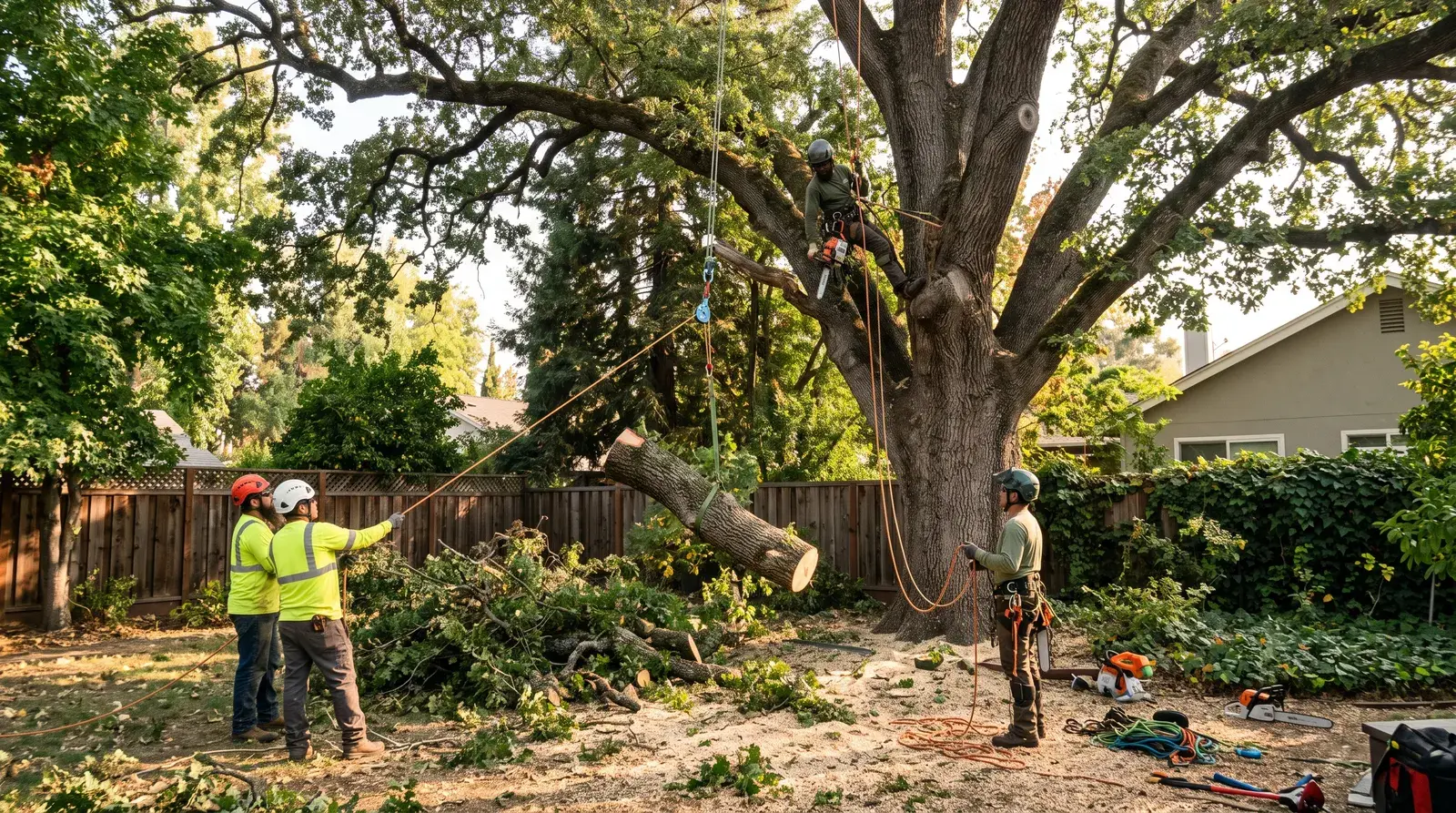
Everything comes down in controlled pieces. On El Dorado Hills grades we set lowering lines high, use friction devices to walk limbs down slowly, and stage wood where a machine or the crew can actually reach it — never rolling logs toward the house below.
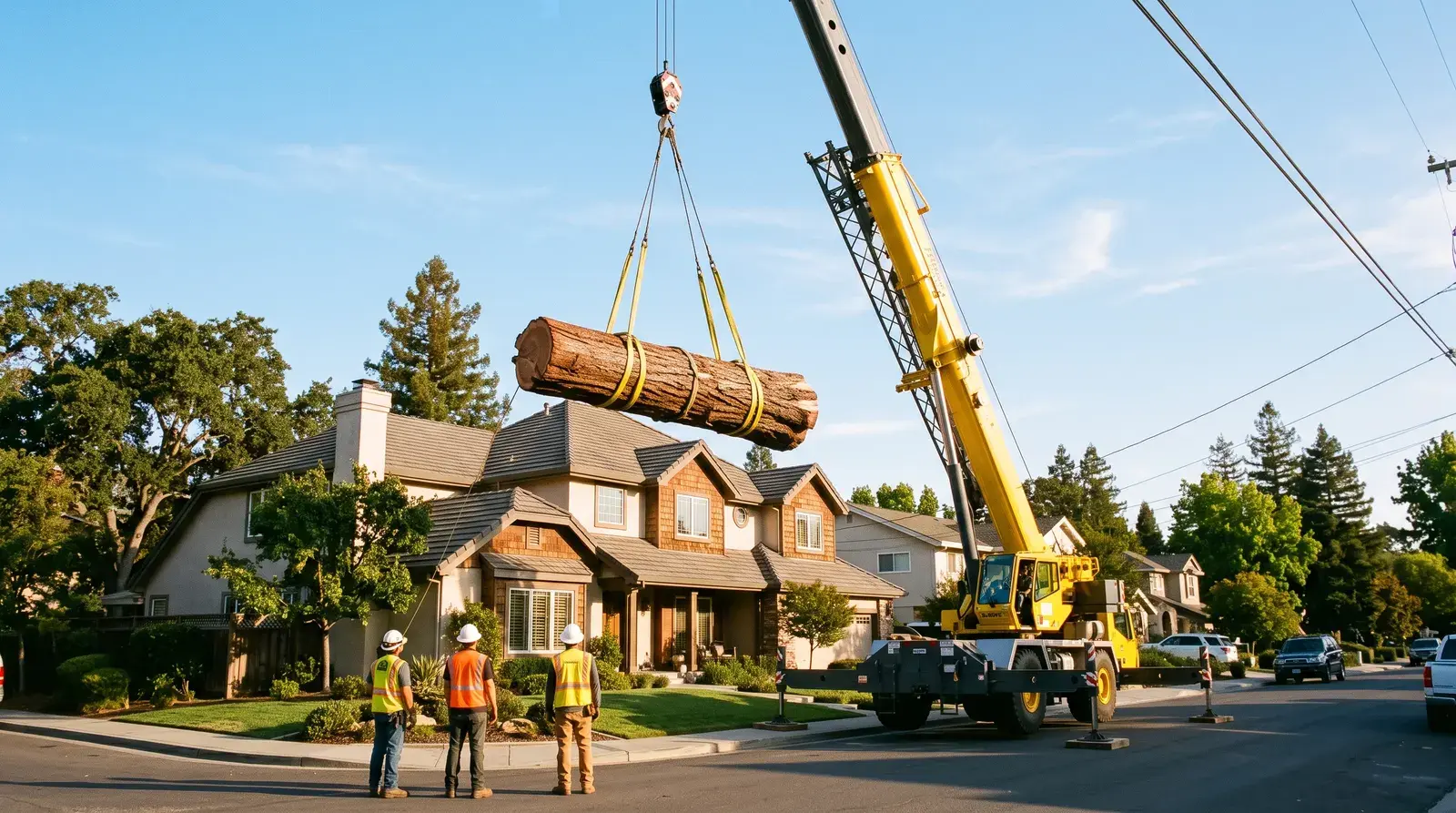
- Climb or lift — sound oaks get climbed; decayed trunks get worked from a lift or crane so nobody trusts bad wood.
- Rig away from targets — pools, glass, retaining walls, and iron fencing sit under half the canopies here; every limb is roped, not dropped.
- Slope-safe staging — logs are choked and winched uphill on steep sections instead of free-rolling.
- Ground protection — mats and plywood protect turf, pavers, and irrigation on the way out.
- Full cleanup — brush chipped, wood hauled or bucked for firewood, rake-out at the end. Stump grinding quoted as its own line.
What Tree Removal Costs in El Dorado Hills
As a broad regional range, most removals run $500–$2,500, and El Dorado Hills jobs skew toward the upper half because the trees are big oaks and the ground is rarely flat. Crane-assisted or severely decayed trees can exceed $5,000–$10,000+.
- Size and species — a 30-inch blue oak outweighs a landscape ash of the same height by a wide margin.
- Slope and access — downslope trees behind the house cost more than driveway-side trees; winching and carrying add labor hours.
- Targets — pool, spa, sport court, or neighbor's fence under the canopy means slower, piece-by-piece rigging.
- Condition — standing-dead oaks and beetle-killed pines are more dangerous to climb, which can push the job to a crane.
- Every quote is free, written, and based on a site walk — not a photo guess.
Need tree removal in El Dorado Hills?
Share the address and project details — we'll come back with a scoped, site-specific estimate.
Remove It or Save It?
Not every worrying oak needs to come down. A healthy live oak with too much end weight over the roof is a crown-reduction job, not a removal — and mature oaks are the reason El Dorado Hills lots look and appraise the way they do.
- Remove: standing dead blue oaks, trunks with major decay or cavities, fresh lean or root-plate lift after a storm.
- Remove: gray pines with dead tops or heavy beetle activity near structures.
- Save: healthy oaks needing weight reduction, clearance pruning, or cabling on a split co-dominant stem.
- Not sure? A tree health assessment costs far less than an unnecessary removal — and we'll tell you honestly which one you need.
The same crew from estimate to cleanup.
No juggling separate contractors for one tree. Tell us the address and what you're dealing with, and we'll come back with a written, site-specific number.
- Removal, trimming, stumps, and cleanup handled by one crew
- Free, site-specific estimates — priced to your tree, not a flat rate
- Sacramento, Placer, El Dorado, and Yolo counties
Pair Removal With Defensible Space Work
If a dead tree is coming out anyway, it usually makes sense to handle PRC 4291 zone clearance in the same mobilization — the chipper and crew are already on site, and one visit beats two on a gated-community schedule.
- Dead-tree removal plus Zone 1 (0–30 ft) limbing and brush clearing in one trip.
- Ladder-fuel pruning on the oaks you're keeping while the rigging gear is out.
- One combined haul-off instead of two debris bills.
- See our El Dorado Hills defensible space clearing page for the full zone-work breakdown.
Related guides
Do You Need a Permit to Remove a Tree in Sacramento?
Which Sacramento trees need a removal permit, how city and county rules differ, and how to check before the saw comes out.
How Much Does Tree Removal Cost in Sacramento? (2026)
Typical 2026 Sacramento tree removal price ranges by tree size, the factors that move the number, and how to read a quote before you sign it.
9 Signs a Tree Needs to Come Down
Nine warning signs a tree is hazardous or dying — and when removal is safer than trying to save it.
What tree removal costs — and what El Dorado Hills allows
Regional ranges, local permit rules, and the alternatives worth weighing before tree removal in El Dorado Hills.
Emergency Tree Service Cost in Sacramento (2026)
Regional range $800–$8,000 — and what moves the number on a real job.
Do You Need a Tree Removal Permit in Citrus Heights?
Where Citrus Heights draws the line before a tree comes down, and who to check with.
Tree Pruning vs. Removal: When to Save a Tree and When to Take It Down
Pruning or Removal — how to tell which one the tree actually needs.
Tree Service in El Dorado County, CA
El Dorado County runs from the Sacramento Valley edge at El Dorado Hills up through Placerville and into Pollock Pines…
Crane-Assisted Tree Removal Cost in Sacramento (2026)
Regional range $2,500–$12,000 — and what moves the number on a real job.
Do You Need a Tree Removal Permit in Rancho Cordova?
Where Rancho Cordova draws the line before a tree comes down, and who to check with.
Want a sense of the work first? See the kinds of tree removal jobs we take on and who shows up to do them.
Frequently asked questions
Do I need a permit to remove an oak tree in El Dorado Hills?
It depends on the situation. El Dorado County has oak woodland management rules, and removing native oaks — especially multiple trees or removals tied to grading and development — can trigger county requirements. A single dead or hazardous oak is usually a simpler path, but document its condition with photos first. Serrano, Blackstone, and other HOA communities typically add their own approval step. We check both the county question and the HOA question during the free estimate.
How much does tree removal cost in El Dorado Hills?
Broad regional range: $500–$2,500 for most residential trees, with El Dorado Hills jobs often landing in the upper half because mature blue and live oaks are heavy and lots are steep. A large oak on a downslope over a pool, or a decayed tree that needs a crane, can exceed $5,000–$10,000+. Slope, access, and targets under the canopy drive the number more than height alone, so we quote from a site visit. Estimates are free.
Can you remove a tree on a steep slope behind my house?
Yes — that describes a large share of our El Dorado Hills work. We rig limbs down on lowering lines, choke and winch logs uphill instead of letting wood roll toward the house below, and carry or track debris out along a planned route. Steep-lot removals take more labor than flat-ground work, which the estimate will reflect, but the tree comes down without wrecking the slope, the irrigation, or the retaining wall.
My oak died during the drought — is it dangerous to leave standing?
A standing-dead blue oak gets more brittle every season, and dead oaks shed large limbs without warning — usually in the first winter windstorm, sometimes on a still summer day. If it can reach a structure, driveway, or play area, plan the removal before storm season rather than after. Dead trees are also flagged during defensible-space inspections in El Dorado Hills. The longer it stands, the more dangerous it is to climb, which can push the job from a standard removal to a crane job.
Do you handle HOA requirements in Serrano and Blackstone?
We work inside gated and HOA-managed communities regularly. You (or your property manager) submit the HOA application since it has to come from the owner, but we supply what the application usually needs: a written scope, the reason for removal, and photos of the tree's condition. On the day of the job we coordinate gate access, street parking for the chip truck, and haul-off timing so the work doesn't generate a compliance letter.