
When Is Removal the Right Call?
Remove a tree when it is dead, structurally failing, or a risk that pruning cannot fix. Trimming helps a sound tree. It does nothing for a tree whose trunk, roots, or crown have already failed.
Placerville trees get large, and the cost of a wrong guess is high. A tree that looks fine from the street can be hollow at the base, while one that looks ragged can be a sound tree with a few dead limbs. We look at the base, the root flare, the trunk, and the crown, and we note what is below the tree. If a tree can be saved with a trim, we will say so, even though that is a smaller job.If you are not sure whether a tree needs to come out, a free look is cheaper than a guess. We will tell you when trimming is enough, and point you to tree trimming in Placerville when that is the right job.
- Dead or beetle-killed ponderosa — a crown that has gone red will not recover, and dead pines get brittle fast.
- Trunk cracks, large cavities, or fungal conks at the base — signs of decay inside.
- Leaning trees with soil heaving or fresh root exposure at the base, especially after a wet winter.
- Storm damage — split trunks, torn-out limbs, and trees hung up on other trees.
- Wrong place — trees too close to a foundation, septic, or roofline to prune around.
- Repeated limb drops — a tree that keeps shedding large limbs is telling you the structure is failing.
How We Take a Tree Down on a Placerville Lot
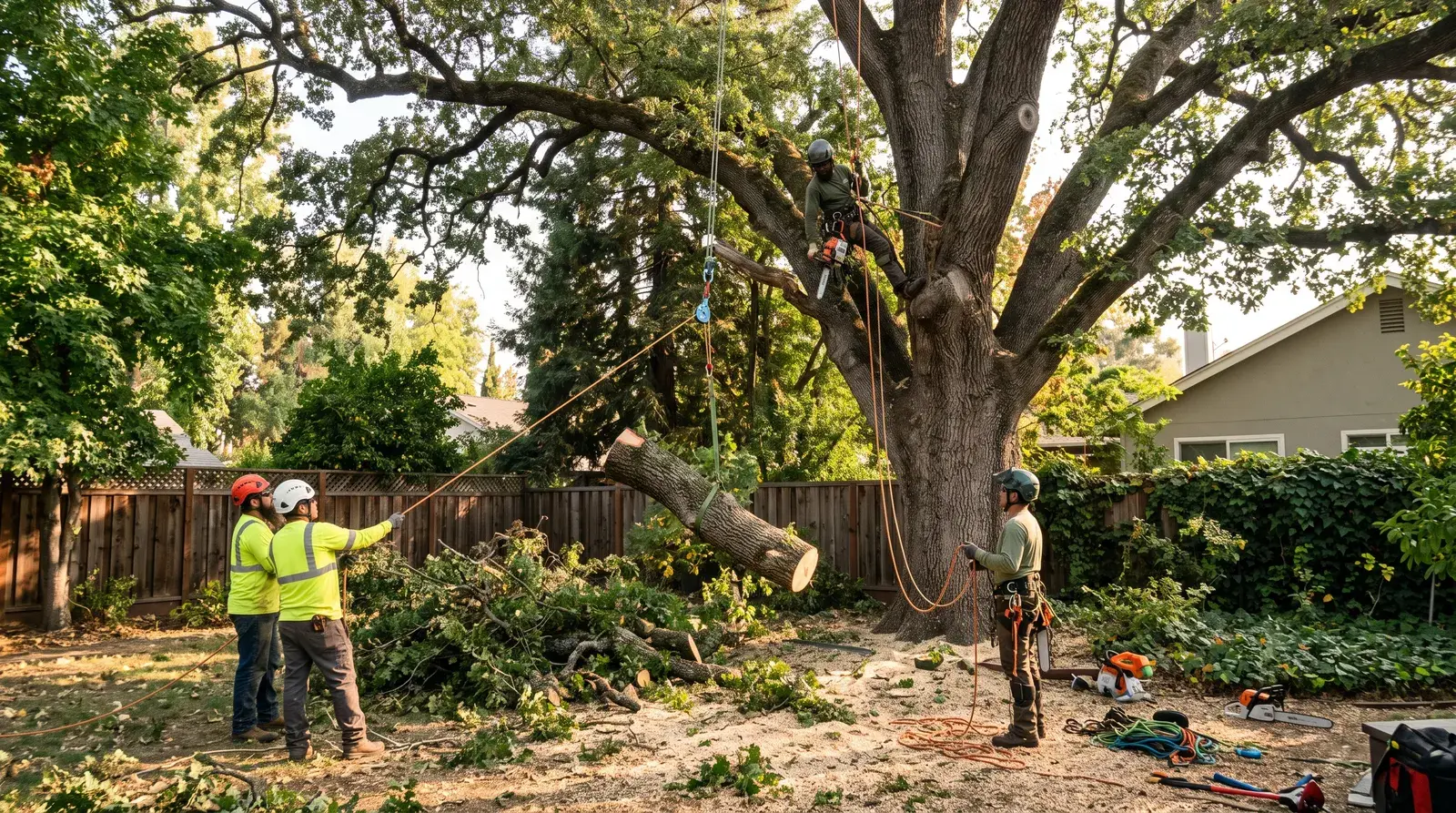
Most Placerville removals are done in pieces, not felled whole. Slope, structures, and neighbors leave no room to drop a tree in one cut.
On steep Placerville lots, the stump often matters more than the tree. A stump and root mass can hold a slope together, so grinding is a choice we talk through, not an automatic add-on. Where a tree sits above a structure, we may leave a tall stump or a low stump until the roots settle, and we will explain the tradeoff in the estimate.
Site walk
We check the tree, the lean, the targets below it, and where the wood and brush can stage.
Written estimate
Scope, cleanup, and stump options in writing before any work is scheduled.
Permit and jurisdiction check
City, county, or neither, flagged before the first cut.
Climb and rig
A climber sets lines so every section is controlled on the way down.
Section down
Limbs first, then the trunk in lengths sized for the terrain.
Clean-up
Brush chipped, wood hauled or left cut to length if you want firewood, site raked.
Stump decision
Grind it, leave it low for a later grind, or leave it for erosion control on a slope.
Tree Removal in Placerville — free, site-specific estimates.
Do I Need a Permit to Remove a Tree in Placerville?
It depends on who has jurisdiction and what kind of tree it is. Placerville has two layers of rules, and which one applies depends on where your lot sits.
Placerville sits where the city, the county, and several special districts meet, and a lot a mile apart can fall under a different set of rules. The official sources are the City of Placerville code library and El Dorado County Planning; they, not a tree crew, decide what applies to you. We flag likely permit issues at the estimate. The property owner is responsible for approvals, and we would rather wait a week for paperwork than cut a tree that should not have come down.
- Street and right-of-way trees — city jurisdiction, not the homeowner's call.
- Native oaks on unincorporated parcels — county ordinance may apply; check before you cut.
- Dead or hazardous trees — documentation helps. Photos or an arborist report make a request smoother. See our arborist reports service.
- Nesting season and utility lines — pause and ask before starting near either.
- HOA or historic district — some neighborhoods have their own rules; check before you schedule.
Need tree removal in Placerville?
Share the address and project details — we'll come back with a scoped, site-specific estimate.
Dead Pines, Black Oak, and Other Trees We Remove Here
The Placerville canopy is a mix of conifer and oak, and each type fails differently. Knowing what yours is doing is half the diagnosis.
Many Placerville removals start with an insurance letter, a failed inspection, or a close call during a storm. The estimate lists what the tree is, why it needs to come out, and what the crew will do about the wood, stump, and brush. That paper trail helps with insurers and neighbors, and it keeps the job on scope.After a storm, a tree that is hung up, split, or leaning on a roof is a hazard to work around. Call before you climb or cut it yourself. Our storm damage cleanup service handles those jobs.
- Ponderosa and gray pine — bark beetles follow drought stress. Our bark beetle guide for the Sierra foothills explains the warning signs.
- Incense cedar — dense, heavy crowns that can tip over when the ground is saturated, and low foliage that hides decay at the base.
- California black oak — heavy laterals and internal decay; large limbs can fail without warning.
- Blue oak and interior live oak — slow to decline, so check permits first, then structure.
- Storm-damaged trees — split trunks and hung-up limbs should be treated as hazards, not DIY projects.
- Fire-prone conifers near homes — if the goal is clearance, see defensible space in Placerville, which covers PRC 4291 zones and inspections.
The same crew from estimate to cleanup.
No juggling separate contractors for one tree. Tell us the address and what you're dealing with, and we'll come back with a written, site-specific number.
- Removal, trimming, stumps, and cleanup handled by one crew
- Free, site-specific estimates — priced to your tree, not a flat rate
- Sacramento, Placer, El Dorado, and Yolo counties

What Does Tree Removal Cost in Placerville?
Removal is priced by tree size, access, and risk, not by the hour on site. As a broad regional range, most Sacramento-region removals run $500–$2,500. Tall conifers and steep access in Placerville tend to land in the upper bands.
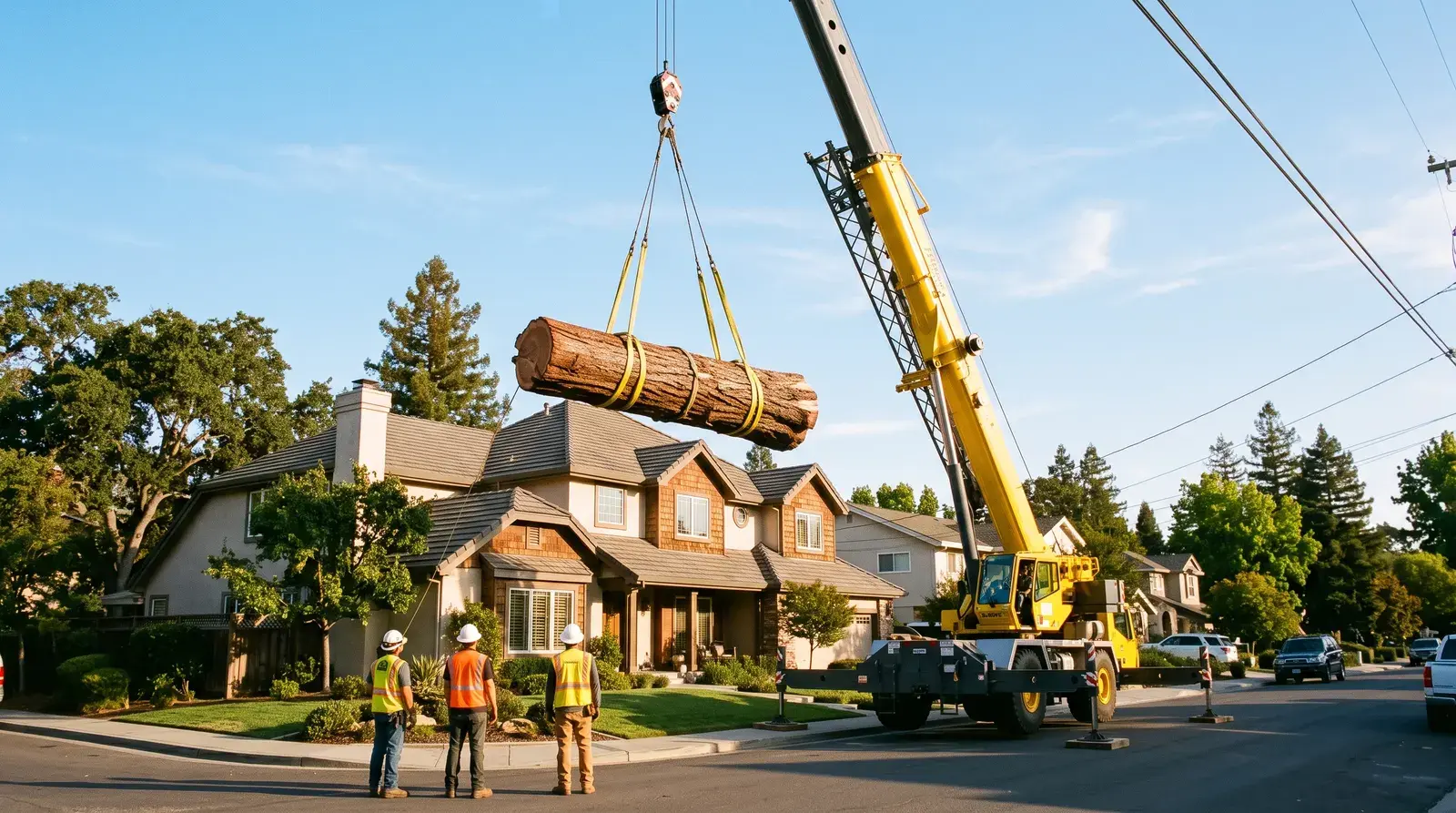
These are regional ranges, not quotes. Our written estimate is free and site-specific. It lists haul-away and stump grinding as separate lines so you can compare. Dead conifers usually cost more than live ones of the same size because they cannot be climbed as freely, and a tree sitting over a house costs more than the same tree in an open yard. When a tree sits where no truck can reach, ask about crane tree removal.
- Small trees
- $500–$900
- Mid-size trees
- $900–$2,500
- Large or complexTall pines, crane-assisted, or tight access
- $2,500–$10,000+
Related guides
Do You Need a Permit to Remove a Tree in Sacramento?
Which Sacramento trees need a removal permit, how city and county rules differ, and how to check before the saw comes out.
How Much Does Tree Removal Cost in Sacramento? (2026)
Typical 2026 Sacramento tree removal price ranges by tree size, the factors that move the number, and how to read a quote before you sign it.
9 Signs a Tree Needs to Come Down
Nine warning signs a tree is hazardous or dying — and when removal is safer than trying to save it.
What tree removal costs — and what Placerville allows
Regional ranges, local permit rules, and the alternatives worth weighing before tree removal in Placerville.
Emergency Tree Service Cost in Sacramento (2026)
Regional range $800–$8,000 — and what moves the number on a real job.
Do You Need a Tree Removal Permit in Citrus Heights?
Where Citrus Heights draws the line before a tree comes down, and who to check with.
Tree Pruning vs. Removal: When to Save a Tree and When to Take It Down
Pruning or Removal — how to tell which one the tree actually needs.
Tree Service in El Dorado County, CA
El Dorado County runs from the Sacramento Valley edge at El Dorado Hills up through Placerville and into Pollock Pines…
Crane-Assisted Tree Removal Cost in Sacramento (2026)
Regional range $2,500–$12,000 — and what moves the number on a real job.
Do You Need a Tree Removal Permit in Rancho Cordova?
Where Rancho Cordova draws the line before a tree comes down, and who to check with.
Want a sense of the work first? See the kinds of tree removal jobs we take on and who shows up to do them.
Frequently asked questions
How do I know if my Placerville pine needs to come out?
Look at the crown. Needles turning yellow, then red-brown, along with pitch tubes or sawdust at the trunk, point to bark beetles. Once a crown has gone red, the tree will not recover. If it stands near a house, driveway, or power line, take it down while it can still be climbed safely. We will check it and tell you if it is worth waiting on.
Can you remove a tree on a steep lot where equipment cannot reach?
Yes. Most Placerville removals are rope-and-climb jobs. A climber rigs each section, lowers it under control, and the crew carries or drags wood and brush to where the chipper and truck can reach. Slope and access add time, so they affect the price, which is why we walk the lot before quoting.
Does Placerville require a permit to remove a tree?
It depends on the tree and the parcel. The City of Placerville addresses tree removal in Title 8, Chapter 13 of its code, and trees in the public right-of-way are city jurisdiction. Outside city limits, El Dorado County's Oak Resources Conservation Ordinance regulates native oaks. Confirm with City Development Services or County Planning before removal, and we will flag likely issues at the estimate.
Do you grind the stump and haul everything away?
Yes, both are options. The estimate lists tree removal, haul-away, and stump grinding as separate lines. Some Placerville homeowners keep the cut wood for firewood, and we can leave it cut to length. Stump grinding on slopes or rocky foothill soil takes longer than on flat ground, so we quote it after seeing the stump.
What does tree removal cost in Placerville?
As a broad regional range, most removals run $500–$2,500, and large or crane-assisted jobs can exceed $5,000–$10,000+. Placerville jobs often sit toward the upper end because of tall conifers and steep access. Size, lean, decay, and where the crew can park decide the number. We give a free, written, site-specific estimate after walking the property.