
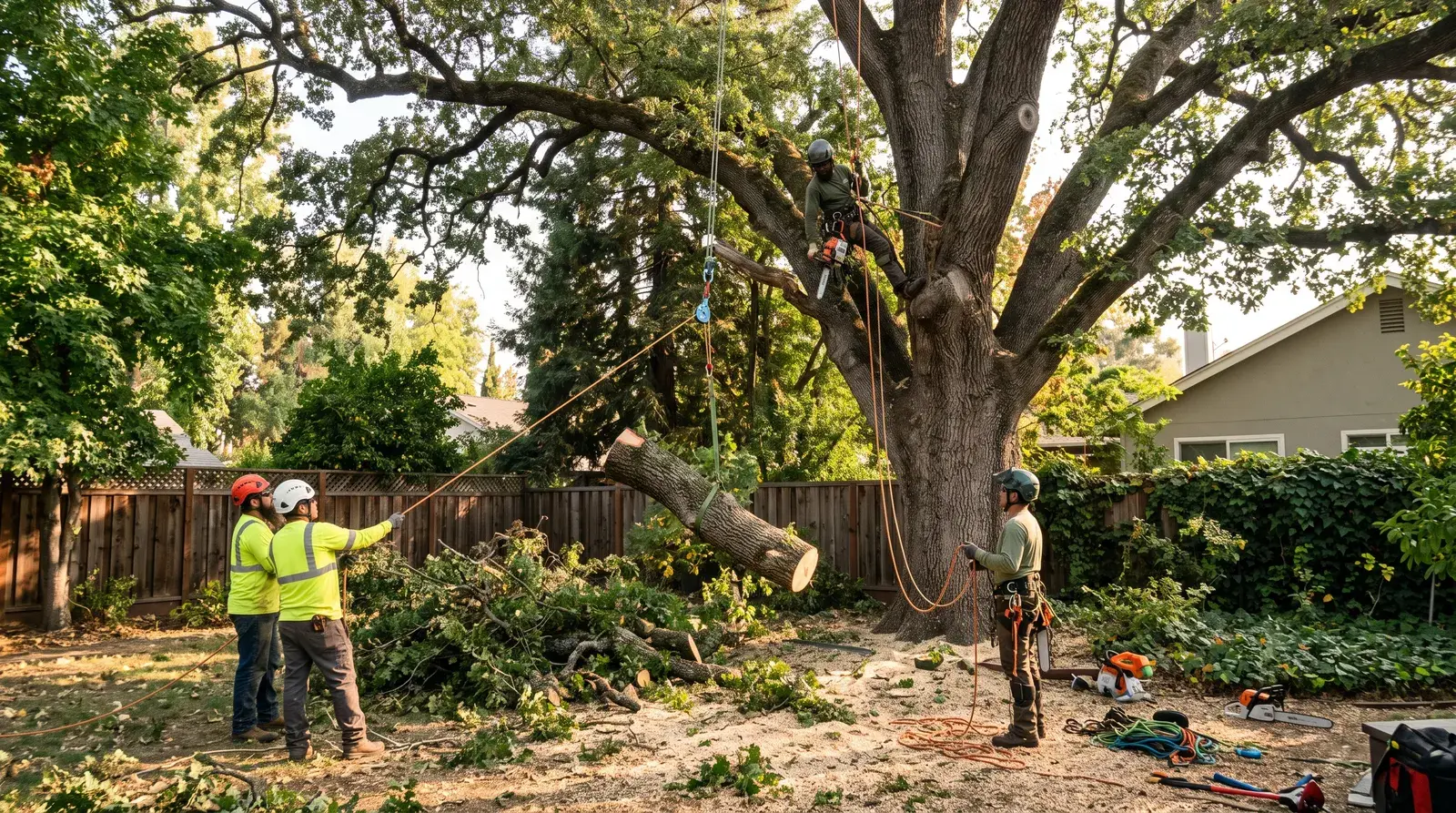
Subdivision Trees at the Maturity Crossroads
Antelope's neighborhoods were built in waves from roughly 1985 through 2005. Trees planted at construction — often two-inch-caliper starters — are now 20 to 40 years old. That age bracket is where subdivision trees either establish themselves as sound, long-term canopy or reveal the structural defects that were always there. In Antelope, both outcomes are common, and the removal side of that equation is busy.
- Ornamental pears — Bradford pear and its relatives — were planted across Antelope in enormous quantities during the 1990s and 2000s. They grow fast, look good in the nursery, and split at the crown with almost no warning once they reach maturity. A pear with co-dominant stems and included bark at the union is a storm-away from a half-tree failure.
- Raywood ash and other ash varieties were another standard Antelope subdivision tree. Many are in decline, showing thinning crowns and dieback from branch tips inward — a pattern that typically ends in removal rather than recovery.
- Crape myrtles were planted in huge numbers as street and parkway trees. Some have been chronically 'crape murdered' — topped repeatedly until they're a mass of knobby regrowth with no real structure. Those trees are usually better removed and replaced than continued on that maintenance path.
- Chinese pistache is one of the better-performing Antelope subdivision trees and often worth keeping with structural pruning. When one does need to come down, they're manageable-sized jobs compared to a mature oak.
- Preserved valley oaks on or near Antelope lots predate the subdivisions — these are the trees worth the most care and the most permit scrutiny. Oak removal here is never casual.
Permits: Sacramento County's Oak Ordinance Is the One That Applies
Antelope is unincorporated Sacramento County. There is no city government and no city urban forestry program, so the permit question goes to Sacramento County — and the county's native oak ordinance is what governs protected trees on private lots here. For most Antelope removals the answer is that no permit is needed at all.
- Sacramento County's native oak ordinance covers valley oak, interior live oak, and blue oak above the county's size thresholds. Removing a protected native oak without county authorization is a code violation.
- Most Antelope subdivision trees are not protected. Ornamental pear, ash, crape myrtle, Chinese pistache, and liquidambar are non-native landscape species and generally come out without a permit.
- Street trees in the county right-of-way — the strip between the sidewalk and the curb — belong to Sacramento County, not to you, even though you maintain the grass around them.
- Dead and hazardous oaks usually have a faster path, but document the condition with photos before the work rather than after.
- One boundary note: Antelope's northern edge sits directly on the Placer County line. If your parcel is right at that edge it is worth confirming on the county parcel map or your tax bill — but a property inside Antelope is a Sacramento County parcel.
- 916 Trees checks whether your tree is a protected species on every Antelope estimate, so the permit question is settled before anything is scheduled.
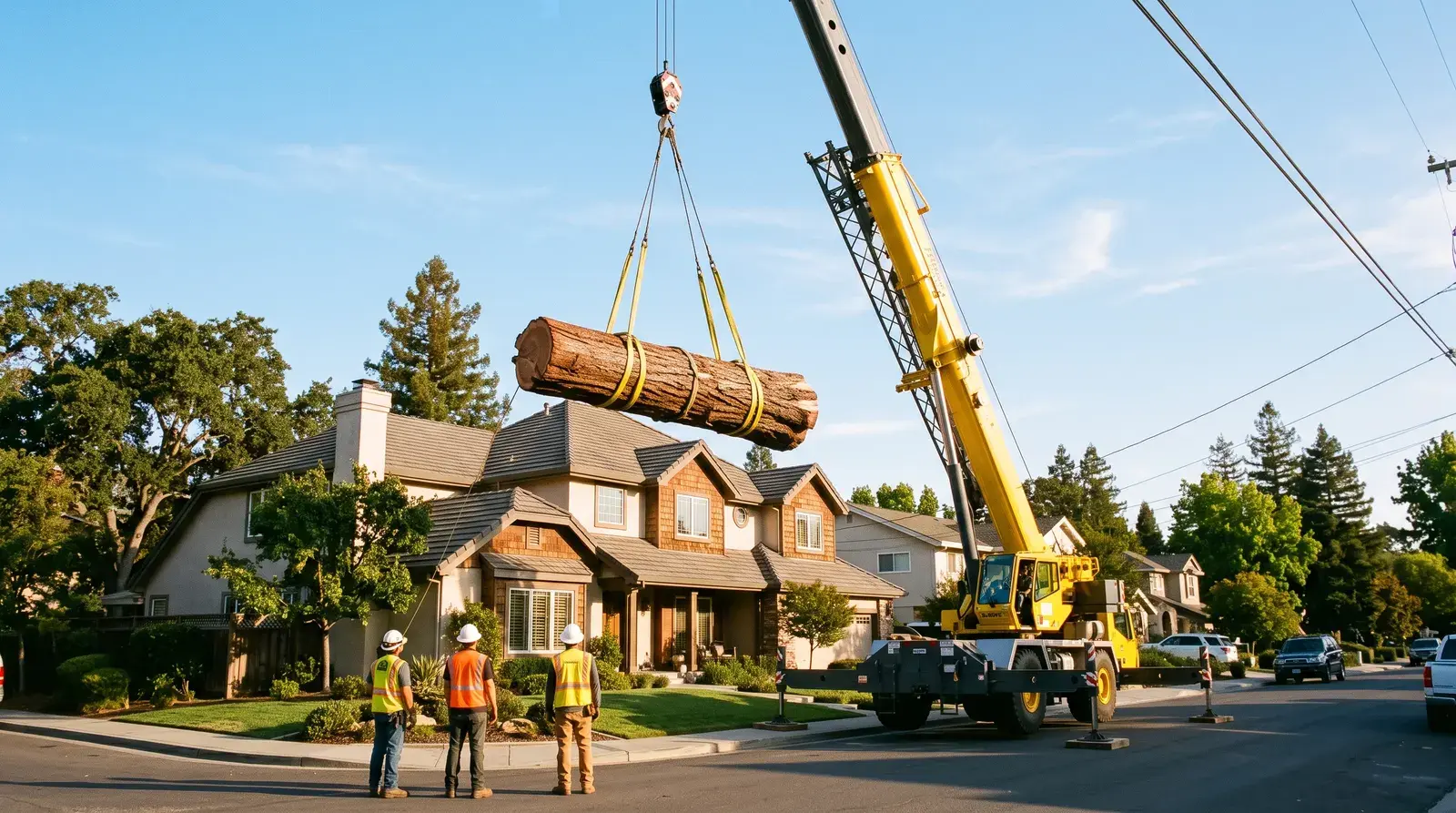
Tree Removal in Antelope — free, site-specific estimates.
Ornamental Pear Failures: Antelope's Most Common Removal
Bradford pear and Callery pear varieties are the dominant removal driver in Antelope — planted everywhere in the 1990s, hitting structural failure age now, and generating splits that destroy fences, crush patio covers, and block driveways with the mess of a mature tree that went over fast.
The problem with Bradford pear is architectural: the variety was bred for a tight, upright form, which produces multiple co-dominant stems arising from nearly the same point on the trunk. As those stems grow to diameter, they compress bark between them rather than forming a solid union — creating included bark, one of the strongest predictors of branch and stem failure in trees. A pear at 20-to-30 years old with two or three major co-dominant stems of similar diameter is under significant splitting pressure. The failure, when it comes, is fast and complete — half the tree goes at once, usually in a wind event or under the weight of an ice storm. Antelope's pears that haven't failed yet mostly show the signs if you look for them: bark folding inward at the main crotch, stems that push against each other, and crowns that have widened beyond the narrow form the tree started with. A failing pear is straightforward to remove; the question is whether to schedule it before the failure or after. Before is always cheaper.
Ash Decline, Crape Myrtle, and the Rest of the Builder Palette
Pears get the attention because they fail dramatically, but they are not the only 1990s Antelope planting reaching the end of its useful life. The rest of the builder palette is aging out on its own schedule, and each species fails differently enough to change the recommendation.
- Raywood ash — planted heavily here and now showing the classic decline pattern: thinning crown, dieback advancing from the branch tips inward, and limbs shedding in wind. Once dieback is well into the scaffold limbs, pruning buys a season or two while the hazard stays put. That is usually a removal-and-replant conversation rather than a maintenance one.
- Crape myrtle — rarely dangerous, frequently ruined. Decades of topping produce a knobby multi-stem mass with no real structure and a crown that flops over in every rain. Some can be brought back with several years of corrective pruning; the ones cut to the same knuckles every winter are usually better removed and replaced.
- Chinese pistache — the best performer in the builder palette. Structural pruning while it is young prevents most of what goes wrong with the pears, and a pistache that does need removal is a manageable job next to a mature oak.
- Liquidambar — planted in some Antelope tracts and a steady source of removal calls for surface roots lifting driveways and sidewalks rather than for any structural danger. Root management sometimes solves it short of removal.
- Fruitless mulberry — fast, weak-wooded, and worth watching wherever it sits over a patio or a parked car.
- Replanting matters more here than most places. A street where every pear came out and nothing went back in gets measurably hotter and loses the shade that kept cooling bills down — our tree planting service covers right-tree-right-place replacements sized for a subdivision parkway.
Need tree removal in Antelope?
Share the address and project details — we'll come back with a scoped, site-specific estimate.
Native Oaks in a Subdivision Setting
Valley oaks and interior live oaks that preexisted Antelope's subdivisions sometimes appear as preserved trees within or at the edges of residential lots — saved when the grading stopped short of them. These trees are decades to centuries older than the houses around them and are the most protected and most valuable trees in the community. They're also under the most stress from subdivision infrastructure.
- Grade changes during construction alter drainage patterns that mature oaks depend on. Trees that were on well-drained ground before grading can end up in areas with changed runoff, affecting root zone health over years.
- Irrigation from lawns and landscaping adds moisture that native oaks — adapted to dry Sacramento Valley summers — didn't evolve with. Chronic wet-summer root zones stress valley oaks over time, sometimes showing up as decline decades after a house was built.
- Native oaks are protected under Sacramento County's ordinance, and the protection follows the tree regardless of the subdivision plat around it. Removal requires county authorization regardless of the tree's age or the lot's development status.
- Sound preserved oaks are worth a tree health assessment rather than removal — a declining oak may be recoverable with adjusted irrigation and corrective pruning, and a thriving one should stay.
- When an oak genuinely needs to come down — death, structural failure, root plate compromise — we document the condition fully and walk the Sacramento County permit process with you.
The same crew from estimate to cleanup.
No juggling separate contractors for one tree. Tell us the address and what you're dealing with, and we'll come back with a written, site-specific number.
- Removal, trimming, stumps, and cleanup handled by one crew
- Free, site-specific estimates — priced to your tree, not a flat rate
- Sacramento, Placer, El Dorado, and Yolo counties

What Tree Removal Costs in Antelope
As broad regional figures, most residential subdivision-tree removals in Antelope run $400–$2,000. Ornamental pears, ash, and crape myrtles at standard subdivision sizes are the lower end of that range; mature preserved oaks, crane-assisted work, or tight-access backyard jobs push toward the top and beyond.
- Pear and ash removals at typical Antelope sizes are usually straightforward — felled or sectioned, chipped, and cleared in a half-day for a single tree with reasonable access.
- Size matters more than species for the price: a large crape myrtle that was never properly maintained and is now 30 feet of multi-trunk chaos is a bigger job than it looks from the street.
- Access is the other major variable — a backyard stump behind a locked gate with no side-yard passage adds hours; an open front-yard tree with chip truck access is the easiest version of any removal.
- Preserved valley oaks that require county permits may carry application and arborist report costs on top of the removal — we flag those at the estimate so the full cost is clear before any work begins.
- Estimates are free, written, and based on a site visit. Antelope tree prices quoted by phone or photo are usually wrong in one direction or the other.
Related guides
Do You Need a Permit to Remove a Tree in Sacramento?
Which Sacramento trees need a removal permit, how city and county rules differ, and how to check before the saw comes out.
How Much Does Tree Removal Cost in Sacramento? (2026)
Typical 2026 Sacramento tree removal price ranges by tree size, the factors that move the number, and how to read a quote before you sign it.
9 Signs a Tree Needs to Come Down
Nine warning signs a tree is hazardous or dying — and when removal is safer than trying to save it.
What tree removal costs — and what Antelope allows
Regional ranges, local permit rules, and the alternatives worth weighing before tree removal in Antelope.
Emergency Tree Service Cost in Sacramento (2026)
Regional range $800–$8,000 — and what moves the number on a real job.
Do You Need a Tree Removal Permit in Citrus Heights?
Where Citrus Heights draws the line before a tree comes down, and who to check with.
Tree Pruning vs. Removal: When to Save a Tree and When to Take It Down
Pruning or Removal — how to tell which one the tree actually needs.
Tree Service in Sacramento County, CA
Tree work in Sacramento County ranges from removing aging valley oaks in East Sacramento to grinding stumps on new-buil…
Crane-Assisted Tree Removal Cost in Sacramento (2026)
Regional range $2,500–$12,000 — and what moves the number on a real job.
Do You Need a Tree Removal Permit in Rancho Cordova?
Where Rancho Cordova draws the line before a tree comes down, and who to check with.
Want a sense of the work first? See the kinds of tree removal jobs we take on and who shows up to do them.
Frequently asked questions
Which county issues tree removal permits in Antelope?
Sacramento County. Antelope is an unincorporated community in Sacramento County — there is no city government, so no city ordinance applies, and there is no second county to check. Sacramento County's native oak ordinance covers valley oak, interior live oak, and blue oak on private parcels, and the county's planning and code departments handle the applications. Antelope's northern edge does sit directly on the Placer County line, so if your property is right at that boundary it is worth confirming on the county parcel map or your tax bill. For a parcel inside Antelope, the answer is Sacramento County. We settle the species and permit question at the free estimate before anything is scheduled.
Do ornamental pears need a permit to remove in Antelope?
No — ornamental pears (Bradford pear, Callery pear, and their variants) are non-native, non-protected species. Sacramento County's native tree ordinance covers native oaks, not ornamental pears, so you can remove a pear without a permit. The permit question only arises when the tree is a protected native species — primarily valley oak, interior live oak, and blue oak. If you have a pear that needs to come down, we schedule it without a permit process. If you have a pear removal and want to confirm there's no protected oak nearby that's in question, we sort that out at the estimate.
How much does tree removal cost in Antelope?
As a broad regional range, most Antelope subdivision-tree removals run $400–$2,000. Ornamental pears and ash at typical residential sizes usually land in the lower-to-middle end of that range. Larger jobs — a preserved valley oak, a multi-trunk crape myrtle that grew unchecked for 30 years, or a backyard tree with difficult access — run toward the upper end and sometimes beyond. Protected native oaks may carry county permit and arborist documentation costs on top of the removal fee. Every estimate is free and site-specific.
My Bradford pear has two big stems that split apart from each other at the crotch. Should I cable it or just take it down?
Depends on the specifics, but most mature Bradford pears with significant co-dominant stems and included bark at the main crotch are better removed than cabled. Cabling extends the life of a structurally sound tree with one defect; it doesn't fix a pear whose fundamental architecture is the problem. If the stems are already moving against each other or there's visible bark fold at the crotch, the included bark has been building pressure for years and the cable would be managing — not correcting — an ongoing failure in progress. A site assessment gives you an honest answer about whether your specific tree is a cable candidate or a removal call. Most 25-to-30-year-old Bradford pears in Antelope that we look at fall in the removal column.
There's a big old oak on my Antelope lot that was there before the houses were built. What do I need to know?
That it's protected, and that the protection applies regardless of the subdivision plat around it. Valley oaks and live oaks of any real size are covered under Sacramento County's native tree ordinance — verify the current thresholds with the county before anything is scheduled. Removal requires authorization before the tree comes down, and the county's process typically wants documentation of the tree's condition. The good news: if the oak is sound, it's probably worth keeping. Preserved pre-subdivision valley oaks are the most valuable trees in any Antelope yard — no amount of new-planting catches up to a mature oak in your lifetime. We assess health, flag the permit process, and give you an honest read on whether removal is actually necessary.