
Tree Service in Antelope, CA
Tree removal, trimming, pruning, stump grinding, and emergency response for Antelope and the surrounding Sacramento County. Free, site-specific estimates.
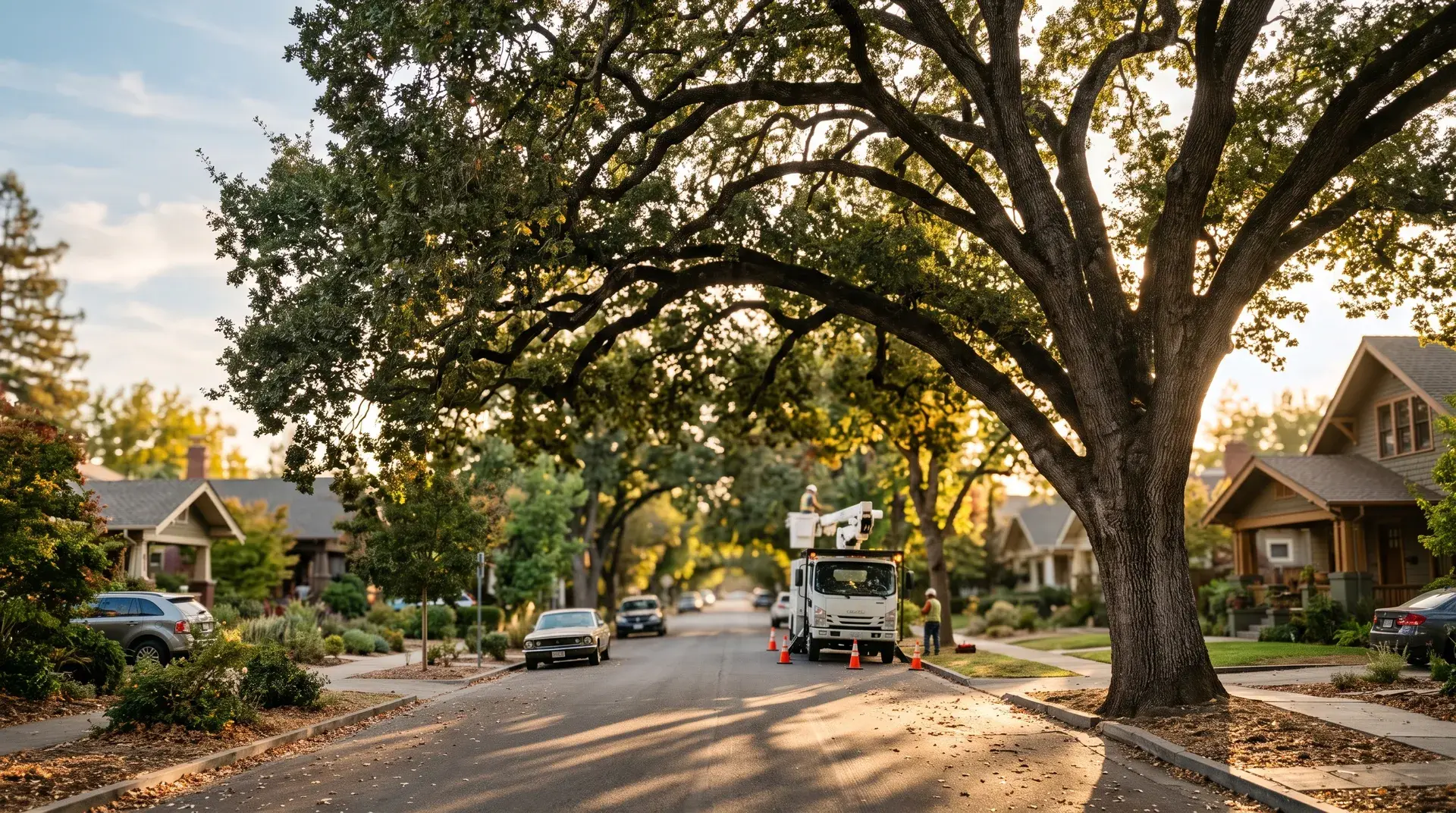
Antelope built out fast in the late 1980s and 1990s, and its canopy is aging in lockstep. The ornamental pears, ash, Chinese pistache, and crape myrtles planted with the subdivisions off Antelope Road, Walerga Road, and Elverta Road are now 25 to 35 years old — prime failure age for pears and other fast growers with tight branch unions, which is why every serious winter windstorm leaves split trees on lawns from Antelope Creek to the Roseville line. The other side of Antelope's tree story runs along Dry Creek, where remnant valley oaks and interior live oaks predate the rooftops; those natives are protected under Sacramento County's tree preservation ordinance, and work on them needs to account for it. Because Antelope is unincorporated county — not Roseville, despite sharing a border and a zip-code reputation — the county's rules are the ones that apply. We prune the subdivision trees before they fail, remove the ones already past saving, and grind the stumps so the front yard is plantable again.
Tree services in Antelope
Every 916 Trees service is available across Sacramento County.
Tree Removal
Safe removal of hazardous, dead, or unwanted trees — including permit help, cleanup, and haul-off across the Sacramento region.
Emergency Tree Service
Fast response for storm-damaged, fallen, or hazardous trees threatening homes, cars, and power lines across the Sacramento area.
Crane-Assisted Tree Removal
Crane-assisted removal for large, dead, or hazardous trees where tight access or overhead risk rules out a conventional takedown.
Palm Tree Removal
Removal and haul-off of Mexican fan palms and other species — including the tall, heavy palms common in older Sacramento neighborhoods.
Storm Damage Cleanup
Cleanup after winter windstorms — split limbs, uprooted trees, and yard debris removed so your property is safe and clear again.
Tree Trimming
Trimming for clearance, appearance, and long-term health — deadwood removal, canopy shaping, and structure on a sensible cycle.
Structural Tree Pruning
Structural pruning that builds sound branch architecture — training young trees and correcting weak, crowded, or co-dominant limbs.
Crown Reduction & Thinning
Reducing height, spread, and wind-sail on overgrown or heavy canopies — proper reduction cuts, never topping.
Palm Tree Trimming & Skinning
Annual frond and seed-pod removal plus trunk skinning — keeping Sacramento's fan palms clean, safe, and tidy.
Oak Tree Care
Specialized care for native valley, blue, and interior live oaks — dry-season pruning and heritage-tree compliance guidance.
Stump Grinding & Removal
Grinding stumps below grade so you can replant, pave, or reclaim the space — chips and surface roots handled.
Root Pruning & Root Barriers
Managing roots that lift sidewalks, driveways, and foundations — targeted root pruning and barrier installation done without killing the tree.
Lot & Land Clearing
Clearing trees, brush, and undergrowth from building sites and overgrown parcels — including ADU-prep tie-ins.
Brush & Vegetation Clearing
Cutting back overgrown brush, weeds, and undergrowth for access, code compliance, and reduced fire fuel.
Defensible Space Clearing
PRC 4291 fuel reduction — limbing up, thinning, and clearing the defensible space zones around foothill homes.
Tree Health Assessment
Diagnosing disease, pests, and structural risk — with an honest plan to treat, monitor, or remove.
Arborist Reports & Permit Support
Documentation for permits, development, and real estate — including protected and heritage tree review support.
Tree Cabling & Bracing
Structural support for co-dominant stems and heavy limbs — hardware that helps preserve mature, valued trees.
Tree Planting & Replacement
Right-tree, right-place planting and replacement — good species choices for Sacramento's heat, soils, and space.
Commercial & HOA Tree Service
Scheduled trimming, removals, and cleanup for property managers, HOAs, and commercial sites — one crew, one clear scope, clean invoicing.
Wood Chipping & Debris Hauling
On-site chipping plus haul-off of logs, chips, and green waste — the cleanup half of any tree job, done to a clean-site standard.
Nearby service areas in Sacramento County
Antelope is part of our Sacramento County tree service area — see county-wide permit rules, species, and terrain notes.
Rules and costs for Antelope tree work
What Sacramento County requires before a tree comes down, and what the work runs regionally.
How Much Does Tree Removal Cost in Sacramento? (2026)
Typical 2026 Sacramento tree removal price ranges by tree size, the factors that move the number, and how to read a quote before you sign it.
Do You Need a Tree Removal Permit in Elk Grove?
Where Elk Grove draws the line before a tree comes down, and who to check with.
Professional vs. DIY Tree Removal: What's Safe to Do Yourself
Professional or DIY — how to tell which one the tree actually needs.
Tree Service in Sacramento County, CA
Tree work in Sacramento County ranges from removing aging valley oaks in East Sacramento to grinding stumps on new-buil…
Emergency Tree Service Cost in Sacramento (2026)
Regional range $800–$8,000 — and what moves the number on a real job.
Do You Need a Tree Removal Permit in Citrus Heights?
Where Citrus Heights draws the line before a tree comes down, and who to check with.
New to us? Have a look at the kinds of tree jobs we handle around Antelope, or read how we work across Sacramento County.
Frequently asked questions
Do I need a permit to remove a tree in Antelope?
For most subdivision landscape trees — ornamental pear, pistache, crape myrtle, ash — no. Antelope is unincorporated Sacramento County, so the county's Tree Preservation and Protection Ordinance is what applies, and it protects native oaks such as valley oak and interior live oak above certain trunk sizes. Oaks near the Dry Creek corridor are the ones most likely to be covered. Verify with Sacramento County before removing any native oak; we flag protected species during the free estimate.
Why is my ornamental pear splitting apart?
Age plus structure. Bradford-type ornamental pears grow multiple upright limbs from nearly the same point on the trunk, with bark pinched inside the unions instead of solid wood. Around 25 to 30 years old — exactly where Antelope's 1990s plantings are now — those unions fail, often in the first saturated windstorm of winter. A pear that has already lost one major limb usually keeps failing. Reduction pruning can extend a sound one; a split one is typically a removal and replant.
What does tree removal cost in Antelope?
Broad regional range: most Sacramento-area removals run $500–$2,500, with large or crane-assisted jobs above that. Typical Antelope removals — a 25-to-40-foot pear, ash, or pistache in a front yard — sit toward the low-to-middle of the range. Tight backyard access on standard subdivision lots adds labor because everything comes over the fence in pieces. Stump grinding is usually quoted alongside so you get one number. Estimates are free and specific to the tree and the access.
Can you work on the oaks along Dry Creek?
Yes. The valley oaks and interior live oaks along the Dry Creek corridor are some of the oldest trees in Antelope, and they're the ones most likely to be protected under the county ordinance. Maintenance pruning — deadwood, clearance, modest end-weight reduction — is generally allowed and should happen in the dry season or dormancy, not with heavy summer cuts. Removals of protected oaks need county sign-off first, and we build that step into the job rather than around it.
When should Antelope homeowners schedule trimming?
Fall, before the storm season, is the practical deadline for anything structural — weight reduction on pears, thinning over-dense pistache, clearing limbs off the roofline. Winter dormancy is ideal for shaping most deciduous trees because you can see the branch architecture. Native oaks get pruned in the dry season or dormancy. If a tree already has a cracked union or a hanging limb, don't wait for the calendar; that's a now job, and we prioritize it that way.