
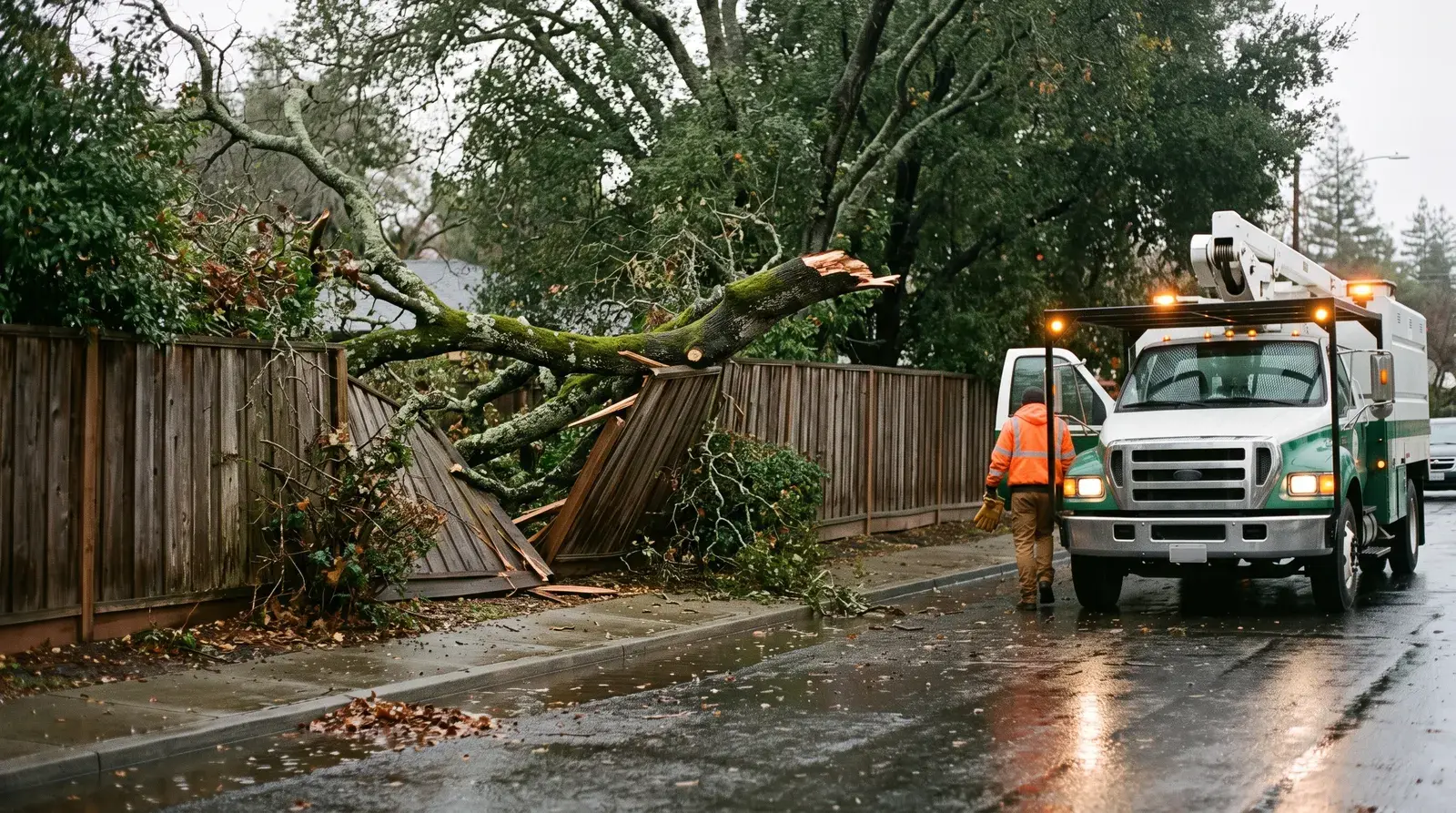
Emergency or Can It Wait Until Monday
On a standard Antelope subdivision lot the fall zone reaches the fence, the neighbor's patio, and the cars in the driveway, so more failures here land on something than in a neighborhood with bigger lots. Still, not everything is an emergency.
Photos settle it fast. We would rather tell you it can wait than bill you emergency rates for a tree that was never going to reach anything.
Deal with it now
Something is loaded, or something is under it.
- Half a pear or ash on the roof, patio cover, fence, or a vehicle.
- The standing half of a split tree, hanging on a torn union over the yard. It is unbalanced and the union has already failed.
- A broken limb caught in the canopy over a driveway, side gate, or play structure.
- A tree that tipped and lifted the lawn on one side — the root plate is out and the tree is not finished.
- Anything touching a SMUD line or a service drop pulled off the house.
- A tree down across the sidewalk or blocking a shared driveway or side access.
The First Hour After a Tree Comes Apart
Most people get hurt after the wind stops. On a subdivision lot the specific risk is a homeowner with a saw working under a half-attached limb in a fenced back yard where nobody can see them.
Clear the whole fall zone
Not just under the failed part. The standing half of a split tree can go the rest of the way with no wind at all, and it will not necessarily go the same direction the first half did.
Treat every wire as live
Antelope is SMUD territory. Call 911 for fire or injury and report line contact to SMUD at 1-888-456-7683. Stay off wet lawn and away from chain link near a downed conductor.
Photograph before anything is cut
Wide shots, then close shots of the torn union or the lifted roots. The bark folded inside a failed pear union is the evidence that explains the failure, and it disappears the moment we chip the tree.
Call your carrier the same day
Get a claim number before the queue fills. Removing a tree off a covered structure and repairing it is normally covered; a tree that hit nothing usually is not.
Talk to the neighbor early if the fence is involved
Damage is generally handled by the policy where it landed, and a calm conversation before the adjusters arrive saves a lot of friction on a shared fence line.
Then call for removal
Tell us what failed, what it is resting on, whether the other half is still standing, and whether the back yard is gate-access only. Most Antelope lots are, and it changes the crew size.
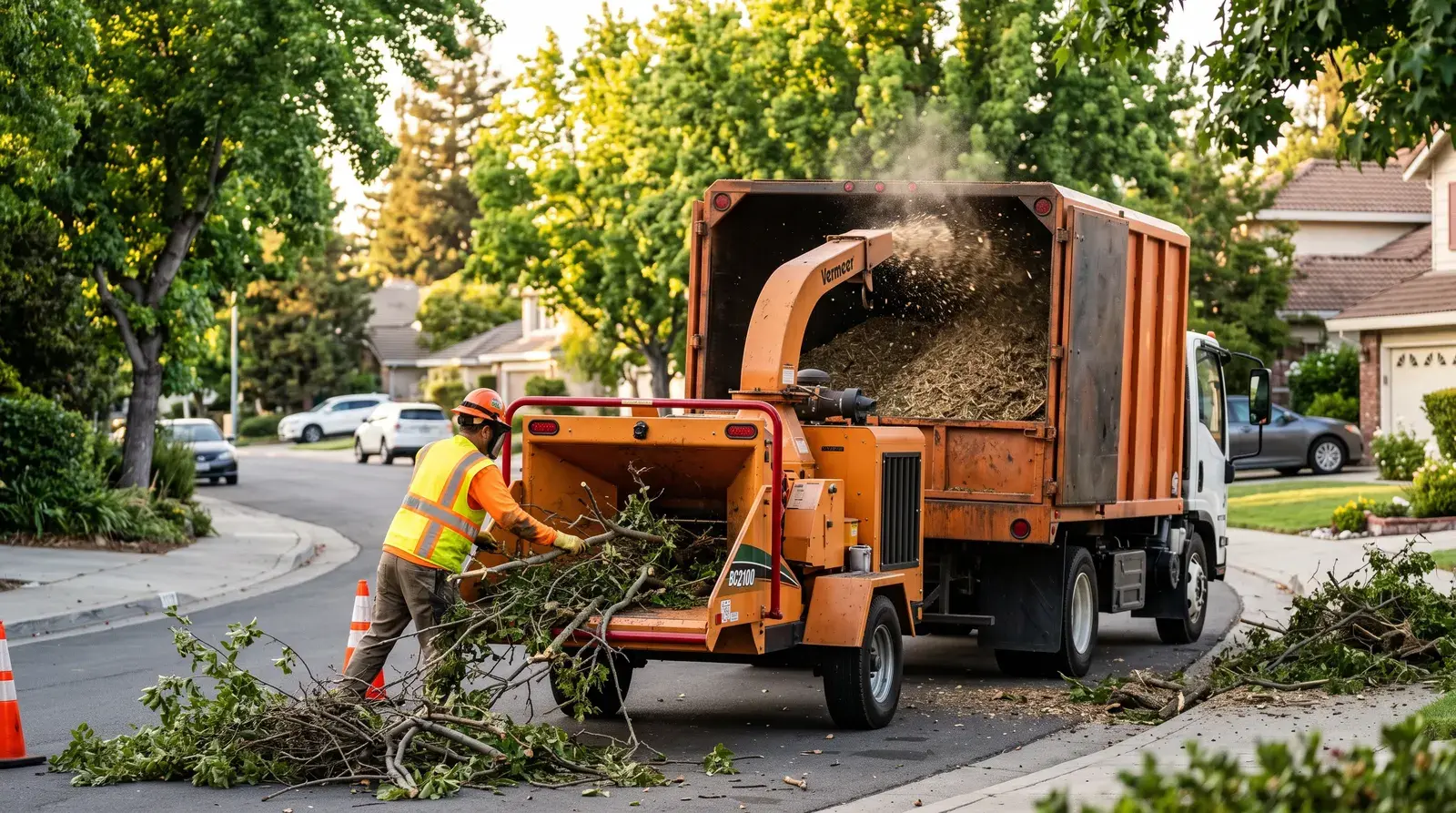
Emergency Tree Service in Antelope — free, site-specific estimates.
The Bradford Pear Split: Antelope's Signature Failure
Ornamental pears were planted across Antelope by the thousands during the 1990s build-out, and their failure is not bad luck — it is built into the shape of the tree.
Callery pear cultivars were bred for a tight, upright form, which produces several main stems rising from nearly the same point on the trunk. As those stems thicken they squeeze bark between them instead of knitting into solid wood, and that included bark is one of the strongest predictors of stem failure in any tree. Around 25 to 35 years old — precisely where Antelope's pears are now — the union gives out. The failure is fast and total: half the tree leaves at once, usually in a saturated winter windstorm, and it lands flat rather than breaking up on the way down, which is why it flattens fences and patio covers instead of just denting them. Two things matter in the emergency. First, the standing half is now a hazard in its own right, hanging on a torn union with all its weight on one side, and it needs to come down or be assessed rather than left through the next front. Second, a pear that split has told you what every other mature pear on the street is going to do. If yours has bark folding inward at the main crotch, book the reduction or the removal now — our Antelope tree removal page covers the planned version at planned pricing.
Wind-Thrown Trees on Flat, Open Ground
Antelope has no ridgelines, no mature canopy breaking the wind, and a lot of trees that were watered daily at the surface for thirty years. That combination produces whole-tree tip-overs rather than trunk snaps.
- Lawn irrigation is the root cause of most of these. A tree watered shallow every day never sends roots down, so there is nothing anchoring it when winter soil saturates.
- Circling roots from the original nursery container are common in build-out era plantings, and a tree that never escaped its root ball has no real root plate at all.
- Chinese pistache and ash tip whole with the lawn still attached, landing intact on whatever is downwind.
- Crape myrtles that were topped repeatedly regrow as multi-stem masses with no structure, and they come apart in wind rather than tipping.
- The partial failure is the one to catch — soil cracked or mounded on the windward side means the tree already moved. That is a scheduled removal today or an emergency next month.
Need emergency tree service in Antelope?
Share the address and project details — we'll come back with a scoped, site-specific estimate.
Dry Creek: Oaks, Cottonwoods, and Riparian Ground
The other side of Antelope's tree story runs along the Dry Creek corridor, where remnant valley oaks and interior live oaks predate every rooftop around them, alongside fast-growing riparian cottonwoods and willows.
- Valley oaks along the corridor are protected under Sacramento County's ordinance, and that protection does not switch off because a storm came through. A genuine failure gets a faster path, but document the condition.
- Cottonwoods and willows in creek-adjacent yards grow fast and hold weak wood. They shed large limbs in wind and are a recurring source of fence and shed damage.
- Root systems in saturated creek-side soil have less to grip, so trees near the drainage tip at lower wind speeds than the same species mid-block.
- Trees within the creek corridor or the riparian setback can involve county review beyond the oak ordinance — we flag that on site rather than guessing.
- For protected oaks worth keeping, reduction and cabling and bracing usually beats removal.
SMUD and the County: Who You Call First
The same crew from estimate to cleanup.
No juggling separate contractors for one tree. Tell us the address and what you're dealing with, and we'll come back with a written, site-specific number.
- Removal, trimming, stumps, and cleanup handled by one crew
- Free, site-specific estimates — priced to your tree, not a flat rate
- Sacramento, Placer, El Dorado, and Yolo counties
Before the Next Storm: The Cheap Version of This Page
Every failure described above has a preventive version that costs a fraction of the emergency call. Antelope's wind does not change, and the trees that will fail next winter are visible right now.
- Get every mature pear inspected at the main crotch. Bark folding inward at the union is the tell, and it is visible from the ground.
- End-weight reduction on pears, ash, and pistache before storm season is the highest-value trim of the year in this neighborhood.
- Pull the lawn irrigation back from trunk zones so trees have a reason to root deeper than the sprinkler line.
- Remove standing dead trees before wind puts them in the neighbor's yard, where the conversation gets more expensive.
- Check young trees for nursery stakes still girdling the trunk. Fixing that is a five-minute job that prevents a tip-over.
Related guides
Tree Fell? What to Do After Storm Damage
The safe, step-by-step response after a tree falls in a storm — downed lines, insurance documentation, triage, and how to avoid storm-chaser scams.
9 Signs a Tree Needs to Come Down
Nine warning signs a tree is hazardous or dying — and when removal is safer than trying to save it.
Do You Need a Permit to Remove a Tree in Sacramento?
Which Sacramento trees need a removal permit, how city and county rules differ, and how to check before the saw comes out.
What emergency tree service costs — and what Antelope allows
Regional ranges, local permit rules, and the alternatives worth weighing before emergency tree service in Antelope.
Emergency Tree Service Cost in Sacramento (2026)
Regional range $800–$8,000 — and what moves the number on a real job.
Do You Need a Tree Removal Permit in Auburn?
Where Auburn draws the line before a tree comes down, and who to check with.
Professional vs. DIY Tree Removal: What's Safe to Do Yourself
Professional or DIY — how to tell which one the tree actually needs.
Tree Service in Sacramento County, CA
Tree work in Sacramento County ranges from removing aging valley oaks in East Sacramento to grinding stumps on new-buil…
Crane-Assisted Tree Removal Cost in Sacramento (2026)
Regional range $2,500–$12,000 — and what moves the number on a real job.
Do You Need a Permit to Remove a Tree in Sacramento?
Which Sacramento trees need a removal permit, how city and county rules differ, and how to check before the saw comes out.
Want a sense of the work first? See the kinds of emergency tree service jobs we take on and who shows up to do them.
Frequently asked questions
Half my Bradford pear split off onto the fence. Is the rest of the tree safe?
No, and that is the part people underestimate. The standing half is hanging on a union that has already failed, with all its remaining weight loaded to one side and a torn face of exposed wood where the other stem was. It can go the rest of the way in the next gust or on a still afternoon, and it will not necessarily fall the same direction the first half did. Keep people, cars, and pets out of the full circle around it. In most cases the remaining stem comes down with the rest, because a pear with one failed union is not a tree you can rebuild — the architecture is the problem, not one bad branch.
Do you offer emergency tree removal in Antelope on weekends?
Yes, storm and hazard calls come in outside normal scheduling and we work them. We will not promise a specific arrival time, because after a regional windstorm every crew in the Sacramento area is working a triage list and a tree on an occupied house or blocking somebody in has to come before a trunk lying in an open back yard. When you call, describe what failed, what it is resting on, whether the other half is still standing, and whether SMUD lines are involved. You will get an honest answer about where you sit rather than a promise designed to win the call.
A tree from my yard landed on the neighbor's fence. Who pays?
Generally the policy covering the property where it landed handles the damage there, so a healthy tree that failed in a storm onto a neighbor's fence is usually their carrier's claim, not yours. The exception is negligence — a visibly dead or previously reported hazardous tree that nobody dealt with can shift responsibility. This is exactly why the photographs matter: sound wood at the break supports a storm event, and decayed wood or long-standing included bark tells a different story. We remove the tree and document its condition either way. Our guide to neighbor tree disputes in California covers the details.
Who removes a dead street tree in front of my Antelope house?
Sacramento County. Antelope is unincorporated with no city government, so the trees in the planting strip between your sidewalk and the curb belong to the county even though you maintain the grass around them. Removing one on your own authority is a code problem regardless of its condition. Report it with photos documenting the hazard, and expect the county to triage blocked roads and structural threats first after a storm. We can document the tree's condition to support your request, but the removal authorization has to come from the county.
Will insurance cover the tree that fell on my patio cover?
Usually if the patio cover is a covered structure under your policy, which most attached ones are. Policies commonly pay to remove the tree off the structure and repair the damage, subject to your deductible and often a cap on the removal portion. A tree that fell on the lawn and hit nothing is frequently not covered at all, and the stump grind usually is not. Photograph before cleanup, open the claim the same day, and ask us for an itemized invoice that separates emergency stabilization from optional follow-up work so the numbers map cleanly to what the adjuster approves.
My tree tipped and lifted the lawn but it is still standing. What now?
Treat it as an emergency if anything is in its fall zone. Mounded or cracked soil on one side of the trunk means the root plate has partially pulled out — the tree has started falling and stopped, not recovered. Roots that tore do not reattach, so the tree is now held up by whatever is left plus luck, and the next saturated week finishes plenty of them with no wind at all. Keep the area clear and get it assessed. A lifted root plate on a subdivision tree is almost always a removal rather than a save.