
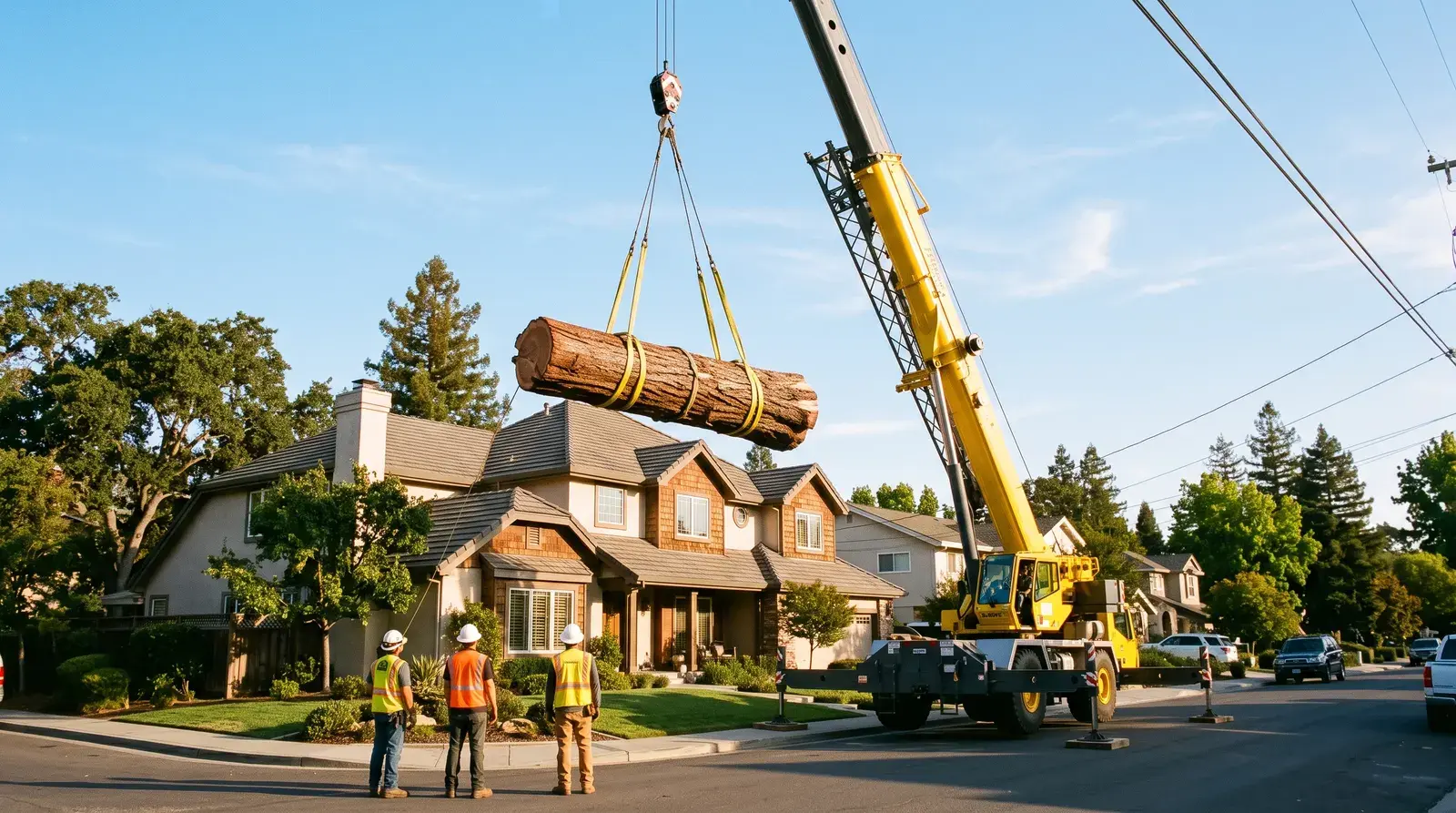
When a Removal Calls for a Crane
Most trees come down fine with ropes and rigging. A crane enters the picture when there's nowhere to lower wood, when the tree can't be trusted to hold a climber, or when the job is simply too big to piece down economically.
- No drop zone — the canopy overhangs the house, garage, pool, spa, or a neighbor's property on every side, leaving no safe place to land limbs.
- Over-structure trunks — a leaning trunk or storm-failed tree resting across a roofline needs to be lifted off, not cut loose.
- Dead or decayed trees — standing dead pines, beetle-hit conifers, and oaks with trunk decay can't safely support climbing or rigging loads.
- Tight access — backyard trees behind pools, additions, or narrow side yards where no loader or chip truck can ever reach.
- Sheer size — mature valley oaks, London planes, eucalyptus, and 80-plus-foot redwoods where craning sections out beats days of rigging.
- Storm response — after winter windstorms, cranes are often the only way to unload a large tree from an occupied house without making the damage worse.
How a Crane Pick Actually Works
A crane removal is a series of coordinated lifts called picks. The crane holds each section of the tree under light tension while it's cut, then flies it over the structure to a landing zone — nothing free-falls, and nothing touches the roof.
A removal that would take a rigging crew two or three days often finishes before lunch with a crane. That efficiency is where the crane earns back its day rate.
- Setup — the crane positions on street or driveway, sets outriggers on pads, and the crew establishes a landing zone, usually at the curb near the chipper.
- Weight planning — the operator and climber size each pick to the crane's rated capacity at that reach. Green wood is heavy: a single large oak limb can weigh over a thousand pounds.
- Rigging the pick — a climber or lift operator sets slings on the section, the crane takes tension, and the cut is made below the rigging point.
- The fly — the severed section lifts straight up, swings clear of the house, and lands in the processing zone where ground crew bucks and chips it.
- Repeat down the trunk — big trees come out in a sequence of picks, canopy first, then trunk logs, until only the stump remains.
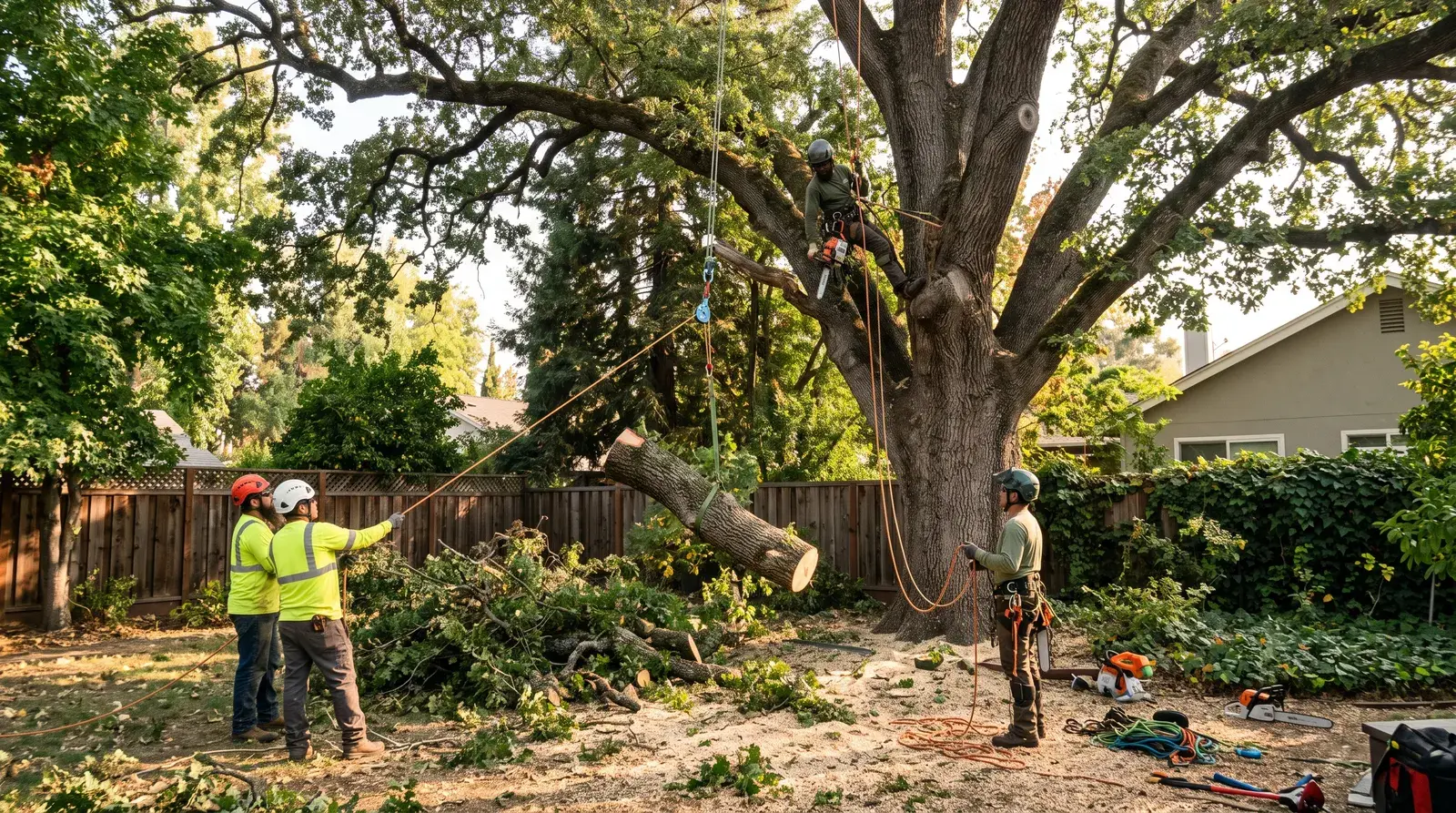
Crane-Assisted Tree Removal across Sacramento, Placer, El Dorado, and Yolo counties.
Street, Access, and Setup Logistics
Crane day takes more planning than a standard removal. The machine needs a firm, level setup spot within working reach of the tree, and on many Sacramento-area streets that means coordinating traffic control, parking, and sometimes utility clearances in advance.
- Setup surface — street, driveway, or compacted ground rated for outrigger loads; we verify reach and setup position during the site visit, not on crane day.
- Traffic control — lane closures on city or county streets need an encroachment/traffic-control permit; we build that lead time into scheduling.
- Overhead lines — crane booms and power lines don't mix. Work near SMUD or PG&E facilities is planned around required clearances, with the utility involved when needed.
- Neighbor coordination — picks that fly over a property line work best with a heads-up; we help with notice so crane day has no surprises.
- Landing zone — a curbside stretch for processing wood, which usually means keeping a few car lengths clear of parked vehicles that morning.
Why Cranes Are Easier on Your Property
Counterintuitively, the biggest machine on the job is often the gentlest on the yard. Because the tree leaves through the air instead of across the ground, crane removals routinely finish with the landscaping looking untouched.
- No dragging — logs and limbs never cross the lawn, garden beds, or irrigation; they fly from the tree to the curb.
- No heavy equipment on turf — the crane works from hard surface, so there are no loader ruts to repair afterward.
- Nothing dropped from height — fences, patios, pool decks, and roof edges under the canopy stay out of the line of fire entirely.
- Faster job, shorter disruption — one loud morning instead of several days of a crew working overhead.
Need crane-assisted tree removal on your property?
Share the address and project details — we'll come back with a scoped, site-specific estimate.
Crane Removal Costs in the Sacramento Region
Expect a crane job to price above a conventional removal of the same tree — you're adding a crane, an operator, and mobilization to the crew cost. What you're buying is speed and the elimination of the riskiest cuts, and on hard trees that trade usually favors the crane.
Every crane recommendation comes with the reasoning attached. If your tree doesn't need a crane, we'll say so and quote the conventional removal instead — estimates are free either way.
- Broad regional range — most crane-assisted residential removals run roughly $3,000–$10,000+, with the largest or most complex trees above that.
- Crane size — a big trunk far from the setup point needs a larger crane with more reach, which costs more than a compact unit working close.
- Number of picks — more sections means more crane time; dense hardwoods like valley oak need smaller, more numerous picks than lighter species.
- Permits and traffic control — lane closures and encroachment permits add real line items on tight streets.
- The comparison that matters — price the crane option against the conventional option for the same tree. On large hazardous removals, the crane is often the cheaper total.
The same crew from estimate to cleanup.
No juggling separate contractors for one tree. Tell us the address and what you're dealing with, and we'll come back with a written, site-specific number.
- Removal, trimming, stumps, and cleanup handled by one crew
- Free, site-specific estimates — priced to your tree, not a flat rate
- Sacramento, Placer, El Dorado, and Yolo counties

Permits Still Apply to Big Trees
The trees big enough to need a crane are exactly the trees most likely to be protected. Heritage trees in the City of Sacramento and native oaks in unincorporated Sacramento County generally require a permit before removal, regardless of the method used to take them down.
- City of Sacramento — Heritage Trees are protected under City Code Chapter 12.56, and street trees are City Trees; verify at cityofsacramento.gov before scheduling.
- Sacramento County — the Tree Preservation and Protection Ordinance covers native oaks in Carmichael, Fair Oaks, Arden-Arcade, and other unincorporated areas.
- Dead and hazardous trees — usually a faster approval path, but document the condition; an arborist report strengthens the file.
- We flag the permit question on every crane estimate, since a stop-work order with a crane on the clock is an expensive way to learn the ordinance.
Related services
Tree Removal
Safe removal of hazardous, dead, or unwanted trees — including permit help, cleanup, and haul-off across the Sacramento region.
Emergency Tree Service
Fast response for storm-damaged, fallen, or hazardous trees threatening homes, cars, and power lines across the Sacramento area.
Storm Damage Cleanup
Cleanup after winter windstorms — split limbs, uprooted trees, and yard debris removed so your property is safe and clear again.
Related guides
How Much Does Tree Removal Cost in Sacramento? (2026)
Typical 2026 Sacramento tree removal price ranges by tree size, the factors that move the number, and how to read a quote before you sign it.
9 Signs a Tree Needs to Come Down
Nine warning signs a tree is hazardous or dying — and when removal is safer than trying to save it.
Tree Fell? What to Do After Storm Damage
The safe, step-by-step response after a tree falls in a storm — downed lines, insurance documentation, triage, and how to avoid storm-chaser scams.
Before you book crane-assisted tree removal
What it runs, where permits bite, and how crane-assisted tree removal stacks up against the alternatives.
Emergency Tree Service Cost in Sacramento (2026)
Regional range $800–$8,000 — and what moves the number on a real job.
Crane vs. Climbing Tree Removal: Which Method and Why
Crane Removal or Climbing Removal — how to tell which one the tree actually needs.
How Much Does Tree Removal Cost in Sacramento? (2026)
Typical 2026 Sacramento tree removal price ranges by tree size, the factors that move the number, and how to read a quote before you sign it.
Want to see what this looks like on a real property? Browse the crane-assisted tree removal jobs we take on, or read how our crew scopes and prices work before you call anyone out.
Frequently asked questions
When does a tree removal need a crane?
Three situations, mainly: no drop zone (the tree overhangs the house, pool, or a neighbor's structure on every side), structural condition (dead, decayed, or storm-split trees that can't safely hold a climber or rigging loads), and access (backyard trees where logs can't be moved out any other way). If limbs can be safely roped down and staged on your own ground, conventional rigging is usually cheaper. We tell you which applies during the free estimate.
How much does crane-assisted tree removal cost?
More than a standard removal — the crane and operator add a significant day rate on top of the tree crew. As a broad regional range, crane-assisted removals commonly land in the $3,000–$10,000+ territory depending on tree size, crane size, and setup complexity. The flip side: the crane compresses days of rigging into hours and eliminates the highest-risk cuts, so on very large or hazardous trees the total is often comparable to — or below — a slow conventional takedown. Estimates are free.
Will the crane damage my driveway or lawn?
Cranes set up on the street or driveway on outrigger pads that spread the load, and we use additional cribbing or protection over concrete, pavers, and known utilities. That's actually one of the crane's advantages: the machine stays on hard surface while the tree flies out over the top, so your lawn, garden beds, and irrigation never see a loader or dragged logs. We check the setup surface as part of the site visit.
Do you need to close the street for a crane removal?
Sometimes. On narrower Sacramento-grid and older suburban streets the crane may occupy a travel lane, which typically requires a temporary traffic-control or encroachment permit from the city or county. We identify that requirement during the estimate and handle the arrangements — plan on some advance notice to neighbors about parking on crane day. On wide streets and long driveways, no closure is needed.
Is a crane removal safer than climbing the tree?
For compromised trees, significantly. A climber in a decayed or storm-damaged tree is trusting wood that has already failed once. With a crane, each section is held under tension by the crane before it's cut, so nothing swings, drops, or depends on the tree's remaining strength. The climber (or an aerial-lift operator) makes controlled cuts, and the crane does the lifting. It removes the worst risks from the most dangerous class of removals.