
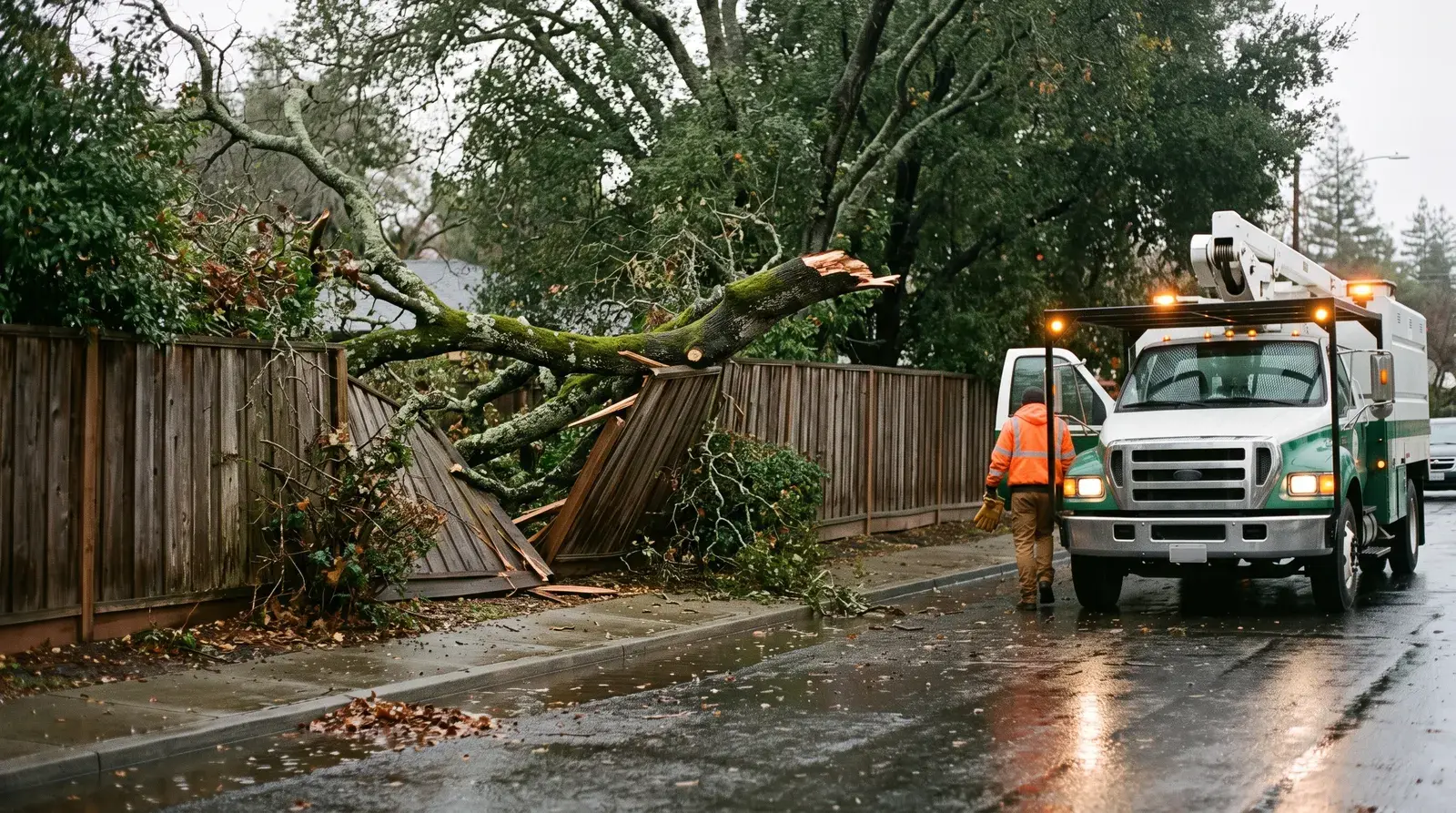
Is This an Emergency, or Can It Wait?
After a Sacramento windstorm we get both calls: a tree on a roof in Tahoe Park, and a limb lying harmlessly on a lawn in Greenhaven. Only one of those is worth emergency pricing, and here is the line between them.
Not sure? Send photos and tell us what is underneath it. Talking you out of an emergency callout you do not need is a better use of the call than selling you one.
Call it in now
The wood is loaded, or there is a target under it.
- A tree or limb on the house, garage, or a vehicle — the load has to come off before it works further into the structure.
- A broken limb hung up in the canopy over a sidewalk, driveway, porch, or the alley. In a mature London plane these weigh far more than they look.
- A new lean or soil mounded on one side of the trunk after a wet windstorm — the anchoring roots have already let go.
- A fresh split at a co-dominant union over a structure, even with nothing on the ground yet.
- Any tree touching a SMUD conductor, or a service drop pulled off the weatherhead.
- A trunk blocking the driveway, the alley, or the sidewalk where people have to walk around into traffic.
The First Hour: What to Do Before Anyone Cuts
Order of operations matters more than speed. Most storm-night injuries in this city happen after the tree is down — from lines, from wood under tension, and from homeowners running chainsaws in the dark with the power out.
Get people out and keep them out
Clear the rooms under the damaged roof section and keep everyone off the driveway and sidewalk in the fall zone. A trunk resting on a structure keeps settling for hours.
Assume every wire is energized
Call 911 for fire, injury, or anyone trapped, and report line contact to SMUD at 1-888-456-7683. Stay off wet ground and away from iron and chain link fencing near a downed conductor; a fence can be energized well away from the tree.
Photograph before anything moves
Wide shots of the tree and the structure, then close shots of the break, the decay pocket, or the lifted root plate. Once the wood is chipped that evidence is gone. Our storm damage and tree emergency guide lists what to capture.
Open the insurance claim the same day
Get a claim number before the adjuster queue fills after a regional storm. Policies generally cover removing a tree off a covered structure and repairing the damage.
Sort out whose tree it is
Street tree in the right-of-way goes to the City of Sacramento. Tree on your lot, or your neighbor's, is private work. Calling the right one first saves hours.
Then call for rigging, not a chainsaw
Tell us the species, roughly how tall, what it is on, whether SMUD lines are involved, and what the street and alley access look like. That determines whether a crane is even possible.
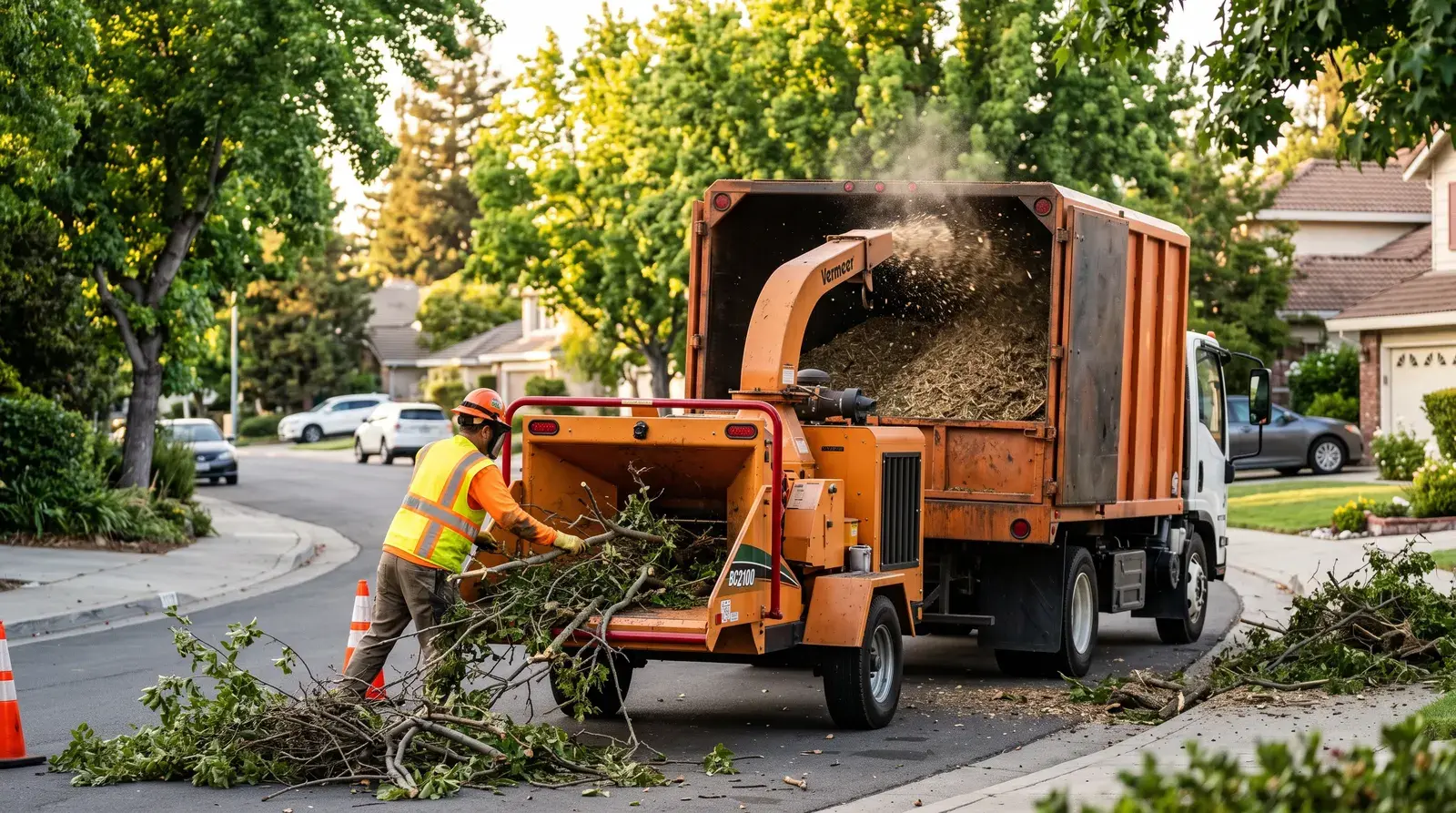
Emergency Tree Service in Sacramento — free, site-specific estimates.
Whose Tree Is It: City, SMUD, or Yours
Sacramento storm damage sorts into three jurisdictions, and getting it wrong costs a day. The dividing lines: the right-of-way belongs to the city, the lines belong to SMUD, and everything else belongs to the property owner.
- Street trees down in the road or the planting strip — report to the City of Sacramento. City street trees are the city's to clear, and urban forestry crews triage citywide after a storm, starting with blocked roads and structural hazards.
- Trees into power lines — SMUD's jurisdiction. The utility clears its lines first and we handle the tree once the line is safe. Our PG&E and SMUD line clearance guide explains who owns which side of the easement.
- Trees on your house, garage, fence, or car — private work, and structures get priority in our queue.
- Your tree onto a neighbor's property — generally the neighbor's carrier handles their damage unless the tree was known to be dead or hazardous. Document the failure point either way; see neighbor tree disputes in California.
- Heritage trees — a designated heritage tree under City Code Ch. 12.56 that fails is still a documentation matter afterward. Photograph the condition before and during the work; see our Sacramento heritage tree ordinance guide.
How Sacramento Trees Fail, Neighborhood by Neighborhood
Failures here are predictable because the canopy is not uniform. The city's oldest neighborhoods, its mid-century tracts, and its newest subdivisions each fail in their own way, and knowing the pattern is how we triage and how you spot the next one.
- East Sacramento, the Fab Forties, Land Park, and Curtis Park — big old street canopy: London plane, camphor, elm, and valley oak. Failures are heavy deadwood and full scaffold limbs onto cars and sidewalks, and whole-tree uprooting when the ground is saturated.
- Midtown and Downtown — the same species on narrower lots with alleys, overhead lines, and no side yard. Everything comes down in rigged pieces or over the roofline, because there is nowhere to drop anything.
- Tahoe Park, Colonial Heights, Hollywood Park, and Oak Park — mid-century Modesto ash and silver maple, both of which decay internally behind a full green canopy and shed major limbs with no warning crack.
- South Land Park and the Pocket and Greenhaven — heat-stressed coast redwoods with dead tops that snap out in wind, plus liquidambar and pear splitting at weak unions.
- Natomas and the newer north-city subdivisions — flat, open, wind-exposed ground with young lawn-irrigated trees that tip whole, root plate and lawn together, rather than breaking.
- Palms across Land Park, Midtown, and the older commercial streets — dead fronds and whole crown failures are a genuine hazard over sidewalks and parked cars. See our palm tree removal service.
Emergency Work on a Tight Grid Lot
A tree on a roof in Curtis Park is a different problem from one in an open suburban yard. There is no room to drag a trunk off with a machine, so the tree comes off the structure in rigged pieces, or with a crane working from the street.
- Crane picks from the street lift trunk sections straight up and off the roof instead of dragging weight across it — usually the least destructive option on a grid lot.
- Setup room, not reach, is the real constraint. Outriggers need level unobstructed pavement, and parked cars, low SMUD lines, and mature street trees all limit where a crane can plant. See our crane-assisted tree removal page.
- When a crane will not fit, every piece is supported before the cut and lowered on a line. Nothing gets dropped and nothing gets dragged.
- Alley access in Midtown and East Sac can be the fastest route in for a chip truck when the street side is parked solid — worth mentioning when you call.
- Tarping and board-up coordination once the load is off, so the roof deck is protected before your contractor arrives.
- Photo documentation before, during, and after for the insurance file, with emergency stabilization itemized separately from optional cleanup.
Need emergency tree service in Sacramento?
Share the address and project details — we'll come back with a scoped, site-specific estimate.
SMUD First, Every Time
Permits, Heritage Trees, and Emergency Removals
Two paperwork questions come up on nearly every Sacramento emergency: will insurance pay, and what about the tree ordinance. Genuinely hazardous and storm-failed trees get a faster path — but faster does not mean undocumented.
If a heritage tree or a large protected tree fails, photograph its condition thoroughly before and during removal: the break, the decay, the lifted root plate, and what it landed on. The city may want that record afterward, and an arborist letter supports it — see our arborist reports service. The harder case is a tree that is damaged but still standing: if it can be stabilized and evaluated rather than removed on the spot, the normal permit process may still apply, and a split trunk is not automatically a removal. We flag the ordinance question even at emergency speed, because a code violation is a bad souvenir from a storm. On the insurance side, policies commonly cover removing a tree off a covered structure and repairing the damage, while a tree that fell in the yard and hit nothing is frequently not covered at all — our storm and uprooted tree insurance guide covers what adjusters actually approve.
The same crew from estimate to cleanup.
No juggling separate contractors for one tree. Tell us the address and what you're dealing with, and we'll come back with a written, site-specific number.
- Removal, trimming, stumps, and cleanup handled by one crew
- Free, site-specific estimates — priced to your tree, not a flat rate
- Sacramento, Placer, El Dorado, and Yolo counties
After the Emergency: Check the Rest of the Canopy
The tree that failed usually has company. The same wind loaded every tree on the block, and partial failures are quieter than a tree on a roof but no less dangerous.
- Look up into every mature tree for limbs sitting broken in the canopy. Hangers stay lodged for weeks and then come down on a still afternoon.
- Walk each trunk for cracked or mounded soil, which is what a root plate looks like after it has moved.
- Check co-dominant unions on ash, liquidambar, and pear for fresh separation or bark folding inward — some are candidates for cabling and bracing rather than removal.
- Have redwood and cedar tops assessed after any significant wind; dead tops should come out before the next one.
- Book storm-prep trimming in the fall. End-weight reduction and deadwooding on the old street canopy costs a fraction of the emergency call it prevents — see Sacramento tree trimming for the planned version.
Related guides
Tree Fell? What to Do After Storm Damage
The safe, step-by-step response after a tree falls in a storm — downed lines, insurance documentation, triage, and how to avoid storm-chaser scams.
9 Signs a Tree Needs to Come Down
Nine warning signs a tree is hazardous or dying — and when removal is safer than trying to save it.
Do You Need a Permit to Remove a Tree in Sacramento?
Which Sacramento trees need a removal permit, how city and county rules differ, and how to check before the saw comes out.
What emergency tree service costs — and what Sacramento allows
Regional ranges, local permit rules, and the alternatives worth weighing before emergency tree service in Sacramento.
Emergency Tree Service Cost in Sacramento (2026)
Regional range $800–$8,000 — and what moves the number on a real job.
Do You Need a Permit to Remove a Tree in Sacramento?
Which Sacramento trees need a removal permit, how city and county rules differ, and how to check before the saw comes out.
Professional vs. DIY Tree Removal: What's Safe to Do Yourself
Professional or DIY — how to tell which one the tree actually needs.
Curtis Park
Curtis Park's canopy is among Sacramento's oldest — streetcar-era Craftsman bungalows built between 1905 and 1930 along…
Tree Service in Sacramento County, CA
Tree work in Sacramento County ranges from removing aging valley oaks in East Sacramento to grinding stumps on new-buil…
Crane-Assisted Tree Removal Cost in Sacramento (2026)
Regional range $2,500–$12,000 — and what moves the number on a real job.
Sacramento neighborhoods we work in
Housing era, canopy, and access change block to block. These pages cover what emergency tree service looks like in each.
East Sacramento
East Sacramento's tree stock is old, large, and tightly regulated.
Land Park
Land Park is one of Sacramento's oldest residential neighborhoods, built out primarily in the 1920s through the 1940s a…
Curtis Park
Curtis Park's canopy is among Sacramento's oldest — streetcar-era Craftsman bungalows built between 1905 and 1930 along…
Midtown
Midtown Sacramento's dense urban grid — roughly 16th Street to 30th Street, between Q Street and Capitol Avenue — packs…
Pocket-Greenhaven
Pocket-Greenhaven is a south Sacramento neighborhood built largely in the 1970s and 1980s in the bend of the Sacramento…
Natomas
Natomas — both North and South — was built mostly between the late 1980s and 2010 on former agricultural and floodplain…
Oak Park
Oak Park sits on ground that was Sacramento's first streetcar suburb, developed in the 1880s around an eight-acre oak g…
Tahoe Park
Tahoe Park was built fast after World War II — mostly late-1940s and 1950s ranch homes and bungalows on Sacramento's ea…
Want a sense of the work first? See the kinds of emergency tree service jobs we take on and who shows up to do them.
Frequently asked questions
A tree fell on my house in Sacramento — what do I do first?
Get everyone away from the damaged section and keep them out; a tree resting on a structure is under load and shifts unpredictably. Check for downed lines and call 911 and SMUD at 1-888-456-7683 if any are involved, staying clear of wet ground and metal fencing. Then photograph everything before any cutting starts, call your insurance carrier for a claim number, and call an emergency crew with rigging and crane capability. Do not climb on the roof and do not let anyone start cutting the trunk with a chainsaw — releasing tension in the wrong order causes most of the secondary damage we see.
Do you do emergency tree removal in Sacramento after hours?
Yes. Storm and hazard calls come in outside normal scheduling and we work them, prioritizing trees on occupied structures, blocked access, and limbs hanging over areas people use. What we will not do is quote a fixed arrival window, because after a regional windstorm every crew in the region works a triage list and any company promising instant arrival to every caller is promising something it cannot deliver. Describe what failed, what it landed on, whether SMUD lines are involved, and whether anyone cannot safely get in or out, and you will get an honest read on where you sit.
A city street tree fell across my driveway. Who removes it?
The City of Sacramento. Trees in the public right-of-way are city street trees, and the city clears them, triaging blocked roads and structural hazards first after a storm. Report it through the city's channels. If the street tree damaged your private property, or a private tree is down alongside it, we can handle the private side while the city processes theirs, and document the scene for your insurance claim. Do not cut a city street tree yourself, even a clearly dead one — that is a code problem regardless of condition.
Is emergency tree removal covered by homeowners insurance?
Usually when the tree hit something. Policies commonly cover removing a tree from a damaged structure plus the repair, subject to your limits and deductible, and removal is often capped separately at a modest amount. A tree that fell in the yard without hitting anything is frequently not covered, and stump grinding usually is not. Photograph everything before cleanup, call your carrier early, and ask for an itemized invoice that separates emergency stabilization from optional cleanup so the numbers map to what the adjuster approves. We provide the photos and written scope adjusters actually use.
The tree is split but still standing. Is that an emergency?
Treat it as one if it is over a target. A split co-dominant stem or a new lean over a house, driveway, or sidewalk can finish failing in the next wind, or in no wind at all. Keep people and cars out from under it and get it assessed quickly. Some split trees can be cabled and saved; many need removal. Either way the answer should come from an assessment rather than from waiting to see what the next storm decides. On a protected or heritage tree, an assessment also creates the record you will want if removal turns out to be necessary.
Can a heritage tree be removed in an emergency in Sacramento?
A tree that has genuinely failed or presents an imminent hazard is treated differently from a healthy tree somebody wanted gone, and you are not required to live under a tree that is about to come down. What makes that distinction hold up afterward is documentation. Photograph the condition before and during the work — the break, the decay, the root plate, the damage — and keep the written scope and invoice. The city may want that record after the fact, and an arborist report closes the loop. We shoot that documentation as standard practice on every emergency removal of a large or protected tree.
Why is it harder to get a tree off a roof in Midtown than in the suburbs?
Room. A Midtown or East Sac lot puts the house within a few feet of the fence on both sides, with an alley behind, overhead SMUD lines above, and cars parked solid along the curb. There is no space to drag a trunk out with a machine, so the tree comes off the structure piece by piece on rigging lines, or a crane lifts it straight up from the street — and the crane needs level, unobstructed pavement for its outriggers, which is the constraint people never expect. That is why we ask about street parking, alley access, and overhead lines on the first call rather than when the truck arrives.