What Cabling and Bracing Actually Do
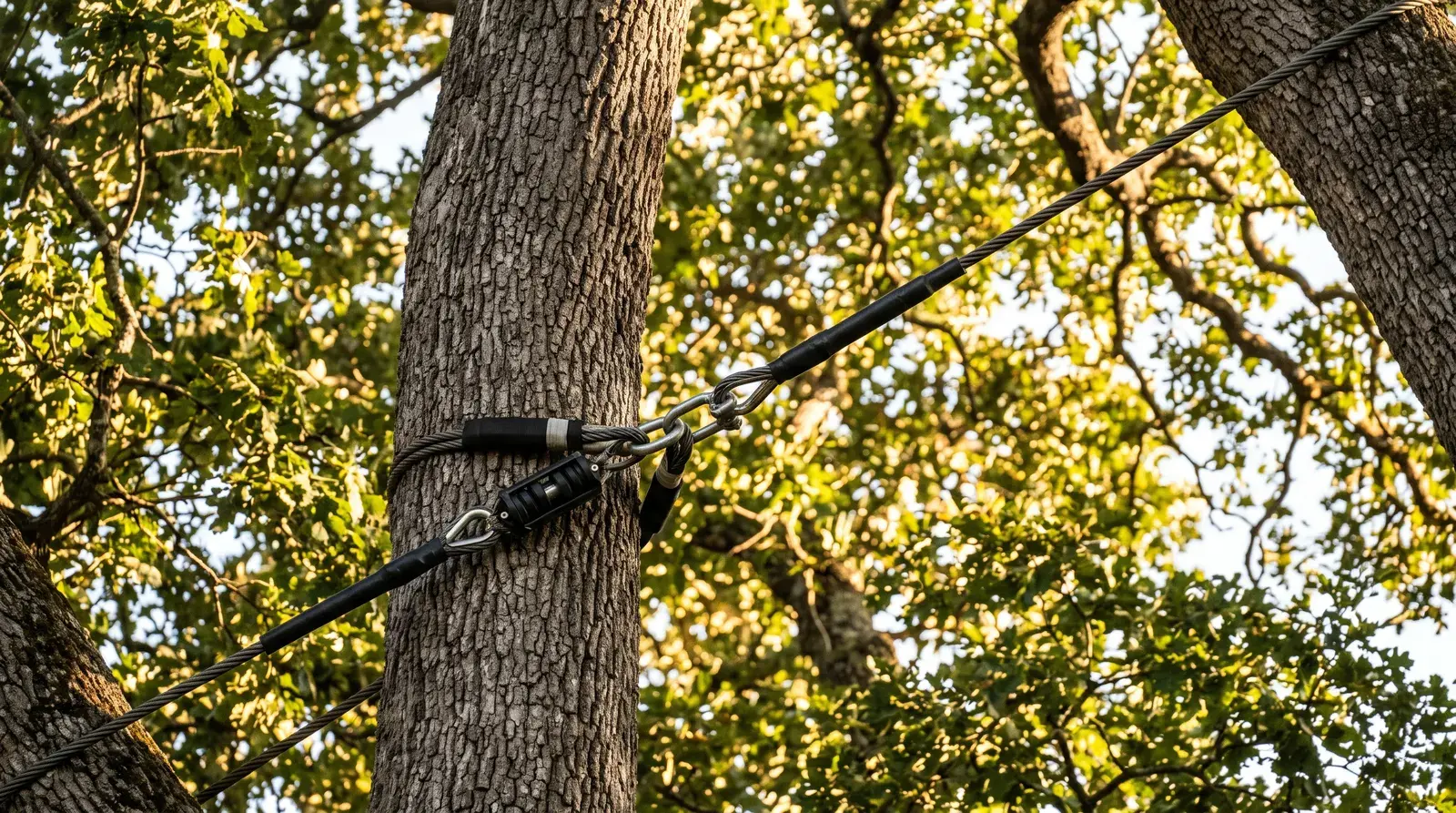
Cables and brace rods don't hold a tree up — they limit how far weak parts can move, so wind and canopy weight don't tear a defective union apart. Cables go high in the canopy between stems; brace rods bolt through a union that's already splitting.
- Cabling — high-strength steel or synthetic cable installed in the upper crown, connecting co-dominant stems so they move together in wind instead of levering apart
- Bracing — threaded rods installed through a weak or splitting union to hold it together mechanically
- Combined systems — a splitting union often gets rods at the joint plus a cable above it
- Reduction pruning — shortening and lightening the supported limbs is usually part of the job; less sail and less end weight means less load on the hardware
The Defects That Call for Support
Most cabling candidates share one anatomy problem: two or more stems of similar size joined at a narrow, V-shaped union, often with bark pinched inside the joint. That included bark means the stems were never structurally fused — the union is a crack waiting for a load.
Warning signs you can spot from the ground: a seam or crack where two trunks meet, bark pushed out in a ridge at the union, or two big stems that visibly spread apart in wind. Any of those on a large tree near a house is worth an assessment before storm season.
- Co-dominant stems with included bark — the classic case; a tight V-crotch instead of a strong U-shaped union
- Heavy horizontal limbs — long, over-extended branches on mature oaks that sag further each year
- Early splitting — a crack starting at the union that hasn't yet run into the trunk
- Storm-damaged unions — a joint strained but not failed in a windstorm, on a tree worth keeping
- Multi-trunk landscape trees — ornamental pears, older camphors, and multi-stem live oaks that grew with poor structure
Tree Cabling & Bracing across Sacramento, Placer, El Dorado, and Yolo counties.
Why This Matters in Sacramento
Sacramento's storm pattern is exactly the load case weak unions fail under: months of dry-season dormancy, then winter storms that combine saturated soil with strong south winds. Trees that stood fine all summer come apart in the first big January blow.
- Winter windstorms — the region's major tree-failure events; saturated soil plus gusty frontal winds
- Big, old canopies — East Sacramento, Land Park, Carmichael, and Fair Oaks carry some of the oldest urban trees in the Valley, many with decades-old structural defects
- Valley and interior live oaks — massive spreading limbs and frequent multi-stem forms make them common support candidates
- Full summer canopies — evergreen oaks and camphors carry their whole sail year-round, so an early-fall storm hits them at full weight
- Heritage tree value — where removal of a protected oak needs a permit anyway, preservation with hardware is often the better path on every axis
Preservation vs. Removal: Making the Call
Hardware is for structurally weak but otherwise healthy trees. The question we answer on-site: is the wood sound enough to anchor into, is the tree worth the ongoing commitment, and does the risk under the tree stay acceptable once it's supported?
We don't install hardware to delay an inevitable removal — that just moves the failure a few years down the road with money spent on top. If removal is the right answer, we'll tell you at the assessment, not after the cable is in.
- Good candidates — healthy crown, sound wood at the anchor points, a defined defect the hardware directly addresses, an owner willing to maintain it
- Poor candidates — decay at the union or anchor zones, extensive crown dieback, root problems, or a split already run deep into the trunk
- Target matters — a supported tree over a lawn is a different risk than one over a bedroom or a school sidewalk
- Cost math — installation plus periodic inspection usually beats removal-plus-replacement on a mature shade tree, often by a wide margin
Need tree cabling & bracing on your property?
Share the address and project details — we'll come back with a scoped, site-specific estimate.
How Installation Works
A proper installation follows industry practice for support systems: hardware sized to the stems, placed roughly two-thirds of the way up from the defect to the tips, with the load path assessed by someone who climbs trees for a living.
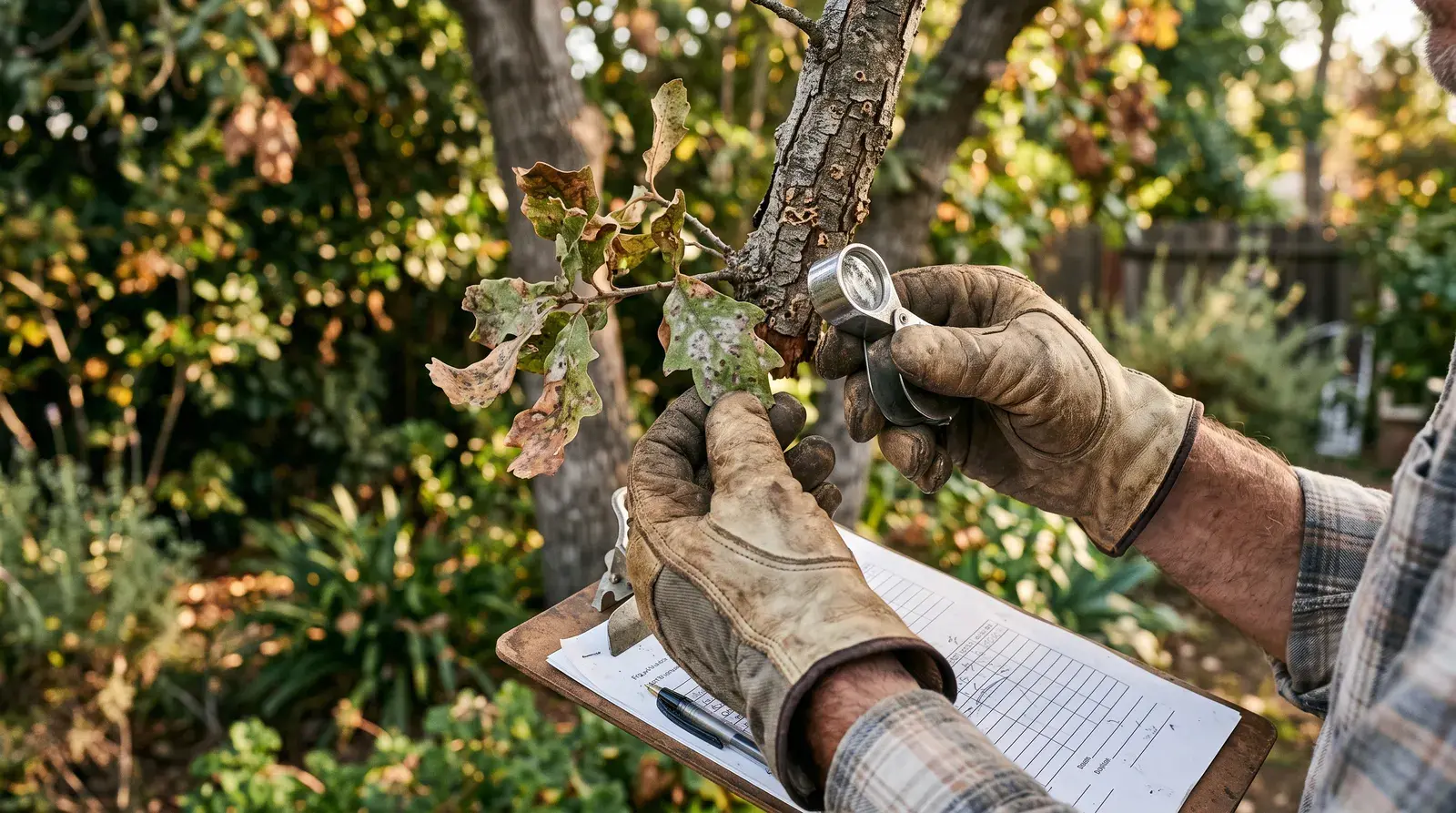
- Assessment first — union condition, decay check, crown weight, and what's in the fall zone
- Pruning first — reduce end weight and wind-sail on the supported stems before hardware goes in
- Cable placement — anchored in sound wood in the upper crown, tensioned to limit spread without immobilizing the stems
- Brace rods where splitting has begun — through-bolted below the cable to reinforce the union itself
- Documentation — what was installed and where, so future inspections know what to check
The same crew from estimate to cleanup.
No juggling separate contractors for one tree. Tell us the address and what you're dealing with, and we'll come back with a written, site-specific number.
- Removal, trimming, stumps, and cleanup handled by one crew
- Free, site-specific estimates — priced to your tree, not a flat rate
- Sacramento, Placer, El Dorado, and Yolo counties
Inspection and Maintenance
A support system is a commitment, not a one-time fix. Trees grow, loads shift, and hardware ages — plan on a periodic check, plus a look after any major windstorm, for as long as the tree stands.
If you've bought a home with an existing cabled tree — common in Sacramento's older neighborhoods — get the system inspected. Hardware installed decades ago and never checked is one of the more frequent problems we find in mature canopies.
- Inspect every year or two — cable tension, anchor condition, and any new movement at the union
- After big storms — a strained system can look fine from the ground and be one gust from failure
- As the tree grows — hardware may need adjustment, replacement, or additional cables as stems gain weight
- Re-prune on a cycle — keeping end weight down is half the system; the hardware is the other half
Related services
Tree Health Assessment
Diagnosing disease, pests, and structural risk — with an honest plan to treat, monitor, or remove.
Structural Tree Pruning
Structural pruning that builds sound branch architecture — training young trees and correcting weak, crowded, or co-dominant limbs.
Crown Reduction & Thinning
Reducing height, spread, and wind-sail on overgrown or heavy canopies — proper reduction cuts, never topping.
Related guides
9 Signs a Tree Needs to Come Down
Nine warning signs a tree is hazardous or dying — and when removal is safer than trying to save it.
Tree Fell? What to Do After Storm Damage
The safe, step-by-step response after a tree falls in a storm — downed lines, insurance documentation, triage, and how to avoid storm-chaser scams.
Before you book tree cabling & bracing
What it runs, where permits bite, and how tree cabling & bracing stacks up against the alternatives.
Want to see what this looks like on a real property? Browse the tree cabling & bracing jobs we take on, or read how our crew scopes and prices work before you call anyone out.
Frequently asked questions
What is a co-dominant stem and why is it a problem?
A co-dominant stem is when a tree splits into two or more trunks of similar size instead of one dominant leader. The union between them is often weak, especially when bark grows down into the joint — called included bark — so the stems aren't structurally connected the way a normal branch is. Under wind or the weight of a full canopy, these unions can split apart. Interior live oaks, ornamental pears, and many multi-trunk landscape trees in Sacramento carry this defect.
Is cabling better than removing the tree?
When the tree is otherwise healthy and the defect is a weak union rather than decay, usually yes. A mature valley oak or shade tree adds real property value and can take decades to replace — hardware plus reduction pruning often manages the risk for a fraction of removal cost. But cabling can't fix a rotting trunk or a failing root system. If decay has compromised the wood the hardware anchors into, removal is the honest answer, and we'll say so.
How much does tree cabling cost in the Sacramento area?
Regionally, a single cable installation typically runs in the several-hundred-dollar range, with larger trees needing multiple cables or brace rods running higher — often $500 to $1,500+ depending on tree size, hardware count, and access. Weight-reduction pruning done at the same time adds to the total but is usually what makes the system work. Estimates are free and site-specific, since no two support installations are alike.
How long does a cabling system last?
Quality hardware commonly serves 10 years or more, but the system should be inspected regularly — a look every year or two, and after major windstorms, is a reasonable rhythm. Trees grow, loads change, and hardware can loosen or the tree can grow around it. Cables installed and forgotten are how support systems fail. Plan on periodic inspection as part of owning a cabled tree.
Can any tree be cabled, or are some too far gone?
Some are too far gone. Cabling requires sound wood to anchor into and a tree healthy enough to justify the investment. Extensive trunk decay, a dying crown, root failure, or a split that has already propagated deep into the trunk usually rule it out. The assessment comes first: we look at the union, probe for decay, check overall health, and consider what's beneath the tree before recommending hardware over removal.