What Structural Pruning Actually Does
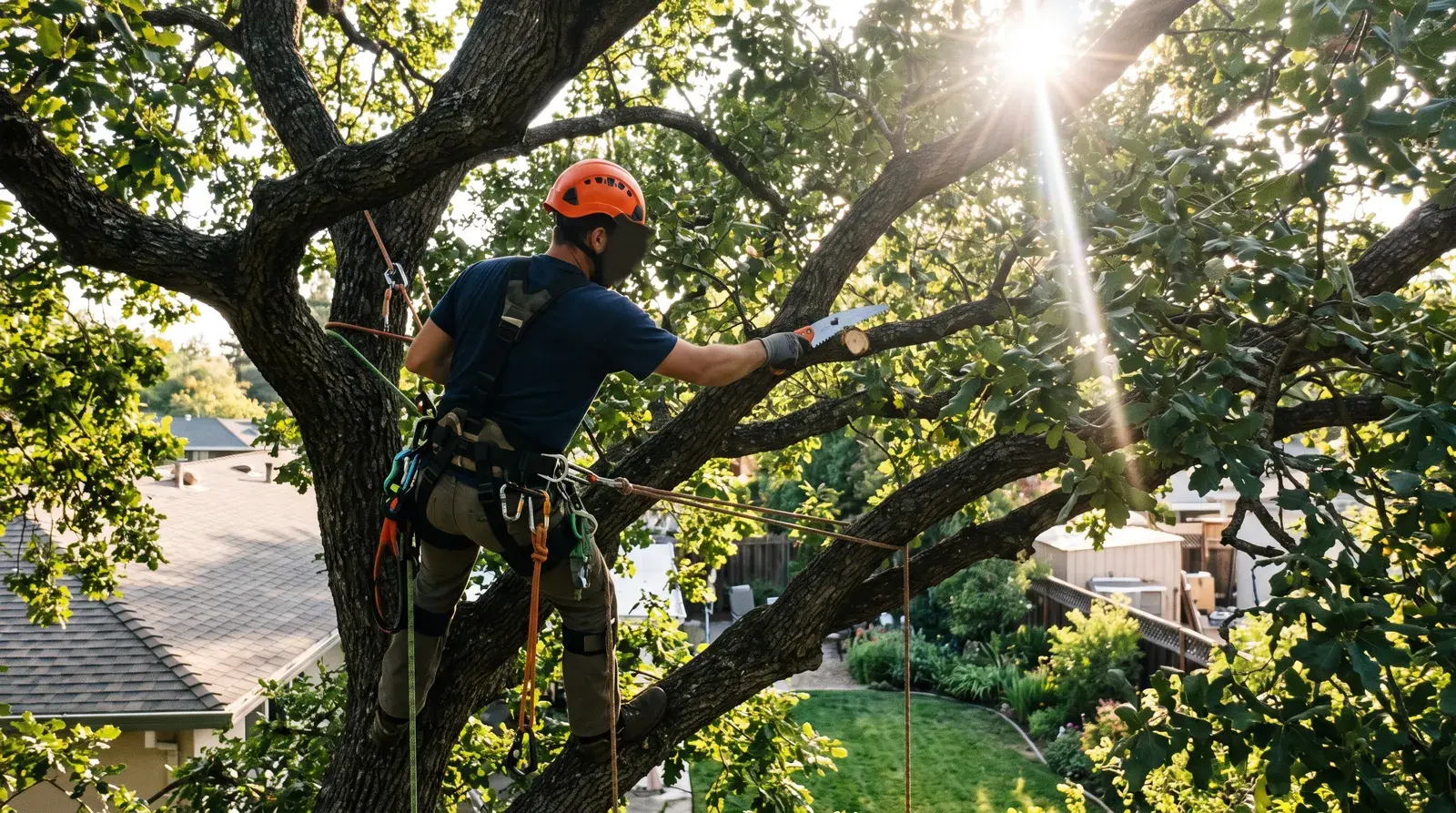
Structural pruning manages a tree's architecture: one dominant leader, well-spaced scaffold branches, and strong attachments. Where trimming maintains the canopy you have, structural pruning decides what canopy the tree builds next — and it's the single best long-term investment you can make in a tree.
We prune to ANSI A300 standards — the industry specification for tree care operations — which mostly comes down to discipline: a stated objective for the tree, correct cuts at the branch collar, and no more live tissue removed than the objective requires.
- Establishes or restores a single dominant leader so the trunk stays the strongest part of the tree
- Subordinates or removes codominant stems before their unions become split hazards
- Spaces scaffold limbs vertically and around the trunk so weight is distributed, not stacked
- Removes crossing, rubbing, and poorly attached branches while they're still small cuts
- Reduces overextended limbs back to laterals before end-weight becomes a rigging job
Training Young Trees: Small Cuts Now, or Big Problems Later
The cheapest pruning a tree will ever get is in its first fifteen years, when structural flaws can be fixed with hand pruners instead of rigging. A young tree trained on a three-to-five-year cycle almost never becomes the mature tree that needs cables, reduction, or removal.
Sacramento's growth pattern makes this vivid. Older neighborhoods — East Sacramento, Curtis Park, Carmichael, Fair Oaks — carry a mature canopy full of codominant camphors, overextended Modesto ash, and storm-damaged elms, most of which would have been a $200 fix at year eight. Meanwhile the region's newer subdivisions in Elk Grove, Roseville, Rocklin, and Lincoln are full of young pistache, zelkova, planes, and oaks at exactly the age where training works. Two or three modest visits now decide whether those streets look like Land Park or like a liability in 2060.
- Visit 1 (years 2–5): select the leader, remove broken and competing stems, leave temporary lower branches to build trunk taper
- Visit 2 (years 5–10): choose permanent scaffolds, subordinate rivals, start raising clearance gradually
- Visit 3+ (years 10–15): confirm structure, correct anything the tree improvised, transition to a normal maintenance cycle
Structural Tree Pruning across Sacramento, Placer, El Dorado, and Yolo counties.
Correcting Structure in Mature Trees
Mature trees with defects — codominant leaders, included bark, long horizontal limbs over a house — can't be rebuilt, but they can be managed. The tools are subordination and reduction cuts to shift growth and shed end-weight, plus cabling and bracing where a union needs mechanical help.
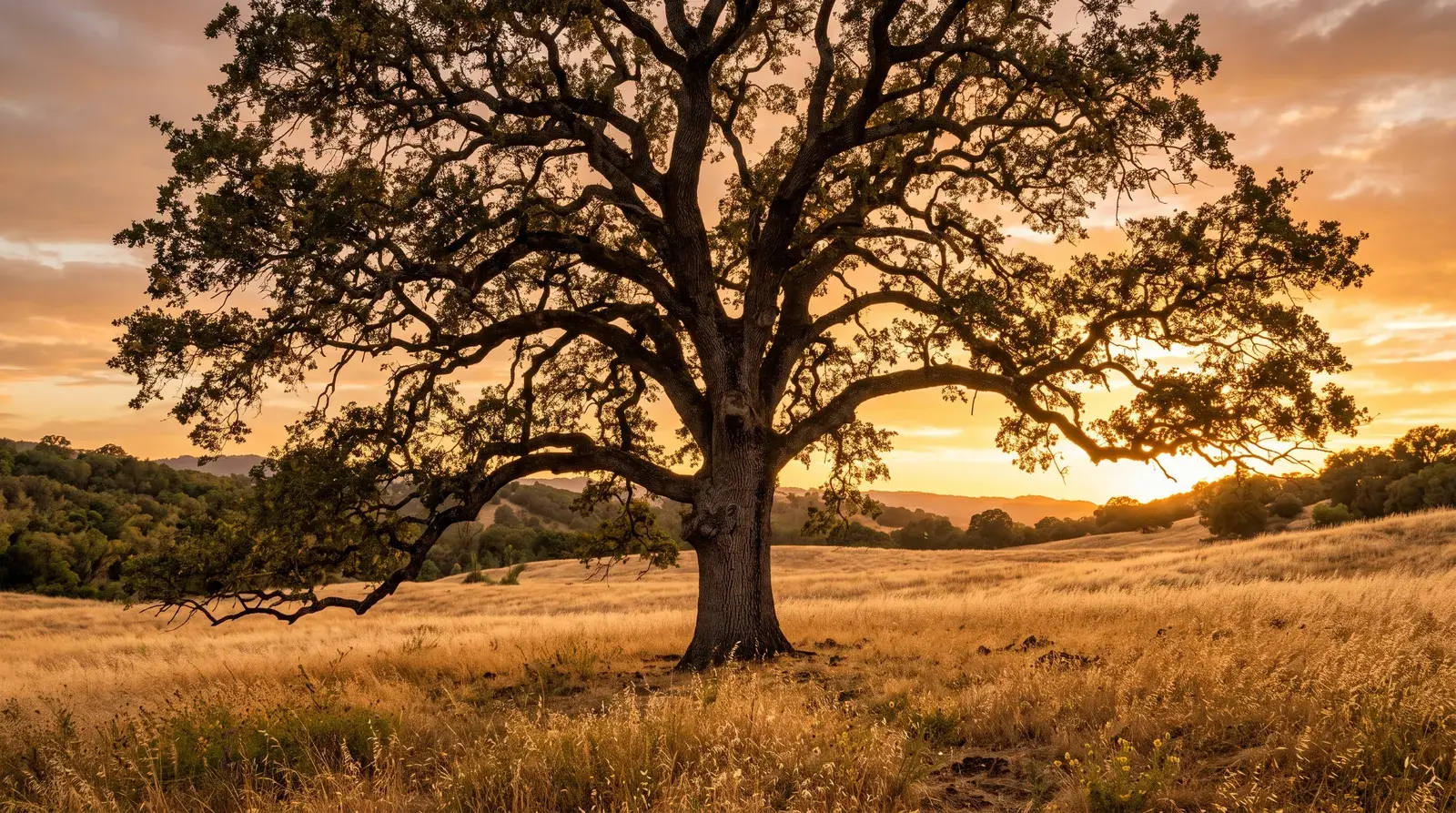
On valley oaks and interior live oaks — which dominate the mature canopy from Fair Oaks to Folsom — we keep cuts conservative and time the work to the dry season. Native oaks handle many small cuts far better than a few big ones.
- Subordination: shortening a competing stem so the tree redirects growth to the leader you keep
- End-weight reduction: cutting long limbs back to strong live laterals to lower leverage on a weak union
- Crown cleaning: deadwood and broken stubs out first — they tell you a lot about where the tree is failing
- Cabling and bracing for unions that pruning alone can't secure — see tree cabling & bracing
- Staged work: heavily defective trees get corrected over two or three seasons, not gutted in one
Why We Never Top Trees
Topping — cutting main stems back to stubs to make a tree shorter — is the most damaging thing commonly done to trees, and we don't do it. It doesn't even achieve its goal: topped trees regrow to their prior height in a few years, weaker and more dangerous than before.
When a tree is genuinely too tall or too heavy for its spot, the legitimate version of "make it smaller" is crown reduction: cutting each stem back to a live lateral big enough to take over as the new end. Smaller tree, intact structure, wounds that seal. That's a separate service — see crown reduction & thinning.
- Stub cuts can't seal, so decay columns run from every cut down into the trunk
- Regrowth sprouts anchor only in outer wood — they snap out in exactly the winter windstorms owners were worried about
- Sudden canopy loss sunscalds bark and starves the roots, tipping stressed trees into decline
- A topped tree usually costs more over the next decade — re-topping, sprout management, then removal — than one proper reduction would have
Need structural tree pruning on your property?
Share the address and project details — we'll come back with a scoped, site-specific estimate.
Timing Structural Pruning in the Sacramento Valley
Structural pruning can happen most of the year here, but the calendar still matters. Winter dormancy is the workhorse season — structure is visible with the leaves off, and the tree puts spring energy into sealing cuts. Native oaks get dry-season timing; heavy cutting waits out July and August heat.
- Winter (Dec–Feb): best all-around window for deciduous trees; bare canopies make defects obvious
- Native oaks: prune in the dry season or dormancy; wet-season cutting raises disease risk — see oak tree care
- Peak summer: light work only; removing shade in 100-degree stretches invites sunscald and drought stress
- After storms: broken limbs get proper cuts promptly so tears don't propagate — any season
What Structural Pruning Costs
Young-tree training visits are cheap — often $100–$300 per tree, less in batches — because the cuts are small and the ground crew barely works. Mature-tree structural work runs like a substantial trim, typically $500–$1,500+, driven by size, rigging, and how much correction the tree needs.
These are broad regional ranges. Estimates are free and site-specific, and for young trees we'll tell you honestly when the answer is "not much needed yet — see you in three years."
- Tree size and access — climbing a 60-foot canopy over a pool costs more than a 15-foot street tree
- Amount of correction — one subordination cut vs. a full end-weight reduction across four limbs
- Hardware — cabling adds materials and installation time when a union needs it
- Batch pricing — training a whole street or yard of young trees in one visit brings the per-tree cost down
The same crew from estimate to cleanup.
No juggling separate contractors for one tree. Tell us the address and what you're dealing with, and we'll come back with a written, site-specific number.
- Removal, trimming, stumps, and cleanup handled by one crew
- Free, site-specific estimates — priced to your tree, not a flat rate
- Sacramento, Placer, El Dorado, and Yolo counties
Signs a Tree Needs Structural Work
Most structural problems announce themselves years before failure, if you know what to look for. If any of these describe a tree on your property, it's worth an assessment before the next storm season rather than after it.
- Two or more trunks of similar size splitting from one point, especially with bark pinched in the crotch
- A seam, crack, or oozing line running down from a branch union
- Long horizontal limbs over a roof, driveway, or play area with all their foliage at the tips
- Branches crossing and rubbing through the interior of the canopy
- A young tree with no clear leader, or one that lost its top and sprouted a cluster of replacements
- Previous topping or storm breakage with dense sprout regrowth
Related services
Tree Trimming
Trimming for clearance, appearance, and long-term health — deadwood removal, canopy shaping, and structure on a sensible cycle.
Crown Reduction & Thinning
Reducing height, spread, and wind-sail on overgrown or heavy canopies — proper reduction cuts, never topping.
Tree Cabling & Bracing
Structural support for co-dominant stems and heavy limbs — hardware that helps preserve mature, valued trees.
Oak Tree Care
Specialized care for native valley, blue, and interior live oaks — dry-season pruning and heritage-tree compliance guidance.
Related guides
When to Trim Oak Trees in California
The best window to prune native California oaks, why dry-season timing cuts disease risk, and the pruning mistakes that shorten an oak's life.
9 Signs a Tree Needs to Come Down
Nine warning signs a tree is hazardous or dying — and when removal is safer than trying to save it.
Best Shade Trees for Sacramento Yards
The shade trees that actually thrive in Sacramento heat and clay soil — valley oak, Chinese pistache, zelkova, and more — plus spacing rules and species to skip near homes.
Before you book structural tree pruning
What it runs, where permits bite, and how structural tree pruning stacks up against the alternatives.
How Much Does Tree Trimming Cost in Sacramento? (2026)
Regional range $300–$2,500 — and what moves the number on a real job.
Do You Need a Tree Removal Permit in Folsom?
Where Folsom draws the line before a tree comes down, and who to check with.
Tree Pruning vs. Removal: When to Save a Tree and When to Take It Down
Pruning or Removal — how to tell which one the tree actually needs.
Crown Reduction Cost in the Sacramento Region (2026)
Regional range $500–$4,000 — and what moves the number on a real job.
Oak Tree Care & Trimming Cost in Sacramento (2026)
Regional range $400–$3,500 — and what moves the number on a real job.
Want to see what this looks like on a real property? Browse the structural tree pruning jobs we take on, or read how our crew scopes and prices work before you call anyone out.
Frequently asked questions
What's the difference between tree trimming and structural pruning?
Trimming is maintenance — clearing roofs and walkways, removing deadwood, tidying the canopy. Structural pruning changes how the tree is built: which stem leads, how branches are spaced, and where weight develops. A trim solves this year's clearance problem; structural pruning solves the failure that would have happened in fifteen years. Most trees need both, on different schedules, and one visit can often cover the two.
What is a codominant stem and why does it matter?
A codominant stem is when a tree splits into two or more leaders of similar size instead of keeping one main trunk. The union between them is often weak — especially with included bark, where bark gets pinched inside the joint and the wood never fuses properly. These unions are where big trees split apart in storms. Caught early, we prune one stem back to subordinate it; on mature trees, the options are reduction cuts or cabling and bracing.
When should young trees be pruned for structure?
Start light training two to five years after planting, then repeat every three to five years through roughly the first fifteen years. Each visit is small — selecting the leader, spacing scaffold limbs, removing crossing branches — and none of it requires heavy cutting. This matters most in newer neighborhoods like Elk Grove, Rocklin, and Lincoln, where street trees planted with the subdivision are hitting the age where structure gets locked in.
Why is topping a tree so bad?
Topping cuts leaders back to stubs with no lateral to take over. The tree responds with dense, fast sprouts attached only to the outer wood of the stub — weakly anchored shoots that grow tall again within a few years and break out in wind. Meanwhile the stub itself can't seal, so decay runs down the trunk. A topped tree is more hazardous than it was before, plus disfigured. If height is the problem, the right tool is crown reduction to live laterals.
How much of a tree can be pruned at once?
A common working rule is no more than about 25% of the live canopy in a single year, and less for mature or stressed trees — native oaks in particular resent heavy cutting. Structural pruning rarely needs to approach that limit anyway; well-chosen cuts do more than many cuts. If a tree needs more correction than one visit can safely deliver, we stage the work across two or three seasons.