
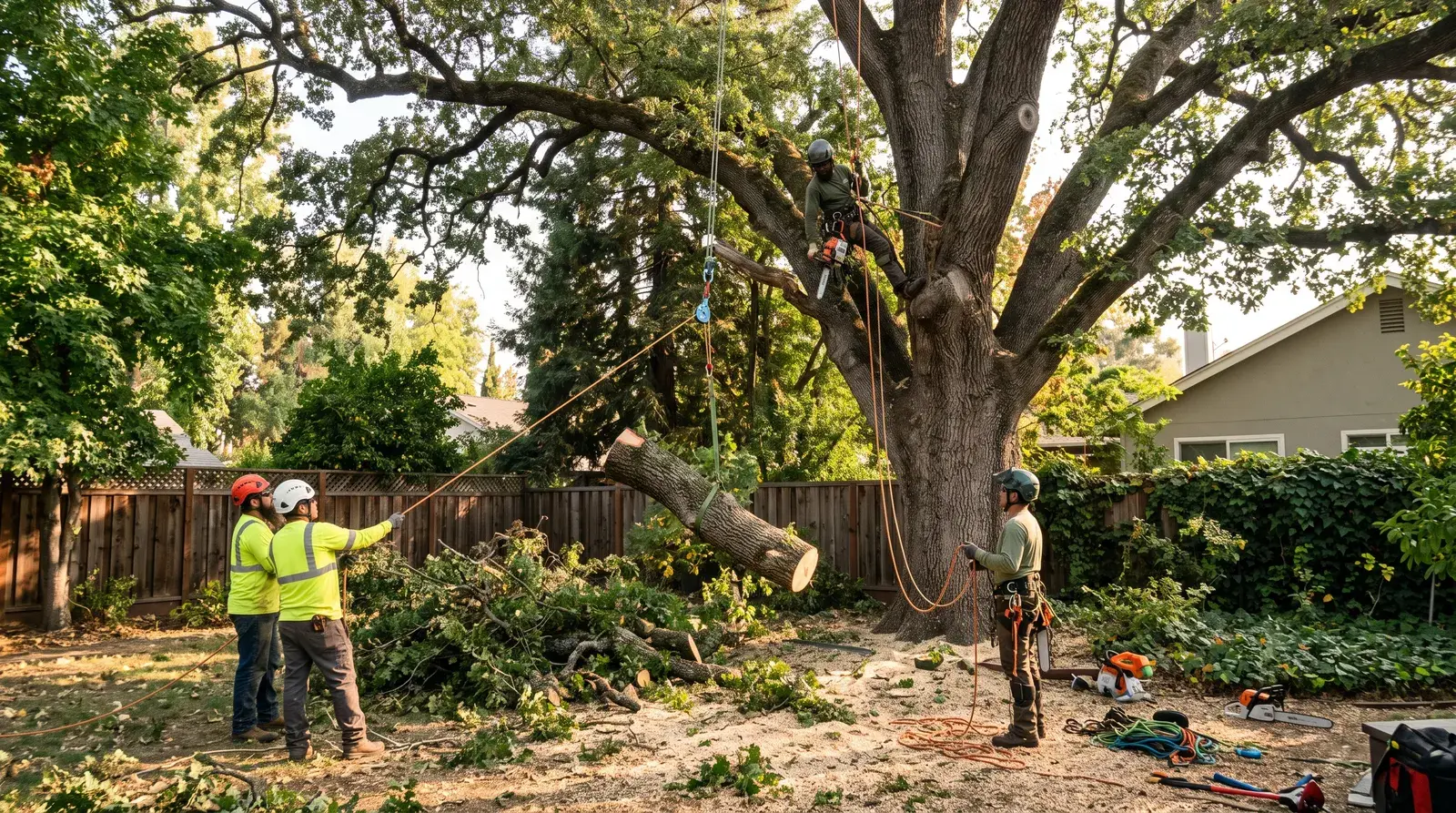
How Our Tree Removal Process Works
Every removal follows the same sequence: assess the tree, confirm whether a permit applies, set up rigging and a drop zone, take the tree down in a controlled way, then grind the stump and clear the debris. Skipping any of those steps is how trees end up on roofs.
Assessment
We look at species, height, lean, decay pockets, root condition, and what the tree can hit. This determines the takedown method and the price.
Permit check
Heritage trees, street trees, and protected native oaks get flagged before we schedule anything. We'd rather lose a week to paperwork than leave you with a code violation.
Rigging setup
Climbing lines, friction devices, and lowering ropes go in before the first cut. On open ground we may fell the tree whole; near structures, everything comes down in pieces.
Sectional takedown
Limbs are roped down or lifted out, then the trunk comes down in logs sized for the equipment on hand.
Cleanup
Brush gets chipped, wood gets hauled (or bucked for firewood if you want it), and the yard gets raked. Stump grinding is available as an add-on.
When a Tree Should Come Down — and When It Shouldn't
Removal is the right call when a tree is dead, structurally failing, or fundamentally wrong for its spot. It's the wrong call for a healthy tree that just needs pruning — mature shade trees add real value in Sacramento's hot-summer climate, and they're slow to replace.
Sacramento's winter windstorms do the sorting for a lot of homeowners — saturated soil plus a strong south wind is when leaning trees and decayed trunks fail. If a tree worried you last winter, get it looked at before the next storm season, not after.
Take it down
Structural failure or wrong tree, wrong place.
- Standing dead trees, trunks with major decay or cavities, trees with root plate lift or a new lean after a storm, and split co-dominant stems that cabling can't save.
- Trees planted in the wrong place — a coast redwood cooking against a south-facing wall, or a fruitless mulberry heaving a driveway with no room for root pruning.
- Not sure? — a tree health assessment gives you an honest answer before you spend removal money. We'd rather preserve a saveable tree than bill for an unnecessary takedown.
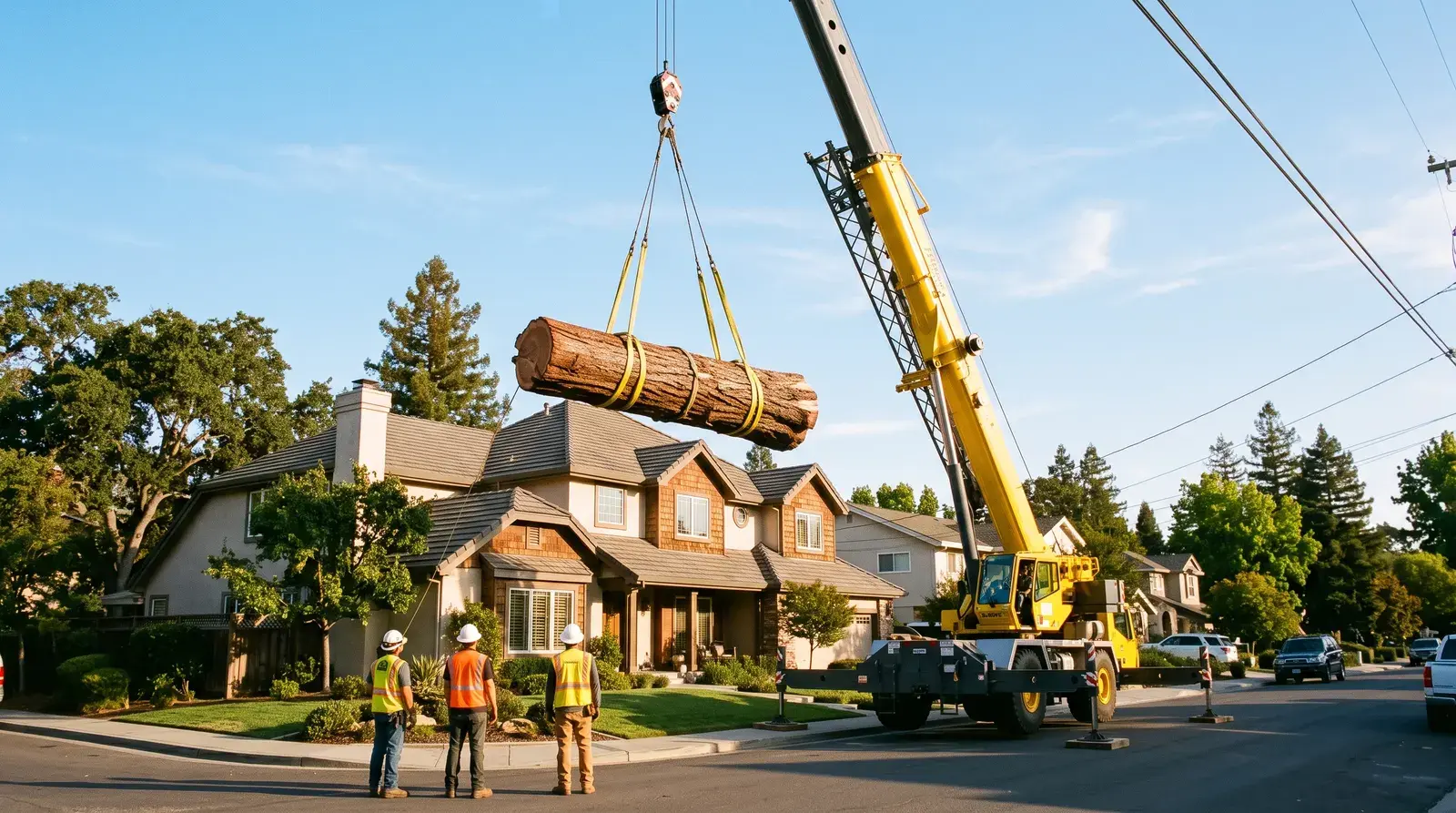
Tree Removal across Sacramento, Placer, El Dorado, and Yolo counties.
Permits: Heritage Trees, Street Trees, and Protected Oaks
The Sacramento region layers several tree ordinances, and the rules change at city limits. The short version: assume nothing about a large native oak or any tree in the strip between sidewalk and street until you've checked.
916 Trees checks the ordinance question on every estimate. If a permit is required, we can prepare supporting documentation and, through our arborist report service, provide the written assessment most applications ask for.
- City of Sacramento — street trees are City Trees regardless of who waters them, and Heritage Trees are protected under City Code Chapter 12.56. Private protected trees need a city permit before removal. Verify current rules at cityofsacramento.gov.
- Sacramento County (unincorporated) — the Tree Preservation and Protection Ordinance protects native oaks, including valley oak, interior live oak, and blue oak. Carmichael, Fair Oaks, Orangevale, and Arden-Arcade all fall under county rules.
- Other cities — Folsom, Roseville, Elk Grove, Citrus Heights, and the El Dorado and Placer county jurisdictions each have their own thresholds. Always verify with the specific city or county before cutting.
- Dead or hazardous trees usually have a faster path, but most jurisdictions still want documentation — photos, and sometimes an arborist letter — before or shortly after removal.
What Drives Tree Removal Cost
Two trees of the same species can differ in price by thousands of dollars. The tree's size matters, but access and risk matter more — a 40-foot tree in a fenced backyard over a pool costs more to remove than a 60-footer in an open front yard.
The bands below are broad regional figures — orientation, not a quote. Every estimate we give is free, written, and specific to your tree and your lot.
- Small trees
- $500–$900
- Mid-size trees
- $900–$2,500
- Large or complex
- $2,500–$10,000+
- Every estimateWritten and site-specific
- Free
- Size — height and trunk diameter set the baseline. More wood means more cuts, more rigging, and more hauling.
- Access — can a chip truck and loader reach the tree, or does every log get carried through a gate? Tight-access backyard trees take far more labor.
- Targets — structures, fences, pools, septic systems, and lines under the canopy all force slower, piece-by-piece rigging.
- Condition — dead and decayed trees are more dangerous to climb, which can push the job toward a crane or aerial lift.
- Species — dense hardwoods like valley oak weigh more per log than a pine or a Modesto ash of the same size; palms are their own category entirely.
- Extras — stump grinding, firewood bucking, and full debris haul-off each add a line item.
Need tree removal on your property?
Share the address and project details — we'll come back with a scoped, site-specific estimate.
Safety and Equipment
Tree removal is consistently one of the most dangerous jobs in the country, and most serious accidents involve untrained crews free-falling wood near targets. Controlled removal means the crew decides where every piece lands — gravity never gets a vote.
- Rigging systems — lowering ropes, blocks, and friction devices let heavy limbs come down slowly instead of crashing through what's below.
- Climbing and aerial access — climbing gear for sound trees; an aerial lift or crane when decay makes climbing unsafe.
- Chippers and loaders — brush is chipped on-site and trunk wood loaded out, which keeps the job fast and your yard clean.
- Ground protection — plywood and mats under equipment on lawns and irrigated areas, so the removal doesn't cost you a landscape repair.
- Utility awareness — work near SMUD or PG&E lines is sequenced with the utility, never improvised around energized conductors.
Sacramento-Area Trees We Remove Most
The 'City of Trees' canopy is a mix of native oaks, mid-century street plantings, and fast-growing landscape trees now reaching the end of their lifespan. A few species make up most of our removal calls.
- Valley oak and interior live oak — usually removed only when dead or structurally failed; both are protected in many jurisdictions, so permits come first.
- Modesto ash — a mid-century favorite now aging out across Sacramento, with brittle wood and frequent limb failure in winter wind.
- London plane and sycamore — big street and yard trees in East Sac, Land Park, and Midtown that occasionally outgrow their space or heave hardscape.
- Camphor — dense, heavy canopies and aggressive surface roots; common removals in older suburbs like Carmichael and Citrus Heights.
- Coast redwood — planted widely in the 1970s–80s and now struggling in Sacramento's heat and drought; dying tops and browning canopies drive removals.
- Mexican fan palm — tall, heavy, and awkward; see our dedicated palm removal service.
The same crew from estimate to cleanup.
No juggling separate contractors for one tree. Tell us the address and what you're dealing with, and we'll come back with a written, site-specific number.
- Removal, trimming, stumps, and cleanup handled by one crew
- Free, site-specific estimates — priced to your tree, not a flat rate
- Sacramento, Placer, El Dorado, and Yolo counties
What Happens After the Tree Is Gone
A removal isn't finished when the trunk hits the ground. Decide up front what you want done with the stump, the wood, and the empty spot — it's cheaper to handle all three in one mobilization than to call anyone back later.
- Stump grinding — standard grinds run 8–12 inches below grade, deeper if you're replanting or pouring hardscape over the spot.
- Wood and chips — keep bucked firewood rounds or a load of chips for mulch at no charge, or have everything hauled off.
- Replanting — Sacramento summers punish bare yards. Our tree planting service can put the right species back in a better spot, which some permit conditions actually require.
- Documentation — we can photograph the tree's condition before and during removal, useful for insurance claims and permit files.
Related services
Emergency Tree Service
Fast response for storm-damaged, fallen, or hazardous trees threatening homes, cars, and power lines across the Sacramento area.
Crane-Assisted Tree Removal
Crane-assisted removal for large, dead, or hazardous trees where tight access or overhead risk rules out a conventional takedown.
Stump Grinding & Removal
Grinding stumps below grade so you can replant, pave, or reclaim the space — chips and surface roots handled.
Storm Damage Cleanup
Cleanup after winter windstorms — split limbs, uprooted trees, and yard debris removed so your property is safe and clear again.
Related guides
Do You Need a Permit to Remove a Tree in Sacramento?
Which Sacramento trees need a removal permit, how city and county rules differ, and how to check before the saw comes out.
How Much Does Tree Removal Cost in Sacramento? (2026)
Typical 2026 Sacramento tree removal price ranges by tree size, the factors that move the number, and how to read a quote before you sign it.
9 Signs a Tree Needs to Come Down
Nine warning signs a tree is hazardous or dying — and when removal is safer than trying to save it.
Before you book tree removal
What it runs, where permits bite, and how tree removal stacks up against the alternatives.
Emergency Tree Service Cost in Sacramento (2026)
Regional range $800–$8,000 — and what moves the number on a real job.
Do You Need a Tree Removal Permit in Citrus Heights?
Where Citrus Heights draws the line before a tree comes down, and who to check with.
Tree Pruning vs. Removal: When to Save a Tree and When to Take It Down
Pruning or Removal — how to tell which one the tree actually needs.
Crane-Assisted Tree Removal Cost in Sacramento (2026)
Regional range $2,500–$12,000 — and what moves the number on a real job.
Do You Need a Tree Removal Permit in Rancho Cordova?
Where Rancho Cordova draws the line before a tree comes down, and who to check with.
Cabling & Bracing vs. Removal: Can This Tree Be Saved?
Cabling & Bracing or Removal — how to tell which one the tree actually needs.
Want to see what this looks like on a real property? Browse the tree removal jobs we take on, or read how our crew scopes and prices work before you call anyone out.
Frequently asked questions
Do I need a permit to remove a tree in Sacramento?
Sometimes. In the City of Sacramento, heritage trees (protected under City Code Chapter 12.56) and street trees — which the city considers City Trees even when they front your lot — require a permit before removal. In unincorporated Sacramento County, the Tree Preservation and Protection Ordinance protects native oaks like valley oak and interior live oak. Other cities (Folsom, Roseville, Elk Grove) have their own rules. We check the tree against local ordinances during the estimate and point you to the right application when one is needed.
How much does tree removal cost in Sacramento?
As a broad regional range, most residential removals run $500–$2,500. Small ornamentals on open ground sit at the low end; a mature valley oak or Modesto ash over a roofline can run several thousand. Large, decayed, or tight-access trees that need a crane can exceed $5,000–$10,000+. Height, trunk diameter, lean, decay, and equipment access drive the number, which is why we quote from a site visit, not a photo. Estimates are free.
Can you remove a tree that's close to my house or power lines?
Yes — that's most of what we do. Trees over structures come down in sections with ropes and rigging hardware, or with a crane when there's no safe drop zone. Trees near service drops and utility lines require coordination: SMUD or PG&E handles work inside their clearance zones, and we sequence the removal around that. Never let anyone free-fall a tree near a structure or line.
How long does a tree removal take?
A small tree on open ground is often gone in a couple of hours. A large oak over a house with rigging on every limb can take a full day, sometimes two with stump grinding and haul-off. Crane-assisted removals are usually faster on-site — often a morning — but need more setup and scheduling. We give you a realistic time window with the estimate.
Does tree removal include stump grinding and debris haul-off?
Haul-off of the trunk and brush is included in our removal quotes unless you ask to keep firewood or chips. Stump grinding is quoted as a separate line item because not everyone wants it — some homeowners leave the stump, others need it ground 8–12 inches below grade to replant or re-landscape. Ask for both numbers on the same estimate so there are no surprises.