
A Mid-Century Canopy Hitting Its Limit
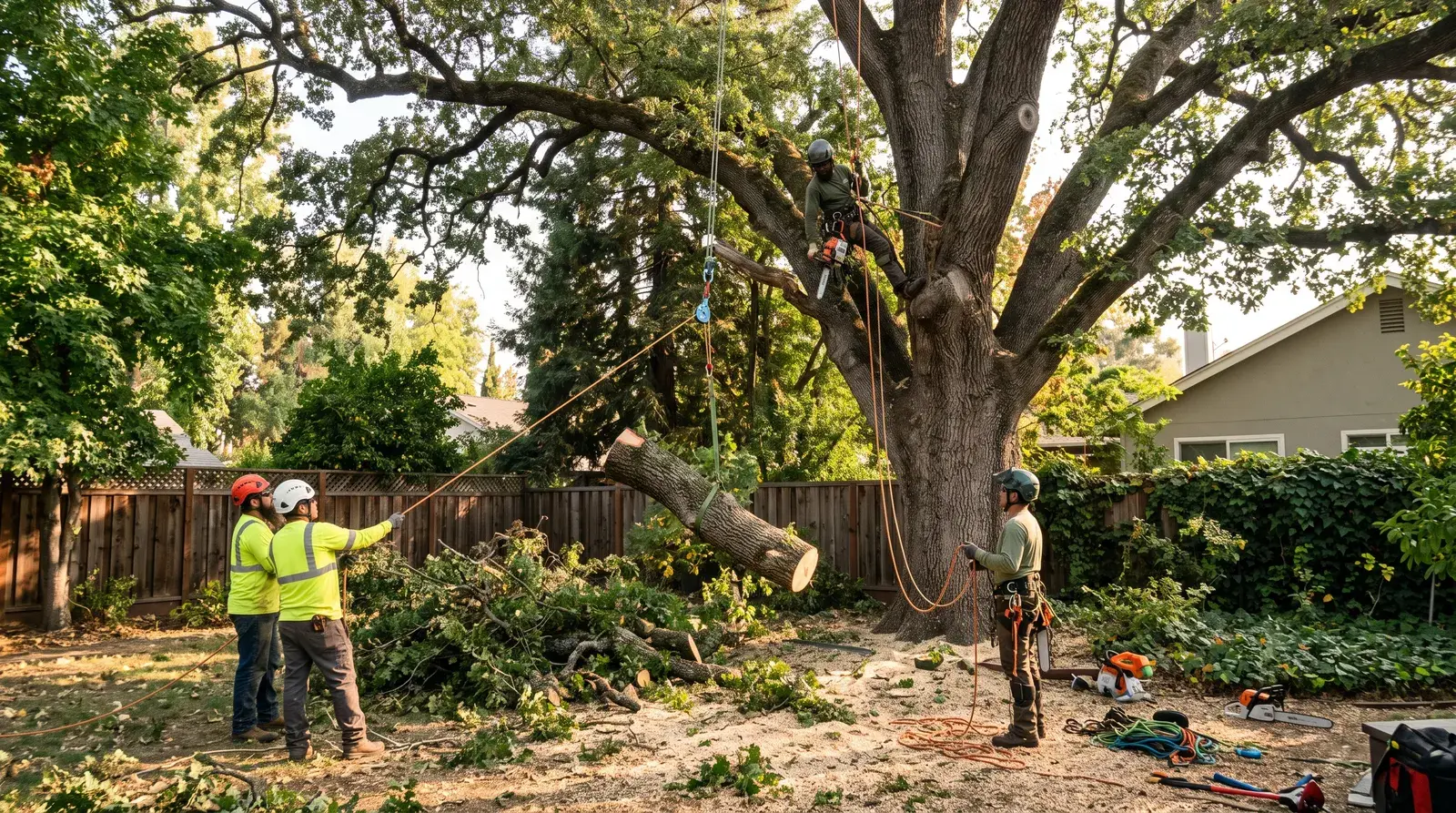
Arden-Arcade's neighborhoods were built between the late 1940s and the mid-1960s, and the trees planted then are now between 60 and 80 years old. Some of those trees are still sound; many are not. Modesto ash — the workhorse street tree of that era — is failing across the region at this age: interior decay, limb drop, and canopies thinning from the top down. Valley oaks in Arden Park and Sierra Oaks that were already mature saplings at planting are now imposing trees with wide root flares and significant end-weight over rooflines and fences.
- Arden Park and Sierra Oaks hold the largest concentration of mature valley oaks in the area — wide-spreading trees that are worth saving when sound, but that generate serious removal jobs when they aren't.
- Del Paso Manor and Arden Manor have extensive Modesto ash planting from the 1950s and 1960s. Many are past their practical lifespan and showing crown dieback, bark splitting, and internal decay.
- Chinese elm — planted widely in the same era — is reaching advanced age across the area, with surface root systems that lift driveways and sidewalks.
- California sycamores along drainages and near American River Parkway corridors grow large and fast; fallen limbs and root damage to older foundations are recurring removal triggers here.
- Unlike Roseville's newer west-side subdivisions, Arden-Arcade removals are rarely young trees that failed in wind. They're older trees in structural decline — heavier wood, bigger root flares, more complex rigging.
Sacramento County Rules — Not the City's
This distinction matters: Arden-Arcade is unincorporated Sacramento County. Residents here are often surprised to learn they fall under Sacramento County's jurisdiction rather than the City of Sacramento's for tree permits. If you're on the Sacramento city side of the line, city rules apply. If you're in unincorporated Arden-Arcade — most of the area east of Watt Avenue toward the American River — it's the county.
- Sacramento County has a native oak protection ordinance that covers valley oak, interior live oak, and blue oak on private residential parcels in unincorporated areas. Removal of protected native oaks generally requires a county review before the tree comes down.
- City of Sacramento's heritage tree ordinance (City Code Ch. 12.56) does not apply to unincorporated Arden-Arcade. Citing city rules for a county parcel is a common mistake — and can result in pulling the wrong permit or no permit at all.
- Dead and hazardous trees often have a streamlined path, but the process still requires documentation of the condition and in some cases a certified arborist report.
- Street trees fronting the public right-of-way are managed by Sacramento County's transportation or parks division — they are not yours to remove, even when you maintain the parkway strip.
- 916 Trees confirms which jurisdiction applies at every Arden-Arcade estimate — and points you to the correct county application when one is required.
Tree Removal in Arden-Arcade — free, site-specific estimates.
American River Proximity: What It Adds to the Equation
The northern edge of Arden-Arcade runs along the American River Parkway — one of the longest urban riparian greenways in the country. Properties near the Parkway may have trees that straddle the boundary between private lot and the county-managed corridor, or whose root systems extend into the riparian setback. That introduces additional review layers beyond the baseline oak ordinance.
California sycamores, Fremont cottonwoods, and willows grow along the river corridor and into adjacent lots. These are generally protected as riparian vegetation under county and state guidelines, and removal near the American River Parkway boundary typically warrants a call to Sacramento County Regional Parks before work begins. Trees fully within your private lot but near the corridor should still be documented carefully — permit conditions for riparian-adjacent removal can include replanting requirements. 916 Trees identifies Parkway-adjacent removals at the estimate stage so there are no surprises mid-project.
SMUD Service and Line-Clearance Work
Arden-Arcade is served by SMUD (Sacramento Municipal Utility District), not PG&E. SMUD manages its own vegetation management program and maintains minimum clearance distances from distribution lines. When a tree is growing into or near SMUD lines, the removal process and who handles which part of the job differs from the PG&E territory most surrounding areas use.
- SMUD maintains its own right-of-way trimming program. Work inside the easement adjacent to transmission lines is SMUD's responsibility; work on your side of the property line is yours.
- For removals where the tree or its canopy is entangled with SMUD distribution lines, SMUD typically needs to de-energize or insulate the line before a crew can safely work around it — that requires coordination and scheduling lead time.
- Emergency situations with trees on SMUD lines go through SMUD first (800-655-2555 for emergencies), then a tree service once the line hazard is addressed.
- If the removal quote involves working within arm's reach of a SMUD line, tell us at the estimate — the scope, timeline, and cost change, and we coordinate with SMUD to make the work safe.
Need tree removal in Arden-Arcade?
Share the address and project details — we'll come back with a scoped, site-specific estimate.
What Tree Removal Costs in Arden-Arcade
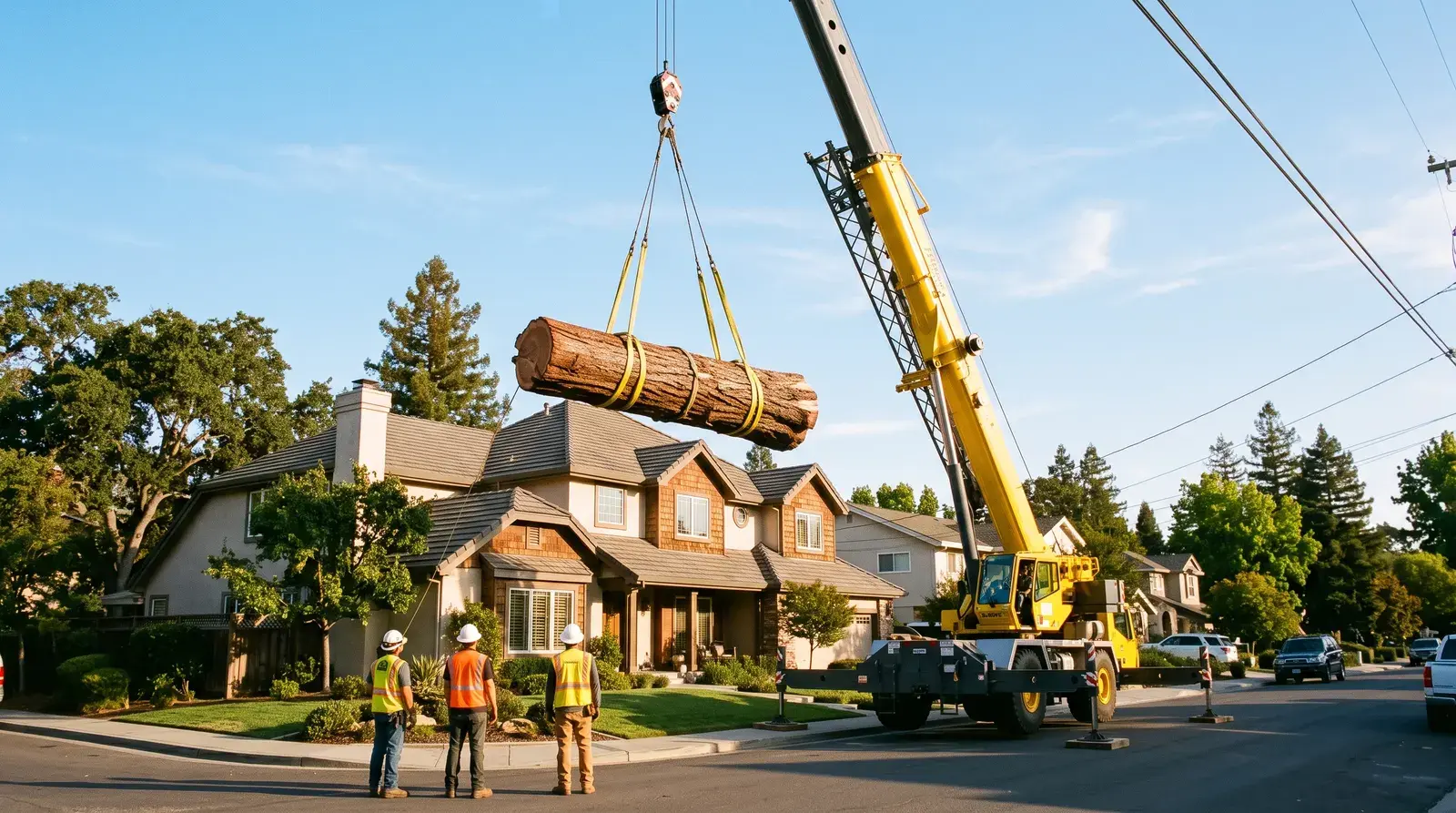
As broad regional figures, most residential removals run $500–$2,500. Arden-Arcade's aging mid-century canopy skews toward the higher end of that range and beyond: mature valley oaks and large sycamores over structures are multi-thousand-dollar jobs, and crane-assisted removals can exceed $5,000–$10,000+.
- Size is the primary driver — a 70-foot valley oak carries far more wood than a 30-foot failing ash, and the rigging reflects that.
- Access across older Arden-Arcade lots varies widely: some have open side yards, others have narrow passes between house and fence that require specialized equipment or hand-lowering every piece.
- Targets under the canopy — rooflines, pools, masonry walls, driveways — force slow, rigged, section-by-section takedowns rather than simple drop cuts.
- Decayed or structurally compromised oaks can be unsafe to climb, pushing toward a crane or lift, especially on the larger trees in Arden Park and Sierra Oaks.
- County permit and arborist report costs apply to protected native oaks — we identify those at the estimate so the total cost is clear before any paperwork starts.
- Estimates are free, written, and based on a site visit — not a photo or square-footage formula.
The same crew from estimate to cleanup.
No juggling separate contractors for one tree. Tell us the address and what you're dealing with, and we'll come back with a written, site-specific number.
- Removal, trimming, stumps, and cleanup handled by one crew
- Free, site-specific estimates — priced to your tree, not a flat rate
- Sacramento, Placer, El Dorado, and Yolo counties
Stumps, Roots, and What Comes After
Old trees in Arden-Arcade leave serious stumps. A 70-year-old valley oak or Modesto ash has a root flare and surface root system that extends well beyond the visible trunk. Plan the stump, the wood, and the replacement — if one is needed — before removal day.
- Stump grinding on mature Arden-Arcade trees is often a multi-hour job — flares extend past the trunk, and Chinese elm surface roots run under lawns and against slabs.
- Oak wood from the removal is excellent firewood; we can buck rounds and leave them stacked at no additional charge.
- Call USA North 811 before any grinding — older lots in Del Paso Manor and Arden Manor have shallow irrigation laterals and older utility runs that aren't always mapped accurately.
- Sacramento County permit conditions sometimes require replacement planting; we can fold a replacement tree into the removal quote so stump grind and new tree happen in one mobilization.
Related guides
Do You Need a Permit to Remove a Tree in Sacramento?
Which Sacramento trees need a removal permit, how city and county rules differ, and how to check before the saw comes out.
How Much Does Tree Removal Cost in Sacramento? (2026)
Typical 2026 Sacramento tree removal price ranges by tree size, the factors that move the number, and how to read a quote before you sign it.
9 Signs a Tree Needs to Come Down
Nine warning signs a tree is hazardous or dying — and when removal is safer than trying to save it.
What tree removal costs — and what Arden-Arcade allows
Regional ranges, local permit rules, and the alternatives worth weighing before tree removal in Arden-Arcade.
Emergency Tree Service Cost in Sacramento (2026)
Regional range $800–$8,000 — and what moves the number on a real job.
Do You Need a Tree Removal Permit in Auburn?
Where Auburn draws the line before a tree comes down, and who to check with.
Tree Pruning vs. Removal: When to Save a Tree and When to Take It Down
Pruning or Removal — how to tell which one the tree actually needs.
Tree Service in Sacramento County, CA
Tree work in Sacramento County ranges from removing aging valley oaks in East Sacramento to grinding stumps on new-buil…
Crane-Assisted Tree Removal Cost in Sacramento (2026)
Regional range $2,500–$12,000 — and what moves the number on a real job.
Do You Need a Permit to Remove a Tree in Sacramento?
Which Sacramento trees need a removal permit, how city and county rules differ, and how to check before the saw comes out.
Want a sense of the work first? See the kinds of tree removal jobs we take on and who shows up to do them.
Frequently asked questions
Do I need a Sacramento County permit or a City of Sacramento permit to remove an oak tree in Arden-Arcade?
Sacramento County's permit, not the city's — Arden-Arcade is unincorporated Sacramento County, so the county's native oak ordinance applies, not City of Sacramento's heritage tree code (City Code Ch. 12.56). The two processes are different, and applying for the wrong one wastes time and doesn't authorize the work. If you're not sure which side of the jurisdictional line your property falls on, Sacramento County's parcel viewer or a quick call to the county planning department will confirm it. We check the jurisdiction at every estimate and point you to the right process.
How much does tree removal cost in Arden-Arcade?
As a broad regional range, most residential removals run $500–$2,500. Arden-Arcade trees tend to run larger and older than subdivision-era trees elsewhere in the region — a mature valley oak in Sierra Oaks or a large sycamore near the American River Parkway is a several-thousand-dollar removal, and crane-assisted work on big oaks over structures can exceed $5,000–$10,000+. Protected oaks may also carry county permit and arborist report costs. Every estimate is free, written, and site-specific.
My Modesto ash is losing limbs and the canopy is thinning. Do I remove it?
Modesto ash in Arden-Arcade is hitting the end of its natural lifespan — trees planted in the 1950s and 1960s are now 60-plus years old, and internal decay, crown dieback, and limb drop are the signature failure pattern. A tree health assessment gives you an honest read: some ash with sound structure can be maintained for a few more years with deadwood removal; others are too far gone to justify the ongoing hazard. Standing dead ash drops limbs without wind, so a thinning crown is worth an assessment sooner rather than later.
My tree is near the American River Parkway. Does that change the removal process?
Possibly. Trees on private lots adjacent to the American River Parkway corridor — particularly riparian species like sycamore, cottonwood, and willow — may be subject to additional county review beyond the baseline oak ordinance. The Parkway boundary isn't always where people expect it, and root systems can extend into the corridor setback even when the trunk is clearly on your property. We identify Parkway-adjacent situations at the estimate and flag whether a call to Sacramento County Regional Parks belongs in the process before work begins.
There's a SMUD line running through my tree. Can you remove it without dealing with SMUD first?
Not safely, and not the parts of the tree entangled with the line. Work inside the SMUD right-of-way or in direct contact with distribution lines requires SMUD involvement — either de-energizing the line or having their crew insulate it before we can work around it. For emergencies with an active line hazard, contact SMUD first (800-655-2555), then call us once the line is addressed. For planned removals, we coordinate the SMUD scheduling in advance so the job flows as one visit. Just tell us about the line at the estimate — it changes the scope, timeline, and cost.