What Grows on Granite: Penryn's Tree Species
Shallow granite bedrock along English Colony Way and Taylor Road shapes what survives here. The oaks that dominate Penryn parcels are drought-adapted, laterally rooted, and built for thin soils — which means wide canopy spreads, surface-running root systems, and stumps that are wider than they look from above.
- Interior live oak is the most common canopy tree on Penryn acreage — evergreen, broad-spreading, and capable of growing large horizontal limbs that extend well past the drip line and over roofs, barns, and fence lines.
- Blue oak grows on the drier, stonier ground at the edges of parcels and on the steeper south-facing slopes; it's slower-growing and more drought-tolerant than interior live oak, and worth preserving when the tree is structurally sound.
- Gray pine (foothill pine) grows quickly in Penryn's rocky soils and is the tree most likely to cause an emergency: it hits drought stress hard, dies young relative to the oaks, and stands dead getting more brittle and more dangerous each season before it fails.
- Old mandarin trees from the Placer County citrus era appear on some older Penryn parcels — rangy, partially hollow, and mixed into the native oak understory. These are non-native trees and not covered by county oak protections.
- Granite outcrops and exposed bedrock create micro-terrain that affects both tree health and equipment access — roots wrap over rock faces, and pockets of deep soil produce trees that are disproportionately large for their surroundings.
- Surface root systems in shallow granite soil extend far from the trunk; plan stump grinding to cover root flare spread, not just the visible round, especially when replanting or building over the spot.
Placer County Native Oak Protections
Penryn has no city hall. Unincorporated Placer County sets the rules, and the county protects certain native oaks on private parcels — including the blue oaks and interior live oaks that make up most of Penryn's canopy. Confirming the county's current requirements is step one on any live oak removal.
- Placer County's tree rules apply to native oaks above specified trunk-diameter thresholds; blue oak and interior live oak — the two species most common on Penryn parcels — are within scope.
- A live native oak at or above the county threshold may require a permit, a replacement planting condition, or both before removal; the process for dead or demonstrably hazardous trees is generally faster but still benefits from condition documentation.
- Non-native trees — old mandarin, ornamental landscape trees — are not covered by the oak ordinance and can typically be removed without a county permit.
- Defensible space fuel reduction under PRC 4291 is a separate regulatory pathway; trees removed specifically for fire clearance on a fire-rated parcel follow that framework rather than the general oak removal process.
- We identify and measure trees during the estimate and flag which ones look like they require county review; current thresholds and the applicable process should always be confirmed directly with Placer County.
- Photos of trunk condition, any visible decay, and the hazard the tree presents to structures are the most useful documentation to have on file before an application — we can provide that documentation as part of the removal scope.
Tree Removal in Penryn — free, site-specific estimates.
Defensible Space on High-Fire-Severity Penryn Parcels
CAL FIRE maps most Penryn parcels as High or Very High Fire Hazard Severity Zone, which puts structures under PRC 4291's 100-foot defensible space requirement. For many Penryn property owners, defensible space planning and tree removal happen in the same conversation — and the same crew can handle both in one mobilization.
- Zone 1 (0–30 feet from structures): dead trees and brush removed, limbs pruned off the roofline, crowns separated, ground litter cleared. Dead gray pine within this zone almost always gets removed — it fails the defensible space standard and creates fire risk.
- Zone 2 (30–100 feet): ladder fuels removed — low limbs pruned off oaks and pines, brush thinned to separated clumps, dead trees and snags out. Healthy oaks generally stay; the goal is crown separation and elimination of fuel continuity from ground to canopy.
- Slopes change the math: fire runs uphill, so downhill-side clearance on canyon-facing Penryn parcels should exceed the flat-ground minimums. CAL FIRE guidelines note this explicitly.
- Zone 0 (0–5 feet from structures): non-combustibles only — no wood mulch, no juniper foundation plants, no firewood stacked against the wall. This zone is increasingly part of insurance inspections in the foothill corridor.
- CAL FIRE and Placer County conduct defensible space inspections in the Penryn area; failed inspections can carry compliance orders and affect policy renewal with carriers in the high-fire zone.
- The Placer County Resource Conservation District runs periodic cost-share chipping programs for foothill landowners — worth checking before committing to hauling brush.
Need tree removal in Penryn?
Share the address and project details — we'll come back with a scoped, site-specific estimate.
Slope, Driveways, and Acreage Access Reality
Penryn is not flat. The roads and private drives along English Colony Way and Taylor Road roll with the granite terrain, and the parcels behind them follow suit. Access planning on Penryn jobs goes into the estimate, not the invoice.
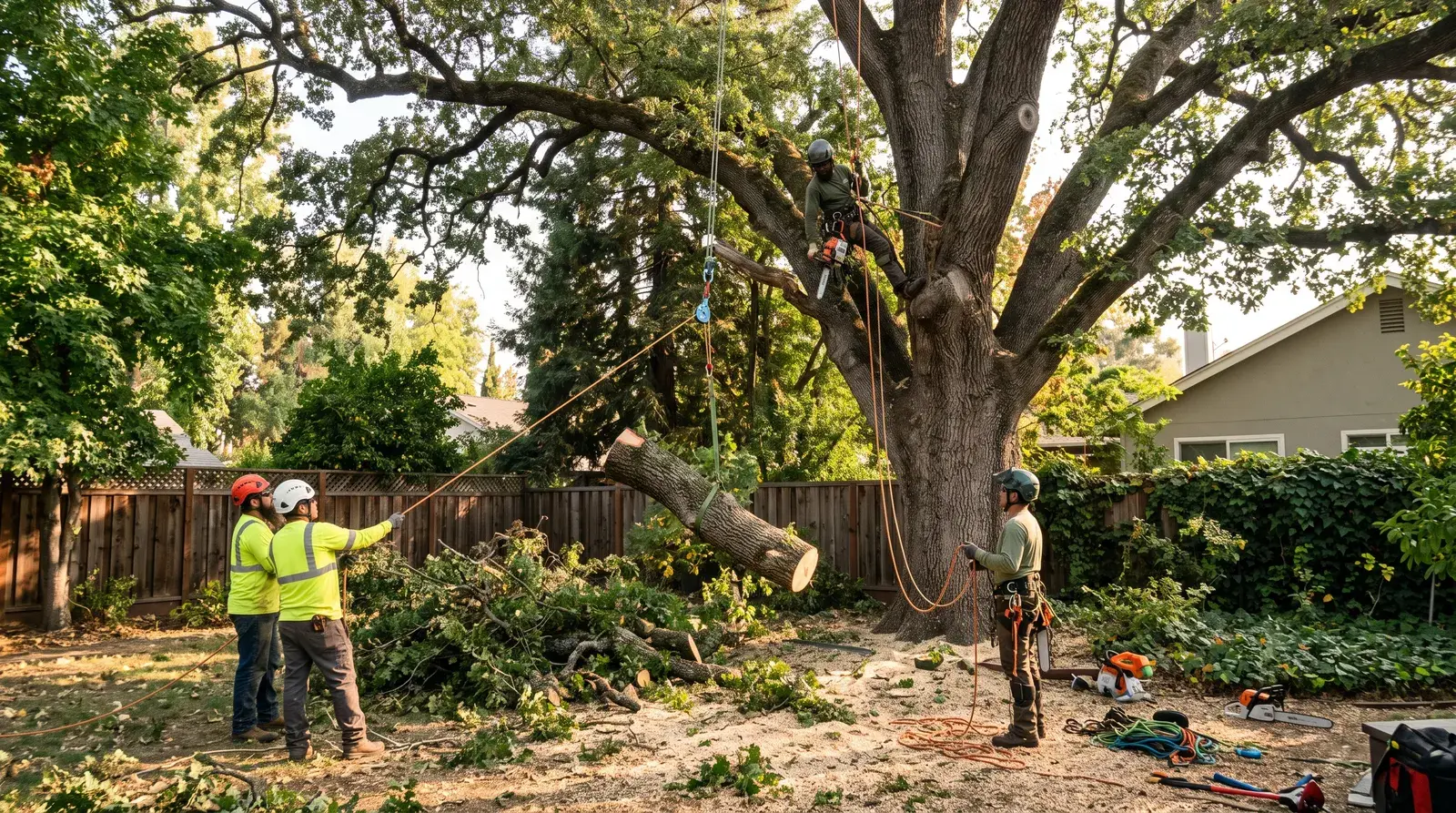
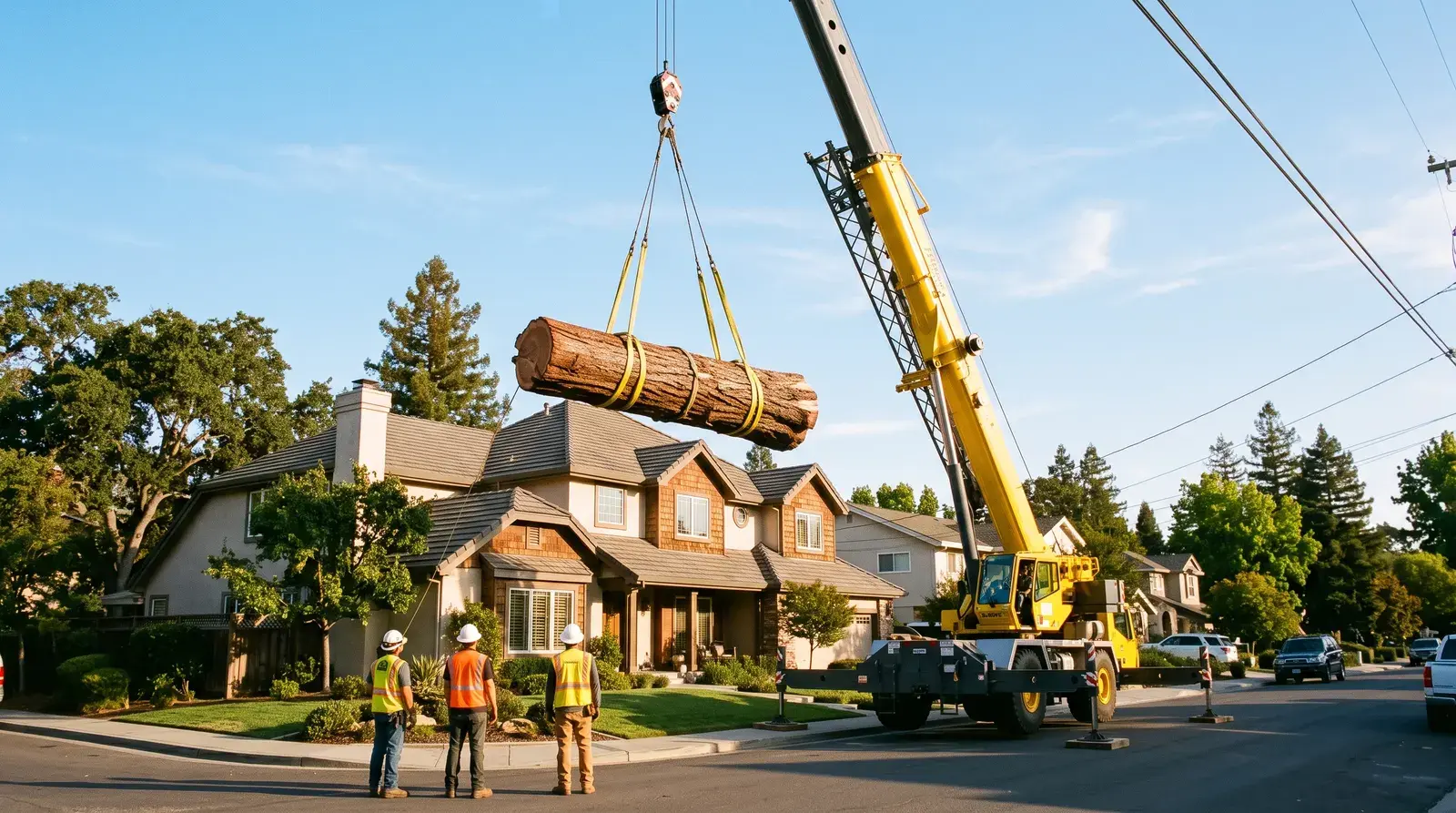
Slope affects tree removal in a few specific ways. Fall direction planning gets more constrained when the ground drops away — a tree on a grade falls faster and hits harder than one on level ground, and rigging becomes more important because the direction of fall matters more when structures and roads are downhill. On steep parcels, some trees can only come down in rigged sections regardless of how much clearance they appear to have. Equipment routing is the other constraint. Many Penryn driveways are steep gravel drives not built for large chip trucks at gross vehicle weight; the right equipment for a Penryn job is confirmed before departure, not discovered at the gate. Compact equipment often handles the access better — but compact grinders and smaller chippers add time to large-volume jobs. The upside of rural acreage is the option to leave wood on site: firewood rounds bucked and stacked, or chips blown into piles for pasture paths and erosion control on disturbed soil from stump grinding. On acreage parcels where a chip truck would make six trips out a long drive, leaving material on site is often the smarter economic choice and works well for fire-adapted landscapes where wood chip mulch has practical uses away from the structure zone.
The same crew from estimate to cleanup.
No juggling separate contractors for one tree. Tell us the address and what you're dealing with, and we'll come back with a written, site-specific number.
- Removal, trimming, stumps, and cleanup handled by one crew
- Free, site-specific estimates — priced to your tree, not a flat rate
- Sacramento, Placer, El Dorado, and Yolo counties
What Tree Removal Costs in Penryn
Most residential removals across the Sacramento foothill region run $500–$2,500 as a broad range. Penryn jobs tend toward the middle and upper end because the trees are mature specimens on rural lots — not young subdivision trees. Large oaks or dead gray pines over structures, with difficult driveway access, are the jobs that exceed that range significantly.
- Tree size is the primary cost driver: a mature interior live oak with a 60-foot spread and wide root flare carries far more wood than a 20-year-old landscape tree, and the cutting, rigging, chipping, and haul scale accordingly.
- Gray pine removal is priced on size, lean, what the tree can reach, and how much dead wood makes it brittle and difficult to climb — dead gray pine removal costs more than living gray pine removal of the same size.
- Access adds cost when driveways are steep, narrow, or gated; an estimate that reaches the tree by walk-in tells you upfront whether a smaller equipment lineup is needed.
- Slope and rigging requirements on hillside Penryn parcels push the labor hours up relative to flat-ground jobs of the same tree size — that is factored into the quote, not billed as a surprise.
- Leaving wood on site as firewood rounds or chips reduces haul-off cost; it's almost always the better economic choice on Penryn acreage when the material is useful.
- Every estimate is free, written, and based on a site visit — a photo gives a rough ballpark, but the exact number for a rural acreage job needs eyes on the tree and the driveway.
Related guides
Do You Need a Permit to Remove a Tree in Sacramento?
Which Sacramento trees need a removal permit, how city and county rules differ, and how to check before the saw comes out.
How Much Does Tree Removal Cost in Sacramento? (2026)
Typical 2026 Sacramento tree removal price ranges by tree size, the factors that move the number, and how to read a quote before you sign it.
9 Signs a Tree Needs to Come Down
Nine warning signs a tree is hazardous or dying — and when removal is safer than trying to save it.
What tree removal costs — and what Penryn allows
Regional ranges, local permit rules, and the alternatives worth weighing before tree removal in Penryn.
Emergency Tree Service Cost in Sacramento (2026)
Regional range $800–$8,000 — and what moves the number on a real job.
Do You Need a Permit to Remove a Tree in Sacramento?
Which Sacramento trees need a removal permit, how city and county rules differ, and how to check before the saw comes out.
Tree Pruning vs. Removal: When to Save a Tree and When to Take It Down
Pruning or Removal — how to tell which one the tree actually needs.
Tree Service in Placer County, CA
Placer County spans flat valley suburbia in Roseville and Rocklin and rises through the oak-woodland foothills to ponde…
Crane-Assisted Tree Removal Cost in Sacramento (2026)
Regional range $2,500–$12,000 — and what moves the number on a real job.
Do You Need a Tree Removal Permit in Elk Grove?
Where Elk Grove draws the line before a tree comes down, and who to check with.
Want a sense of the work first? See the kinds of tree removal jobs we take on and who shows up to do them.
Frequently asked questions
Do I need county approval to remove an oak in Penryn?
Likely yes for a live native oak of any real size. Penryn is unincorporated Placer County, and the county's tree regulations cover certain native oaks — including blue oak and interior live oak, which are the most common trees on Penryn parcels — based on species, trunk diameter, and parcel zoning. A dead or demonstrably hazardous tree typically has a faster path, but document the condition thoroughly with photos before anything is cut. Non-native trees, including old mandarin and orchard stock, are generally outside the ordinance. We flag which trees appear to require county review during the estimate; always confirm current rules and thresholds directly with Placer County.
What's the most common tree removal situation in Penryn?
Two calls come up repeatedly. First, dead or dying gray pine — it grows fast in Penryn's granite soils, gets hit hard in drought years, and stands dead getting more dangerous every season before it drops a limb or falls toward the house. Second, interior live oak limbs over rooflines and structures — mature oaks spread wide on shallow Penryn soils, and large horizontal limbs over roofs don't fail often, but when they do the result is serious. Both are assessment-first calls: we look at the tree, tell you the honest condition, and quote what the right scope actually is.
How does defensible space work on a Penryn acreage lot?
PRC 4291 requires 100 feet of defensible space around structures on High and Very High Fire Hazard Severity Zone parcels — which describes most Penryn lots. Zone 1 (0–30 feet) gets the most intensive treatment: dead vegetation out, limbs off the roof, crowns separated from the structure. Zone 2 (30–100 feet) is about fuel reduction: ladder fuels under the oaks removed, brush thinned to separated clumps, dead trees and snags taken down. On a typical two-to-five-acre Penryn parcel that usually means several days of limbing, brush clearing, and chipping rather than mass tree removal — healthy oaks generally stay. Slope matters: on downhill-facing canyon lots, clearance distances should exceed the flat-ground minimums. Full guidance at readyforwildfire.org.
Why do stumps in Penryn need special grinding depth?
Griffith Quarry's shallow granite soils force tree roots to grow laterally rather than deep, which means root flares and surface roots spread wider than the visible trunk round. A standard grind targeting just the stump circle often leaves lateral roots close to the surface — a problem for replanting, for hardscape work, and for mowers catching exposed roots. We grind to cover the full root flare, not just the stump diameter, and we ask what's going in the spot before we start. Replanting over a shallow granite profile needs the deepest grind we can achieve and chips removed rather than left in the hole; chips decaying in rocky soil rob nitrogen from new roots.
When is the right time to remove a dead gray pine in Penryn?
As soon as you confirm it's dead — any season. Waiting is the wrong move with dead gray pine. The wood becomes increasingly brittle and unpredictable to work around the longer it stands; the bark loosens, the long limbs destabilize, and the pitch-laden wood makes it a fire risk within your defensible space zone. Gray pine also gets more expensive to remove as it deteriorates, because brittle dead wood is more hazardous for climbers and the rigging becomes more conservative. If you're seeing a red or faded crown, pitch tubes on the bark, or boring dust at the base, get a professional assessment immediately — don't wait for the crown to confirm it's fully dead before scheduling.