
Do You Need a Permit to Remove a Tree in Fair Oaks?
Often, yes. Fair Oaks sits in unincorporated Sacramento County, where the Tree Preservation and Protection Ordinance protects native oaks above certain size thresholds. If the tree in question is a valley oak, interior live oak, or blue oak, assume a permit conversation comes first and verify with the county.
- Protected species — valley oak, interior live oak, and blue oak are the county's protected natives, and they make up a large share of the Fair Oaks canopy.
- Non-native trees — Modesto ash, camphor, deodar cedar, pines, and fruit trees generally are not covered by the oak ordinance, though it is worth confirming when a tree is unusually large.
- Dead and hazardous oaks — usually a faster path, but the county still wants documentation. We photograph condition and can supply an arborist letter when an application asks for one.
- We flag the permit question on every Fair Oaks estimate — before scheduling, not after the tree is on the ground.
What Fair Oaks Removals Actually Look Like
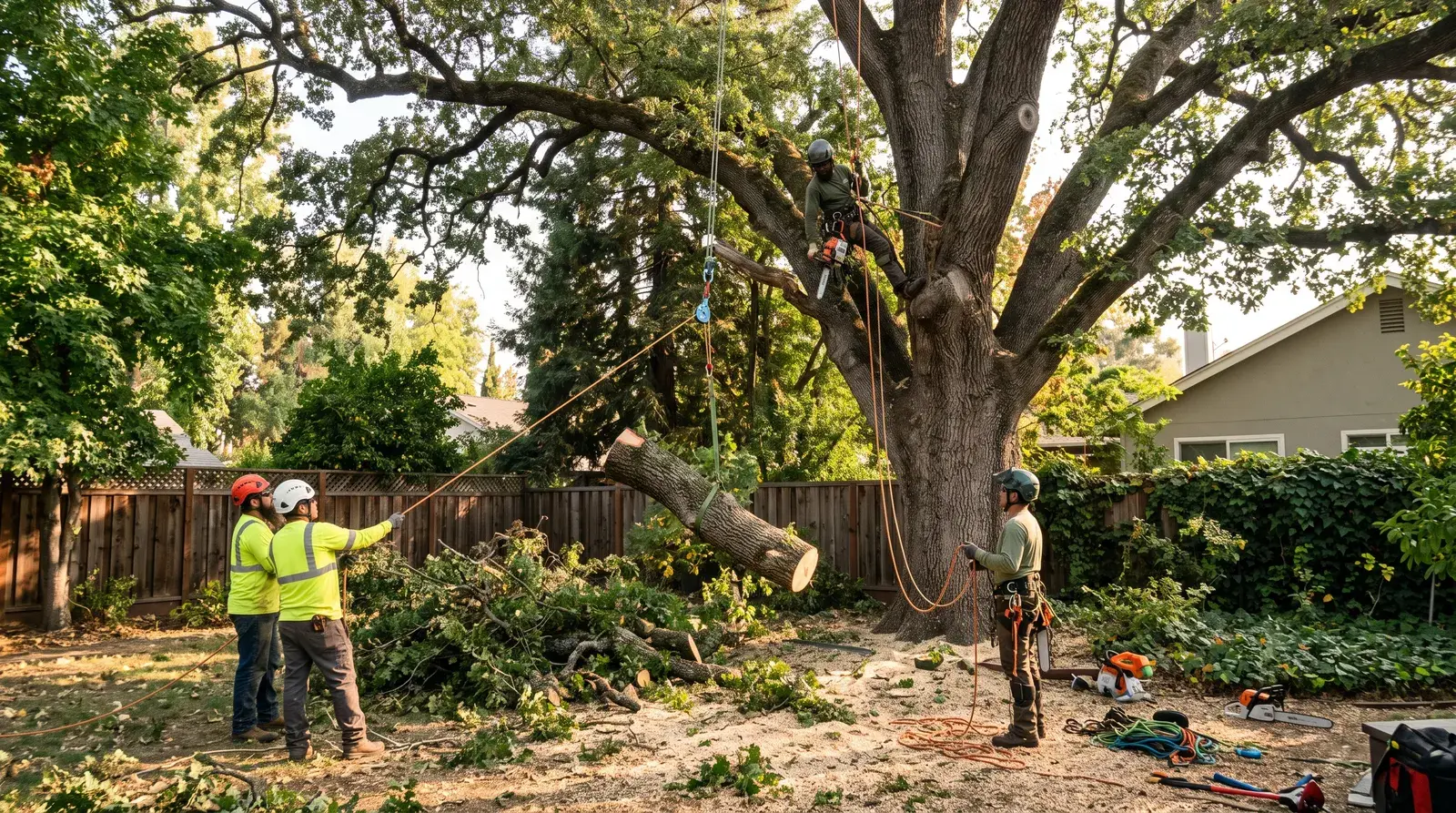
Fair Oaks lots are older and more wooded than most of the Sacramento suburbs, which changes how trees come down. Big oaks over rooflines, septic systems on some parcels, and fenced backyards mean most removals here are rigged down in sections rather than felled whole.
- Fair Oaks Village — tight lots, old-growth oaks over historic structures, and the resident chickens underfoot. Everything comes down on ropes with a controlled drop zone.
- Bluff and canyon-rim properties — lots above the American River Parkway often have limited equipment access on the river side, so wood gets rigged uphill and carried out.
- Gum Ranch and Phoenix Field — larger parcels with better truck access, where a straightforward fell is sometimes possible on open ground.
- Horse properties along the parkway corridor — we coordinate around paddocks and fencing, and can leave chips for footing or mulch if you want them.
Tree Removal in Fair Oaks — free, site-specific estimates.
Why Fair Oaks Oaks Fail
Most of our Fair Oaks removal calls are mature oaks that have finally lost the structural argument: decay columns in century-old trunks, root damage from decades-old trenching or grade changes, and saturated-soil windthrow during winter south winds.
If a saveable oak just needs weight off the ends, removal is the wrong tool — see our oak tree care service. We would rather preserve a healthy heritage-size oak than bill for taking one down.
- Summer irrigation kills native oaks slowly — lawns and drip lines under valley oaks promote root rot that shows up years later as a thinning crown.
- Split co-dominant stems on big live oaks — sometimes cable-able, sometimes past saving. We tell you which honestly.
- Storm-lean after a wet winter — a new lean with lifted soil on the root plate is an emergency, not a watch-and-wait.
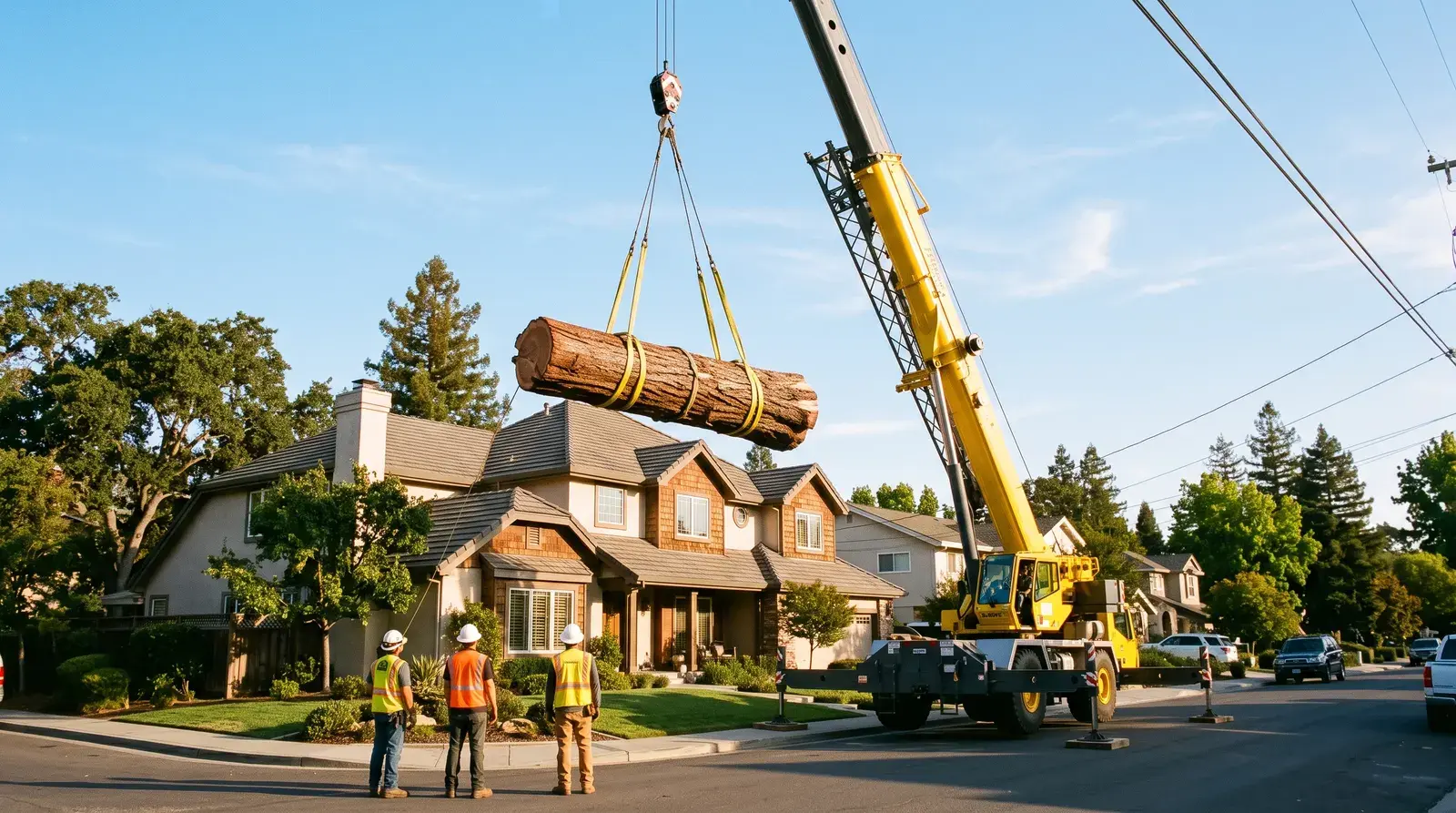
- Standing dead gray pines and ash — not protected, but dangerous to climb, which can shift the method toward a lift or crane.
Need tree removal in Fair Oaks?
Share the address and project details — we'll come back with a scoped, site-specific estimate.
What Tree Removal Costs in Fair Oaks
As broad regional ranges: small trees typically run $500–$900, mid-size trees $900–$2,500, and large oaks over structures $2,500–$10,000+. Fair Oaks skews toward the upper ranges because the canopy is old and the targets — houses, fences, pools — sit right under it.
- Dense oak wood weighs more per log than pine or ash, which means more rigging cycles and more hauling.
- Backyard access through a gate versus driveway access for a chip truck can swing a quote by hundreds of dollars.
- Permit support and arborist documentation are quoted up front when the county requires them.
- Stump grinding is a separate line item — ask for both numbers on the same free estimate.
The same crew from estimate to cleanup.
No juggling separate contractors for one tree. Tell us the address and what you're dealing with, and we'll come back with a written, site-specific number.
- Removal, trimming, stumps, and cleanup handled by one crew
- Free, site-specific estimates — priced to your tree, not a flat rate
- Sacramento, Placer, El Dorado, and Yolo counties

Cleanup, Stumps, and What Comes Next
A removal quote from us includes haul-off of trunk wood and brush unless you want firewood or chips left behind. Stump grinding, replanting, and permit-required replacement trees are all handled in the same conversation so you are not calling three companies.
- Standard stump grinds run 8–12 inches below grade; deeper if you plan to replant or pour hardscape.
- County oak permits sometimes carry replacement-planting conditions — our tree planting service covers that.
- Oak firewood is worth keeping if you have the space; we buck rounds to length at no charge.
Related guides
Do You Need a Permit to Remove a Tree in Sacramento?
Which Sacramento trees need a removal permit, how city and county rules differ, and how to check before the saw comes out.
How Much Does Tree Removal Cost in Sacramento? (2026)
Typical 2026 Sacramento tree removal price ranges by tree size, the factors that move the number, and how to read a quote before you sign it.
9 Signs a Tree Needs to Come Down
Nine warning signs a tree is hazardous or dying — and when removal is safer than trying to save it.
What tree removal costs — and what Fair Oaks allows
Regional ranges, local permit rules, and the alternatives worth weighing before tree removal in Fair Oaks.
Emergency Tree Service Cost in Sacramento (2026)
Regional range $800–$8,000 — and what moves the number on a real job.
Do You Need a Tree Removal Permit in Folsom?
Where Folsom draws the line before a tree comes down, and who to check with.
Tree Pruning vs. Removal: When to Save a Tree and When to Take It Down
Pruning or Removal — how to tell which one the tree actually needs.
Tree Service in Sacramento County, CA
Tree work in Sacramento County ranges from removing aging valley oaks in East Sacramento to grinding stumps on new-buil…
Crane-Assisted Tree Removal Cost in Sacramento (2026)
Regional range $2,500–$12,000 — and what moves the number on a real job.
Do You Need a Tree Removal Permit in Citrus Heights?
Where Citrus Heights draws the line before a tree comes down, and who to check with.
Want a sense of the work first? See the kinds of tree removal jobs we take on and who shows up to do them.
Frequently asked questions
Can I remove a valley oak on my own property in Fair Oaks?
Not automatically. Fair Oaks is unincorporated Sacramento County, and the county's Tree Preservation and Protection Ordinance protects native oaks — valley oak, interior live oak, and blue oak — above certain sizes even on private land. Removing a protected oak without a permit can mean fines and replacement-planting requirements. We check the species and size against the ordinance during the free estimate and point you to the county application when one is needed.
How much does it cost to remove a large oak in Fair Oaks?
As a broad regional range, large oak removals commonly run $2,500–$10,000+, on top of the $500–$2,500 typical for small and mid-size trees. Fair Oaks oaks are often century-old trees over rooflines, which forces slow, piece-by-piece rigging, and oak wood is heavy to haul. Access, decay, and permit documentation all move the number, which is why we quote from a site visit. Estimates are free.
My tree is dead — do I still need a county permit?
Usually there is a faster path for dead or hazardous protected oaks, but Sacramento County still wants the condition documented. Take photos before anything is cut, and expect the county to ask for evidence — sometimes an arborist letter — with or shortly after the removal. We photograph the tree's condition as standard practice and can prepare the written assessment through our arborist report service.
Can you remove trees on bluff lots above the American River Parkway?
Yes. Canyon-rim properties off Winding Way and the bluff streets above the parkway usually have no equipment access on the river side, so we climb, rig the wood uphill away from the slope, and carry it out. It is slower than a driveway-side removal and priced accordingly, but it protects the slope and keeps debris out of the parkway. Trees on parkway land itself belong to the county — we can help you figure out where the line is.
When is the best time of year to remove a tree in Fair Oaks?
For hazardous trees, now — before the next winter windstorm does it for you, on its own terms. For non-urgent removals, late summer and fall are practical: dry ground protects lawns from equipment, and you are ahead of the storm season backlog. If the tree is a protected oak, build in lead time for the county permit before you plan around a date.