
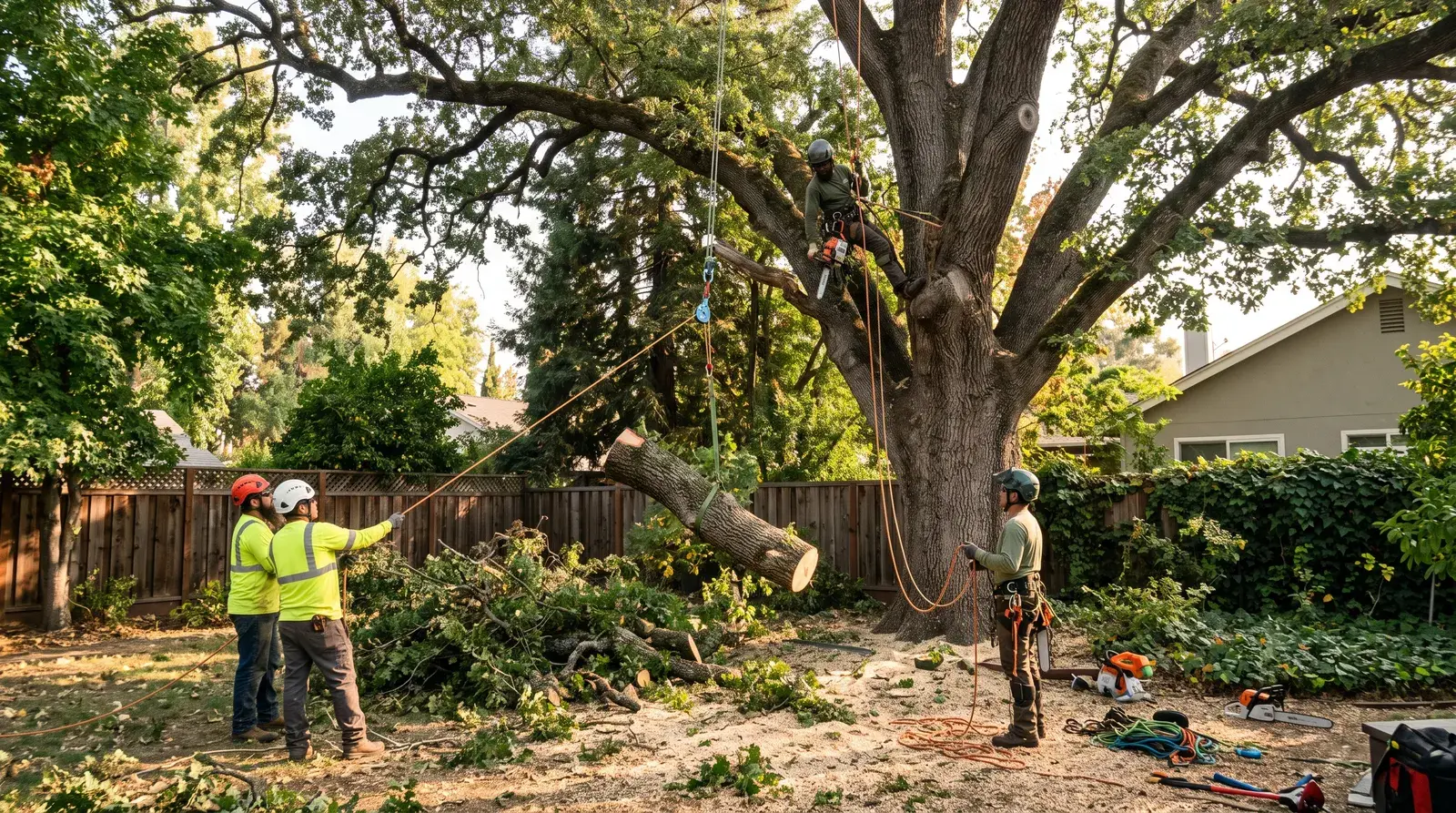
Two Kinds of Lincoln Removals: Subdivision and Rural Edge
Lincoln grew fast, and the tree work shows it. Subdivision removals are usually small trees with easy access; rural-edge removals are big wood, long carries, and sometimes a tractor path instead of a driveway. The price and method differ enough that we scope them as separate categories.
- Subdivision jobs — failed ornamental pears, declining crape myrtles, and street trees that never established in compacted pad soil. Often a half-day with a small crew.
- Rural-edge jobs — mature valley oaks and blue oaks on acreage, eucalyptus windrows planted decades ago as windbreaks, and dead gray pine drifting in from the foothill fringe.
- Access changes everything: a chip truck parked at the curb in Twelve Bridges versus equipment staged down a gravel drive off Wise Road are different bids for the same size tree.
- Windrow and shelter-row removals are usually priced per row or per day rather than per tree — ask for it quoted both ways.
Do You Need a Permit to Remove a Tree in Lincoln?
Check before you cut. The City of Lincoln has its own tree regulations, and native oaks — valley oak, blue oak, interior live oak — get extra scrutiny across Placer County. Street trees in the newer villages may also fall under HOA or city landscape requirements.
- Native oaks over certain sizes may require city or county approval before removal — verify current thresholds with the City of Lincoln directly.
- Unincorporated parcels just outside city limits fall under Placer County rules, which treat native oaks differently than landscape trees.
- HOA communities like Lincoln Crossing and Sun City Lincoln Hills often have their own tree standards on top of city code — check your CC&Rs.
- Dead and hazardous trees usually have a faster path, but photograph the condition before removal in case documentation is requested.
- 916 Trees flags the permit question on every estimate and can supply an arborist report when an application needs one.
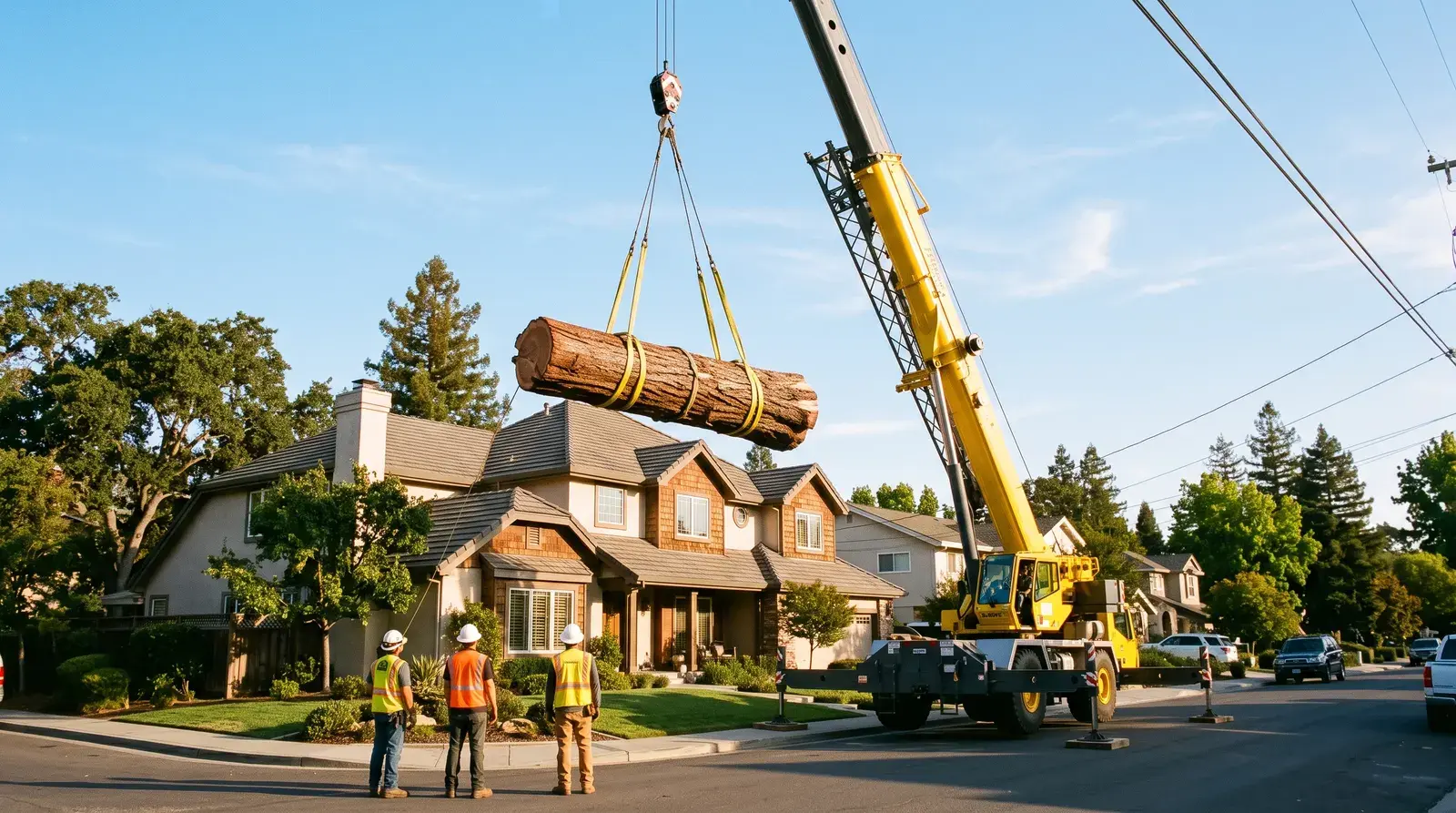
Tree Removal in Lincoln — free, site-specific estimates.
Why Young Street Trees Fail in Lincoln
A surprising share of our Lincoln removals are trees under 20 years old. Subdivision pad soil is compacted, parkstrips are narrow, and summer heat off new pavement is brutal. When a young tree is structurally done, replacement usually beats rehabilitation.
- Circling and girdled roots from container stock — the tree looks fine for a decade, then declines fast or snaps at the root collar in wind.
- Stakes and ties left on too long, cutting into the trunk and creating a permanent weak point.
- Wrong species for a west-facing lot: shallow-rooted ornamentals cook in Lincoln's open, low-shade subdivisions.
- The good news: small-tree removals sit at the low end of the cost range, and replanting the right species in the same spot is cheap insurance.
Valley Oaks and Rural Windrows
The mature trees on Lincoln's rural edge are a different animal. Valley oaks out here can carry limbs the size of subdivision trees, and old eucalyptus windrows shed bark and drop limbs every windstorm. Both need rigging, not a chainsaw and optimism.
- Valley oak removals are permit-first, then rigging — dense wood, wide crowns, and usually a barn, fence line, or well head under the canopy.
- Eucalyptus windrows fail unpredictably; brittle limb attachments make them one of the more dangerous trees to climb, so we often work them from a lift.
- Dead gray pine near the Highway 193 side of town is a fire and failure hazard — beetle-killed pine gets more dangerous to remove the longer it stands.
- On acreage we can leave bucked firewood rounds and chip piles on-site at no charge, which cuts haul-off cost meaningfully.
Need tree removal in Lincoln?
Share the address and project details — we'll come back with a scoped, site-specific estimate.
What Lincoln Tree Removal Costs
As broad regional figures: small subdivision trees often run $500–$900, mid-size trees $900–$2,500, and large oaks or windrow work $2,500–$10,000+. Access, targets under the tree, and wood density drive the number more than height alone.
Treat those ranges as orientation, not a quote. A leaning valley oak over a shop off Nicolaus Road prices nothing like the same-size oak in an open pasture. Every 916 Trees estimate is free, written, and based on a site visit — and we quote stump grinding as a separate line so you can decide whether the stump stays.
The same crew from estimate to cleanup.
No juggling separate contractors for one tree. Tell us the address and what you're dealing with, and we'll come back with a written, site-specific number.
- Removal, trimming, stumps, and cleanup handled by one crew
- Free, site-specific estimates — priced to your tree, not a flat rate
- Sacramento, Placer, El Dorado, and Yolo counties

After the Removal: Stumps, Wood, and Replanting
Decide what happens to the stump and the wood before the crew mobilizes — handling everything in one trip is cheaper than a call-back. In Lincoln's newer neighborhoods, replanting is worth serious thought; shade is scarce and summer is long.
- Stump grinding runs 8–12 inches below grade standard, deeper if you're replanting or pouring concrete over the spot.
- Keep firewood or chips at no charge, or have everything hauled — rural lots often keep the wood, subdivision lots almost never do.
- Replacement planting: our tree planting service can put a heat-tolerant, right-sized species back in — a better outcome than another struggling ornamental pear.
Related guides
Do You Need a Permit to Remove a Tree in Sacramento?
Which Sacramento trees need a removal permit, how city and county rules differ, and how to check before the saw comes out.
How Much Does Tree Removal Cost in Sacramento? (2026)
Typical 2026 Sacramento tree removal price ranges by tree size, the factors that move the number, and how to read a quote before you sign it.
9 Signs a Tree Needs to Come Down
Nine warning signs a tree is hazardous or dying — and when removal is safer than trying to save it.
What tree removal costs — and what Lincoln allows
Regional ranges, local permit rules, and the alternatives worth weighing before tree removal in Lincoln.
Emergency Tree Service Cost in Sacramento (2026)
Regional range $800–$8,000 — and what moves the number on a real job.
Do You Need a Tree Removal Permit in Rancho Cordova?
Where Rancho Cordova draws the line before a tree comes down, and who to check with.
Tree Pruning vs. Removal: When to Save a Tree and When to Take It Down
Pruning or Removal — how to tell which one the tree actually needs.
Tree Service in Placer County, CA
Placer County spans flat valley suburbia in Roseville and Rocklin and rises through the oak-woodland foothills to ponde…
Crane-Assisted Tree Removal Cost in Sacramento (2026)
Regional range $2,500–$12,000 — and what moves the number on a real job.
Do You Need a Tree Removal Permit in Auburn?
Where Auburn draws the line before a tree comes down, and who to check with.
Want a sense of the work first? See the kinds of tree removal jobs we take on and who shows up to do them.
Frequently asked questions
Do I need a permit to remove an oak tree in Lincoln, CA?
Possibly. Native oaks — valley oak, blue oak, interior live oak — get protection in much of Placer County, and the City of Lincoln has its own tree regulations. Thresholds vary by trunk size and location, so verify with the city before cutting; unincorporated parcels outside city limits fall under county rules instead. 916 Trees checks the ordinance question during every free estimate and can provide an arborist report if an application requires one.
How much does tree removal cost in Lincoln?
As a broad regional range, most residential removals run $500–$2,500. Small failed street trees in Lincoln Crossing or Twelve Bridges sit at the low end. Mature valley oaks on rural acreage, eucalyptus windrows, and anything requiring a crane can run $2,500–$10,000+. Access matters as much as size — a gravel-drive property off Wise Road bids differently than a curbside tree. Estimates are free and site-specific.
Can you remove a whole eucalyptus windrow on rural property?
Yes. Windrow removals are common on Lincoln's rural edge, where old eucalyptus breaks were planted as windbreaks and are now shedding limbs every storm. We typically price row work per day or per row rather than per tree, work brittle eucalyptus from a lift where climbing is unsafe, and can leave wood and chips on-site to reduce haul-off cost. Ask for the job quoted both ways.
My young street tree died — is it worth replacing or just removing?
Usually worth replacing. Young-tree failures in Lincoln's subdivisions are mostly root and planting problems — girdled container roots, compacted pad soil, stakes left on too long — not a sign the spot can't grow a tree. Removal of a small tree sits at the low end of the cost range, and replanting a heat-tolerant species correctly gives you shade that matters in a low-canopy neighborhood. Check HOA and city street-tree rules before swapping species.
Do you handle tree removal outside Lincoln city limits, toward Sheridan?
Yes. We work the rural parcels north and west of Lincoln — Sheridan, the Camp Far West direction, and the acreage along Wise and Nicolaus Roads. Note that unincorporated properties follow Placer County tree rules rather than City of Lincoln code, which matters for native oaks. Long access drives and staging areas get factored into the estimate, so tell us about gates, bridges, and soft ground when you call.