
Street Tree or Private Tree? Check Before You Cut
The single biggest mistake Sacramento homeowners make is treating the tree in the planting strip as theirs. If it stands between the sidewalk and the curb — or anywhere in the city right-of-way — it's a City Tree, and the city controls whether it stays or goes.
- City Trees: anything in the right-of-way, including the sidewalk strip. You can't remove or heavily prune these yourself; the request goes through the city.
- Heritage Trees: protected under City Code Chapter 12.56 regardless of where they stand on your lot. Removal requires a city permit, and the bar is high for healthy trees.
- Private, non-protected trees: yours to remove without a permit in most cases — but verify before cutting, because the protected list is broader than most people expect.
- Verify current rules at cityofsacramento.gov. We check the classification on every estimate and tell you which bucket your tree falls in before we quote the work.
How We Remove Trees on Tight Sacramento Lots
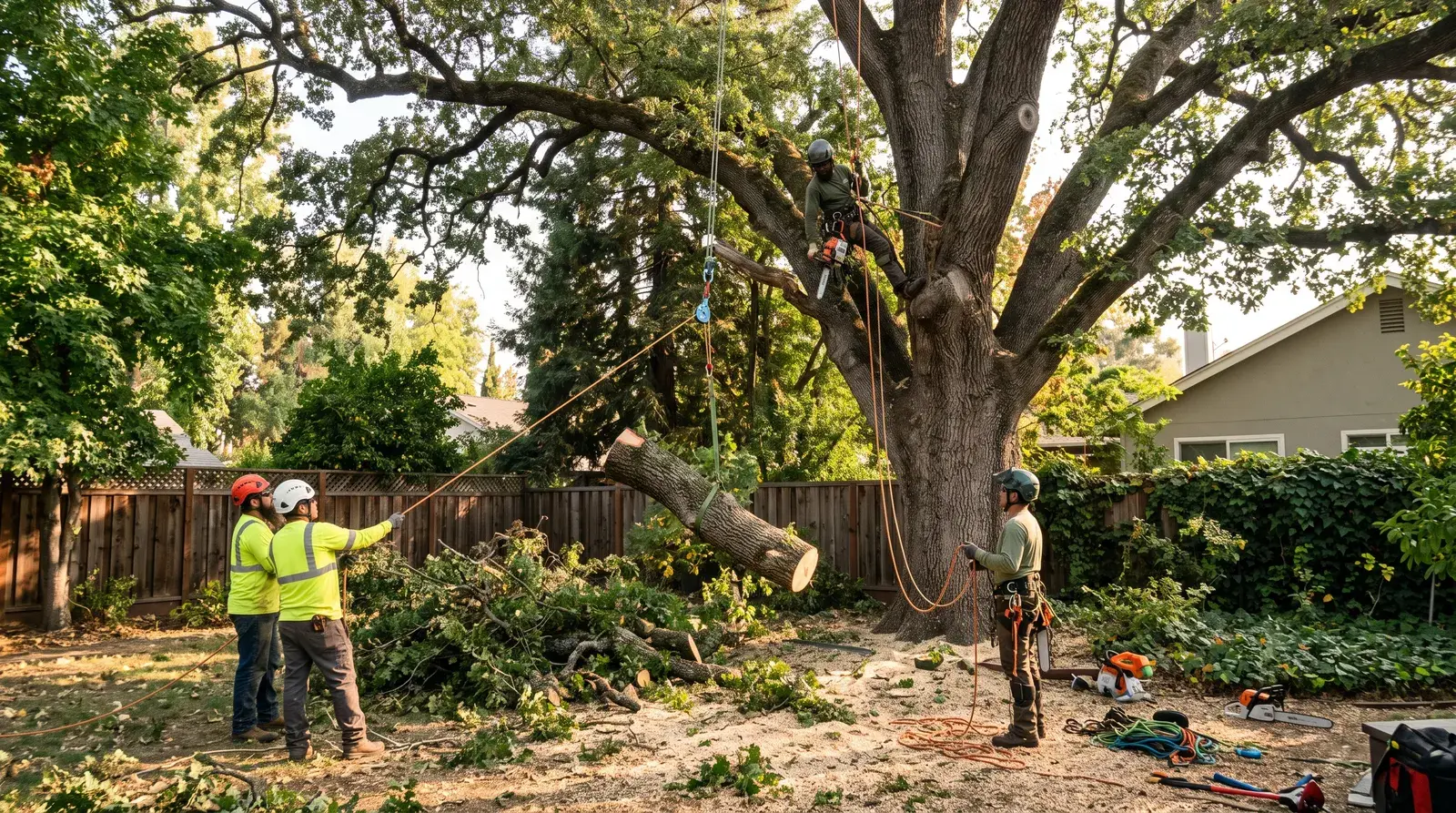
City lots leave no room to fell a tree whole. A mature London plane in East Sac or a camphor over a Land Park roofline comes down in rigged sections — every limb roped, lowered, and landed where the crew decides, not where gravity does.
- Climb-and-rig removals for trees boxed in by houses, fences, garages, and pools — the standard method in the older neighborhoods.
- Alley access in East Sacramento and Midtown lets us stage the chipper behind the lot instead of dragging brush through the house side yard.
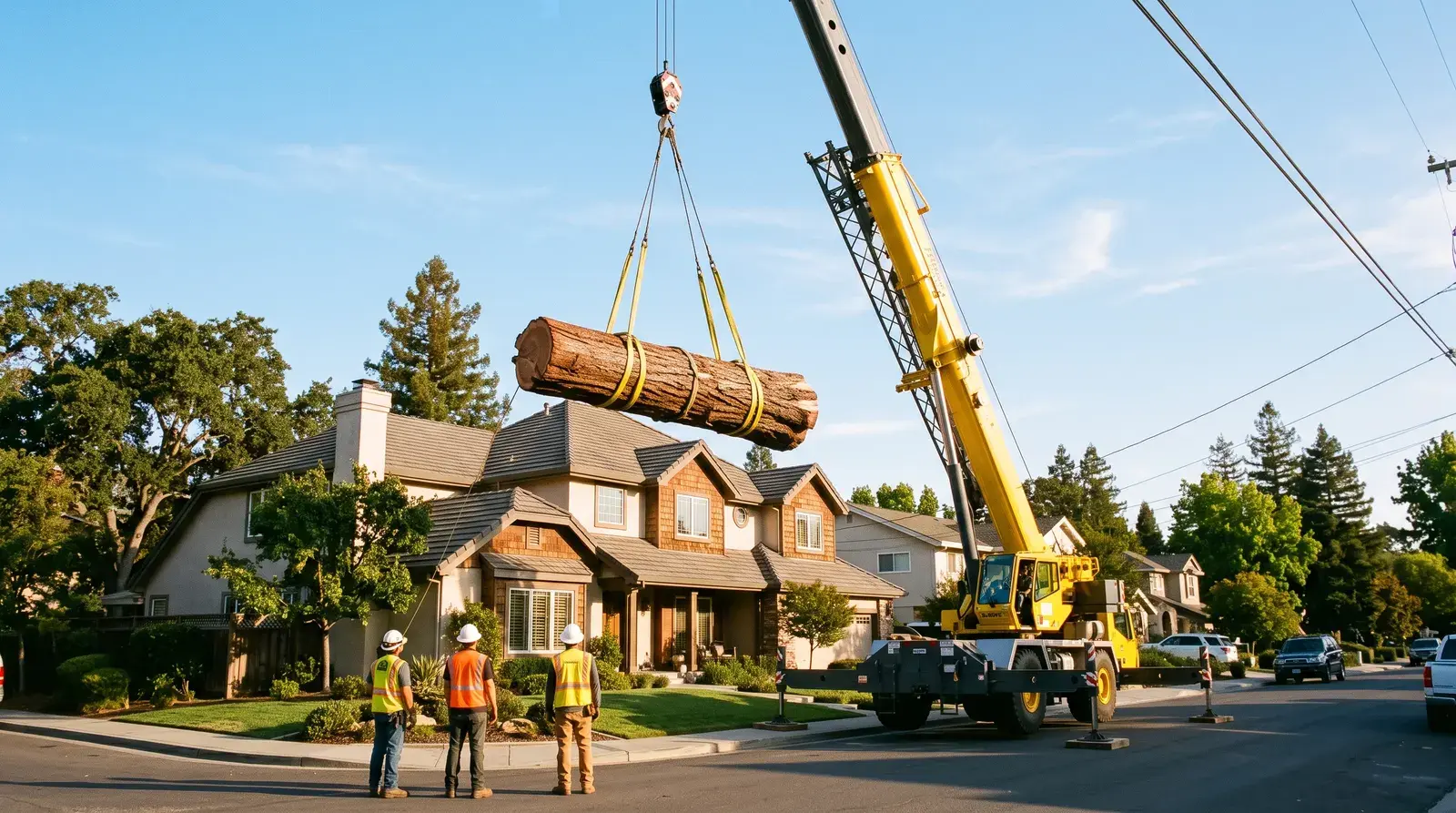
- Crane-assisted removal when there's no safe drop zone at all — common for big decayed trees over grid-street bungalows.
- Coordination with SMUD before working near service drops and lines; nobody improvises around energized conductors.
- Ground protection over lawns and irrigation, and a full rake-out before we leave.
Tree Removal in Sacramento — free, site-specific estimates.
Trees That Drive Sacramento Removals
The City of Trees canopy is old, and age is what generates removal calls. Mid-century plantings are failing at the same time the original native oaks need honest structural evaluation.
- Modesto ash — the classic aging-out street and yard tree across the city; brittle wood, frequent limb failure in winter wind.
- Valley oak and interior live oak — removed only when dead or structurally failed, and only after the permit question is settled.
- London plane and sycamore — big canopy trees in East Sac, Land Park, and Midtown that heave sidewalks and occasionally outgrow their lot.
- Coast redwood — 1970s–80s plantings now browning out in the heat, especially in South Land Park and the Pocket.
- Mexican fan palm — tall, heavy, and common in older South Sacramento and Oak Park yards; a specialty removal of its own.
What Tree Removal Costs in Sacramento
As broad regional ranges: small trees often run $500–$900, mid-size trees $900–$2,500, and large, decayed, or crane-assisted removals $2,500–$10,000+. On city lots, access moves the number more than height does.
Treat published ranges as orientation only. Every 916 Trees estimate is free, written, and based on a site visit — not a photo.
- Backyard trees with no alley access cost more — every log gets carried or wheeled through a gate.
- Targets under the canopy (roof, pool, fence, neighbor's garage) force slower piece-by-piece rigging.
- Dense hardwoods like valley oak weigh far more per log than ash or pine of the same height.
- Stump grinding and haul-off are quoted as clear line items so you can compare bids honestly.
Need tree removal in Sacramento?
Share the address and project details — we'll come back with a scoped, site-specific estimate.
Storm Season Is When Sacramento Trees Fail
Saturated winter soil plus a strong south wind is the failure recipe here. Trees that leaned a little more after last winter's storms, or dropped a big limb without obvious cause, should be evaluated before the next front — not after they're on the house.
If the tree is already down or split, that's an emergency call, and we prioritize trees on structures. If it's still standing but worrying you, a scheduled removal in dry weather is safer and cheaper than a storm-night response. Either way, the permit rules still apply — hazardous trees usually get a faster path, but the city still wants documentation, so photograph the tree's condition before anything is cut.
The same crew from estimate to cleanup.
No juggling separate contractors for one tree. Tell us the address and what you're dealing with, and we'll come back with a written, site-specific number.
- Removal, trimming, stumps, and cleanup handled by one crew
- Free, site-specific estimates — priced to your tree, not a flat rate
- Sacramento, Placer, El Dorado, and Yolo counties

After the Removal: Stumps, Wood, and Replanting
Decide what happens to the stump and the wood before the crew mobilizes — it's cheaper to handle everything in one trip. Standard stump grinds run 8–12 inches below grade, deeper if you're replanting. Keep chips or bucked firewood at no charge, or have it all hauled. And in a city that trades on its shade, think about replacement: our planting service can put a better-suited species back in a smarter spot, which some permit approvals actually require.
Related guides
Do You Need a Permit to Remove a Tree in Sacramento?
Which Sacramento trees need a removal permit, how city and county rules differ, and how to check before the saw comes out.
How Much Does Tree Removal Cost in Sacramento? (2026)
Typical 2026 Sacramento tree removal price ranges by tree size, the factors that move the number, and how to read a quote before you sign it.
9 Signs a Tree Needs to Come Down
Nine warning signs a tree is hazardous or dying — and when removal is safer than trying to save it.
What tree removal costs — and what Sacramento allows
Regional ranges, local permit rules, and the alternatives worth weighing before tree removal in Sacramento.
Emergency Tree Service Cost in Sacramento (2026)
Regional range $800–$8,000 — and what moves the number on a real job.
Do You Need a Permit to Remove a Tree in Sacramento?
Which Sacramento trees need a removal permit, how city and county rules differ, and how to check before the saw comes out.
Tree Pruning vs. Removal: When to Save a Tree and When to Take It Down
Pruning or Removal — how to tell which one the tree actually needs.
East Sacramento
East Sacramento's tree stock is old, large, and tightly regulated.
Tree Service in Sacramento County, CA
Tree work in Sacramento County ranges from removing aging valley oaks in East Sacramento to grinding stumps on new-buil…
Crane-Assisted Tree Removal Cost in Sacramento (2026)
Regional range $2,500–$12,000 — and what moves the number on a real job.
Sacramento neighborhoods we work in
Housing era, canopy, and access change block to block. These pages cover what tree removal looks like in each.
East Sacramento
East Sacramento's tree stock is old, large, and tightly regulated.
Land Park
Land Park is one of Sacramento's oldest residential neighborhoods, built out primarily in the 1920s through the 1940s a…
Curtis Park
Curtis Park's canopy is among Sacramento's oldest — streetcar-era Craftsman bungalows built between 1905 and 1930 along…
Midtown
Midtown Sacramento's dense urban grid — roughly 16th Street to 30th Street, between Q Street and Capitol Avenue — packs…
Pocket-Greenhaven
Pocket-Greenhaven is a south Sacramento neighborhood built largely in the 1970s and 1980s in the bend of the Sacramento…
Natomas
Natomas — both North and South — was built mostly between the late 1980s and 2010 on former agricultural and floodplain…
Oak Park
Oak Park sits on ground that was Sacramento's first streetcar suburb, developed in the 1880s around an eight-acre oak g…
Tahoe Park
Tahoe Park was built fast after World War II — mostly late-1940s and 1950s ranch homes and bungalows on Sacramento's ea…
Want a sense of the work first? See the kinds of tree removal jobs we take on and who shows up to do them.
Frequently asked questions
Do I need a permit to remove a tree in the City of Sacramento?
Often, yes. Street trees — anything in the right-of-way, including the strip between sidewalk and curb — are City Trees and can't be removed by homeowners at all. Heritage Trees on private property are protected under City Code Chapter 12.56 and need a city permit before removal. Ordinary, non-protected private trees generally don't require one, but verify at cityofsacramento.gov first. We check the classification on every free estimate.
The tree between my sidewalk and the street is dying. Can 916 Trees remove it?
Not without the city's involvement — that tree is a City Tree even though it fronts your lot and you've been watering it for years. The removal request goes through the City of Sacramento's urban forestry process. What we can do is assess the tree, document its condition with photos, and handle any private trees on the same visit while the city processes the street tree.
How do you remove a large tree from a backyard in Midtown or East Sac with no driveway access?
In sections, by rope. The climber takes the canopy apart limb by limb, each piece is lowered on rigging lines, and wood gets carried or wheeled out through the gate — or staged in the alley when the lot backs onto one, which many East Sac and Midtown lots do. Alley access can cut hours off a job. When decay makes climbing unsafe and there's no drop zone, we bring a crane.
How much does tree removal cost in Sacramento?
Most residential removals in the region run $500–$2,500 as a broad range. A small ornamental on open ground sits at the low end; a mature valley oak or a big Modesto ash over a Curtis Park roofline runs several thousand. Crane-assisted or heavily decayed trees can exceed $5,000–$10,000+. Access, targets, and condition drive the price more than height alone, so we quote from a free site visit.
What happens if I remove a protected tree without a permit?
The city can issue fines and require mitigation — typically replacement plantings or payment into the city tree fund — and unpermitted removal of a Heritage Tree is treated seriously. It's not worth the gamble. If the tree is genuinely hazardous, document its condition with photos, get a written assessment, and use the hazard process; most jurisdictions move faster for legitimate safety cases.