
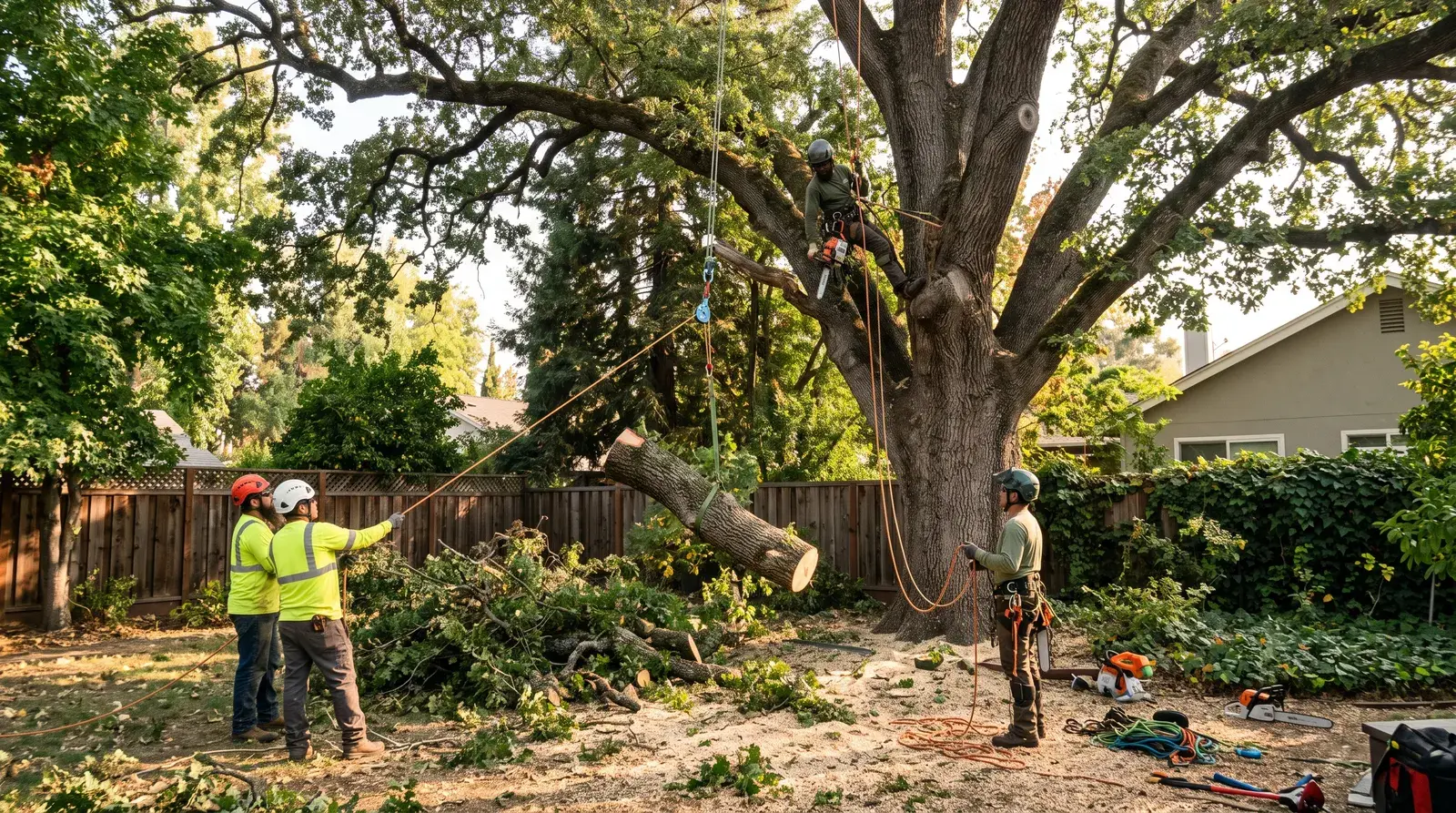
Valley Oaks on Galt's Agricultural-Root Lots
Valley oaks are the signature native tree of the Sacramento Valley floor, and in Galt they appear on properties that were agricultural not long ago. Older residential lots on the city's edges often carry mature oaks — trees that predate the house and have reached sizes that make any removal a significant job.
- Valley oaks on former agricultural parcels in Galt can be very large — 60 to 80 feet tall with trunk diameters well over 24 inches — especially on lots that were farmland before the city's residential edges expanded around them.
- These trees are slow-growing and long-lived; a mature Galt valley oak may be 80 to 150 years old, which means it predates the neighborhood around it by generations and reached its current size without any urban tree care.
- Galt's valley floor location places valley oaks in their native deep alluvial soils, allowing extensive root systems that make stump grinding after any permitted removal a substantial operation in its own right.
- Walnut trees and other orchard remnants sometimes appear on older Galt lots — reminders of the agricultural economy that surrounded the city before residential expansion absorbed those parcels.
- Valley oak is the species most likely to carry city permit weight in Galt; any removal of a large native oak on a residential lot should be verified with the City of Galt before a chainsaw comes out.
City of Galt Tree Rules: Municipal Code, Not County
Because Galt is an incorporated city, its tree ordinance authority sits with the City of Galt — not Sacramento County. This distinction matters for every property inside city limits: Sacramento County's tree protections apply to unincorporated areas and do not govern trees in Galt.
- Tree removal permits for native oaks within Galt city limits go through City of Galt planning or public works — confirm the current intake process directly with the city, as requirements update.
- Native valley oaks are the species most consistently protected under California city codes, and Galt's agricultural heritage means significant oaks are common enough that the permit question comes up regularly.
- Street trees in Galt's public right-of-way belong to the city regardless of which lot they front — contact the city about a street tree problem rather than hiring a private crew to remove it independently.
- Dead and visibly hazardous trees typically have a streamlined path through the process, but documentation — photos of the decay, split leader, root plate failure, or structural defect — supports a faster review and protects the homeowner afterward.
- 916 Trees identifies the permit question at every Galt estimate and can supply written condition notes and dated photos when a city application needs supporting documentation.
Tree Removal in Galt — free, site-specific estimates.
Large Lots, Rural Access, and What It Changes
Galt's larger residential lots — standard in the city's older core and especially on its agricultural edges — change the tree removal equation in ways that cut both directions. More open space usually means better equipment access and fewer targets under the canopy, but it also means more wood to move and a bigger job overall.
In north-county Sacramento suburbs, the constraint is almost always tight access — small side gates, fences close to the trunk, pools and patio covers directly underneath. In Galt, the constraint is more often sheer scale: a valley oak on a half-acre lot that has been growing unchecked for a century is a major removal regardless of how clear the access is. Open lots let us bring larger equipment and work more efficiently, which matters on big-wood jobs. Trees on rural-edge Galt properties — where the lot abuts agricultural land, irrigation ditches, or drainage channels — often have root systems extended well beyond the visible drip line, which affects stump grinding scope. Orchard irrigation infrastructure sometimes runs underground in these areas, so USA North 811 locates before grinding are not just protocol — they catch real infrastructure that does not appear on standard maps.
Galt's Climate and Tree Failure Patterns
Galt's climate is more Central Valley than Sacramento metro. Summers are consistently hotter, with less cooling from the Delta breeze that moderates Sacramento's afternoons. Winters bring tule fog that sits over the valley floor for days without clearing, keeping soil moisture high and reducing the drying-out period between rains.
- Heat stress is a bigger factor in Galt than in north Sacramento — trees on south-facing lots or without supplemental irrigation can show drought-related crown dieback faster, especially ornamentals planted on the assumption of a milder microclimate.
- Tule fog keeps soils saturated for extended periods in winter, which can promote shallow root systems on trees that don't need to chase water deep — those shallow-rooted trees are wind-tipping candidates when a storm rolls through.
- Wind events in south Sacramento County tend to run with the valley north wind rather than the sustained south winds that tip trees in the open subdivisions around west Roseville and Lincoln — the failure patterns differ, but the result is the same.
- Fire-season defensible space is a real consideration for properties on Galt's agricultural edges, where dry annual grasses and orchard remnants can carry fire into residential areas; removing dead or declining trees near structures is part of that preparation, not a separate conversation.
- The Cosumnes River drainage runs near Galt's northern and eastern edges, and properties near the Cosumnes River Preserve boundary benefit from a tree health assessment alongside any removal work — riparian native species in that corridor carry their own set of protections.
Need tree removal in Galt?
Share the address and project details — we'll come back with a scoped, site-specific estimate.
What Tree Removal Costs in Galt
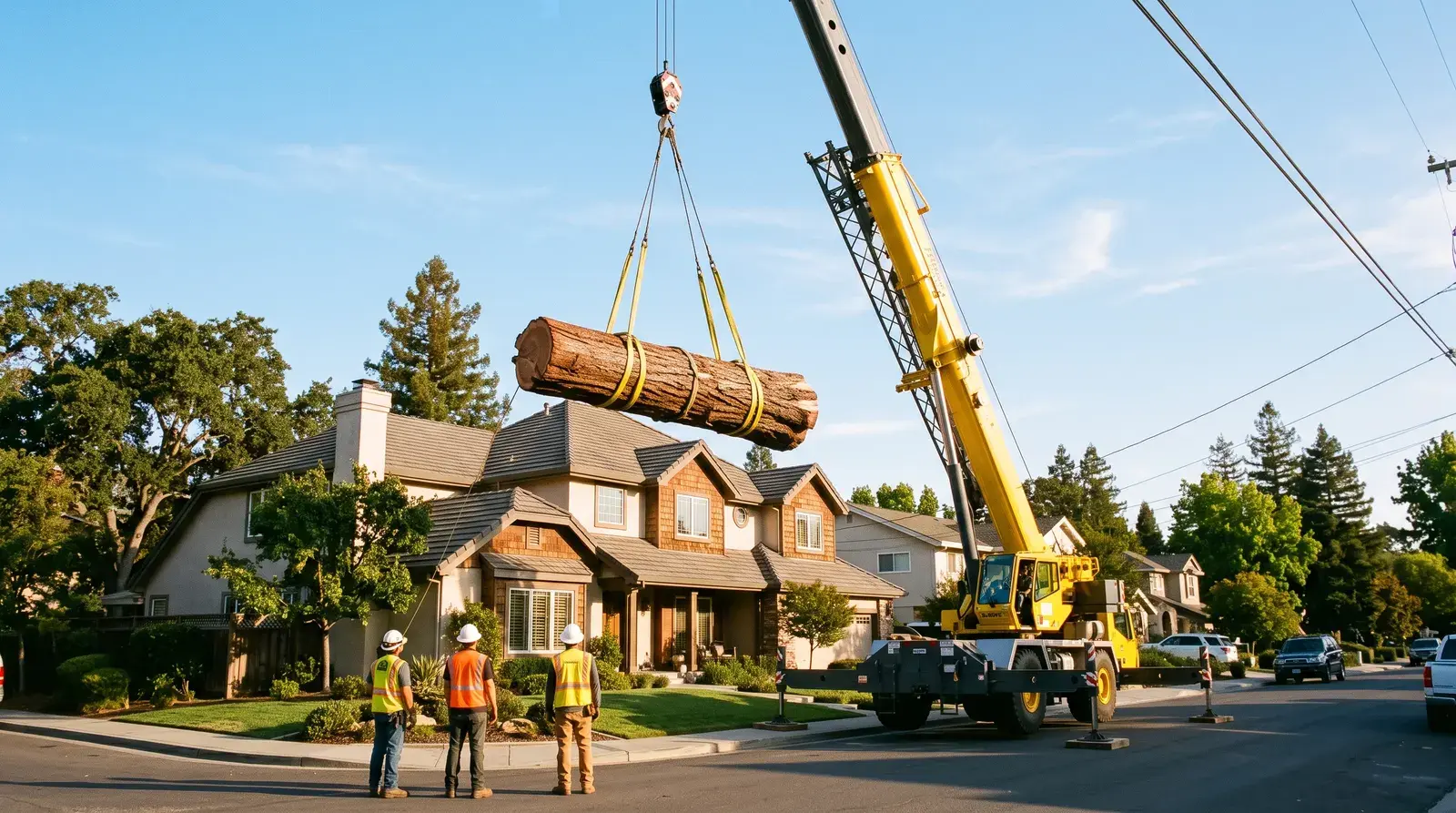
As broad regional figures, most residential removals run $500–$2,500. Large valley oaks on agricultural-edge lots — with significant trunk diameter, deep root systems, and long carries to chip truck access — move past this range, and crane-assisted removals over structures can exceed $5,000–$10,000+.
- Trunk diameter and height set the baseline; a 70-foot valley oak is a fundamentally different job from a 20-foot ornamental plum in the same yard.
- Open-lot access helps with equipment, but large wood volume offsets the access advantage on a big oak — more cutting, more chipping, and more haul-off trips than any suburban removal.
- Targets under the canopy still determine the rigging requirement; an oak over a shop building or a hay barn on a Galt agricultural-edge lot needs the same sectional rigging approach as an oak over a roof in a city subdivision.
- Galt's distance from the Sacramento metro tree-service core can affect scheduling, particularly during storm season when demand spikes county-wide and crew availability compresses.
- City permit and replacement-planting costs for protected native oaks add to the budget when they apply — we flag those requirements at the free estimate so there are no mid-project surprises.
The same crew from estimate to cleanup.
No juggling separate contractors for one tree. Tell us the address and what you're dealing with, and we'll come back with a written, site-specific number.
- Removal, trimming, stumps, and cleanup handled by one crew
- Free, site-specific estimates — priced to your tree, not a flat rate
- Sacramento, Placer, El Dorado, and Yolo counties

PG&E Lines and Utility Coordination
Galt is PG&E territory — not SMUD — which changes the utility coordination picture for any removal near overhead power lines. PG&E handles its own utility-zone trimming under a separate line-clearance program, and work near energized distribution lines requires PG&E involvement, not just a private tree crew.
- Trees with branches in PG&E's distribution lines require a PG&E line-clearance coordination call before any crew goes up — this applies regardless of how urgent the removal situation is, and PG&E scheduling has its own lead time.
- Private removal work on the ground and root system can proceed around the utility conflict, but the aerial cut-back near energized conductors belongs to PG&E's qualified line-clearance arborists under state regulations.
- Dead trees leaning toward PG&E lines on rural-edge Galt properties are the most time-sensitive situation — report to PG&E and get a private tree assessment simultaneously rather than waiting on one to start the other.
- Call USA North 811 before stump grinding anywhere in Galt — agricultural-edge properties may have old irrigation infrastructure, buried drainage tile, or lateral utility lines that do not appear on standard locate databases.
- We coordinate directly with PG&E on Galt removals where utility contact is a factor and will tell you plainly at the estimate which parts of the job require PG&E scheduling and which we can handle on a standard timeline.
Related guides
Do You Need a Permit to Remove a Tree in Sacramento?
Which Sacramento trees need a removal permit, how city and county rules differ, and how to check before the saw comes out.
How Much Does Tree Removal Cost in Sacramento? (2026)
Typical 2026 Sacramento tree removal price ranges by tree size, the factors that move the number, and how to read a quote before you sign it.
9 Signs a Tree Needs to Come Down
Nine warning signs a tree is hazardous or dying — and when removal is safer than trying to save it.
What tree removal costs — and what Galt allows
Regional ranges, local permit rules, and the alternatives worth weighing before tree removal in Galt.
Emergency Tree Service Cost in Sacramento (2026)
Regional range $800–$8,000 — and what moves the number on a real job.
Do You Need a Permit to Remove a Tree in Sacramento?
Which Sacramento trees need a removal permit, how city and county rules differ, and how to check before the saw comes out.
Tree Pruning vs. Removal: When to Save a Tree and When to Take It Down
Pruning or Removal — how to tell which one the tree actually needs.
Tree Service in Sacramento County, CA
Tree work in Sacramento County ranges from removing aging valley oaks in East Sacramento to grinding stumps on new-buil…
Crane-Assisted Tree Removal Cost in Sacramento (2026)
Regional range $2,500–$12,000 — and what moves the number on a real job.
Do You Need a Tree Removal Permit in Elk Grove?
Where Elk Grove draws the line before a tree comes down, and who to check with.
Want a sense of the work first? See the kinds of tree removal jobs we take on and who shows up to do them.
Frequently asked questions
Does Galt have its own tree removal ordinance?
Yes. Galt is an incorporated city with its own municipal code, and tree removal permits within city limits go through the City of Galt — not Sacramento County. This is the most important distinction for Galt homeowners: Sacramento County's tree protection ordinances apply to unincorporated areas outside city boundaries and do not govern trees on private property inside Galt. For native oaks or other significant trees, the City of Galt's planning or public works department is the right first contact. We verify current requirements at every Galt estimate and point you to the right city intake process.
I have a valley oak on my lot — do I need a city permit to remove it?
Likely, if it meets the City of Galt's size thresholds. Valley oaks are native protected species under most California city codes, and Galt's municipal code reflects that protection for oaks within city limits. Dead and visibly hazardous trees generally move through the process faster, but documentation — photos of the decay, the structural failure point, or the hazard condition — is the right practice before any protected oak comes down. We check the current City of Galt permit requirement at the estimate and can supply written condition notes and dated photos to support a city application when one is needed.
How much does tree removal cost in Galt?
Most residential removals run $500–$2,500 as a broad regional range. Large valley oaks on Galt's agricultural-edge lots — mature trees with significant trunk diameter, deep root systems, and long carries to chip truck access — move well past the top of that range. Trees requiring crane access or rigging over structures can exceed $5,000–$10,000+. City permit and replacement-planting costs for protected native oaks add to the budget when they apply. Every estimate is free and based on a site visit; we do not quote from photos or satellite imagery.
My property borders agricultural land on the edge of Galt. Does that change the job?
It often does. Agricultural-edge lots in Galt sometimes carry mature oaks or orchard remnants large enough to require crane removal or significant rigging regardless of clear access. Root systems on these trees can extend well beyond the visible drip line into adjacent agricultural soil, which affects both felling direction and stump grinding scope. If the property borders an irrigation ditch or drainage channel, we verify with USA North 811 before grinding and watch for old agricultural infrastructure that does not appear on standard locate maps. Fire-season defensible space is also more relevant on agricultural edges where dry grassland borders the property.
My tree is near a PG&E line — can you still remove it?
Partially, and the rest requires PG&E coordination. Galt is PG&E territory, so utility-zone work near energized distribution lines falls under PG&E's line-clearance program — not a private tree crew. We handle the ground work and any sections of the tree clear of the conductors; the aerial cut-back near the lines is a PG&E scheduling item with its own lead time. For dead trees leaning toward a PG&E line, contact PG&E and schedule a private tree assessment at the same time — those situations are time-sensitive and both tracks need to run in parallel. We will tell you at the free estimate exactly which parts of the removal we handle and which require PG&E coordination.