
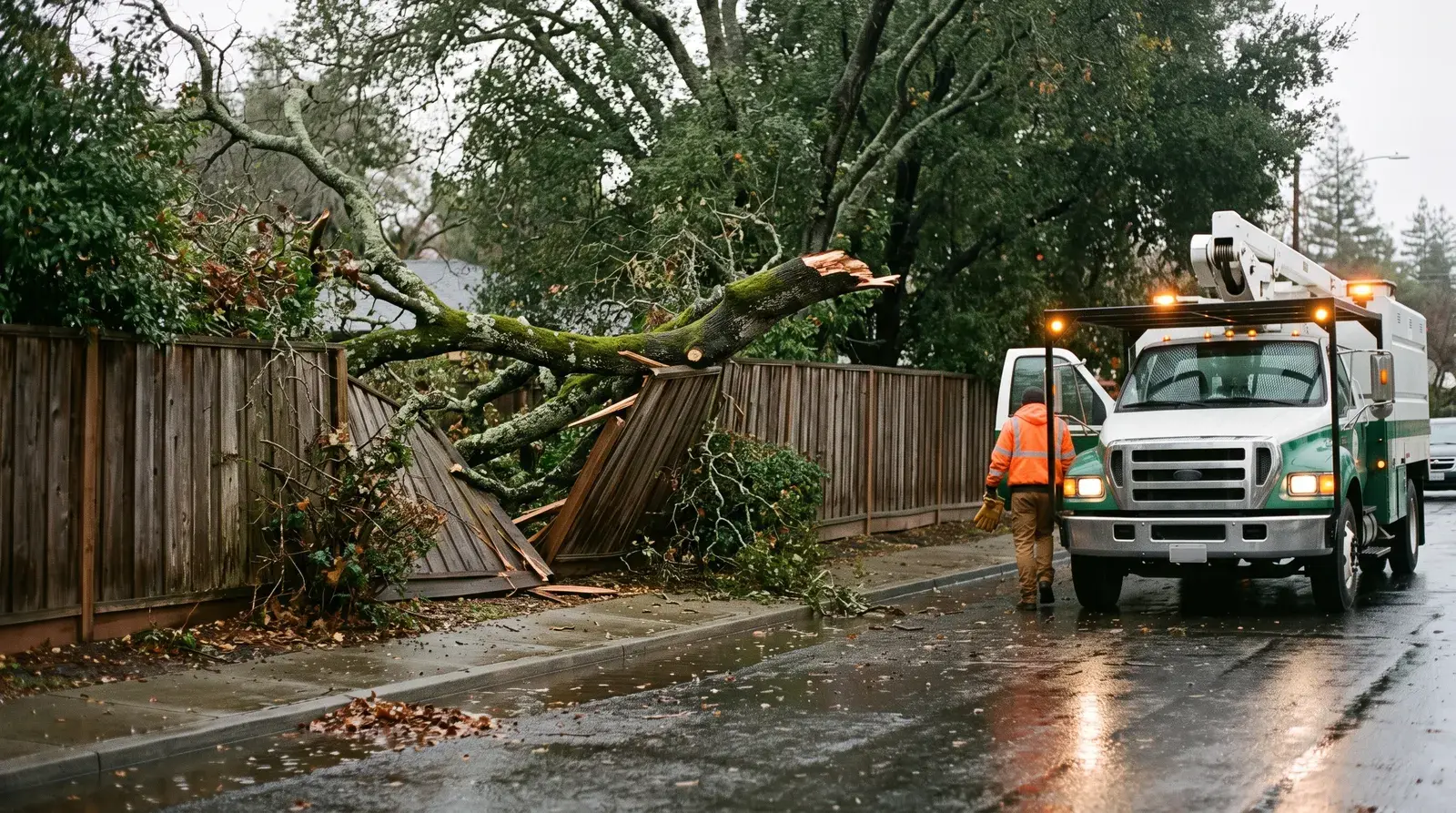
What Counts as a Tree Emergency
An emergency is a tree problem with a target under it: failed or failing wood over a house, car, walkway, or line. Everything else — a tree down in open lawn, an old lean that hasn't changed — is urgent at most, and treating it that way saves you money.
- Tree or major limb on a structure or vehicle — the clearest emergency; the load needs to come off before it does more damage.
- Split trunk or fresh crack in a main stem — the tree is failing in slow motion and can finish the job in the next gust.
- Root plate lift or a new lean — soil mounding on one side of the trunk after rain-soaked wind means the anchoring roots have let go.
- Hanging broken limbs (widow-makers) caught in the canopy over driveways, play areas, or entries.
- Tree blocking your only access — a driveway or private road you can't get emergency vehicles down.
- Anything involving power lines — that starts with SMUD or PG&E, not a tree crew.
Sacramento's Storm Pattern: When Trees Fail Here
Most Sacramento-area tree failures cluster in the winter storm season, roughly November through March, when Pacific systems bring strong south winds over soil that's already saturated. Full canopies, wet ground, and wind is the exact combination that tips whole root plates.
The practical takeaway: if a tree concerned you during the last storm — new lean, cracking sounds, a limb that almost hit something — have it assessed in the calm season. A scheduled removal or crown reduction costs a fraction of an emergency callout plus a roof repair.
- Winter windstorms — the region's big failure events; saturated soil undercuts a tree's anchorage right when wind load peaks.
- Evergreen risk — live oaks, redwoods, and pines carry full sail through winter storms, while deciduous trees have dropped theirs.
- Summer limb drop — mature valley oaks can shed large limbs on hot, still summer days with no warning; it's a known behavior of the species.
- Aging street trees — Modesto ash and other mid-century plantings across Sacramento's older suburbs are past their prime and fail disproportionately in wind.
- Drought stress — years of dry summers weaken roots and invite decay, so failures often trace back to seasons-old damage.
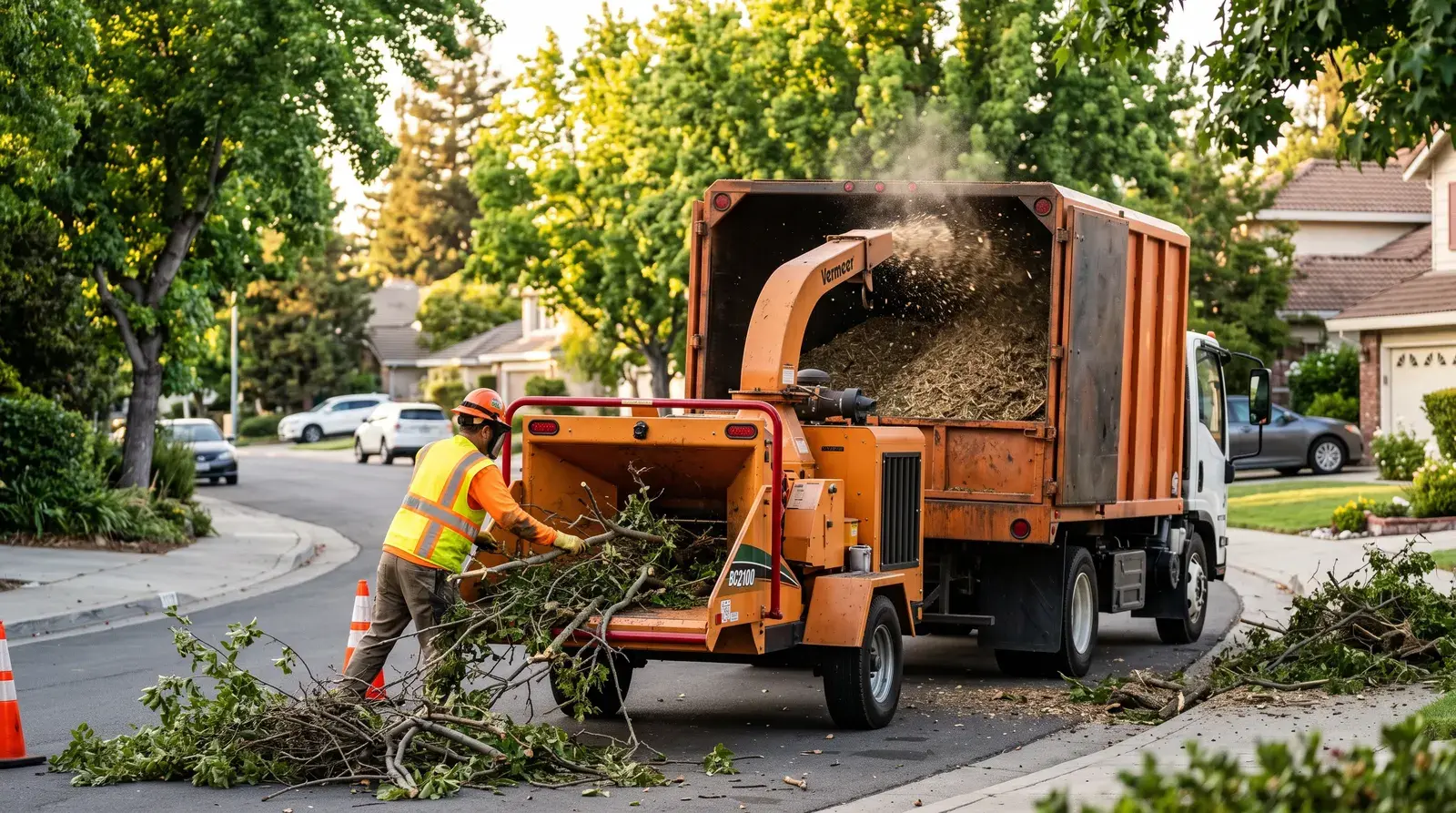
Emergency Tree Service across Sacramento, Placer, El Dorado, and Yolo counties.
What to Do Right Now, Step by Step
Before any tree crew arrives, your job is to keep people away from the hazard and start the paper trail. Here is the order that protects both your family and your insurance claim.
- 1. Clear the area — keep people and pets away from the tree and out of rooms under the damaged section of roof.
- 2. Check for wires — if any line is down or the tree is touching one, treat everything near it as energized. Call SMUD or PG&E, and 911 for immediate danger.
- 3. Photograph everything — the tree, the failure point, the damage, from multiple angles, before anything moves. Adjusters want to see the scene as it happened.
- 4. Call a tree service — describe what fell, what it's on, and access to the tree. That's enough for a crew to mobilize with the right equipment.
- 5. Open your insurance claim — most carriers have around-the-clock claim lines; your claim number helps us direct documentation to the right file.
- 6. Don't self-rescue — a trunk resting on a roof is loaded like a spring. Homeowner chainsaw work on storm-damaged trees causes a wave of injuries after every major storm.
How We Handle an Emergency Callout
Emergency work is triage: stabilize the hazard first, protect the structure second, and finish the cleanup once nothing can get worse. On a tree that's already on a house, the removal is a rigging problem — every cut changes the load, so the sequence matters more than speed.
Emergency response is available through 916 Trees across Sacramento, Placer, El Dorado, and Yolo counties. After a major regional windstorm, every reputable crew is running a queue — trees on occupied structures come first, and honest dispatching means telling you where your job sits in that line.
- Hazard assessment — we walk the scene, identify what's still under tension, and set an exclusion zone before anyone cuts.
- Stabilize and unload — the tree comes off the structure in controlled sections, rigged or craned so no piece drops onto already-damaged roofing.
- Crane when it's the safer tool — for large trunks across a roofline, a crane pick is often the only way to lift wood off without dragging it through the structure. See crane-assisted removal.
- Tarp and dry-in coordination — once the tree is off, the roof opening needs covering fast; we coordinate timing with your roofer or emergency board-up contractor.
- Site cleanup — debris chipped and hauled, either immediately or scheduled once the urgent hazard is resolved.
Need emergency tree service on your property?
Share the address and project details — we'll come back with a scoped, site-specific estimate.
Insurance Documentation We Provide
Insurance carriers pay tree claims on documentation, not descriptions. Since we're on-site at the failure, we capture what your adjuster needs while the evidence is still intact — it's one of the most valuable parts of an emergency callout.
- Photos of the failure point — decay columns, root plate, or split stems, shot before and during removal, showing why the tree failed.
- Photos of the damage — the tree in contact with the structure, from angles you can't safely reach yourself.
- Itemized invoicing — removal from the structure listed separately from general debris cleanup, since carriers often treat those differently.
- Written condition notes — what we observed about the tree's health, useful when questions come up about whether the failure was foreseeable.
- Arborist reports — for disputed claims or neighbor-tree situations, a formal report is available through our arborist report service.
The same crew from estimate to cleanup.
No juggling separate contractors for one tree. Tell us the address and what you're dealing with, and we'll come back with a written, site-specific number.
- Removal, trimming, stumps, and cleanup handled by one crew
- Free, site-specific estimates — priced to your tree, not a flat rate
- Sacramento, Placer, El Dorado, and Yolo counties
After the Emergency: Check the Trees That Didn't Fall
The tree that fell is done doing damage. The bigger question is the ones still standing — the same wind and saturated soil stressed every tree on the property, and partial failures are easy to miss from the ground.
- Cracked limbs and hangers lodged in canopies can hold for weeks, then drop in the next breeze.
- Trees that leaned and partially recovered may have broken roots you can't see; soil cracks near the trunk are the tell.
- Neighboring trees that lost a windbreak when one tree fell now catch wind they've never carried.
- A post-storm health assessment catches these before the next system rolls through — cheaper than a second emergency.
Related services
Storm Damage Cleanup
Cleanup after winter windstorms — split limbs, uprooted trees, and yard debris removed so your property is safe and clear again.
Tree Removal
Safe removal of hazardous, dead, or unwanted trees — including permit help, cleanup, and haul-off across the Sacramento region.
Crane-Assisted Tree Removal
Crane-assisted removal for large, dead, or hazardous trees where tight access or overhead risk rules out a conventional takedown.
Related guides
Tree Fell? What to Do After Storm Damage
The safe, step-by-step response after a tree falls in a storm — downed lines, insurance documentation, triage, and how to avoid storm-chaser scams.
9 Signs a Tree Needs to Come Down
Nine warning signs a tree is hazardous or dying — and when removal is safer than trying to save it.
Do You Need a Permit to Remove a Tree in Sacramento?
Which Sacramento trees need a removal permit, how city and county rules differ, and how to check before the saw comes out.
Before you book emergency tree service
What it runs, where permits bite, and how emergency tree service stacks up against the alternatives.
Crane-Assisted Tree Removal Cost in Sacramento (2026)
Regional range $2,500–$12,000 — and what moves the number on a real job.
Do You Need a Permit to Remove a Tree in Sacramento?
Which Sacramento trees need a removal permit, how city and county rules differ, and how to check before the saw comes out.
Professional vs. DIY Tree Removal: What's Safe to Do Yourself
Professional or DIY — how to tell which one the tree actually needs.
How Much Does Tree Removal Cost in Sacramento? (2026)
Typical 2026 Sacramento tree removal price ranges by tree size, the factors that move the number, and how to read a quote before you sign it.
Do You Need a Tree Removal Permit in Elk Grove?
Where Elk Grove draws the line before a tree comes down, and who to check with.
Want to see what this looks like on a real property? Browse the emergency tree service jobs we take on, or read how our crew scopes and prices work before you call anyone out.
Frequently asked questions
What counts as a tree emergency?
Anything that can't safely wait for a regular appointment: a tree or large limb on a house, garage, car, or fence; a trunk that has split but not yet fallen; a tree with fresh lean or lifted roots after wind or saturated soil; and large broken limbs hanging in the canopy over areas people use. A tree that fell in an open part of the yard and isn't touching anything can usually wait a few days — tell us that, and you'll often pay less than emergency pricing.
A tree fell on my house. What do I do first?
Get everyone away from the damaged rooms — more of the tree or the structure can still move. If any wires are involved or down, stay clear and call the utility (SMUD or PG&E) and 911 if there's immediate danger. Then call a tree service to remove the tree, and your insurance carrier to open a claim. Take photos before anything is moved if it's safe to do so. Don't climb on the roof and don't let anyone start cutting a loaded trunk with a chainsaw — wood under tension is what hurts people after the storm.
Does homeowners insurance cover emergency tree removal?
Generally, if a tree damages a covered structure — the house, garage, or fence — policies cover removal from the structure and the repair, subject to your deductible and limits. A tree that falls in the yard without hitting anything often isn't covered, or is capped at a small amount. Whose tree it was usually matters less than what it hit. We photograph the failure point and the damage, and provide itemized invoices, which is what adjusters ask for. Confirm specifics with your carrier.
Can you remove a tree that's leaning on power lines?
Not until the utility deals with the line. Trees in contact with energized conductors are handled by SMUD or PG&E crews or their line-clearance contractors — that's their jurisdiction and the only safe way. Call the utility first; once the line is de-energized or cleared, we take the rest of the tree down. If a service drop to your own house was pulled off, an electrician re-attaches it after we remove the tree.
Do you charge more for emergency work?
Emergency callouts typically cost more than scheduled work — crews mobilize outside normal routing, often in bad weather, and the rigging is more complicated because the tree is already loaded against a structure. What you can control: be accurate about whether it's a true emergency, and get the hazard stabilized now while scheduling the full cleanup for a regular slot. Every job still starts with a clear price before we cut.