
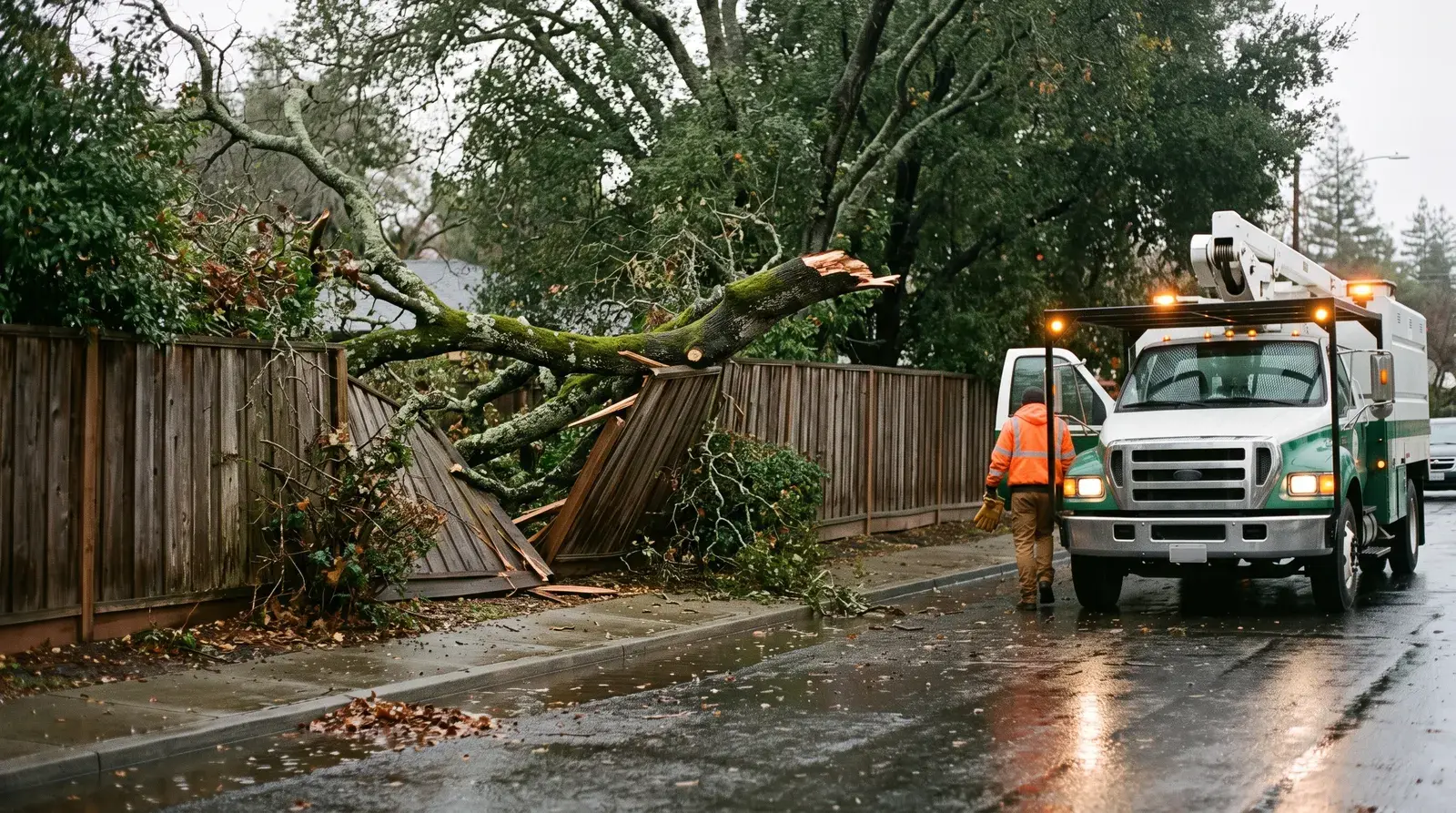
Rural Triage: What Cannot Wait Out Here
The emergency list on an acreage parcel is different from the one in a subdivision, because the things a tree can land on are different and because help takes longer to arrive.
On rural parcels the honest advice is usually to split the job: we cut access open and make the immediate hazard safe now, then come back for the full cleanup on a normal schedule at normal pricing.
Handle it now
Loaded wood, blocked access, or utilities involved.
- A trunk across the driveway or the private road — it blocks emergency vehicles, not just your truck.
- A tree or limb on the house, garage, shop, barn, or a vehicle.
- Anything down on or against a propane tank, its regulator, or the line run — keep clear and call your propane supplier and the fire district.
- A tree on the well head, pump house, or septic tank lid.
- Any tree in contact with a PG&E conductor or a service drop pulled off the mast.
- A ponderosa or gray pine with a snapped top hung up in its own canopy over anything you use.
The First Hour on an Acreage Parcel
Storm response is slower everywhere out here — utility crews, fire, and tree crews all have further to drive and more ground to cover. That makes the first hour more important, not less.
Account for everyone and clear the fall zone
On a slope the danger area below a leaning tree is far larger than the area above it. Keep people and vehicles out of the downhill side entirely.
Treat every wire as live
Shingle Springs is PG&E territory. For a downed line call 911 first, then report it to PG&E at 1-800-743-5000. Rural lines can take longer to reach, so assume the line is energized for as long as it takes.
Check your access route
Walk or drive the driveway to the county road before you need it in a hurry. If it is blocked, say so on the first call; access-blocking failures get priority over property damage.
Look at the utilities the tree may have hit
Propane tank and regulator, well head, pump house, septic lid. If you smell gas, get upwind, do not operate switches or start engines, and call the propane supplier and the fire district from a distance.
Photograph everything before cutting
Wide shots and close shots of the break, the root plate, or the beetle damage on the trunk. Once the wood is bucked, the evidence is gone.
Then call for rigging
Tell us the species, the slope, what the tree is on, whether the driveway is blocked, and whether a chip truck can physically get to the work. That last question changes the whole plan.
Emergency Tree Service in Shingle Springs — free, site-specific estimates.
A Blocked Driveway Is an Emergency Here
In a subdivision, a tree across the driveway is a hassle. On a Shingle Springs parcel with a long private drive, a locked gate, and no second way out, it is a safety problem for everyone on the property.
Rural driveways are frequently the only route in for an ambulance, a fire engine, or a PG&E crew, and many of them are single-lane with a cut bank on one side and a drop on the other, which means there is no going around the trunk. If somebody on the parcel has a medical condition, if there is livestock to move, or if there is any fire activity in the area, that trunk is the first thing that has to go. We cut access open as a distinct piece of work — a corridor wide enough for an engine, with the cut ends secured so nothing rolls back into the road — and then deal with the rest of the tree separately. If your gate is locked or code-operated, have that sorted before the crew arrives. A crew sitting at a call box with a loaded chip truck is not helping anyone. And if the failure happened during a Public Safety Power Shutoff or an outage, an electric gate may not open at all, so know where the manual release is before you need it.
Why Foothill Trees Fail Around Shingle Springs
The failure pattern here is a product of the ground and the species: shallow, rocky decomposed granite that holds fine until it saturates, oak-pine woodland with a lot of stored weight, and elevation high enough to catch wet snow that the valley never sees.
- Gray pine — multi-stemmed, top-heavy, resinous, and the most reliable storm failure in the foothills. It sheds whole stems rather than single limbs.
- Ponderosa pine on the higher and shadier aspects — large and straight, and the tree most likely to lose a top under an ice or wet-snow load.
- Beetle-killed and drought-killed pines that fail on still days with no weather at all. Pitch tubes and boring dust on the trunk are the warning — see our guide to bark beetle pine mortality in the foothills.
- Blue and valley oak root plate failure in saturated decomposed granite, where there was never much soil depth to grip in the first place.
- Long live oak laterals reaching for light over driveways and decks, tearing out at the union under their own end weight.
- Landscape trees planted close to homes during the 1980s and 1990s build-out, now large enough to reach the roof and structurally weak enough to get there.
Need emergency tree service in Shingle Springs?
Share the address and project details — we'll come back with a scoped, site-specific estimate.
Working a Failure on Steep, Remote Ground
Rural emergency work is slower and more deliberate than it looks from the road. Nothing can be dropped where it will roll into a drainage, a fence line, or the structure below, and the equipment that makes suburban work fast often cannot reach the tree at all.
- Access determines method. If a chip truck and lift can reach the work, the job runs one way; if they cannot, it becomes rope-access rigging and hand carry, which takes longer and is priced honestly.
- Everything is rigged and lowered on grade. Uncontrolled wood on a foothill slope goes into whatever is downhill, which out here is often a neighbor's fence or a seasonal drainage.
- Storm-loaded pine is among the most dangerous wood there is — tension and compression change with every cut, and a wrong sequence releases it all at once.
- We stabilize first and finish in daylight when a tree is partly failed. Working a loaded trunk on a slope in the dark is how people get hurt.
- Debris on a large parcel is a real cost line. Chips can often stay on site as ground cover, which cuts the haul bill considerably.
PG&E, El Dorado County, and Documentation
The same crew from estimate to cleanup.
No juggling separate contractors for one tree. Tell us the address and what you're dealing with, and we'll come back with a written, site-specific number.
- Removal, trimming, stumps, and cleanup handled by one crew
- Free, site-specific estimates — priced to your tree, not a flat rate
- Sacramento, Placer, El Dorado, and Yolo counties

After the Storm: Survivors and Fuel
Post-storm on a foothill parcel there are two follow-up questions, and one of them is seasonal. What is still standing that moved, and what is now dead fuel sitting inside your defensible space.
- Walk the trunks for cracked or mounded soil on the uphill side. A tree that moved has partially failed and has not recovered.
- Look up into the pines for hung tops and broken stems still lodged in the canopy — these come down on still days with no warning.
- Damaged and broken trees left standing become dead fuel inside the 100-foot defensible space perimeter by the following summer. Clearing them in winter is cheaper than clearing them under an inspection notice in July.
- Storm slash left in piles is fuel too. Chip it, spread it outside the ember-resistant zone next to the structure, or have it hauled.
- For the compliance side, see our defensible space clearing service and the California defensible space requirements guide. For planned removals, our Shingle Springs tree removal page covers access, permits, and pricing.
Related guides
Tree Fell? What to Do After Storm Damage
The safe, step-by-step response after a tree falls in a storm — downed lines, insurance documentation, triage, and how to avoid storm-chaser scams.
9 Signs a Tree Needs to Come Down
Nine warning signs a tree is hazardous or dying — and when removal is safer than trying to save it.
Do You Need a Permit to Remove a Tree in Sacramento?
Which Sacramento trees need a removal permit, how city and county rules differ, and how to check before the saw comes out.
What emergency tree service costs — and what Shingle Springs allows
Regional ranges, local permit rules, and the alternatives worth weighing before emergency tree service in Shingle Springs.
Emergency Tree Service Cost in Sacramento (2026)
Regional range $800–$8,000 — and what moves the number on a real job.
Do You Need a Tree Removal Permit in Elk Grove?
Where Elk Grove draws the line before a tree comes down, and who to check with.
Professional vs. DIY Tree Removal: What's Safe to Do Yourself
Professional or DIY — how to tell which one the tree actually needs.
Tree Service in El Dorado County, CA
El Dorado County runs from the Sacramento Valley edge at El Dorado Hills up through Placerville and into Pollock Pines…
Crane-Assisted Tree Removal Cost in Sacramento (2026)
Regional range $2,500–$12,000 — and what moves the number on a real job.
Do You Need a Tree Removal Permit in Roseville?
Where Roseville draws the line before a tree comes down, and who to check with.
Want a sense of the work first? See the kinds of emergency tree service jobs we take on and who shows up to do them.
Frequently asked questions
A tree is blocking my only driveway in Shingle Springs. Is that an emergency?
Yes, and we treat it as one. On a rural parcel the driveway is usually the only route in for an ambulance, a fire engine, or a utility crew, and most private drives out here are single lane with a bank on one side and a drop on the other, so there is no going around. Say clearly on the first call that access is blocked and whether anyone on the property has a medical need or livestock to move. We cut a corridor wide enough for an emergency vehicle, secure the cut ends so nothing rolls back into the road, and handle the rest of the tree as separate work.
Do I call PG&E or SMUD for a downed line in Shingle Springs?
PG&E. Shingle Springs and the surrounding unincorporated El Dorado County area are PG&E territory; SMUD serves Sacramento County. For a downed line, call 911 first, then report it to PG&E at 1-800-743-5000. Keep everyone away from the tree, the wire, and anything metal touching either, including wire fencing, which can carry current a long way from the failure. No responsible tree crew works around an energized line. Rural restoration can take longer than it does in town, so assume the line is live until PG&E tells you otherwise.
How fast can a crew get out to a rural parcel after a storm?
Honestly, it depends on the storm and on how far in you are, and we will tell you rather than guess for you. Emergency response is available and genuine hazards get priority — blocked access, trees on occupied structures, failures involving propane or the well. What we will not do is promise a fixed arrival window, because after a foothill wind or snow event every crew in El Dorado County is working a triage list and the drive times out here are long. Describe the situation accurately and you will get a straight answer about where you sit.
A pine fell on my propane tank. What do I do?
Get everyone upwind and well away, and do not operate any switch, start an engine, or use anything that sparks near it. If you smell gas, call 911 and your propane supplier from a distance and let them shut it down and inspect the tank, regulator, and line — that is their equipment and their call, not a tree crew's. We do not cut wood off a tank until the propane company has confirmed the system is safe. Once it is, we rig the tree off rather than dragging it, so the removal does not add damage to the tank or the line.
Do I need county approval to remove an oak that failed in a storm?
A genuinely failed or hazardous oak is treated differently from a healthy one, but documentation is what makes that distinction stand up later. Shingle Springs is unincorporated El Dorado County, so the question goes to El Dorado County Planning and Building rather than to a city. Photograph the tree, the failure point, the decay, and what it landed on before and during the work, and keep the written scope. If the removal is part of documented defensible space compliance, that inspection record strengthens the paper trail. Verify current county requirements directly, since they do change.
Will insurance cover a tree that fell on my shop or barn?
Often, if the outbuilding is a covered structure under your policy — many homeowner policies cover detached structures at a percentage of the dwelling limit, but the specifics vary and rural outbuildings are exactly where people find gaps. Removing the tree off a covered structure and repairing it is normally covered, subject to your deductible and any cap on removal. A tree that fell in open woodland and hit nothing generally is not, and stump grinding usually is not either. Photograph before cleanup, open the claim the same day, and ask for an itemized invoice separating emergency work from optional cleanup.