
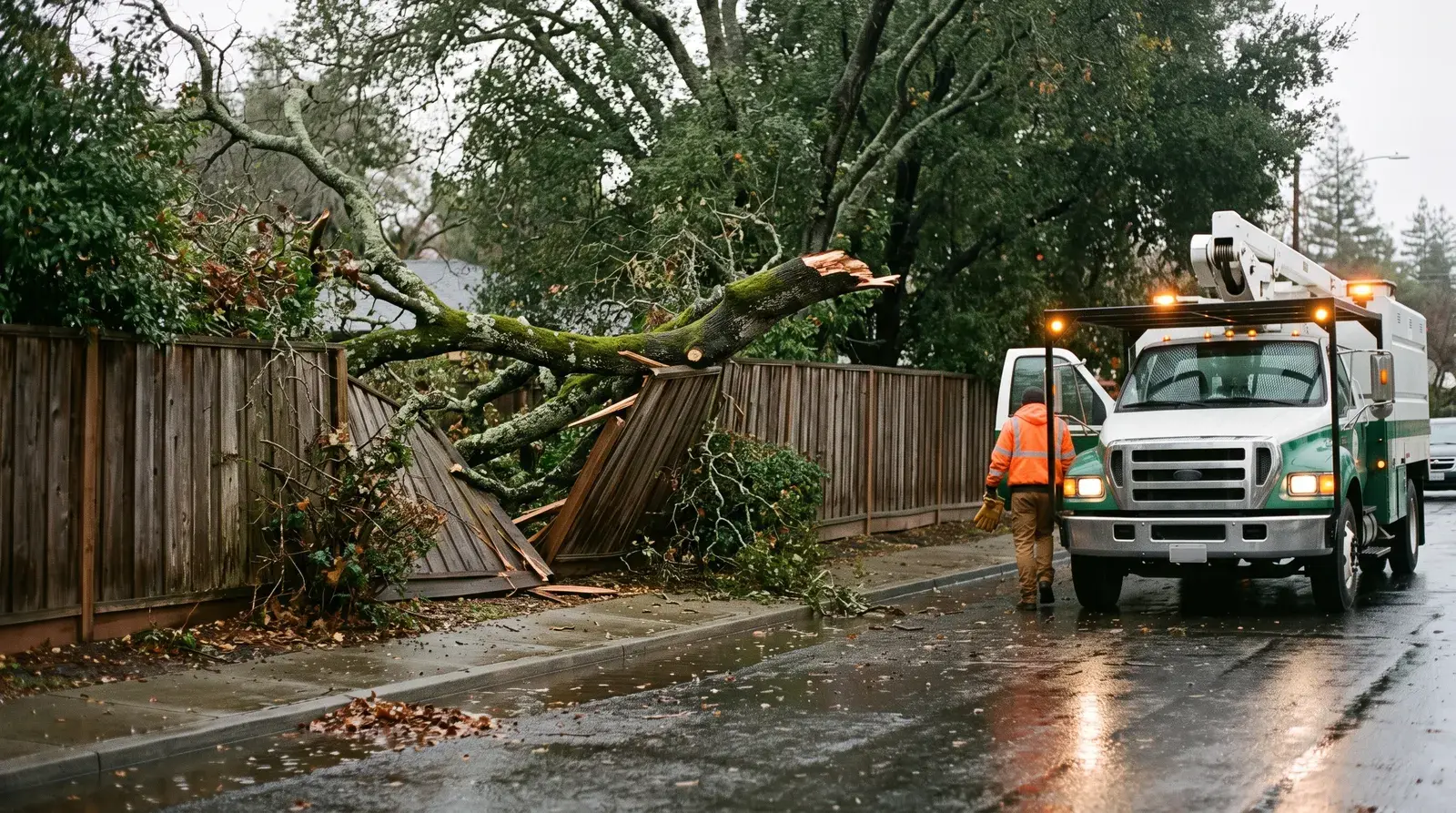
What to Do in the First Ten Minutes
The decisions that matter most happen before any tree service arrives, and they are mostly about staying out from under things. A tree resting on a structure is loaded in directions nobody can see from the ground.
- Get everyone out from under the damaged area and keep them out. Loaded wood shifts without warning, and a limb that has been stable for an hour is not therefore stable.
- If any wire is involved — touching the tree, down in the driveway, sagging — call 911, then PG&E at 1-800-743-5000, before anything else, and treat every line as energized. Nobody touches a tree in contact with a conductor.
- Photograph the scene from safe angles before anything moves. This is the only chance you get at that documentation, and adjusters use it.
- Do not let anyone start cutting a tree off a structure with a chainsaw and enthusiasm. Releasing tension in the wrong order causes most of the secondary damage we see.
- If your driveway is blocked on a single-access foothill lot, say so when you call — access for you, and for any emergency vehicle, moves that job up the list.
Why Auburn Trees Fail
Foothill failures are more predictable than they feel in the moment. Thin soil over rock, drought-weakened conifers, and canyon wind produce the same few failure modes every winter.
The uncomfortable truth in most Auburn emergencies is that the tree had been telling somebody for a year or two. A red-needled pine or a limb with a visible crack is a scheduled removal at a fraction of what the same tree costs at midnight in January.
- Beetle-killed ponderosa and gray pine — the region's most reliable storm failure. Dead conifers dry, check, and lose strength, then shed tops or snap partway up the stem.
- Gray pine's habit works against it: tall, leaning toward light, often multi-topped, and heavy with sap-loaded cones. It fails in ways that are hard to predict from the ground.
- Black oak limb failure — large limbs tearing out under wind load, especially on trees that have never had end weight reduced.
- Root plate lift — thin soil over decomposed granite gives shallow anchorage. Saturate it for a week and a strong gust tips the whole tree, root ball and all.
- Slope and wind together — the canyon funnels gusts, and a tree already leaning downhill has gravity working with the wind rather than against it.
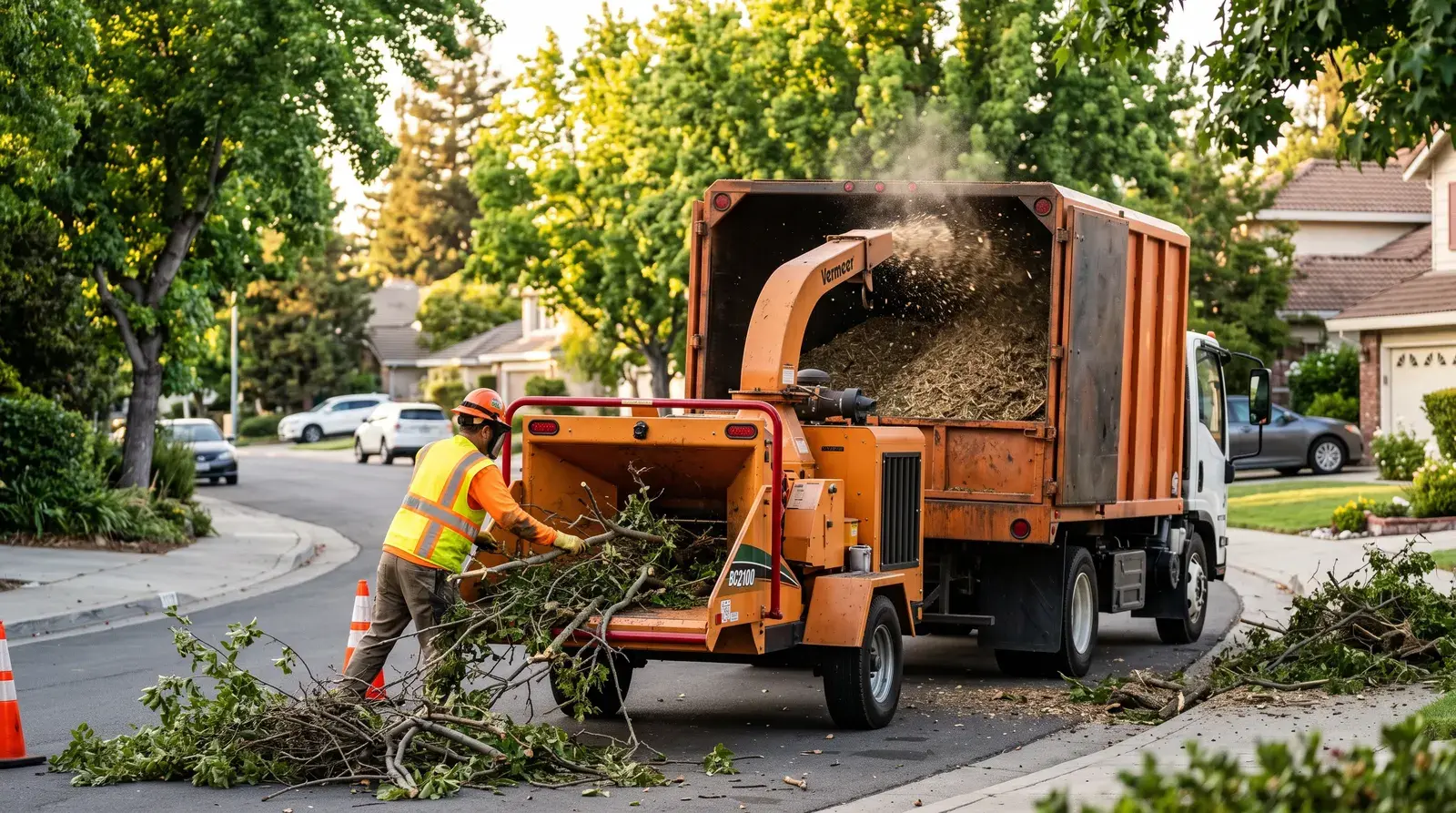
Emergency Tree Service in Auburn — free, site-specific estimates.
Access Is the Emergency Inside the Emergency
In the valley, an emergency call is about the tree. In Auburn it is frequently about the road. A single pine across a shared gravel drive can isolate several households, and getting equipment in is half the problem.
- Blocked drives get cut open first — enough width to get vehicles, and emergency services, past — before anyone starts the full cleanup.
- Long private drives, soft shoulders, culverts, and low bridges limit what can come up the hill. Tell us the constraints on the phone so the right equipment arrives the first time.
- On steep ground, wood from the downhill side is rigged and brought up rather than dropped, which is slower but it is the only controlled option on a grade.
- Where a road sits above the structure, staging from uphill and lifting wood out over the house is sometimes both faster and safer than working from the yard.
- Storm nights in the foothills mean multiple calls at once. We triage honestly: trees on structures, blocked sole access, and hangers over occupied areas come before a tree lying harmlessly in an open field.
Power Lines and Outages
Auburn is PG&E territory and the foothills lose power in most significant storms. Trees and conductors are a large part of why, and it is the one situation where the tree service is not the first call.
- Any tree touching, leaning on, or fallen across a line: 911 and PG&E at 1-800-743-5000 first, every time. Keep people and pets well clear, including from puddles and fences near the contact point.
- Assume every downed wire is live, including ones that are not arcing. Damaged conductors can re-energize without warning.
- The service drop from the pole to your house is generally the owner's responsibility, but it still requires the utility to make it safe before tree work happens near it.
- Once the line is dealt with and the utility has cleared the site, we can take the tree apart properly — including trees that failed into a right-of-way.
Need emergency tree service in Auburn?
Share the address and project details — we'll come back with a scoped, site-specific estimate.
Insurance Documentation That Actually Helps
Homeowner policies typically cover removing a tree off a covered structure and repairing the damage, subject to deductible and limits. A tree that falls in an open field usually is not covered. What separates a smooth claim from an argument is documentation taken before cleanup.
- Photograph the tree on the structure, the failure point, and the surrounding damage before anything is cut or moved.
- Keep the written estimate and the invoice, and make sure the scope is described clearly — emergency stabilization, removal, haul-off, and repairs are separate items to an adjuster.
- We photograph as we work and provide written descriptions of the condition and the failure that adjusters can use.
- Ask your adjuster whether they want debris staged for inspection before it is hauled. Chipping the evidence first is a common and avoidable mistake.
- Tarping and getting the roof weather-tight until your contractor arrives is part of the emergency scope, not a separate errand.
The same crew from estimate to cleanup.
No juggling separate contractors for one tree. Tell us the address and what you're dealing with, and we'll come back with a written, site-specific number.
- Removal, trimming, stumps, and cleanup handled by one crew
- Free, site-specific estimates — priced to your tree, not a flat rate
- Sacramento, Placer, El Dorado, and Yolo counties
After the Storm, Walk the Rest of the Property
The wind that broke one tree loaded every tree on the parcel. The second failure — a week later, on a calm day — is often the one that hits something, because nobody looked.
Once the immediate hazard is handled, it is worth walking the property for hangers caught in canopies, fresh cracks at unions, soil mounding around trunks, and any conifer that has faded since last summer. Preventive work before storm season — end-weight reduction on black oaks, cabling a co-dominant union, removing dead pine while it can still be climbed — costs a fraction of what emergency response costs in January. Our Auburn tree trimming and defensible space clearing both do double duty here: the fuel you remove for fire season is largely the same material that fails in a windstorm.
Related guides
Tree Fell? What to Do After Storm Damage
The safe, step-by-step response after a tree falls in a storm — downed lines, insurance documentation, triage, and how to avoid storm-chaser scams.
9 Signs a Tree Needs to Come Down
Nine warning signs a tree is hazardous or dying — and when removal is safer than trying to save it.
Do You Need a Permit to Remove a Tree in Sacramento?
Which Sacramento trees need a removal permit, how city and county rules differ, and how to check before the saw comes out.
What emergency tree service costs — and what Auburn allows
Regional ranges, local permit rules, and the alternatives worth weighing before emergency tree service in Auburn.
Emergency Tree Service Cost in Sacramento (2026)
Regional range $800–$8,000 — and what moves the number on a real job.
Do You Need a Tree Removal Permit in Auburn?
Where Auburn draws the line before a tree comes down, and who to check with.
Professional vs. DIY Tree Removal: What's Safe to Do Yourself
Professional or DIY — how to tell which one the tree actually needs.
Tree Service in Placer County, CA
Placer County spans flat valley suburbia in Roseville and Rocklin and rises through the oak-woodland foothills to ponde…
Crane-Assisted Tree Removal Cost in Sacramento (2026)
Regional range $2,500–$12,000 — and what moves the number on a real job.
Do You Need a Tree Removal Permit in Rancho Cordova?
Where Rancho Cordova draws the line before a tree comes down, and who to check with.
Want a sense of the work first? See the kinds of emergency tree service jobs we take on and who shows up to do them.
Frequently asked questions
A tree fell across my driveway in Auburn and I can't get out. What now?
Tell us that when you call — sole-access blockage on a foothill lot moves up our triage list, because it affects emergency services reaching you as much as it affects your car. Check for wires in or near the tree first; if any are involved, call 911 and PG&E at 1-800-743-5000, and stay well clear before anyone approaches. We cut the drive open to a passable width first, then handle the full removal and cleanup. On long private drives, tell us about culverts, bridges, and gate widths so the right equipment comes up the first time.
How fast can you respond to a tree emergency in Auburn?
We provide emergency response for storm damage and hazardous trees across Auburn and the surrounding foothills. Contact us and we will tell you honestly how quickly we can be on site given conditions and where you fall in the queue. After a significant windstorm the foothills generate a lot of calls at once, and we triage on genuine danger: trees on occupied structures, blocked sole access, and hangers over areas people use come before a tree lying safely in an open field.
A power line is down in my yard. Should I call you or PG&E?
PG&E at 1-800-743-5000 — and 911 if the line is down, sparking, or across a road — immediately, and nobody else until they have made it safe. Auburn is PG&E territory and foothill storms bring lines down regularly. Treat every downed wire as energized even if it is not arcing or sparking, keep people and animals well back including from wet ground and metal fences nearby, and do not attempt to move branches off a conductor. Once the utility has dealt with the line and cleared the site, we can take the tree apart properly.
Will insurance cover emergency tree removal in Auburn?
Usually when the tree damaged a covered structure — most homeowner policies cover getting the tree off the house and repairing the damage, subject to your deductible and limits. A tree that falls in the yard or a field without hitting anything is frequently not covered. Photograph everything before cleanup starts, keep the estimate and invoice, and ask your adjuster whether they want debris staged before it is hauled. We document our emergency work in a form adjusters can actually use.
My tree is leaning after the storm but hasn't fallen. How urgent is that?
Treat a new lean as urgent, especially in Auburn's thin soil over decomposed granite. Look at the ground: cracked or mounded soil on one side of the trunk means the root plate has lifted and the tree's anchorage is already failing. That tree can come down in the next gust or the next rain, without more wind than it has already seen. Keep everyone out from under it and the area beyond it, and get it assessed promptly. An old lean on a tree with undisturbed soil is a different and much less urgent picture.
There's a broken limb hanging in my oak. Can it wait until spring?
Not if it is over anything anyone uses — a deck, a drive, a walkway, a play area. Hangers come down without warning, and a black oak limb weighs far more than it looks like from the ground. Keep the area beneath it closed off and have it rigged out promptly. If it is hanging over open ground on an acreage parcel and nothing is beneath it, it is less urgent, but it is still worth handling before the next storm rather than after it has taken more of the tree with it.