
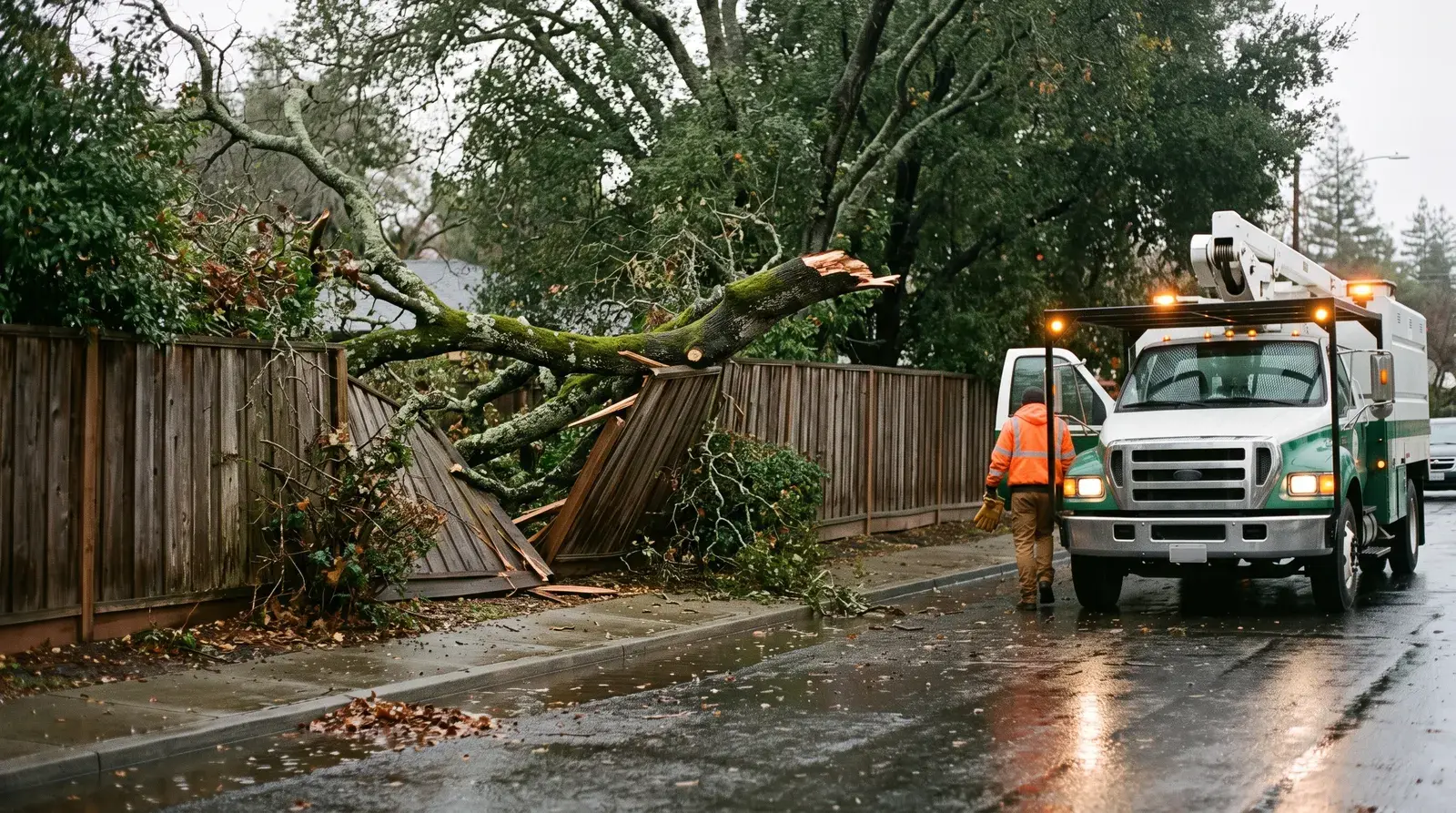
Emergency Tonight, or a Job for Monday?
After a storm we get both calls, and only one of them is worth emergency pricing. The dividing line is whether the wood is loaded and whether something is underneath it.
Send photos if you are unsure. We would rather tell you it can wait than charge emergency rates for a tree that was never going to reach anything.
This needs a crew now
Loaded wood, or a target under it.
- A tree or limb on the roof, garage, patio cover, fence, or a vehicle.
- A wind-thrown tree resting against the house — the root plate can roll the trunk back upright when weight comes off.
- A broken ash limb hung up in the canopy over a driveway, walkway, or play structure.
- Soil cracked or mounded on one side of a trunk after a wet windstorm — the roots have already let go.
- Anything in contact with a SMUD conductor or a service drop pulled off the house.
- A trunk blocking the driveway or a shared side access.
First Steps When a Tree Fails in Elk Grove
Order of operations matters more than speed. People get hurt after the storm — cutting loaded wood, walking under hung limbs, touching fences near downed lines — more often than during it.
Clear the whole area, including the far side
A wind-thrown tree on a fence is under tension you cannot see, and it can move in a direction nobody expects when the load changes.
Assume every wire is energized
Call 911 for fire or injury and report line contact to SMUD at 1-888-456-7683. Stay off wet lawn and away from metal fencing near a downed conductor; a fence can carry current well away from the tree.
Get people out from under damaged rooms
Roof structures keep settling for hours after impact, and a trunk resting on the sheathing is still working its way in.
Photograph before cleanup starts
Insurers want pre-work photos of the tree, the structure, and the point of failure. Once the wood is chipped, that evidence is gone. See our storm damage and tree emergency guide.
Open the claim the same day
Get a claim number before the adjuster queue fills after a regional storm.
Then call for professional removal
Tell us what the tree is on, whether lines are involved, and whether the back yard is gate access only. Homeowner chainsaws and storm-loaded wood are a bad combination.
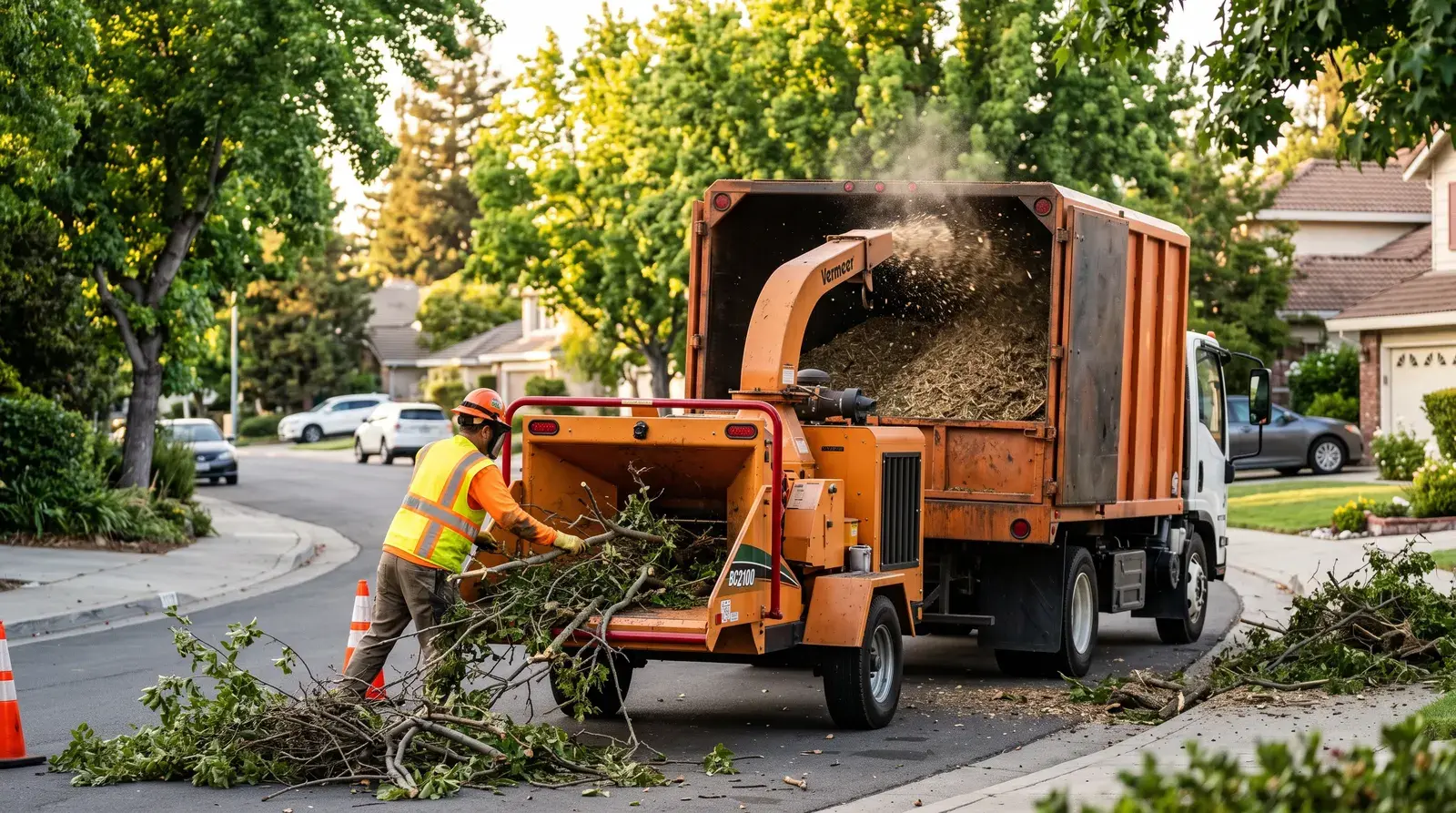
Emergency Tree Service in Elk Grove — free, site-specific estimates.
Why Open Subdivisions Fail in Wind
Elk Grove's newer neighborhoods sit on flat, exposed ground with no mature canopy to slow the wind, and the trees themselves are the vulnerable kind: young, lawn-irrigated, shallow-rooted, and often planted with circling container roots that never anchored.
The failure signature is whole-tree tip-over — root plate and all — rather than trunk snap. Saturated January soil loosens the grip, a sustained south wind does the rest, and the tree lands on whatever is downwind: fences, patio covers, play structures, parked cars. Franklin, Laguna Ridge, and west Elk Grove Village see it every major storm. The near-misses matter too: a tree that partially lifted — soil cracked or mounded on the windward side, a new lean — has failed, just not finished. That tree should come down on your schedule before the next front finishes it on the tree's schedule.
Trees on Roofs, Fences, and Cars
A tree resting on a structure is a rigging problem, not a chainsaw problem. Cut the wrong fiber and the load shifts — into the roof deeper, through the fence, or onto the person cutting. We take the load apart in controlled pieces.
- Weight comes off the structure in rigged sections, supported before each cut, so nothing drops or rolls.
- Cranes or lifts come in when a tree lies across a roofline with no safe working angle — more common with the bigger Sheldon-area oaks. See our crane-assisted tree removal service.
- Fence-line failures get sectioned with the neighbor's side in mind; shared-fence trees are a two-party conversation we have navigated plenty of times.
- Vehicles get the same treatment: lift and remove, never drag, so the removal does not add to the damage claim.
Split Limbs and Hangers on Aging Ash
Not every emergency is a whole tree down. Around Old Town Elk Grove and the older boulevard streets, aging Modesto ash and mulberry shed big limbs in wind — and a cracked limb hung up in the canopy over a driveway is as urgent as one on the ground.
- Hangers (broken limbs caught in the canopy) come out first on any storm call — they fall without warning.
- Split unions on ash can sometimes be cabled if caught early; more often the failed leader comes off and the tree gets a structural reassessment. See our cabling and bracing service.
- A limb that tore a long strip of bark down the trunk changes the tree's future — we will tell you honestly if it is a prune, a cable, or a removal.
- Post-storm is the right time to book preventive end-weight reduction on the ash you kept — before the next storm tests it.
Need emergency tree service in Elk Grove?
Share the address and project details — we'll come back with a scoped, site-specific estimate.
SMUD First When a Line Is Involved
Insurance Documentation and Scope
Storm damage claims go smoother with a clean paper trail. We document as we work and keep emergency scope separate from optional follow-up work so your claim and your invoice line up.
- Photos before, during, and after removal — the tree, the point of failure, and the structure damage.
- Written scope describing what failed and what was removed, in language adjusters recognize.
- Emergency stabilization (getting the tree off the structure, making the site safe) is itemized separately from stump grinding and full haul-off, which insurers treat differently.
- Your insurer generally pays for structure damage and removal of the tree from the structure; a fallen tree that hit nothing is usually the owner's cost — worth knowing before the adjuster call. See storm and uprooted tree insurance.
The same crew from estimate to cleanup.
No juggling separate contractors for one tree. Tell us the address and what you're dealing with, and we'll come back with a written, site-specific number.
- Removal, trimming, stumps, and cleanup handled by one crew
- Free, site-specific estimates — priced to your tree, not a flat rate
- Sacramento, Placer, El Dorado, and Yolo counties
Before the Next Storm: The Cheap Version of This Page
Every emergency on this page has a pre-storm prevention that costs a fraction of the callout. Elk Grove's wind map does not change — the trees that will fail next winter are visible now.
- Get leaning trees and soil-lift assessed in fall, before the ground saturates.
- End-weight reduction on ash, pear, and pistache ahead of storm season is the highest-value trim of the year here. See Elk Grove tree trimming.
- Remove standing dead trees — dead redwood screens are the common one — before wind does it into your neighbor's yard. Our Elk Grove tree removal page covers the planned version.
- Check young trees for girdling stakes and circling roots; fixing a staking problem beats a tip-over.
Related guides
Tree Fell? What to Do After Storm Damage
The safe, step-by-step response after a tree falls in a storm — downed lines, insurance documentation, triage, and how to avoid storm-chaser scams.
9 Signs a Tree Needs to Come Down
Nine warning signs a tree is hazardous or dying — and when removal is safer than trying to save it.
Do You Need a Permit to Remove a Tree in Sacramento?
Which Sacramento trees need a removal permit, how city and county rules differ, and how to check before the saw comes out.
What emergency tree service costs — and what Elk Grove allows
Regional ranges, local permit rules, and the alternatives worth weighing before emergency tree service in Elk Grove.
Emergency Tree Service Cost in Sacramento (2026)
Regional range $800–$8,000 — and what moves the number on a real job.
Do You Need a Tree Removal Permit in Elk Grove?
Where Elk Grove draws the line before a tree comes down, and who to check with.
Professional vs. DIY Tree Removal: What's Safe to Do Yourself
Professional or DIY — how to tell which one the tree actually needs.
Tree Service in Sacramento County, CA
Tree work in Sacramento County ranges from removing aging valley oaks in East Sacramento to grinding stumps on new-buil…
Crane-Assisted Tree Removal Cost in Sacramento (2026)
Regional range $2,500–$12,000 — and what moves the number on a real job.
Do You Need a Tree Removal Permit in Folsom?
Where Folsom draws the line before a tree comes down, and who to check with.
Want a sense of the work first? See the kinds of emergency tree service jobs we take on and who shows up to do them.
Frequently asked questions
Do you do emergency tree removal in Elk Grove after hours?
Yes. Emergency tree removal calls come in outside normal scheduling and we work them, with storm situations getting priority — a tree on an occupied house or blocking a driveway moves ahead of routine work. What we will not do is promise a fixed arrival time, because after a regional windstorm every crew in the area is working a triage list. When you call, describe what the tree is on, whether lines are involved, and whether anyone cannot safely enter or leave. You will get an honest read on the response window and what to stay clear of until the crew arrives.
A tree fell on my fence in Elk Grove — whose problem is it?
Generally, damage lands on the policy of the property where it lands: if your neighbor's healthy tree failed in a storm onto your fence, your insurance typically handles your side. The exception is negligence — if the tree was visibly dead or hazardous and the owner ignored it, responsibility can shift. Photograph the failure point before cleanup, since decayed wood at the break is exactly the evidence that matters. We can remove the tree and document its condition either way. Our guide to neighbor tree disputes in California covers the rest.
My tree is leaning after the storm but has not fallen. Is it an emergency?
Treat it like one. A new lean with cracked or mounded soil on the opposite side means the root plate has partially failed — the tree has already started falling and is pausing, not stabilizing. Keep people, cars, and pets out of the fall zone and get it assessed quickly. In Elk Grove's open subdivisions the next wind event usually finishes what the last one started, and a controlled removal costs far less than the fence, roof, or car underneath it.
Will insurance cover removing the tree from my roof?
Usually, yes — removal of a tree off a covered structure and repair of the damage are typically covered storm losses, minus your deductible and often subject to a cap on the removal portion. What is often not covered is removing a tree that fell in the yard and hit nothing, or grinding the stump afterward. We itemize emergency stabilization separately from optional cleanup so your invoice maps cleanly to what the adjuster approves, and we provide photos and a written scope for the claim file.
Can I cut up a fallen tree myself?
If it is a small tree lying flat on open lawn with nothing under tension — maybe. But wind-thrown trees on fences, structures, or other trees are loaded springs: trunks under tension and compression that can kick, roll, or snap upright at the root ball when cut wrong. Storm cleanup injures a lot of competent homeowners every winter. Anything touching a structure, a line, or another tree is professional work — and it is exactly the work our rigging exists for.
How much does emergency tree removal cost in Elk Grove?
Emergency callouts cost more than scheduled work, because crews mobilize outside normal routing, often in bad weather, and the rigging is more complicated when a tree is already loaded against a structure. What you can control: be accurate about whether it is a true emergency, and get the hazard stabilized now while scheduling the full cleanup and stump grinding for a regular slot. Broad regional removal ranges still apply as a starting point, but every emergency is priced from what is actually loaded and what is under it. You get a clear price before we cut.