
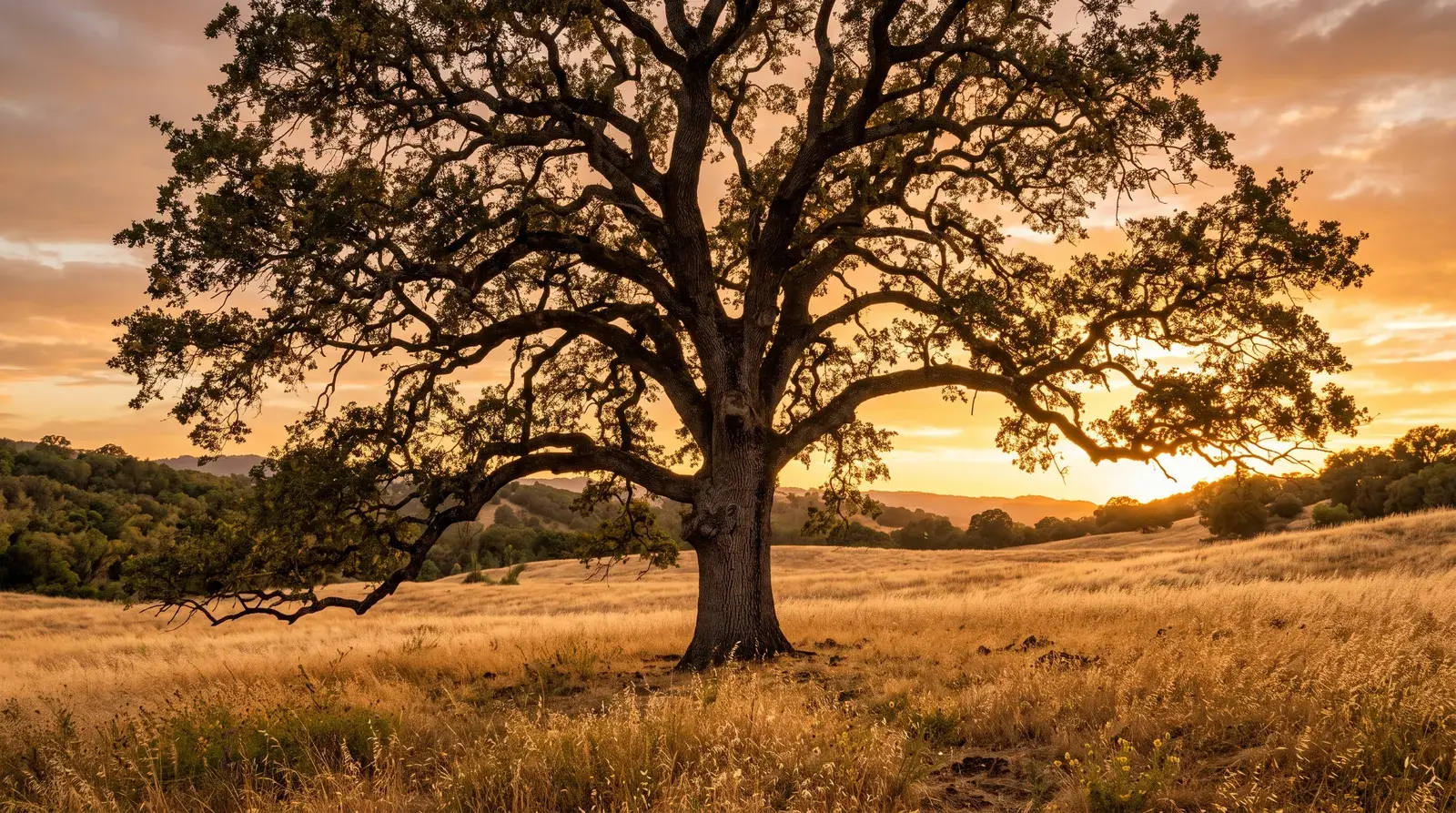
When to Prune Oaks in Sacramento
Timing is the cheapest thing you can get right with an oak. Prune in the dry season or winter dormancy, keep the cuts conservative, and skip wet weather entirely — fresh wounds in the rain are an open door for disease.
- Best windows: late summer through early fall for light work; winter dormancy for larger structural pruning.
- Avoid heavy pruning in spring and early summer, when the tree is spending its reserves — stress cuts then cost the tree the most.
- Never prune in wet weather; pathogens spread through rain-splashed fresh cuts.
- Less is more: mature native oaks tolerate far less live-canopy removal than younger landscape trees. Deadwood and targeted reduction, not gutting.
Heritage Oak Compliance in the City of Sacramento
Before major work on a mature Sacramento oak, answer the legal question: does it qualify as a Heritage Tree under City Code Chapter 12.56? Many of the city's big native oaks do, and protected status covers more than just removal.
- Heritage Trees need a city permit before removal — and heavy cutting or root damage that harms one can trigger the same enforcement.
- Street-side oaks in the right-of-way are City Trees regardless of heritage status; the city controls their care entirely.
- In unincorporated Sacramento County — Carmichael, Fair Oaks, Arden-Arcade — native oaks fall under the county's Tree Preservation and Protection Ordinance instead.
- Verify current thresholds at cityofsacramento.gov. We check status on every estimate, and our arborist report service supports permit applications when work needs approval.
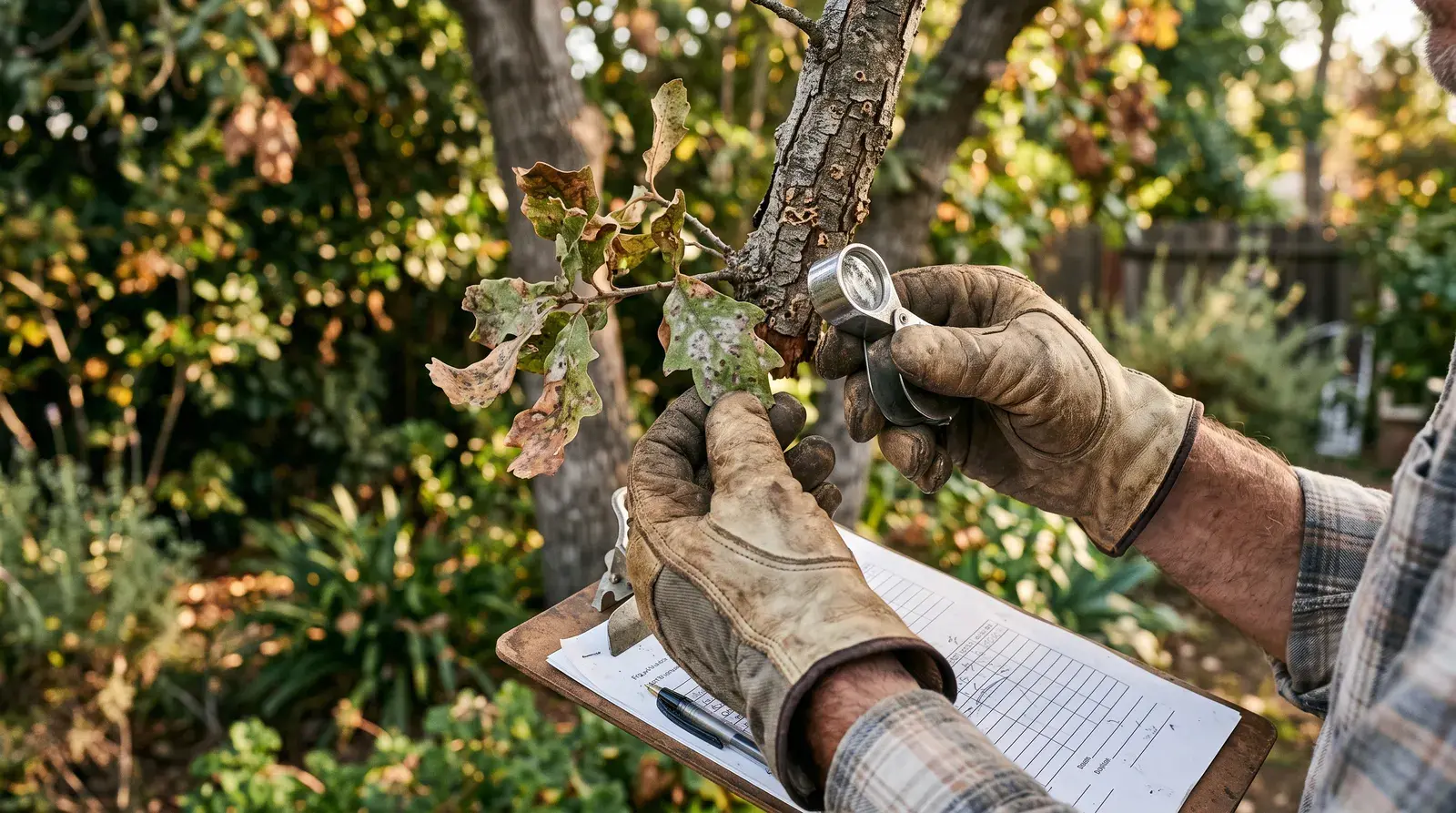
Oak Tree Care in Sacramento — free, site-specific estimates.
The Root Zone Is Where Sacramento Oaks Die
Most oak decline on city lots starts underground, years before the canopy shows it. The root zone — roughly the dripline and beyond — is where construction, trenching, grade changes, and summer lawn watering quietly kill mature oaks.
- Summer irrigation is the classic Sacramento killer: native oaks evolved for dry summers, and lawn watering over the root zone invites crown and root rot.
- Trenching for utilities, ADU foundations, and pool digs severs structural roots — plan construction around the dripline, and get an arborist involved before excavation, not after.
- Grade changes and soil compaction from parked equipment suffocate roots; even a few inches of fill over the root zone does damage.
- Good practice: mulch (not lawn) under the canopy, water deeply and rarely at the dripline only if at all, and keep hardscape projects outside the protected zone.
Structural Work: Reduction, Cabling, and Old Limbs
Big old oaks carry enormous lateral limbs over roofs and yards, and the goal of structural work is keeping those limbs — safely. Reduction and support beat amputation on a tree with a century of value in it.
- End-weight reduction shortens overextended horizontal limbs back to sound laterals, cutting the leverage without gutting the canopy.
- Cabling and bracing supports co-dominant stems and long limbs that reduction alone can't secure — common on the sprawling valley oaks of Land Park and Curtis Park.
- Deadwood removal on live oaks is routine safety work; dead oak limbs are heavy and come down without warning.
- Sudden summer limb drop is a known valley oak behavior even on healthy trees — weight management over targets is the practical defense.
Need oak tree care in Sacramento?
Share the address and project details — we'll come back with a scoped, site-specific estimate.
Health Problems We See in Sacramento Oaks
Most struggling city oaks are fighting site conditions, not a mystery disease. The assessment sorts what's cosmetic from what's structural — and what's fixable from what's a removal conversation.
- Crown thinning and dieback from root zone damage or chronic summer irrigation — the most common finding on residential lots.
- Decay fungi and conks at the base or old wounds, which signal structural questions a visual canopy check can't answer.
- Mistletoe loads on valley oaks — heavy infestations stress the tree and add limb weight; management is pruning-based.
- Pest activity like oak pit scale and borers, which mostly matter on trees already stressed by the site. We diagnose and refer treatment appropriately rather than sell sprays.
The same crew from estimate to cleanup.
No juggling separate contractors for one tree. Tell us the address and what you're dealing with, and we'll come back with a written, site-specific number.
- Removal, trimming, stumps, and cleanup handled by one crew
- Free, site-specific estimates — priced to your tree, not a flat rate
- Sacramento, Placer, El Dorado, and Yolo counties
Preserve First — Removal Is the Last Resort
A mature valley oak is irreplaceable on any human timescale — the tree shading a Curtis Park backyard may be older than the neighborhood. Our default is preservation: prune conservatively, fix the root zone conditions, support what can be supported, and monitor. When an oak genuinely has to come down — major trunk decay, failed root plate, deadwood past the point of return — the permit process comes first, the removal is rigged with the same care as any big-tree takedown, and replanting a native oak nearby is worth discussing while the crew is there. Every oak estimate is free and starts with an honest read of what the tree needs.
Related guides
When to Trim Oak Trees in California
The best window to prune native California oaks, why dry-season timing cuts disease risk, and the pruning mistakes that shorten an oak's life.
Sacramento's Heritage Tree Ordinance, Explained
What makes a Sacramento tree a Heritage Tree, what City Code Chapter 12.56 protects, and how to get pruning or removal approved.
Do You Need a Permit to Remove a Tree in Sacramento?
Which Sacramento trees need a removal permit, how city and county rules differ, and how to check before the saw comes out.
What oak tree care costs — and what Sacramento allows
Regional ranges, local permit rules, and the alternatives worth weighing before oak tree care in Sacramento.
Oak Tree Care & Trimming Cost in Sacramento (2026)
Regional range $400–$3,500 — and what moves the number on a real job.
Do You Need a Permit to Remove a Tree in Sacramento?
Which Sacramento trees need a removal permit, how city and county rules differ, and how to check before the saw comes out.
Deep-Root Fertilization vs. Surface Feeding: What Trees Actually Need
Deep-Root Fertilization or Surface Feeding — how to tell which one the tree actually needs.
Natomas
Natomas — both North and South — was built mostly between the late 1980s and 2010 on former agricultural and floodplain…
Tree Service in Sacramento County, CA
Tree work in Sacramento County ranges from removing aging valley oaks in East Sacramento to grinding stumps on new-buil…
Arborist Report Cost in Sacramento (2026)
Regional range $300–$1,500 — and what moves the number on a real job.
Sacramento neighborhoods we work in
Housing era, canopy, and access change block to block. These pages cover what oak tree care looks like in each.
East Sacramento
East Sacramento's tree stock is old, large, and tightly regulated.
Land Park
Land Park is one of Sacramento's oldest residential neighborhoods, built out primarily in the 1920s through the 1940s a…
Curtis Park
Curtis Park's canopy is among Sacramento's oldest — streetcar-era Craftsman bungalows built between 1905 and 1930 along…
Midtown
Midtown Sacramento's dense urban grid — roughly 16th Street to 30th Street, between Q Street and Capitol Avenue — packs…
Pocket-Greenhaven
Pocket-Greenhaven is a south Sacramento neighborhood built largely in the 1970s and 1980s in the bend of the Sacramento…
Natomas
Natomas — both North and South — was built mostly between the late 1980s and 2010 on former agricultural and floodplain…
Oak Park
Oak Park sits on ground that was Sacramento's first streetcar suburb, developed in the 1880s around an eight-acre oak g…
Tahoe Park
Tahoe Park was built fast after World War II — mostly late-1940s and 1950s ranch homes and bungalows on Sacramento's ea…
Want a sense of the work first? See the kinds of oak tree care jobs we take on and who shows up to do them.
Frequently asked questions
When should I prune my oak tree in Sacramento?
Dry season or winter dormancy. Light pruning and deadwood removal work well from late summer into early fall; save larger structural cuts for winter dormancy. Avoid heavy pruning in spring and early summer when the tree is most stressed by cutting, and never prune in wet weather — rain spreads disease through fresh wounds. Native oaks also tolerate less live-canopy removal than most trees, so conservative cuts beat aggressive ones every time.
Is my oak a protected Heritage Tree?
Possibly — the City of Sacramento protects Heritage Trees under City Code Chapter 12.56, and many mature valley and interior live oaks on city lots qualify. Protected status means removal requires a permit, and damaging work can trigger enforcement too. Street-side oaks in the right-of-way are City Trees regardless. Verify current criteria at cityofsacramento.gov; we check status during every estimate and prepare arborist documentation when a permit is needed.
Why is my valley oak declining even though I water it?
The watering may be the problem. Valley and interior live oaks evolved for bone-dry Sacramento summers, and regular lawn irrigation over the root zone promotes the root and crown rots that kill mature oaks slowly. The fix is cultural: convert the area under the canopy from lawn to mulch, stop summer watering inside the dripline, and avoid compacting or trenching the root zone. An assessment can tell you whether the decline is reversible.
Can I build an ADU or pool near my oak tree?
Plan it around the root zone, not just the trunk. Structural roots extend to the dripline and beyond, and trenching or excavation through them can kill the tree years later — and if the oak is a protected Heritage Tree, damaging it carries the same exposure as removing it without a permit. Get an arborist involved at design stage; our arborist report service maps the protection zone and produces the documentation city plan review often asks for.
My oak drops big limbs in summer with no wind. Is it dying?
Not necessarily — sudden limb drop on hot, still summer days is a documented valley oak behavior even in healthy trees, usually on long horizontal limbs. It's unpredictable, but manageable: end-weight reduction on overextended limbs over the house, driveway, and seating areas cuts the risk substantially. Pair that with a look at overall structure and deadwood, since a limb that dropped from decay is a different conversation than classic summer drop.