
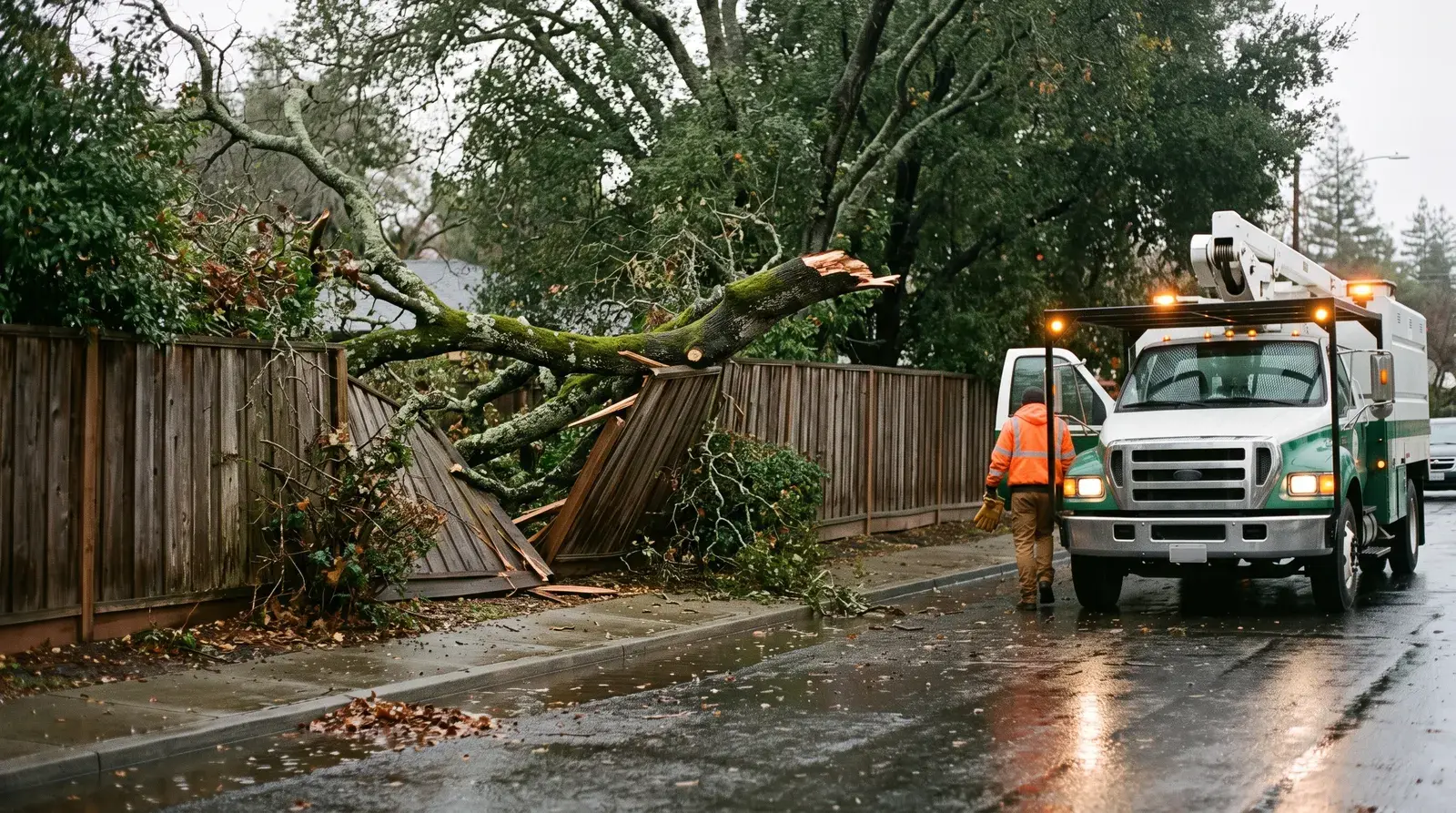
First Moves When a Tree Fails
The sequence matters: people safe, utilities reported, damage photographed, then removal. Most storm injuries happen after the wind stops — cutting loaded wood, walking under hangers, touching fences near downed lines.
- Keep everyone out of the fall zone, including the far side — a tree on a fence or roof is under tensions you can't see.
- Lines down or arcing? Call 911, then report it to Roseville Electric — the city runs its own electric utility. Treat every downed line and anything touching it as energized.
- Tree on the house? Move people out of the rooms underneath; roof loads can shift hours after impact.
- Photograph the tree, the failure point, and the damage before any cleanup — your adjuster will want pre-work photos.
- Then call for professional removal. Storm-loaded wood and homeowner chainsaws end badly together.
East-Side Oak Failures: Heavy Wood, Careful Rigging
When a mature valley oak drops a limb — or the whole tree — in Stoneridge, Maidu, or Olympus Pointe, the wood on the structure can weigh thousands of pounds. That's a rigging and sometimes a crane problem, never a chainsaw-from-a-ladder problem.
- Oak limbs on roofs come off in supported, rigged sections so nothing shifts deeper into the structure mid-cut.
- Whole oaks across rooflines with no safe working angle get a crane — lifted off in pieces rather than dragged.
- Big oak failures usually trace to decay, old wounds, or overloaded horizontal limbs; we document the failure point, which matters for insurance and for the ordinance file on a protected tree.
- Even in an emergency, a protected oak's removal should be documented — photos and a written condition report keep you clean with the city after the fact.
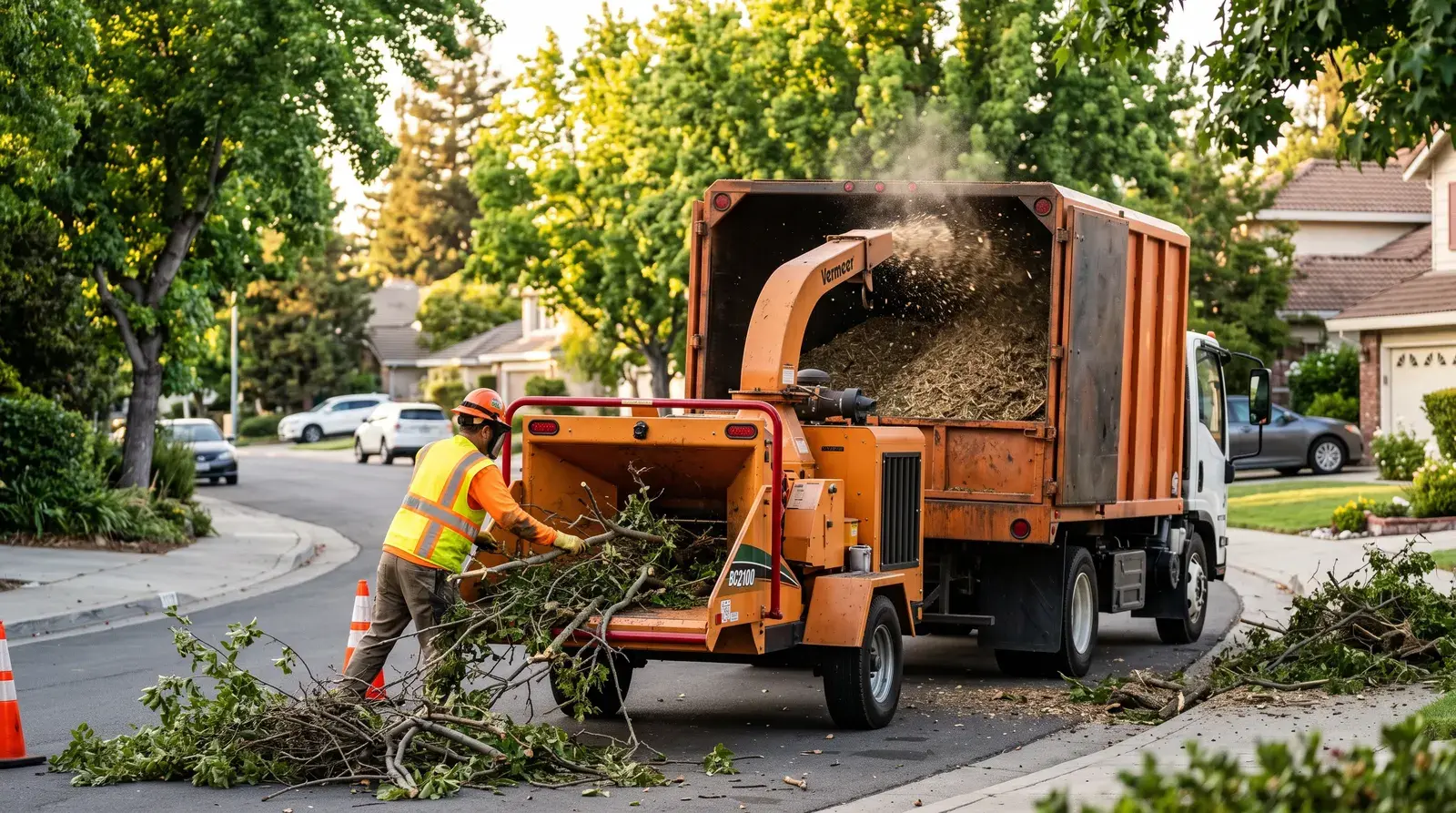
Emergency Tree Service in Roseville — free, site-specific estimates.
West-Side Wind Tip-Overs
Open graded ground, no mature windbreak, young lawn-watered trees with shallow or circling roots, saturated January soil — West Roseville's recipe for whole-tree tip-over. The same storm drops trees across Fiddyment Farm and WestPark all at once.
The good news is these failures are lighter than east-side oak wood: a tipped pistache on a fence is usually a same-visit fix — section the tree, free the fence line, grind or flush-cut the exposed root ball. The important part is what you do with the survivors. A tree that partially lifted — cracked or mounded soil on the windward side, a new lean — has already failed and paused. Get those assessed right after the storm, because the next front finishes them, and a scheduled removal beats a second emergency on the same block.
Hangers, Split Unions, and Half-Failed Trees
Not every emergency is on the ground. Broken limbs caught in the canopy, split co-dominant unions still holding, and cracked leaders over driveways are the after-storm hazards that hurt people days later.
- Hangers come out first on every storm call — they drop without warning, and a big oak hanger is lethal.
- Split unions on younger ash and pear sometimes get cabled if caught early; more often the failed leader comes off with a structural reassessment.
- A long bark tear down the trunk changes the tree's future — we'll say plainly whether it's a prune, a cable, or a removal.
- Post-storm is the right moment to book preventive work on the trees you kept: end-weight reduction before next season is the cheap version of this page.
Need emergency tree service in Roseville?
Share the address and project details — we'll come back with a scoped, site-specific estimate.
Insurance Documentation That Actually Helps
Storm claims settle faster with a clean paper trail. We document as we work and split emergency scope from optional follow-up so your invoice matches what the adjuster approves.
- Photos before, during, and after: the tree, the failure point, and the structure damage.
- Written scope in adjuster-friendly language — what failed, why, and what was removed.
- Emergency stabilization (tree off the structure, site made safe) itemized separately from stump grinding and full haul-off, which insurers treat differently.
- Rule of thumb: removal off a covered structure is usually covered; a tree that fell in the yard and hit nothing usually isn't. Knowing that before the adjuster call saves friction.
The same crew from estimate to cleanup.
No juggling separate contractors for one tree. Tell us the address and what you're dealing with, and we'll come back with a written, site-specific number.
- Removal, trimming, stumps, and cleanup handled by one crew
- Free, site-specific estimates — priced to your tree, not a flat rate
- Sacramento, Placer, El Dorado, and Yolo counties
Before Next Storm Season
Roseville's failure map barely changes year to year — exposed west-side subdivisions tip young trees, and east-side oaks shed overloaded limbs. Which means most of next winter's emergencies are visible, and preventable, right now.
- Fall assessment for leaning trees and soil lift in the wind-exposed west-side neighborhoods, before soil saturates.
- End-weight reduction and deadwood removal on mature east-side oaks — the highest-value oak work of the year, done in the dry season.
- Cable or brace split-prone co-dominant unions instead of waiting for the storm to choose a side.
- Remove standing dead trees on your schedule — wind removes them on theirs, usually into the neighbor's yard.
Related guides
Tree Fell? What to Do After Storm Damage
The safe, step-by-step response after a tree falls in a storm — downed lines, insurance documentation, triage, and how to avoid storm-chaser scams.
9 Signs a Tree Needs to Come Down
Nine warning signs a tree is hazardous or dying — and when removal is safer than trying to save it.
Do You Need a Permit to Remove a Tree in Sacramento?
Which Sacramento trees need a removal permit, how city and county rules differ, and how to check before the saw comes out.
What emergency tree service costs — and what Roseville allows
Regional ranges, local permit rules, and the alternatives worth weighing before emergency tree service in Roseville.
Emergency Tree Service Cost in Sacramento (2026)
Regional range $800–$8,000 — and what moves the number on a real job.
Do You Need a Tree Removal Permit in Roseville?
Where Roseville draws the line before a tree comes down, and who to check with.
Professional vs. DIY Tree Removal: What's Safe to Do Yourself
Professional or DIY — how to tell which one the tree actually needs.
Tree Service in Placer County, CA
Placer County spans flat valley suburbia in Roseville and Rocklin and rises through the oak-woodland foothills to ponde…
Crane-Assisted Tree Removal Cost in Sacramento (2026)
Regional range $2,500–$12,000 — and what moves the number on a real job.
Do You Need a Tree Removal Permit in Rancho Cordova?
Where Rancho Cordova draws the line before a tree comes down, and who to check with.
Want a sense of the work first? See the kinds of emergency tree service jobs we take on and who shows up to do them.
Frequently asked questions
A big oak limb is on my roof in Roseville. What do I do right now?
Get everyone out of the rooms under it, stay off the roof, and don't let anyone start cutting — a multi-thousand-pound oak limb can shift deeper into the structure with one wrong cut. Photograph the limb and the damage from the ground for your insurance claim, tarp nothing until the weight is off, and call for emergency removal. We rig limbs off roofs in supported sections, and bring a crane when there's no safe working angle.
Do you provide emergency tree service at night or on weekends?
Emergency response is available, and active hazards get priority — a tree on an occupied house, a blocked driveway, or a hanger over an entry moves ahead of routine work. When you call, tell us what the tree is on, whether power lines are involved (report those to Roseville Electric first), and whether anyone can't safely enter or leave. We'll give you a straight answer on the response window and what to keep clear of until the crew arrives.
My neighbor's tree fell on my fence. Who pays for removal?
Usually your policy covers your side — when a healthy tree fails in a storm, damage lands on the insurance of the property where it lands. It shifts toward the neighbor if the tree was visibly dead or hazardous and they'd ignored it, which is why photos of the failure point matter: decay at the break is exactly the evidence. We can remove the tree, document its condition in writing, and keep the removal itemized so either policy can process it cleanly.
Does a storm-damaged protected oak still need a permit to remove?
Hazardous and storm-failed trees generally have a faster path than routine removals, but Roseville's protections don't just vanish — the safe practice is to document the emergency thoroughly. We photograph the failure, note the decay or defect that caused it, and provide a written condition report so the removal file stands up if the city asks afterward. For a partially failed oak that's still standing, we verify the current process with the city before it comes down whenever conditions allow.
My tree is leaning after the storm but hasn't fallen. How urgent is it?
Very. A new lean with cracked or mounded soil on the opposite side means the root plate has partially failed — the tree has started falling and paused, not stabilized. This is the signature West Roseville follow-up failure: the tree that lifted in December goes over in the January storm. Keep people, cars, and pets out of the fall zone and get it assessed now; a controlled removal on your schedule costs far less than an emergency plus whatever it lands on.