
Oaks and Conifers Need Opposite Things
The single most useful thing to understand about Auburn trimming is that the two dominant tree groups have different problems, different calendars, and different goals. Treating them the same is how properties end up with butchered oaks and pines that still carry fire.
On a typical Auburn acre both are happening at once, which is why we scope trimming by tree rather than quoting a flat yard price. The oak by the deck and the pine on the downhill side are not the same line item.
Native oaks
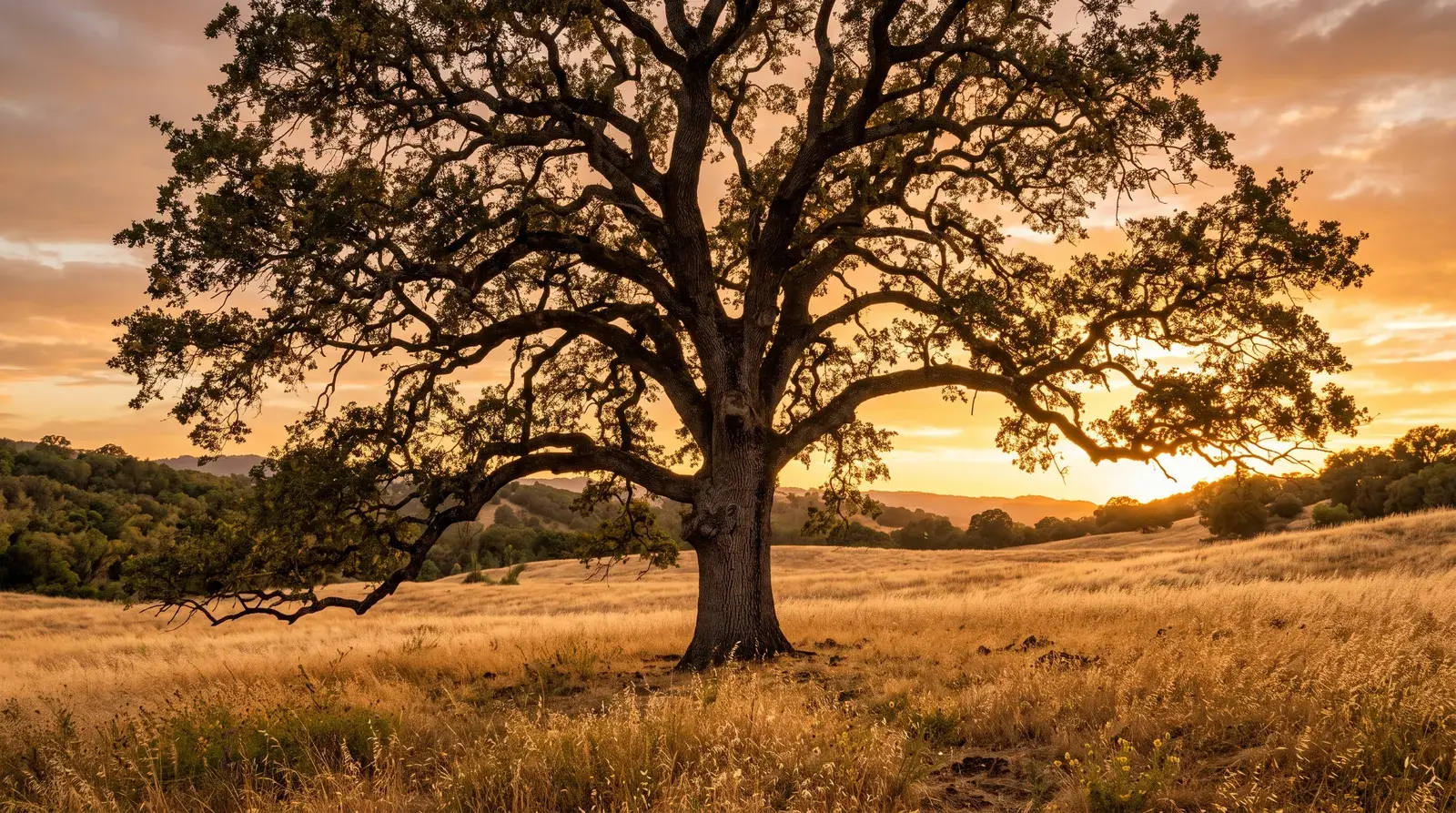
Interior live, blue, and black oak.
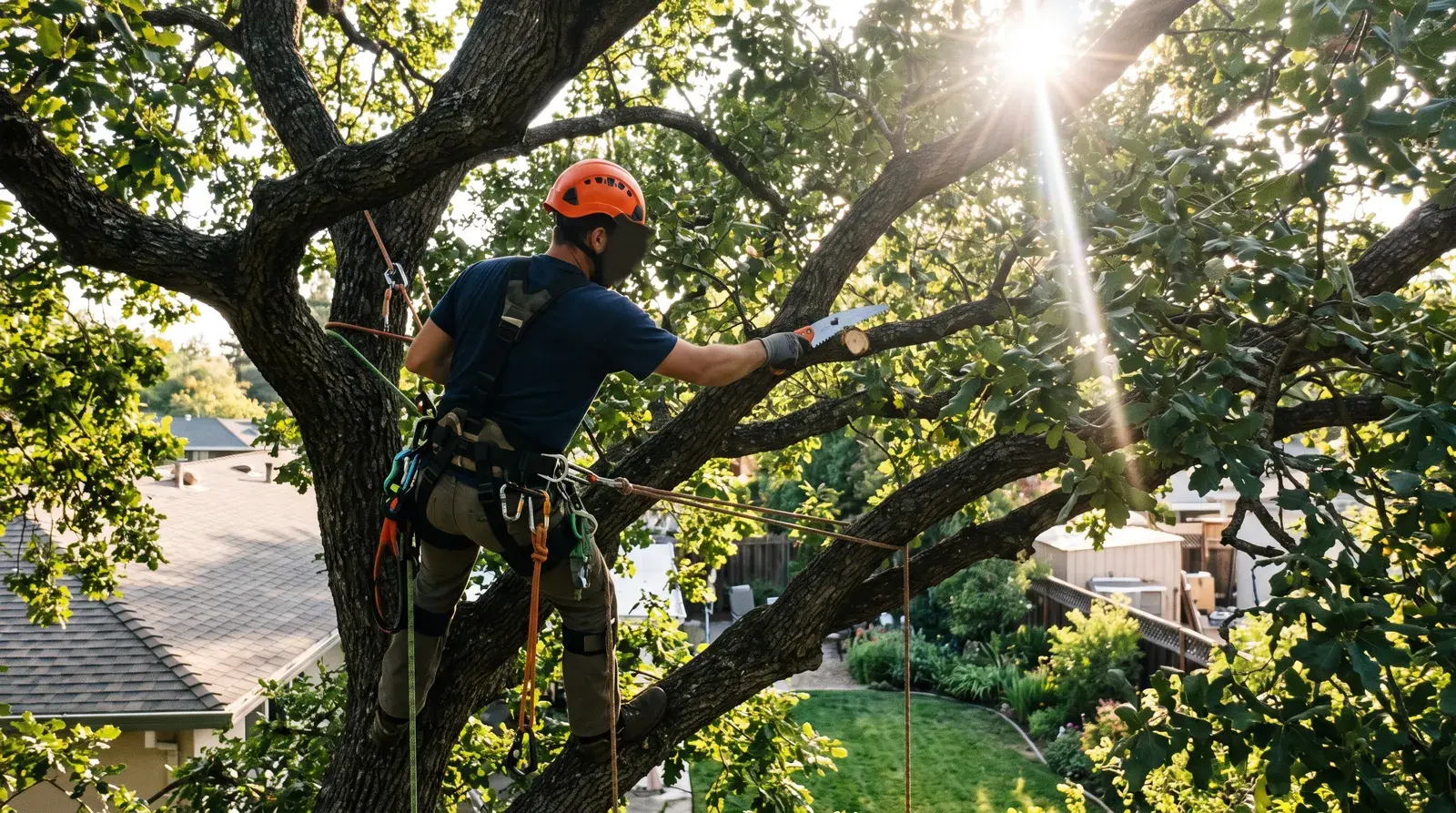
- The work is crown cleaning — pulling out the accumulated interior deadwood a mature live oak carries — plus shortening the one over-extended limb aimed at the roof.
- Black oaks are the winter limb-droppers here; they shed big wood in foothill windstorms and benefit most from end-weight reduction.
- Prune in the dry season or dormancy, keep summer work light, and never strip the interior. Healthy, well-pruned oaks are relatively fire-resistant and worth keeping.
Limbing Up Is Fire Work, Not Cosmetics
Auburn sits in mapped high fire severity terrain with the American River canyon funneling wind and fire toward the rim. Under California PRC 4291, the ladder-fuel connection between ground vegetation and tree crowns is exactly what the standard targets, and trimming is how you break it.
- Raise the lowest limbs on conifers so there is real vertical separation between brush and crown — the standard scales with slope and the height of the vegetation below.
- Separate crowns horizontally where trees are crowded, prioritizing conifers. Oak-to-oak spacing standards are more forgiving than conifer spacing.
- Clear limbs away from the roof and the chimney. The 0–5 foot ember zone around the structure and the roof edge are the highest-value feet on the property.
- Clean the deadwood out of mature live oaks — years of dead interior limbs is fuel held up in the air where embers can find it, and removing it keeps the tree.
- Slash never stays on the slope. Cut brush and limbs left in place are worse fuel than the standing material was.
- Current standards and checklists are at readyforwildfire.org; broader zone work is on our Auburn defensible space page.
Tree Trimming in Auburn — free, site-specific estimates.
When to Prune What in Auburn
Timing matters more in the foothills than in the valley, and it differs by species. Getting this wrong invites disease into oaks and beetles into pines — both expensive mistakes on a mature tree.
Drought-stressed conifers are the ones that get hit hardest by badly timed pruning. If a pine is already thinning, the safest move is to leave the live wood alone and get the tree assessed rather than pruned.
- Native oaks — dry season through early fall, or winter dormancy. Avoid heavy cuts in wet weather when fresh wounds are most exposed, and avoid stripping live canopy during a heat wave.
- Ponderosa and other pines — avoid pruning during peak bark beetle flight in spring and early summer. Fresh cuts release resin volatiles that attract beetles to an already drought-stressed tree. Late fall through winter is safer.
- Deadwood — any time of year, in any species. It involves no live tissue, so there is no seasonal risk.
- Storm damage — immediately, regardless of season. A cracked union or a hanger over a walkway is not a scheduling question.
- Best booking window for planned work: late winter through spring, before fire-season inspection notices push everyone's calendar in June.
Trimming on Canyon-Rim Slopes
The lots that need the work most are the hardest to work on. Robie Point, the neighborhoods along the Auburn State Recreation Area boundary, and the tiered yards dropping into drainages off Auburn Folsom Road all mean limbs cannot simply be dropped and brush cannot simply be dragged out.
- Limbs on the downhill side get rigged and lowered under control, then carried or winched uphill — slower and more labor than flat ground, and the bid says so honestly.
- Where a road sits above the house, we can sometimes stage from the uphill side and move material out over the structure instead of through the yard.
- Long shared gravel drives, soft shoulders, culverts, and narrow gates decide what equipment reaches the tree. Tell us about them when you call so the estimate matches reality.
- On raw slope we cut brush high or leave root systems in the ground so winter rain does not take the hillside down with the fuel.
- Know where your parcel actually ends near the recreation area and canyon trail corridors — trimming across a boundary is a problem nobody needs.
Need tree trimming in Auburn?
Share the address and project details — we'll come back with a scoped, site-specific estimate.
Power Lines: PG&E First, Always
Auburn is PG&E territory, and trees into conductors are a leading cause of both outages and fires in the foothills. This is the one part of tree work where the correct answer is to stop and make a phone call.
- Nobody should trim a tree touching or near a conductor without the utility involved. That includes the branch that looks like it is only close.
- PG&E maintains clearance around its own distribution lines under its vegetation management program — report a tree growing into them rather than handling it yourself.
- The service drop from the pole to your house is generally the property owner's responsibility, and it still is not a homeowner job. Call the utility to discuss de-energizing or a temporary disconnect before anyone goes up.
- During a storm, treat every downed line as live and keep everyone clear. If a tree is on a line, that is an emergency call to PG&E, not to a tree service — see our Auburn emergency tree service for what happens after the line is handled.
The same crew from estimate to cleanup.
No juggling separate contractors for one tree. Tell us the address and what you're dealing with, and we'll come back with a written, site-specific number.
- Removal, trimming, stumps, and cleanup handled by one crew
- Free, site-specific estimates — priced to your tree, not a flat rate
- Sacramento, Placer, El Dorado, and Yolo counties
What Trimming Costs in Auburn
Trimming prices per tree by size, condition, and access. Auburn skews higher than valley cities for one reason: the trees are bigger and the ground is steeper, so more of the job is rigging and carrying rather than driving up and reaching.
A deadwood pass on a mature live oak with truck access at the curb is a different number than the same tree on a canyon-side terrace where every limb comes up by rope. Most Auburn property owners bundle several trees into one visit, which is where the value is — a single mobilization covers the yard. We quote in writing from a free site walk, per tree, so you can prioritize the fire-critical work first and the cosmetic work later. Chips stay as free mulch if you want them; otherwise everything is chipped and hauled rather than left on the slope.
Related guides
When to Trim Oak Trees in California
The best window to prune native California oaks, why dry-season timing cuts disease risk, and the pruning mistakes that shorten an oak's life.
Keeping Trees Alive Through Sacramento Summers
Deep watering at the dripline, real mulch, and the heat-stress signs that matter — how Sacramento trees survive months of triple-digit heat.
Sacramento's Heritage Tree Ordinance, Explained
What makes a Sacramento tree a Heritage Tree, what City Code Chapter 12.56 protects, and how to get pruning or removal approved.
What tree trimming costs — and what Auburn allows
Regional ranges, local permit rules, and the alternatives worth weighing before tree trimming in Auburn.
How Much Does Tree Trimming Cost in Sacramento? (2026)
Regional range $300–$2,500 — and what moves the number on a real job.
Do You Need a Tree Removal Permit in Auburn?
Where Auburn draws the line before a tree comes down, and who to check with.
Crown Reduction vs. Topping: What's the Difference?
Crown Reduction or Topping — how to tell which one the tree actually needs.
Tree Service in Placer County, CA
Placer County spans flat valley suburbia in Roseville and Rocklin and rises through the oak-woodland foothills to ponde…
Crown Reduction Cost in the Sacramento Region (2026)
Regional range $500–$4,000 — and what moves the number on a real job.
Do You Need a Tree Removal Permit in Folsom?
Where Folsom draws the line before a tree comes down, and who to check with.
Want a sense of the work first? See the kinds of tree trimming jobs we take on and who shows up to do them.
Frequently asked questions
When should oaks be trimmed in Auburn?
Dry season through early fall, or winter dormancy. Avoid heavy pruning during wet weather, when fresh cuts are most exposed to disease, and keep summer work light on a tree already coping with foothill heat. Deadwood removal is safe any time of year since it takes no live tissue. If the oak sits on a county parcel, note that Placer County protects oaks at 5 inches diameter and up, so heavy work on a large oak is worth checking against the ordinance first.
How high should I limb up the pines around my house?
The goal is vertical separation between whatever is growing on the ground and the lowest live branches — commonly 6 to 10 feet, more where brush beneath is tall or the ground slopes, since fire climbs faster uphill. Do not remove so much live crown that you stress the tree; on a short conifer, take less and clear more brush underneath instead. Current state standards and clearance guidance are at readyforwildfire.org, and we scope it by tree at the free estimate.
Do you top trees in Auburn?
No. Topping produces weakly attached regrowth that fails in exactly the windstorms you were trying to protect against, opens the trunk to decay, and permanently wrecks the tree's structure. If a tree is genuinely too tall for its spot, crown reduction — cutting back to sound lateral limbs big enough to take over — achieves height reduction without destroying it. If reduction will not solve the problem either, we will tell you the tree is in the wrong place rather than sell you a topping job.
Can you trim trees on a steep lot where a truck can't reach?
Yes — that is normal work here. Limbs on the downhill side get rigged and lowered under control rather than dropped, then carried or winched uphill to the chipper. Where a road sits above the house we sometimes stage from the uphill side instead. It is slower and more labor than a flat valley yard, and the bid reflects that honestly. Tell us about your drive, gates, bridges, and slope when you call so the estimate matches what the crew will face.
Is there a wrong time of year to prune pine trees in Auburn?
Yes. Avoid pruning pines during peak bark beetle flight in spring and early summer — fresh cuts release resin volatiles that attract beetles to trees that are often already drought-stressed. Late fall through winter is the safer window for planned conifer work. Dead limbs and storm damage are exceptions and can come out any time. If a pine is already thinning or fading, leave the live wood alone and get it assessed before pruning it.
How often do Auburn trees need trimming?
Mature native oaks generally want attention every 3 to 5 years, mostly deadwood and weight management. Conifers near structures are better thought of on a fire-compliance cycle than a cosmetic one — an annual walk-through catches new dead limbs, regrown brush beneath, and any tree that has started to fade. Young trees benefit from structural pruning in their first decade. We will give you a realistic cycle for your specific trees at the estimate rather than a subscription pitch.