How We Trim Granite Bay's Estate Oaks
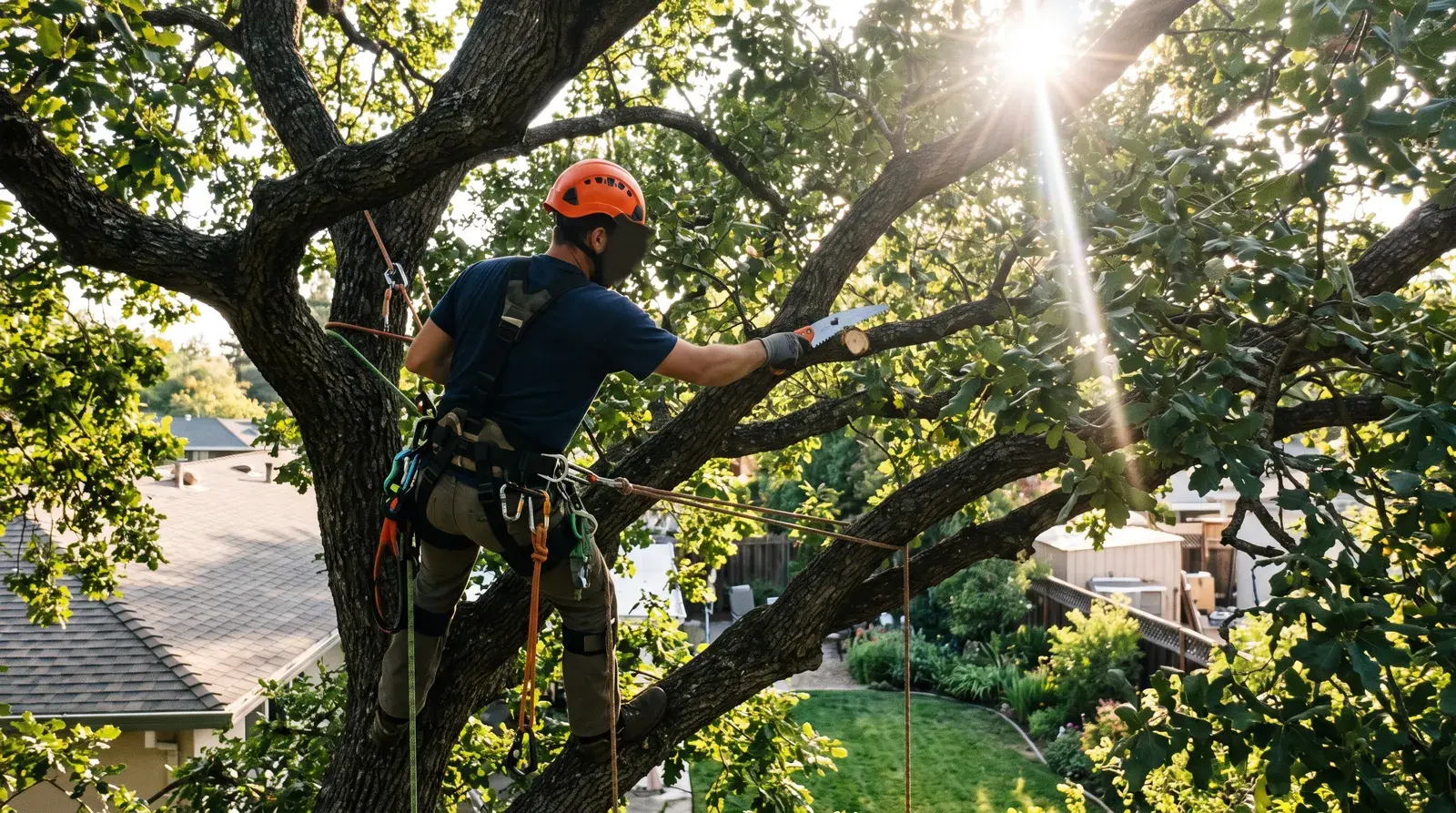
The goal on a mature oak is to remove what's dead, dangerous, or over-extended and leave the rest alone. Over-thinning an old live oak stresses it and invites sunburn and sprouting; the right cut list is shorter than most homeowners expect.
- Deadwood removal — dead limbs over patios, play areas, and parking are the first priority on any old oak; they come down whether or not anything else gets cut.
- End-weight reduction — long horizontal live oak limbs get tip weight reduced so they don't fail at the trunk, keeping the limb instead of losing it.
- Clearance pruning — roofs, chimneys, pool decks, driveways, and lake-view corridors, cut back to a lateral rather than stubbed.
- Structural pruning on younger trees — cheaper to train a 15-year-old oak now than to cable a defective 60-year-old later.
- No topping, ever — topped oaks respond with weakly attached sprouts that become the next decade's hazard.
When to Trim Native Oaks in Granite Bay
Timing matters more for native oaks than almost any other Sacramento-area tree. Prune in the dry season or dormancy; avoid heavy pruning in the peak of summer stress and avoid creating wounds during extended wet weather, when disease spreads most easily.
- Late summer through fall dry season and winter dormancy are the standard windows for major oak work.
- Deadwood can be removed any time of year — dead limbs don't wound live tissue.
- Blue oaks are drought-adapted and resent aggressive pruning; small, well-placed cuts on a longer cycle beat a big cleanout.
- If a limb is cracked or hanging, don't wait for the calendar — hazard cuts happen when the hazard appears.
Tree Trimming in Granite Bay — free, site-specific estimates.
Placer County Rules on Native Oak Work
Granite Bay is unincorporated Placer County, so county tree rules — not a city ordinance — govern native oak work here. Routine maintenance pruning is generally the homeowner's call, but heavy cutting or removal of protected native oaks can require county review.
- Verify current Placer County requirements before removing or drastically cutting back a native oak — thresholds and processes change.
- Pruning that removes a large share of live canopy can be treated like partial removal; keep cuts selective and documented.
- Properties near the Folsom Lake shoreline may have additional state recreation area boundaries to respect — know where your lot line actually is.
- 916 Trees flags anything permit-adjacent during the estimate rather than after the cuts are made.
Trimming for Wind, Fire, and Lake Weather
Granite Bay sits where valley wind meets foothill fuel. Winter south winds off the lake load long oak limbs, and dry-season fire risk rewards canopies that are cleaned up and separated from roofs. Good trimming addresses both without gutting the tree.
- Wind-sail reduction — thinning selected interior and end weight on exposed lakeside and ridgeline trees so storms move through the canopy instead of levering it.
- Roof and chimney clearance — separating limbs from the structure removes both an abrasion problem and an ember-catching fuel bridge.
- Deadwood is fire fuel — a mature live oak can hold years of accumulated dead limbs; getting it out is the cheapest fire-hardening a wooded lot can buy.
- Gray pine and ornamental conifers on the lot edge get evaluated separately — pine deadwood behaves very differently from oak.
Need tree trimming in Granite Bay?
Share the address and project details — we'll come back with a scoped, site-specific estimate.
What Estate-Lot Trimming Costs in Granite Bay
Single-tree trims in the region typically run a few hundred dollars for small ornamentals to $1,000–$2,500+ for a large mature oak needing climbing and rigging. Granite Bay jobs are usually multi-tree, so we quote tree-by-tree and price the visit as a package.
Multi-tree estate work is where a per-tree package beats piecemeal calls: the crew, chipper, and cleanup are already on-site, so the tenth tree costs far less than the first. Many Granite Bay clients put their oaks on a rotating cycle — a section of the property each year — which spreads cost and keeps every tree on a reasonable pruning interval. Estimates are free and walked on-site.
The same crew from estimate to cleanup.
No juggling separate contractors for one tree. Tell us the address and what you're dealing with, and we'll come back with a written, site-specific number.
- Removal, trimming, stumps, and cleanup handled by one crew
- Free, site-specific estimates — priced to your tree, not a flat rate
- Sacramento, Placer, El Dorado, and Yolo counties
Neighborhoods We Work
We trim across Granite Bay — the estate corridors off Douglas Boulevard, Los Lagos and Wexford, Treelake Village, Ashley Woods, the Hidden Lakes area, and the lots backing Folsom Lake near Granite Bay Beach and Beals Point.
Access on large lots is rarely a problem, but tell us about gated entries, landscape irrigation zones, and any trees shared with a neighbor's property line when you book — shared oaks are common on older parcel splits here, and it's worth sorting out whose tree it is before the crew arrives.
Related guides
When to Trim Oak Trees in California
The best window to prune native California oaks, why dry-season timing cuts disease risk, and the pruning mistakes that shorten an oak's life.
Keeping Trees Alive Through Sacramento Summers
Deep watering at the dripline, real mulch, and the heat-stress signs that matter — how Sacramento trees survive months of triple-digit heat.
Sacramento's Heritage Tree Ordinance, Explained
What makes a Sacramento tree a Heritage Tree, what City Code Chapter 12.56 protects, and how to get pruning or removal approved.
What tree trimming costs — and what Granite Bay allows
Regional ranges, local permit rules, and the alternatives worth weighing before tree trimming in Granite Bay.
How Much Does Tree Trimming Cost in Sacramento? (2026)
Regional range $300–$2,500 — and what moves the number on a real job.
Do You Need a Tree Removal Permit in Davis?
Where Davis draws the line before a tree comes down, and who to check with.
Crown Reduction vs. Topping: What's the Difference?
Crown Reduction or Topping — how to tell which one the tree actually needs.
Tree Service in Placer County, CA
Placer County spans flat valley suburbia in Roseville and Rocklin and rises through the oak-woodland foothills to ponde…
Crown Reduction Cost in the Sacramento Region (2026)
Regional range $500–$4,000 — and what moves the number on a real job.
Do You Need a Permit to Remove a Tree in Sacramento?
Which Sacramento trees need a removal permit, how city and county rules differ, and how to check before the saw comes out.
Want a sense of the work first? See the kinds of tree trimming jobs we take on and who shows up to do them.
Frequently asked questions
When is the best time to trim oak trees in Granite Bay?
Dry season or winter dormancy for major work — late summer through fall, or the dormant months. Avoid heavy pruning during peak summer stress and avoid large cuts in extended wet weather, when disease organisms spread most easily. Deadwood removal is fine year-round since it doesn't wound live tissue. If a limb is cracked or hanging over a target, safety cuts happen immediately regardless of season.
How much of my oak's canopy can be trimmed at once?
Less than most people think. On mature interior live oaks and blue oaks, staying under roughly 25% of live canopy in a single cycle is the standard guidance, and old blue oaks tolerate even less. The productive cuts are deadwood, end-weight reduction on over-extended limbs, and clearance — not interior stripping. Over-thinned oaks respond with stress sprouting and sunburned bark, which creates more problems than the trim solved.
Do I need a permit to trim oaks in Granite Bay?
Routine maintenance pruning generally doesn't require one, but Granite Bay is unincorporated Placer County, and county rules protect native oaks — heavy cutting that removes a large share of live canopy, or removal, can trigger county review. Verify current requirements with Placer County before drastic work. We flag anything permit-adjacent during the free estimate so nothing gets cut that shouldn't be.
Can you trim all the trees on a large estate lot in one visit?
Yes, and it's usually the cheapest way to do it. Once the crew, chipper, and cleanup equipment are on-site, each additional tree costs much less than a standalone visit. We walk the property, build a tree-by-tree scope, and quote it as a package. Many Granite Bay clients rotate instead — a section of the property each year — which keeps every oak on a reasonable cycle without one large bill.
Will trimming help protect my Granite Bay home during fire season?
Meaningfully, yes. Deadwood in mature oaks is standing fuel, and limbs touching or overhanging the roof act as an ember bridge. Cleaning deadwood out of the canopy, lifting limbs off the structure, and separating tree crowns from chimneys are core dry-season fire-hardening steps under California defensible space guidance (PRC 4291). For wooded lots near the lake and open space, pair canopy work with brush clearing in the 0–30 foot zone.