
The Jurisdiction Question Comes First in Auburn
Auburn's city boundary is not a tidy circle, and the difference between inside and outside it is not academic — the tree rules, the permit path, and the office you call all change. Sort this out before anything else.
That last point is the practical one. Small, straightforward removals on a county parcel often need less paperwork than people expect; larger clearing projects need more. Knowing which you are before you start saves both money and a stop-work conversation.
- Inside City of Auburn limits — Old Town, the courthouse hill, and the older downtown neighborhoods — the city's own tree regulations apply. Verify current requirements with the city before removing significant trees.
- Unincorporated Placer County covers North Auburn, most of the canyon-rim acreage, and the parcels out toward Christian Valley and Bowman. There the Woodland Conservation Ordinance in Placer County Code Article 19.50 applies.
- Under that county ordinance, oaks are protected at a lower threshold than other trees — 5 inches diameter at breast height and up for oak species, versus 6 inches for a single-stem native tree generally, or 10 inches combined for multi-trunk.
- For a single-family lot with no other discretionary permit in play, the county's minor tree permit is the usual path, and the county arborist can issue one in the field.
- An arborist's report is not always required for a minor permit — but the county can require one when the removal scope is significant or when mitigation fees need calculating.
Documenting a Dead or Hazardous Tree Before It Comes Down
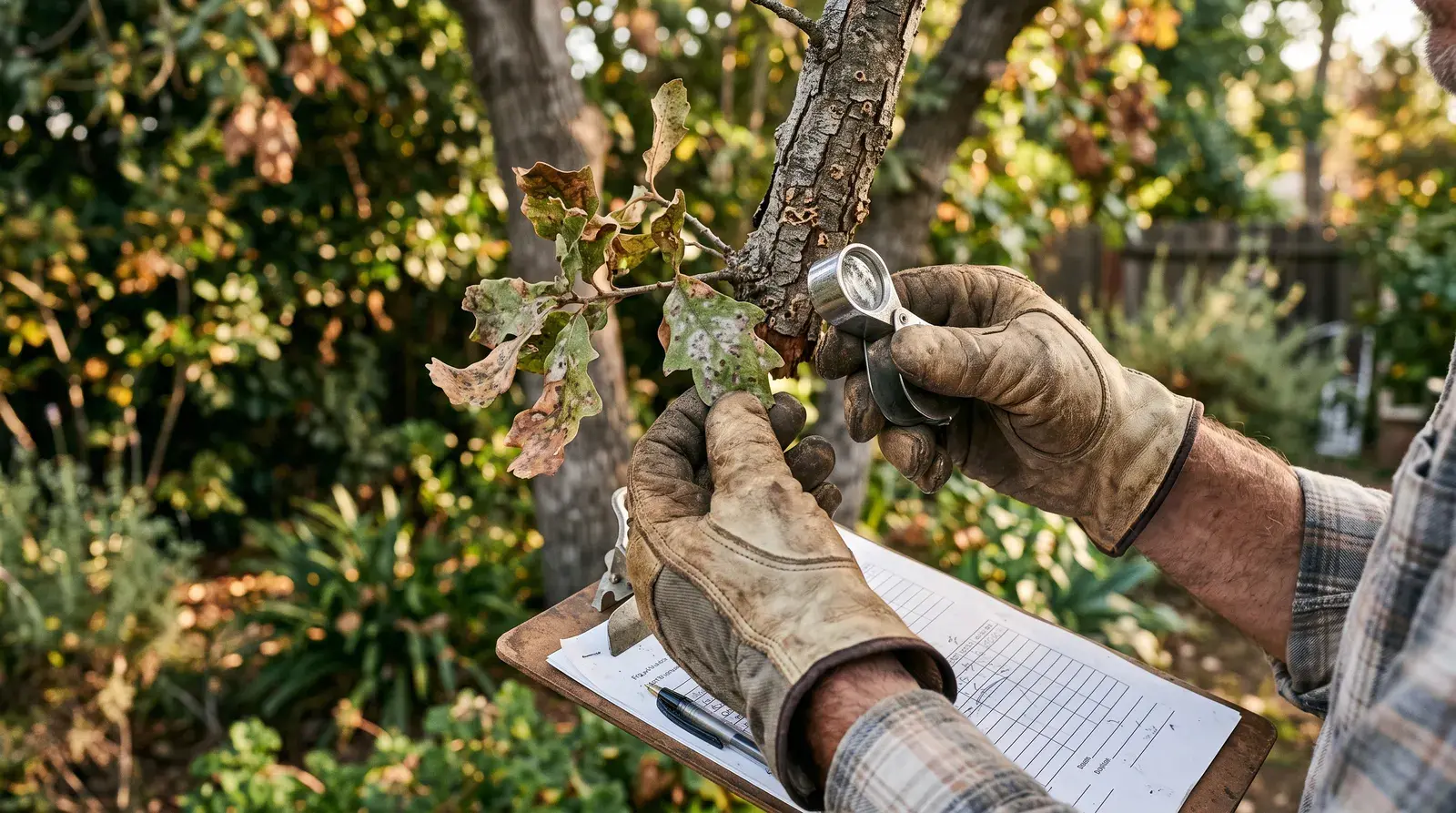
Auburn's most common assessment is also the most time-sensitive: a ponderosa or gray pine that has faded from green to red to gray, or an oak with a new lean and soil mounding at the base. Removal is usually the answer, but photograph and document the condition first.
There is a timing argument here too. Fresh-dead pine can usually be climbed and rigged conventionally; long-dead pine often needs a lift or crane because the wood no longer holds a climber. The assessment that gets done this month is attached to a cheaper removal than the same assessment next year.
- Dead and hazardous condition is normally a valid basis for approval — but a stump proves nothing after the fact. Photographs of the standing tree, the failure point, and the defect are what protect you from after-the-fact enforcement.
- Beetle-killed conifers decline on a schedule you can see: needles fade, then redden, then drop. Documenting where the tree is in that progression makes the case clearly.
- Root plate lift — soil cracking or mounding on one side of a trunk after heavy rain — is the strongest single evidence a tree is failing, and it is easy to photograph.
- Fungal conks at the base, open cavities, and cracked unions all belong in the record with a scale reference in the frame.
- Get the documentation and the removal from the same visit rather than paying twice for someone to look at the tree.
Arborist Reports & Permit Support in Auburn — free, site-specific estimates.
Reports for Insurance and Defensible Space
Auburn homeowners increasingly need tree documentation for reasons that have nothing to do with a permit. Carriers writing in mapped high fire severity terrain ask about vegetation and trees near structures, and want to see that something was actually done.
- Documented condition assessments give you something concrete to show a carrier — which trees were evaluated, what was found, and what work followed.
- Defensible space under PRC 4291 is measured in zones: 0–5 feet ember-resistant, 0–30 feet lean, clean, and green, and 30–100 feet reduced fuel. Before-and-after photographs of that work are the record.
- We cannot promise what any insurer will do with documentation — nobody honestly can. What we can do is give you an accurate written record of tree condition and completed work instead of a verbal assurance.
- Current state standards and checklists live at readyforwildfire.org; your carrier may layer its own requirements on top of them.
- Fuel reduction and hazard-tree work often overlap completely on an Auburn lot — the standing dead pine near the house is both the strike hazard and the fuel. Our Auburn defensible space clearing covers the broader zone work.
Credentials: What to Ask Before You Hire
Report work is where credentials get claimed loosely, so here is the plain version. There are two separate things, they are verifiable, and you should check them on anyone — including us.
Where we are unambiguously useful: getting on the property, identifying the species correctly, measuring the tree the way the ordinance defines it, documenting the defects with photographs, telling you which jurisdiction governs your address, and doing the removal, pruning, or fuel reduction once it is approved.
- ISA Certified Arborist is a professional certification from the International Society of Arboriculture, earned by exam and kept current with continuing education. It is verifiable in the ISA's public directory.
- A California contractor's license is a different thing entirely, issued by the Contractors State License Board, and it is what covers performing the physical tree work. Look up any number free at cslb.ca.gov, including its workers' comp record.
- Placer County and the City of Auburn each set their own expectations for who prepares a report and when one is required. Ask what your specific application needs before you commission anything.
- Ask 916 Trees for our qualifications and insurance documentation in writing before work begins. That is exactly what our licensing and insurance page tells you to demand of any tree service, ours included.
Need arborist reports & permit support in Auburn?
Share the address and project details — we'll come back with a scoped, site-specific estimate.
Woodland Parcels, Development, and Canopy Retention
Placer County's ordinance is called Woodland Conservation for a reason — it is aimed at the cumulative loss of oak woodland across the county, not just at individual trees. On acreage that changes how a project is evaluated.
- Larger clearing and development projects are looked at in terms of canopy and woodland retained, not simply tree count, so an inventory is where the analysis starts.
- Mitigation fees can attach to removals above certain thresholds, and calculating them is one of the situations that triggers a report requirement.
- Building envelopes on canyon-rim and woodland parcels are often shaped as much by the oaks as by the topography. Designing around them beats mitigating for them.
- Grading and driveway cuts on steep foothill lots damage root systems well outside the visible canopy — protection zones need to reflect that, especially on slope.
- Confirm current thresholds, permit types, and fee calculations with Placer County; the ordinance has been amended and staff interpretation governs your parcel.
The same crew from estimate to cleanup.
No juggling separate contractors for one tree. Tell us the address and what you're dealing with, and we'll come back with a written, site-specific number.
- Removal, trimming, stumps, and cleanup handled by one crew
- Free, site-specific estimates — priced to your tree, not a flat rate
- Sacramento, Placer, El Dorado, and Yolo counties

How the Consultation Runs
For a single worrying tree this is short and practical. For an acreage parcel or a clearing project it scales with the number of regulated trees.
If the tree is under threshold or genuinely outside the ordinance, we say so and you skip the process entirely. If the tree can be saved with pruning or cabling instead of removed, we say that too — a sound old interior live oak is worth more standing than the removal invoice is worth to us.
Free site visit
We walk the property, look at the tree or trees in question, and establish whether you are on city or county ground.
Evaluation
Species, diameter measured as the ordinance defines it, height and spread, crown condition, defects, root zone, and what is inside the fall zone.
Documentation
Written findings, a stated recommendation, and photographs that show what the words describe.
Permit path
Which office, which permit type, and whether a report is likely to be required for your scope.
The work
Removal, pruning, cabling, fuel reduction, or protection fencing once approved, plus replacement planting if the approval calls for it.
Related guides
Do You Need a Permit to Remove a Tree in Sacramento?
Which Sacramento trees need a removal permit, how city and county rules differ, and how to check before the saw comes out.
Sacramento's Heritage Tree Ordinance, Explained
What makes a Sacramento tree a Heritage Tree, what City Code Chapter 12.56 protects, and how to get pruning or removal approved.
Neighbor Tree Disputes in California: Your Rights
Who owns the tree on the fence line, what you can legally trim, and who pays when a neighbor's tree falls — California's general rules, explained.
What arborist reports & permit support costs — and what Auburn allows
Regional ranges, local permit rules, and the alternatives worth weighing before arborist reports & permit support in Auburn.
Arborist Report Cost in Sacramento (2026)
Regional range $300–$1,500 — and what moves the number on a real job.
Do You Need a Tree Removal Permit in Auburn?
Where Auburn draws the line before a tree comes down, and who to check with.
Crown Reduction vs. Topping: What's the Difference?
Crown Reduction or Topping — how to tell which one the tree actually needs.
Tree Service in Placer County, CA
Placer County spans flat valley suburbia in Roseville and Rocklin and rises through the oak-woodland foothills to ponde…
Oak Tree Care & Trimming Cost in Sacramento (2026)
Regional range $400–$3,500 — and what moves the number on a real job.
Do You Need a Tree Removal Permit in Roseville?
Where Roseville draws the line before a tree comes down, and who to check with.
Want a sense of the work first? See the kinds of arborist reports & permit support jobs we take on and who shows up to do them.
Frequently asked questions
Do I need a permit to remove an oak on my Auburn property?
It depends on which side of the city line you are on. Inside City of Auburn limits, the city's tree regulations apply and you should verify with the city before removing significant trees. On unincorporated parcels — North Auburn, canyon-rim acreage, out toward Christian Valley — Placer County's Woodland Conservation Ordinance in Article 19.50 applies, and oaks are protected at 5 inches diameter at breast height and larger. Single-family lots usually go through the county's minor tree permit. Confirm current requirements before cutting.
Does a minor tree permit in Placer County require an arborist report?
Often not. For a single-family lot with no other discretionary permit involved, the county's minor tree permit typically does not require a full arborist's report, and the county arborist can issue one in the field. A report can be required when the removal scope is significant or when mitigation fees need to be calculated. Either way, photograph the tree's condition before it comes down — documentation is what protects you if the removal is questioned later.
What does a tree consultation cost in Auburn?
The initial site visit and assessment is free — we would rather look at the tree than guess from a photo. Formal written documentation prices by scope: single-tree reports for a permit application typically run a few hundred dollars regionally, and multi-tree inventories on acreage or development parcels scale with tree count, often into the low thousands. The tree count drives the cost more than the acreage does. We quote it site-specifically before starting.
My insurance company is asking about the trees near my house. Can you document them?
Yes. We assess the trees within striking distance of structures, document species, condition, and defects with photographs, and record what work was completed — dead-tree removal, limbing up, brush clearing to the PRC 4291 zone standards. What we will not do is promise how any carrier will respond; nobody can honestly guarantee that. An accurate written record and before-and-after photos of the completed work is what you actually have to show them, and that is what we produce.
The pine next to my house is turning red. How urgent is an assessment?
Urgent, and mostly for cost reasons. A conifer fading from green to red is dying or dead, and dead pine loses structural strength quickly — fresh-dead pine can usually be climbed and rigged conventionally, while long-dead pine often needs a lift or crane, which changes the price materially. It is also concentrated fuel and a strike hazard sitting next to your house in a high fire severity area. Get it looked at now; the assessment is free and the removal only gets more expensive standing.
Can you tell me whether my oak needs to come out at all?
That is the most common honest answer we give in Auburn: not yet, or not at all. Interior live oaks frequently grow with a natural lean and stay sound for decades — the questions are whether the lean is new, whether the root plate has lifted, and whether there is decay at the base. An old lean over solid roots may only need end-weight reduction or a cable. We would rather assess it properly and preserve a heritage-age oak than bill for a removal that was not warranted.