Two Different Things People Mean by "Folsom Arborist"
Search results blur them together, but they are separate roles and only one of them you hire. The City Arborist is a City of Folsom staff position that reviews tree permits and enforces the ordinance. A private assessment is what produces the evidence that application is judged on.
If your question is "can I take this tree out," the honest sequence is: get the tree assessed, find out whether Chapter 12.16 covers it, then apply with documentation instead of guessing. Verify current forms, fees, and thresholds with the City of Folsom — they change.
The City of Folsom Arborist
City staff — reviews and decides.
- Works inside the city's Community Development department, administering the Tree Preservation Ordinance in Folsom Municipal Code Chapter 12.16.
- Reviews tree permit applications, decides whether the required findings are met, and sets conditions like replacement planting or protection fencing.
- Not someone you hire for your own tree — the City Arborist is the reviewing authority, so contact the city directly for permit questions and current forms.
What Chapter 12.16 Actually Protects
Folsom replaced its old tree ordinance in 2020, and the version in force now protects several categories of tree — not just the big oaks people expect. Assume a mature tree on a Folsom lot is regulated until you have confirmed otherwise.
Confirm the current Master Tree List, size thresholds, and permit types with the City of Folsom before any cutting. The fine and replacement-planting requirement for an unpermitted removal is dramatically more expensive than the permit was.
- Native oaks — blue oak, interior live oak, and valley oak. These are the trees builders were required to work around in Empire Ranch, Willow Creek, and American River Canyon, and they are still protected decades later.
- Heritage Trees — a tree on the city's Master Tree List over 30 inches in diameter at standard height, or a multi-trunked Master Tree List tree with a combined diameter of 50 inches or more.
- Landmark and Regulated Trees — additional protected categories under the same chapter, which is why a large non-oak in the right situation can still need a permit.
- Diameter is measured at standard height — 4.5 feet above ground, standing on the high side of the tree. On the sloped lots above Lake Natoma and along the canyon, which side you measure from genuinely changes the number.
- Removal of a protected tree requires a city tree permit even when the tree is dead. Dead condition is usually a valid basis for approval, but it is not an exemption from applying.
Arborist Reports & Permit Support in Folsom — free, site-specific estimates.
What Goes Into the Report
A useful report is specific and measurable. "The tree looks bad" gets an application sent back; species, dimensions, documented defects, and a stated recommendation with reasoning are what a reviewer can act on.
- Identification — species and exact location on the parcel, tagged or numbered when there is more than one tree.
- Measurements — trunk diameter at standard height, overall height, and canopy spread, recorded the way the ordinance defines them.
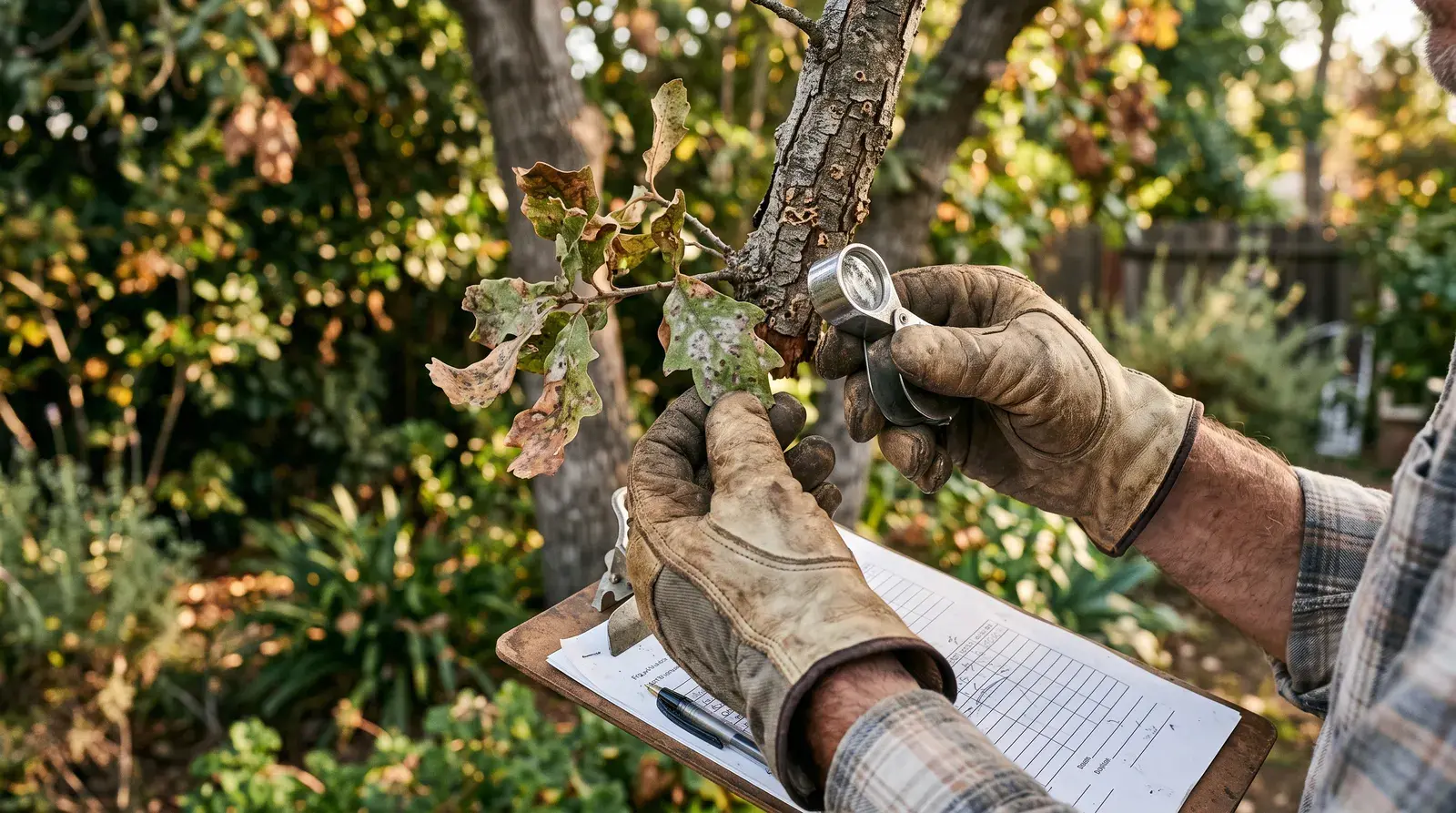
- Condition — crown density and dieback, pest and disease signs, trunk cavities and decay, fungal conks at the base, and root-zone problems like grade change or chronic irrigation.
- Structure and risk — defects such as included bark, cracked unions, or root plate movement, plus what sits under the canopy: house, pool, play area, street.
- Recommendation — retain, prune, treat, monitor, or remove, stated plainly with the reasoning attached.
- Photographs — condition shots that show what the words describe, which is what a reviewer looking at a file instead of the tree actually needs.
Credentials: What to Ask For, Ours Included
This matters more in the report business than in any other tree work, and it is worth being direct about. Some applications and some jurisdictions specify who may prepare the report — so find out what yours requires before you pay anyone.
What we do provide is the field work that any report is built on: an honest, measured, photographed evaluation of the tree, the ordinance question sorted out for your address, and the removal, pruning, cabling, or protection fencing once the city signs off.
- An ISA Certified Arborist credential comes from the International Society of Arboriculture. It shows tested tree-care knowledge and can be verified through the ISA's public directory. It is a professional certification, not a contractor's license.
- A California contractor's license is separate, issued by the Contractors State License Board, and is what covers doing the physical tree work. You can look up any license number, its status, and its workers' comp record free at cslb.ca.gov.
- Ask any company — 916 Trees included — for its qualifications and insurance documentation in writing before work starts. That is the same advice we give on our licensing and insurance page, and we hold ourselves to it.
- If your Folsom application requires a report authored by a specific credential, we will tell you that up front rather than sell you documentation that will not be accepted. Knowing what you need is worth more than a hopeful submission.
Need arborist reports & permit support in Folsom?
Share the address and project details — we'll come back with a scoped, site-specific estimate.
Building Near a Folsom Oak
Construction quietly kills more preserved Folsom oaks than storms do. ADUs, pool installs, room additions, and the ongoing Folsom Ranch build-out all put equipment and trenches near root systems that were specifically protected when the lot was graded — and root damage takes years to show in the canopy.
Plan the tree protection while the design is still on paper. Moving a trench line on a drawing costs nothing; replacing a 150-year-old valley oak is not something money can do.
- Critical root zone — for a Heritage Tree, the city defines it as a circle with a radius of at least 1.5 feet for every inch of trunk diameter at standard height. A 36-inch trunk means a 54-foot radius. That number surprises most homeowners and most contractors.
- Protection fencing goes up before equipment arrives, not after the first trench. Fencing after the damage is documentation of the damage.
- Trenching for irrigation, gas, electrical, or pool plumbing gets routed around the root zone, or bored underneath it. Open trenching through oak roots is the single most common cause of slow post-construction decline.
- No fill soil, no grade cuts, no material staging, and no equipment parking inside the zone. Compaction suffocates roots as effectively as cutting them.
- Approvals for work near protected trees can carry protection conditions; documented compliance protects both the tree and your project timeline.
The same crew from estimate to cleanup.
No juggling separate contractors for one tree. Tell us the address and what you're dealing with, and we'll come back with a written, site-specific number.
- Removal, trimming, stumps, and cleanup handled by one crew
- Free, site-specific estimates — priced to your tree, not a flat rate
- Sacramento, Placer, El Dorado, and Yolo counties
How the Process Runs
For a single-tree permit question this moves quickly. Multi-tree sites and development parcels scale with the tree count and the level of protection planning required.
If the tree turns out to be exempt — under threshold, not a protected category, or genuinely outside the ordinance — we tell you that and you skip the paperwork entirely. That answer is free too.
Free site visit
We look at the tree, the targets under it, and which Chapter 12.16 category it falls into for your address.
Evaluation
Measurements at standard height, condition and structural assessment, defect documentation, and photographs.
Written findings
The assessment and recommendation, formatted for what a Folsom reviewer expects to see attached to an application.
Application support
You know what to submit and what is likely to draw questions. The property owner signs and files the application itself.
The work
Once approved, we handle the removal, pruning, cabling, or protection fencing, plus any replacement planting the approval requires.
Related guides
Do You Need a Permit to Remove a Tree in Sacramento?
Which Sacramento trees need a removal permit, how city and county rules differ, and how to check before the saw comes out.
Sacramento's Heritage Tree Ordinance, Explained
What makes a Sacramento tree a Heritage Tree, what City Code Chapter 12.56 protects, and how to get pruning or removal approved.
Neighbor Tree Disputes in California: Your Rights
Who owns the tree on the fence line, what you can legally trim, and who pays when a neighbor's tree falls — California's general rules, explained.
What arborist reports & permit support costs — and what Folsom allows
Regional ranges, local permit rules, and the alternatives worth weighing before arborist reports & permit support in Folsom.
Arborist Report Cost in Sacramento (2026)
Regional range $300–$1,500 — and what moves the number on a real job.
Do You Need a Tree Removal Permit in Folsom?
Where Folsom draws the line before a tree comes down, and who to check with.
Tree Pruning vs. Removal: When to Save a Tree and When to Take It Down
Pruning or Removal — how to tell which one the tree actually needs.
Tree Service in Sacramento County, CA
Tree work in Sacramento County ranges from removing aging valley oaks in East Sacramento to grinding stumps on new-buil…
Oak Tree Care & Trimming Cost in Sacramento (2026)
Regional range $400–$3,500 — and what moves the number on a real job.
Do You Need a Tree Removal Permit in Auburn?
Where Auburn draws the line before a tree comes down, and who to check with.
Want a sense of the work first? See the kinds of arborist reports & permit support jobs we take on and who shows up to do them.
Frequently asked questions
Who is the City Arborist in Folsom, and can I hire them?
No — the City Arborist is a City of Folsom staff position inside Community Development, not a private contractor. That office administers the Tree Preservation Ordinance in Municipal Code Chapter 12.16, reviews tree permit applications, and decides whether the required findings are met. If you need permit forms, current fees, or a ruling on your specific tree, contact the city directly. If you need the tree assessed and documented so the application has something to stand on, that is the private side of the job, and that is what we do.
Do I need a permit to remove a dead tree in Folsom?
If it is a protected tree under Chapter 12.16, yes — the ordinance covers removal of protected trees including dead ones. Dead or hazardous condition is normally a solid basis for approval, but the city still wants the application and the evidence that the tree is actually dead or dangerous. Photograph the tree before anything comes down, get the condition documented, and apply. Cutting first and explaining later is how homeowners end up with a fine plus a mandatory replacement planting.
What counts as a Heritage Tree in Folsom?
Under the city's ordinance, a Heritage Tree is a tree on Folsom's Master Tree List measuring over 30 inches in diameter at standard height, or a multi-trunked Master Tree List tree whose trunks total 50 inches or more. Standard height is 4.5 feet above ground, measured from the high side of the tree — which matters on the sloped lots near Lake Natoma and the American River Canyon. The Master Tree List and current thresholds are maintained by the city, so verify against the current version before you assume your tree is under the line.
How much does an arborist report cost in Folsom?
As broad regional figures, single-tree documentation for a removal permit typically runs a few hundred dollars, while multi-tree development work scales with tree count, parcel size, and how much protection planning is involved — often into the low thousands on larger sites. The tree inventory is what drives most of the cost, so the number of regulated trees matters more than acreage. We quote site-specifically and the initial assessment visit is free.
I'm putting in a pool near my oak. What will the city want?
Expect the root zone to be the central issue. For a Heritage Tree the city defines a critical root zone with a radius of at least 1.5 feet per inch of trunk diameter, which is far larger than most pool contractors plan around. Realistically that means protection fencing before excavation, plumbing and electrical routed around or bored under the root zone, no spoil piles or equipment parking inside it, and documentation showing the protections were actually in place. Sort this out during design, not during dig week.
Can you assess a tree for a property sale in Folsom?
Yes, and it is worth doing on both sides of a transaction. A big valley oak over a Broadstone roofline is either a documented asset or an unquantified five-figure liability, and buyers increasingly ask. Sellers use a condition assessment to show a mature tree is structurally sound; buyers use one to price in a declining oak before close rather than discovering it in the first winter storm. We assess, document, and give you the honest read either way.