
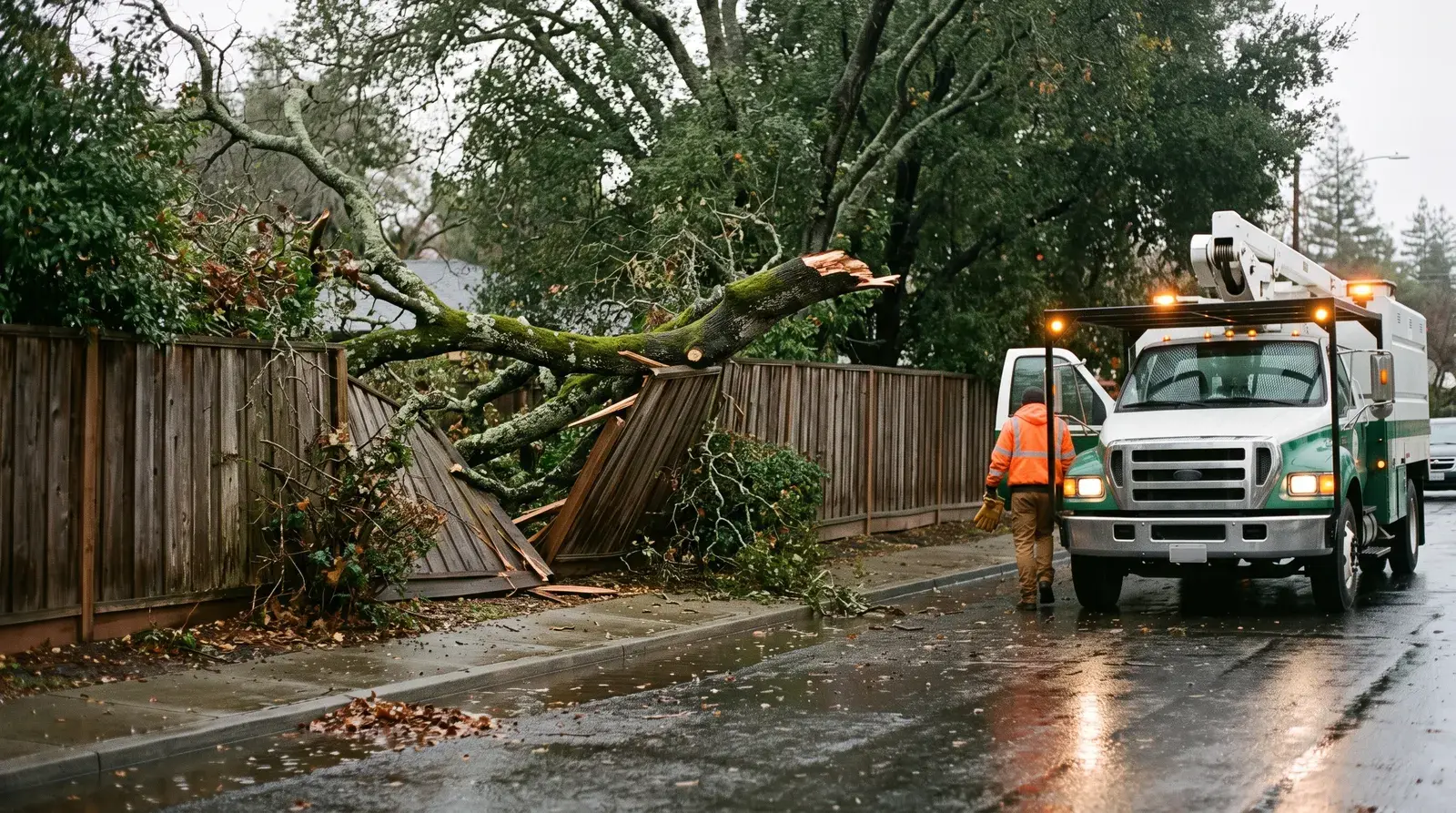
Triage: The Order Storm Damage Gets Handled
After a windstorm, everything looks urgent. It isn't. The right order deals with wood that can still hurt someone before wood that's already done falling — working that sequence is the difference between cleanup and a second accident.
One rule sits above the entire list: anything involving a power line belongs to SMUD or PG&E before it belongs to anyone else. Treat every downed line as energized and stay clear.
- 1. Active hazards — trees or limbs on structures, vehicles, or blocking your only access. These are emergency callouts, handled first.
- 2. Hangers and widow-makers — broken limbs suspended in canopies over driveways, walkways, and play areas. Invisible from indoors, lethal from below.
- 3. Compromised standing trees — new leans, root plate lift, and trunk cracks that mean a tree survived this storm but may not survive the next one.
- 4. Downed wood in open areas — trees and limbs on lawn that aren't touching anything can wait for a scheduled slot, which costs less.
- 5. Ground debris — scattered branches and leaf litter, raked, chipped, and hauled last.
Why Sacramento Storms Take Trees Apart
The Sacramento region's damaging storms are winter events — Pacific fronts that stack strong south winds on top of soil already saturated by weeks of rain. That combination fails trees two ways: whole-tree tipping at the roots, and limb or stem breakage in the canopy.
- Saturated-soil windthrow — wet ground grips roots poorly, so otherwise healthy trees tip with the root plate intact; evergreens like live oaks, pines, and redwoods catch the most winter wind because they hold full canopies.
- Brittle species — aging Modesto ash, silver maple, and Siberian elm across Sacramento's older neighborhoods shed large limbs in almost every significant blow.
- Included bark unions — tight V-shaped forks in ornamental pears, ash, and liquidambar split under wind load; these are the classic 'tree ripped in half' calls.
- Overweight canopies — trees that haven't been thinned in a decade carry sail area their structure can't back up; crown reduction before storm season is the cheap version of this service.
- Summer counterpart — mature valley oaks can also drop big limbs on hot, windless days; different mechanism, same cleanup.
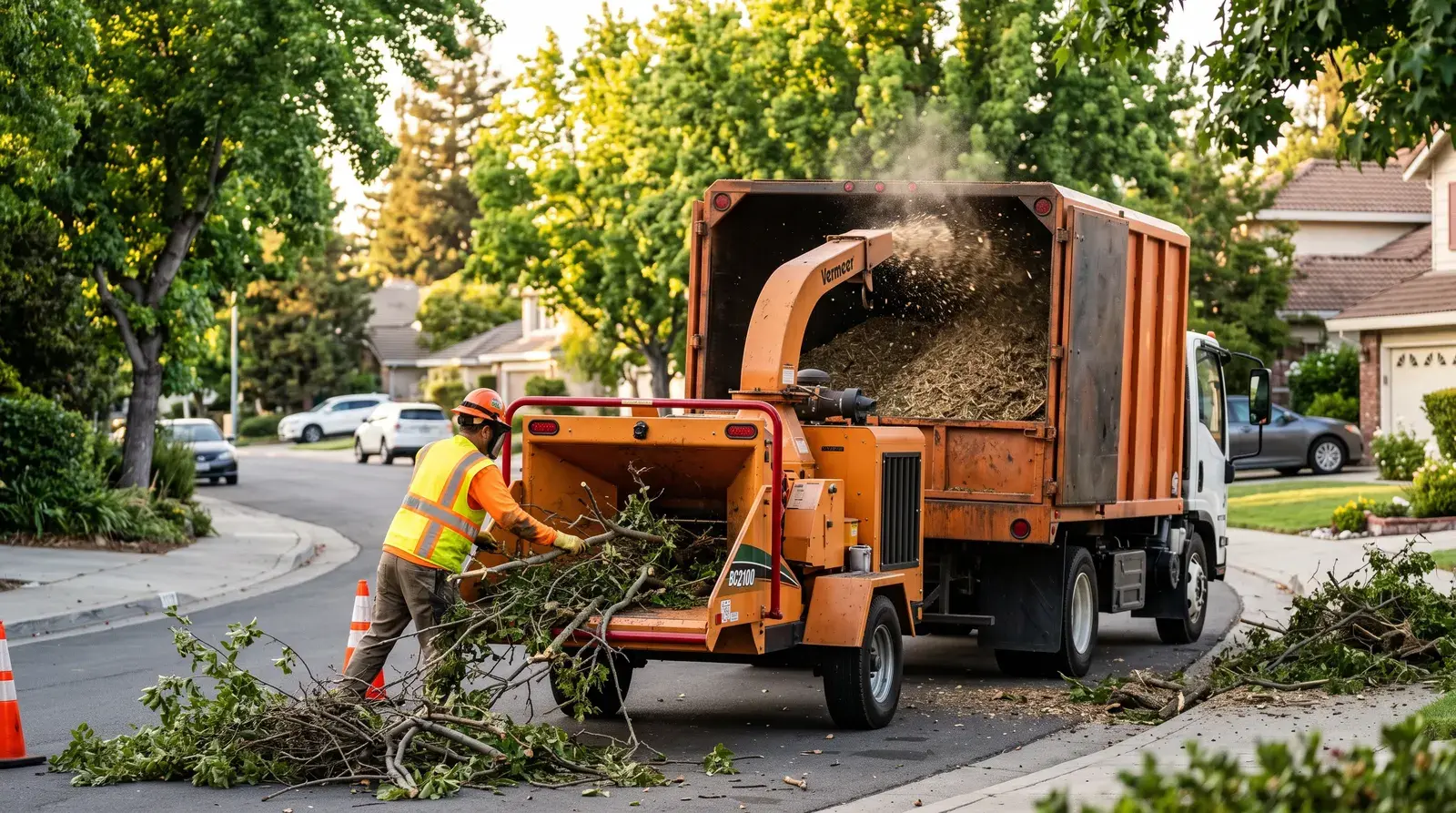
Storm Damage Cleanup across Sacramento, Placer, El Dorado, and Yolo counties.
Hanging Limbs: The Hazard That Waits
Broken limbs that hang up in the canopy — widow-makers — are the most dangerous thing a storm leaves behind, precisely because the storm is over and the yard feels safe. A hanger can hold for weeks and release without warning in the next light breeze.
- Where they hide — hangers rest across other limbs high in the canopy and are easy to miss from the ground; walk the yard and look up along every large tree, or better, don't walk under them at all.
- Why DIY fails — pulling a hanger with a rope, poking it with a pole, or working a ladder under it puts you exactly where the wood lands, with no control over when.
- How we remove them — a climber or lift operator ropes the hanger, frees it under control, and lowers it in pieces; the broken stub then gets a clean pruning cut so the wound closes properly.
- Check after every storm — even if nothing fell, a five-minute look at your big trees after a windstorm catches hangers before they catch you.
Save It or Remove It: Assessing Damaged Trees
Storm damage doesn't automatically mean removal. Roughly speaking, a tree with a sound trunk, an anchored root plate, and most of its canopy intact is a pruning job, not a takedown — and mature shade is worth saving in Sacramento's climate.
- Usually saveable — broken secondary limbs, torn branch ends, canopy loss under about a third; clean reduction cuts at the failure points and the tree rebuilds.
- Sometimes saveable — split co-dominant stems caught early can be pulled back and secured with cabling and bracing; worth a look before writing the tree off.
- Usually removal — snapped main leaders, cracks running into the trunk, decay exposed at the break, or any lift and soil cracking at the root plate.
- Always removal — a tree that partially tipped and is now leaning on its neighbors; it's a slow-motion failure, not a survivor.
- When it's a close call, a tree health assessment settles it with an inspection instead of a guess.
Need storm damage cleanup on your property?
Share the address and project details — we'll come back with a scoped, site-specific estimate.
Tarping, Insurance, and Working With Your Other Contractors
When storm damage involves the house, tree work is step one of a longer chain: tree off, roof covered, claim documented, repairs scheduled. We've been the first crew on that chain enough times to make the handoffs clean.
- Sequence with the roofer — the roof can't be tarped or dried-in until the wood is off; we coordinate timing so the opening isn't exposed longer than necessary.
- Broken glass in the opening — a limb through a window or skylight leaves a hole that has to be secured before anyone can measure and order replacement glass; up the hill in Placer County, Colfax Glass handles emergency board-up and works the same wood-off-first order a roofer does.
- Photo documentation — failure point, contact damage, and the debris field, captured before and during the work for your claim file.
- Itemized invoices — structure-related removal separated from general yard cleanup, because carriers treat them differently.
- Fence and neighbor situations — trees across property lines are common in storm work; we document which side the tree stood on and what it hit, which is what both insurers will ask.
- Claim-ready paperwork — written scope and condition notes available for adjusters; formal arborist reports are available when a claim is disputed.
Debris: Chipping, Hauling, and What You Can Keep
A single failed oak can bury a yard in more material than a green-waste bin handles in a year. Cleanup ends when the debris is actually gone — decide up front what leaves and what stays, since keeping wood on-site lowers the haul cost.
- Chipping on-site — brush and limb wood goes through the chipper at the curb; keep the chips for mulch at no charge or have them hauled.
- Firewood — storm-downed oak and ash make good firewood; we can buck trunks to rounds and stack them instead of hauling.
- Full haul-off — for most homeowners, everything leaves: logs, brush, and raked debris, with the lawn left clean.
- Stumps — an uprooted tree leaves a root ball and crater; we can cut out the root plate, grind the stump, and rough-grade the hole as part of the same visit.
- Larger properties — for acreage and HOA common areas with widespread debris, our wood chipping and hauling service handles volume work.
The same crew from estimate to cleanup.
No juggling separate contractors for one tree. Tell us the address and what you're dealing with, and we'll come back with a written, site-specific number.
- Removal, trimming, stumps, and cleanup handled by one crew
- Free, site-specific estimates — priced to your tree, not a flat rate
- Sacramento, Placer, El Dorado, and Yolo counties
Before Next Winter: Cheap Insurance
Almost every storm failure we clean up telegraphed itself in advance — the overloaded canopy, the tight fork, the dead limb that had been dead for years. A pre-season inspection and selective pruning in fall costs a fraction of one storm callout.
- Thin and reduce before storm season — crown reduction cuts the wind-sail on top-heavy trees before the south winds arrive.
- Deadwood every big tree — dead limbs are the first thing wind removes, and it drops them on whatever is below.
- Cable the forks that concern you — known weak unions can be secured for far less than the damage they cause when they let go.
- Watch the repeat offenders — if a tree drops limbs every winter, that's the tree telling you something; get it assessed before the storm decides for you.
Related services
Emergency Tree Service
Fast response for storm-damaged, fallen, or hazardous trees threatening homes, cars, and power lines across the Sacramento area.
Tree Removal
Safe removal of hazardous, dead, or unwanted trees — including permit help, cleanup, and haul-off across the Sacramento region.
Wood Chipping & Debris Hauling
On-site chipping plus haul-off of logs, chips, and green waste — the cleanup half of any tree job, done to a clean-site standard.
Related guides
Tree Fell? What to Do After Storm Damage
The safe, step-by-step response after a tree falls in a storm — downed lines, insurance documentation, triage, and how to avoid storm-chaser scams.
9 Signs a Tree Needs to Come Down
Nine warning signs a tree is hazardous or dying — and when removal is safer than trying to save it.
How Much Does Tree Removal Cost in Sacramento? (2026)
Typical 2026 Sacramento tree removal price ranges by tree size, the factors that move the number, and how to read a quote before you sign it.
Before you book storm damage cleanup
What it runs, where permits bite, and how storm damage cleanup stacks up against the alternatives.
Emergency Tree Service Cost in Sacramento (2026)
Regional range $800–$8,000 — and what moves the number on a real job.
How Much Does Tree Removal Cost in Sacramento? (2026)
Typical 2026 Sacramento tree removal price ranges by tree size, the factors that move the number, and how to read a quote before you sign it.
Want to see what this looks like on a real property? Browse the storm damage cleanup jobs we take on, or read how our crew scopes and prices work before you call anyone out.
Frequently asked questions
What's the difference between storm damage cleanup and emergency tree service?
Urgency. Emergency service is for active hazards — a tree on the house, a split trunk about to finish falling, a blocked driveway. Storm damage cleanup is the everything-else that follows a windstorm: downed limbs across the yard, a tree that fell in open lawn, broken branches hanging in canopies. Cleanup can usually be scheduled within days rather than hours, and scheduled work costs less than emergency mobilization. If you're not sure which you have, describe the scene when you call and we'll tell you straight.
What is a widow-maker and why is it dangerous?
A widow-maker is a broken limb that didn't make it to the ground — it's hung up in the canopy, resting on other branches, waiting for wind or its own weight to bring it down. They're the most underestimated hazard after a storm because the yard looks calm while several hundred pounds of wood hangs overhead. Never work under one, and don't try to knock one down with a rope or pole. A climber removes hangers in controlled pieces; it's routine work for a tree crew and genuinely dangerous work for anyone else.
Can a storm-damaged tree be saved, or does it have to come down?
Plenty survive. A tree that lost less than about a quarter to a third of its canopy, with no trunk cracks and an intact root plate, usually recovers with clean pruning cuts at the break points. Trees with split main stems can sometimes be preserved with cabling and bracing. What doesn't recover: snapped leaders on the main trunk, root plate lift, and splits into the trunk itself. We assess every damaged tree during cleanup and tell you which category it's in before recommending removal.
Will insurance pay for storm cleanup?
It depends on what the tree hit. If a tree or limb damaged a covered structure — house, garage, fence — policies generally cover removal from the structure plus repairs, subject to your deductible. Debris that fell in open yard without hitting anything is often not covered, or capped at a modest limit. We document the damage with photos, itemize invoices so structure-related removal is separated from yard cleanup, and provide what your adjuster asks for. Confirm coverage specifics with your carrier.
How soon after a storm can you get to my property?
It depends on how the storm treated the whole region. After a major windstorm, every crew in Sacramento is triaging: trees on occupied homes come first, blocked access second, hazardous hangers third, ground debris last. We'll tell you honestly where your job sits in that order and give you a realistic window rather than a promise we can't keep. If your situation is a true hazard, say so — it changes your place in line.