Historic Neighborhoods: What the Urban Forest Actually Looks Like
Woodland's historic residential streets — the neighborhoods that grew up around the Yolo County Courthouse in the late 1800s and early 1900s — have the most significant tree canopy in the city. The species reflect a Victorian-era planting sensibility: fast-growing shade trees chosen for their canopy spread, many of which are now reaching the end of their structural lifespan.
- Valley oak is the region's native signature species and appears throughout the older neighborhoods and the agricultural periphery; large specimens can exceed 100 feet in height and carry massive lateral limb structures that require careful rigging over historic homes.
- Black walnut is common in and around the historic district — long-lived, densely wooded, and the tree most likely to have significant infrastructure conflicts from its aggressive root system and allelopathic effect on surrounding plantings.
- Green ash and Modesto ash were planted heavily as street trees in Woodland's mid-century expansion neighborhoods; both are reaching the end of their functional lifespan, with chronic die-back, included bark at major unions, and frequent scaffold failure.
- Deodar cedar and other large conifers appear in some historic yards — the needle species are less common than in foothill communities but occur in the older west-side neighborhoods.
- Chinese pistache, ornamental pear, and raywood ash are the newer-vintage street tree plantings in the subdivisions built since the 1980s; these are still in active structural development and the most common removals from storm or wind failure.
City of Woodland Urban Forest Program: Permits and Street Trees
Woodland is an incorporated city that actively manages its urban forest. The city's Public Works and Parks Department oversees street trees in the public right-of-way, and the municipal code addresses tree removal requirements for significant private-lot trees. The urban forestry program means there are real rules here — not suggestions.
- Street trees in the planting strip between sidewalk and curb are city-managed; removing or significantly pruning one without city authorization is a code violation, even when the tree is lifting your driveway or damaging the sidewalk.
- For dead or hazardous street trees, the right move is contacting the City of Woodland Public Works to request removal or inspection — we can document the tree's condition to support that request, but the city controls the work on street trees.
- For significant private-lot trees, the City of Woodland's municipal code sets permit thresholds and procedures; these requirements can change, so we verify directly with the city's Planning and Building Division before any removal where the question applies.
- Heritage-scale trees in the historic neighborhoods — particularly large valley oaks — may have additional layers of review; the city's urban forestry staff can advise on the current process for individual specimens.
- Replacement planting is a common permit condition for significant removals; we can fold a replacement into the removal scope so the city's requirement is satisfied in a single visit.
Tree Removal in Woodland — free, site-specific estimates.
Valley Oaks: The Most Valuable and Most Complicated Removals
Valley oaks are native to the Sacramento Valley and are the most ecologically significant trees in Woodland's landscape. A healthy, structurally sound valley oak is almost never the right call for removal — they are irreplaceable canopy assets that take 50 to 100 years to reach mature size. When removal is necessary, it's a major job.
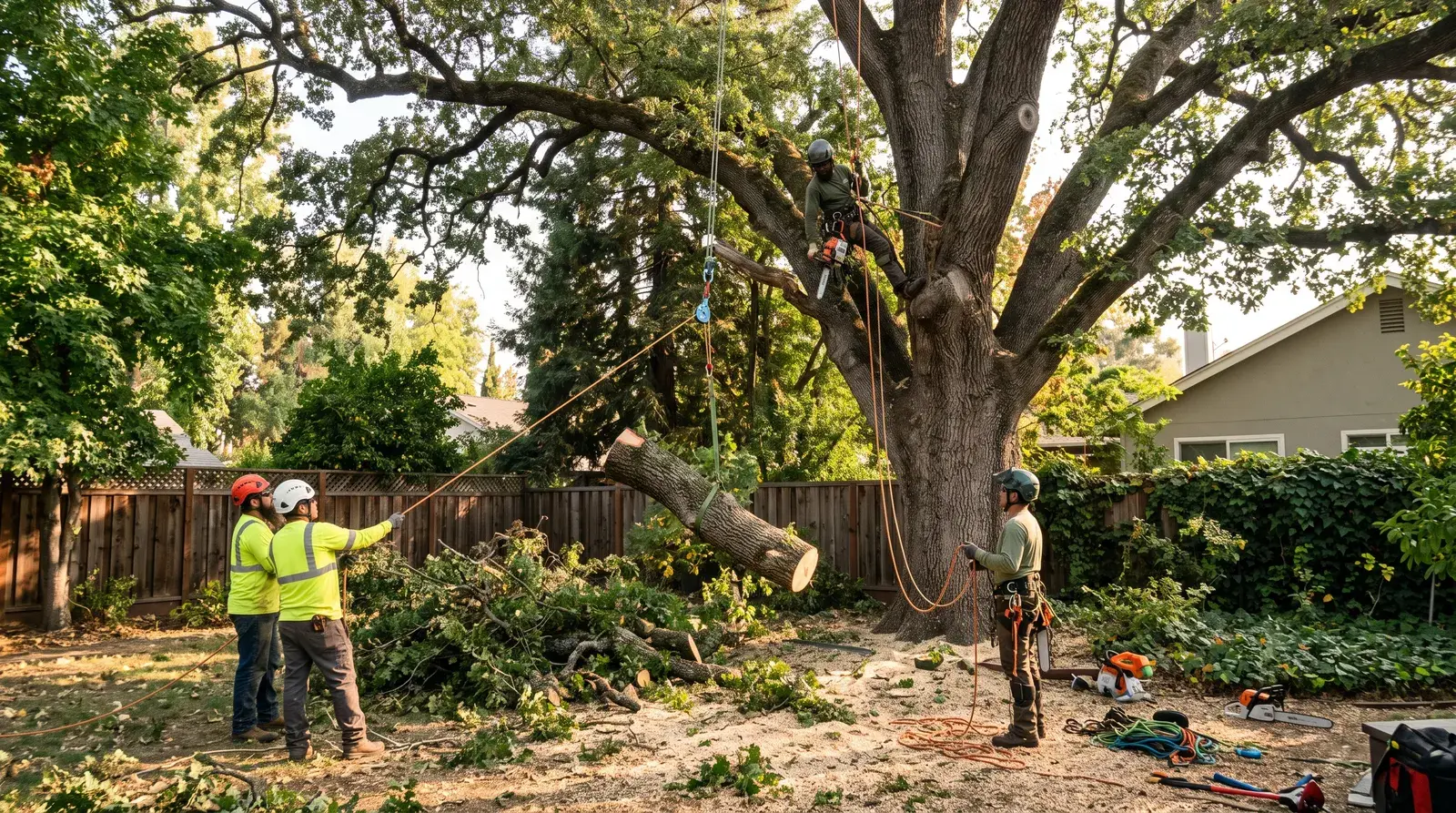
The valley oaks in Woodland's older neighborhoods and at the agricultural edges of the city reach sizes that make removal a significant undertaking: trunk diameters of 3–5 feet, canopy spreads of 60–80 feet, and lateral limb structures that frequently overhang multiple neighboring properties as well as the removal target's own structures. Removal is the right call for standing dead oaks with no structural integrity, oaks with major trunk decay at the root collar or along main scaffold limbs, and trees with root plate failure that has progressed past the point of stabilization. It is not the right call for a healthy oak with a bad branch or a too-close-to-the-house siting — in those cases, directional pruning, crown reduction, or cabling are the actual answers. A valley oak that's been in the ground for 80 years can't be replaced on a human timescale, and we'll say so at the estimate rather than take a removal job that doesn't need to happen. When removal is the right answer, we rig in sections, plan around the structures under the canopy, and work with the city's permit process before any cuts are made.
Clay Soils and the Agricultural Valley Floor
Woodland sits on deep Sacramento Valley clay — the same heavy adobe soil that made the surrounding Yolo County farmland productive and makes tree work more complex than in sandier suburban soils. Clay affects how roots spread, how soil drains, and how quickly a saturated root zone becomes a structural problem.
- Valley clay drains slowly; after winter rains, tree root zones can stay saturated for weeks. That saturation reduces the soil's ability to resist lateral root plate movement — trees that looked perfectly stable in October are at measurably higher tip-over risk in February after a prolonged wet spell.
- Root systems in heavy clay tend to spread wide and relatively shallow rather than straight down; mature oaks and walnuts in clay often have surface roots extending 20–30 feet from the trunk that break hardscape and conflict with irrigation and sewer lines.
- Stump grinding in Woodland's clay runs slower and harder than in loamier soil; a large oak or walnut stump in full clay is a multi-hour job, and chips from clay-site grinds are dense and waterlogged.
- Replanting after a removal on clay soil requires imported topsoil in the stump hole; backfilling with the clay chips from the grind produces a compacted, low-oxygen root zone that stunts or kills replacement trees.
- Hot, dry summers — Woodland regularly sees 100°F-plus heat from June through September — compound the clay problem: trees stressed by summer drought and heat that have also been overwatered to compensate often develop root rot in clay where water pools below the irrigation depth.
Need tree removal in Woodland?
Share the address and project details — we'll come back with a scoped, site-specific estimate.
Heat Stress, Drought, and When Agricultural-Climate Trees Finally Fail
Woodland's Sacramento Valley climate — hot, dry summers with months of 95°F-plus temperatures, and cold wet winters with frost — is what native valley oaks evolved for. It's also the climate that stresses non-native landscape trees toward decline faster than almost anywhere else in the greater Sacramento region.
The trees that fail most visibly in Woodland's heat are the mid-century street plantings that were chosen for fast growth rather than climate fit: Modesto ash, green ash, and older ornamental plums struggle through their third or fourth decade in clay soil under consistent summer heat, showing progressive die-back, scaffold failures, and structural decline that eventually makes removal the only reasonable outcome. Black walnuts, also common in the historic neighborhoods, are better climate-adapted but develop trunk cavities and major structural defects with age that concentrate near the crotch of scaffold limbs — a 60-year-old walnut with a hollow center is a structural failure waiting for the wrong wind event. For valley oaks in heat stress, the signature is summer scorch on the leaf margins followed by early defoliation — usually a soil moisture or root stress issue rather than a removal trigger, but it signals that the tree's root zone needs investigation. We'll give you an honest assessment of whether the tree is declining past recovery or whether it's a soil and care problem with a fix. A tree removal quote is easy to give; it's more useful to tell you which trees actually need to come out.
The same crew from estimate to cleanup.
No juggling separate contractors for one tree. Tell us the address and what you're dealing with, and we'll come back with a written, site-specific number.
- Removal, trimming, stumps, and cleanup handled by one crew
- Free, site-specific estimates — priced to your tree, not a flat rate
- Sacramento, Placer, El Dorado, and Yolo counties

What Tree Removal Costs in Woodland
As broad regional figures, most residential tree removals in Woodland run $500–$2,500. Mature valley oaks and large black walnuts over historic structures are the high-end jobs; newer subdivision trees — ornamental pear, pistache, younger ash — are typically at the lower end.
- Size and wood volume set the baseline: a 60-foot valley oak carries five to six times the wood mass of a 25-foot ornamental pear.
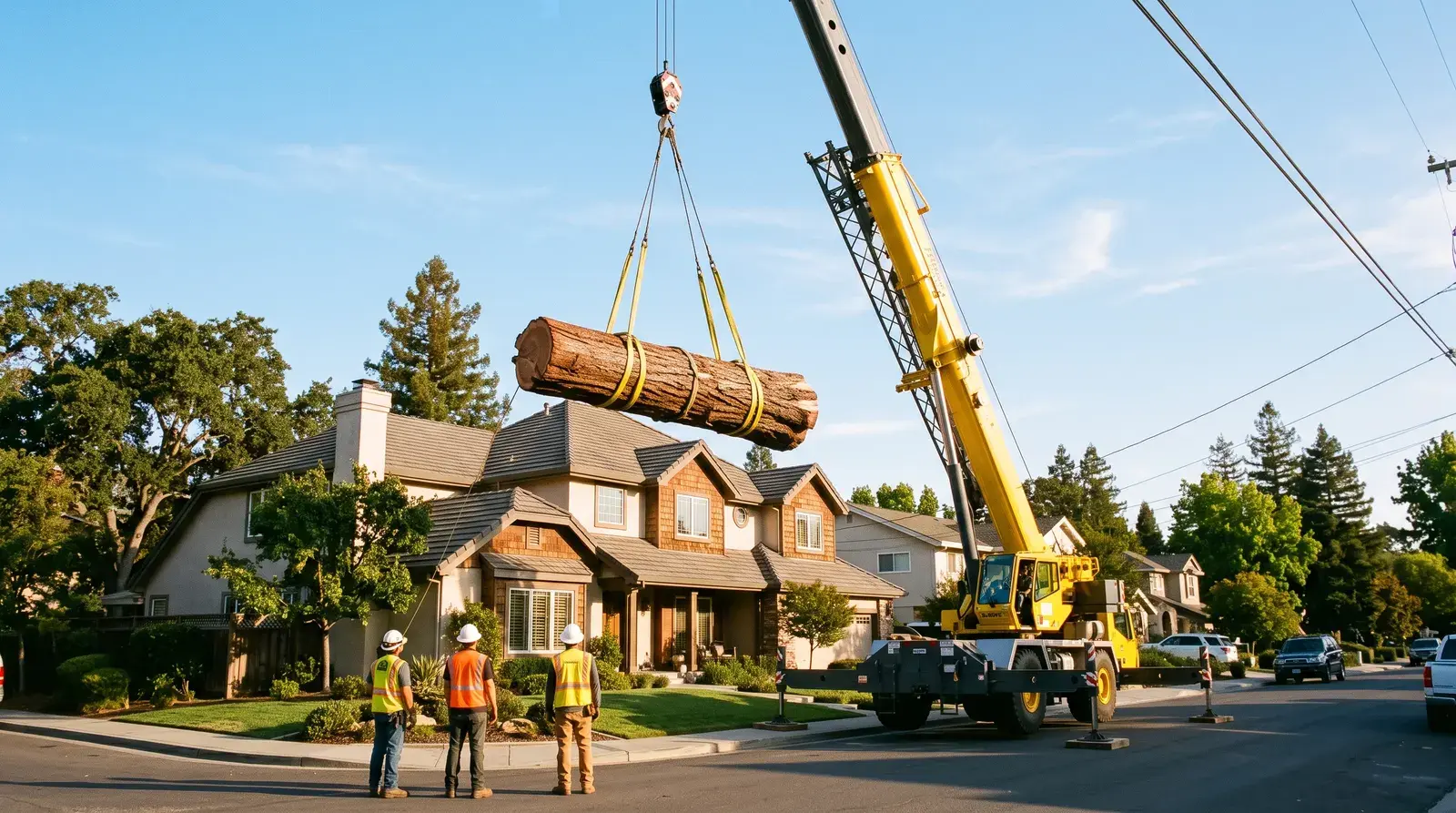
- Historic-district work near older homes requires slow, rigged takedowns — nothing dropped, everything sectioned — because the structures below are often irreplaceable.
- Clay soil stump grinding is its own line item; a large oak or walnut stump in clay takes significantly longer than the same size stump in a sandier suburban yard.
- City permit costs, where applicable, are external to the removal quote — we flag those up front at the estimate so they're not a surprise after work is scheduled.
- Debris haul-off is included in the base quote; firewood from oak and walnut is a genuine value if you want rounds left rather than chipped.
- Every estimate is free, done on site, and includes a direct conversation about permit requirements and the tree's actual condition before any pricing is put on paper.
Related guides
Do You Need a Permit to Remove a Tree in Sacramento?
Which Sacramento trees need a removal permit, how city and county rules differ, and how to check before the saw comes out.
How Much Does Tree Removal Cost in Sacramento? (2026)
Typical 2026 Sacramento tree removal price ranges by tree size, the factors that move the number, and how to read a quote before you sign it.
9 Signs a Tree Needs to Come Down
Nine warning signs a tree is hazardous or dying — and when removal is safer than trying to save it.
What tree removal costs — and what Woodland allows
Regional ranges, local permit rules, and the alternatives worth weighing before tree removal in Woodland.
Emergency Tree Service Cost in Sacramento (2026)
Regional range $800–$8,000 — and what moves the number on a real job.
Do You Need a Tree Removal Permit in Rancho Cordova?
Where Rancho Cordova draws the line before a tree comes down, and who to check with.
Tree Pruning vs. Removal: When to Save a Tree and When to Take It Down
Pruning or Removal — how to tell which one the tree actually needs.
Tree Service in Yolo County, CA
Yolo County is flat valley floor — Sacramento River bottomland, Yolo Bypass floodplain, and agricultural land stretchin…
Crane-Assisted Tree Removal Cost in Sacramento (2026)
Regional range $2,500–$12,000 — and what moves the number on a real job.
Do You Need a Tree Removal Permit in Auburn?
Where Auburn draws the line before a tree comes down, and who to check with.
Want a sense of the work first? See the kinds of tree removal jobs we take on and who shows up to do them.
Frequently asked questions
Does Woodland require a permit to remove a tree on my private property?
Woodland is an incorporated city with its own municipal code, so permit requirements are set by the City of Woodland — not by Yolo County. The city's Planning and Building Division oversees tree removal permits for significant private-lot trees, and the specific thresholds and procedures can change. We verify directly with the city on every removal where the question is live. Heritage-scale trees and valley oaks are the most common trigger point. Dead and clearly hazardous trees often have a faster path, but documentation — photos, a written condition assessment — is still important. We flag the permit question at every free estimate.
The tree is in the strip between the sidewalk and the street. Is that mine to deal with?
No — trees in the public planting strip are Woodland street trees managed by the city's Public Works and Parks Department, even if you maintain the strip and rake the leaves. Removing or significantly pruning one without city authorization is a code violation, and the city controls the work on those trees regardless of what the tree is doing to your sidewalk or driveway. The right path is contacting Woodland Public Works to report a dead, hazardous, or infrastructure-damaging street tree. We can document the condition in writing and photos to support that request — but the removal itself goes through the city program.
I have a big valley oak over my house. Does it need to come down?
Probably not, if it's structurally sound and healthy. A valley oak over a structure is a management problem, not automatically a removal situation. The trees most often removed in this scenario are those with significant trunk decay at the root collar, root plate failure showing as soil heave or new lean, multiple co-dominant stems with included bark that have cracked under load, or standing dead specimens. A healthy oak with too much end weight over a roofline typically needs crown reduction and end-weight reduction, not removal — and a 100-year-old valley oak can't be replaced in a generation. We'll give you an honest answer at the free estimate rather than recommend a removal that doesn't need to happen. City permit requirements for significant oaks apply regardless.
How does Woodland's heat and clay soil combination affect tree health?
It's hard on non-native landscape trees and stressful even for adapted natives in poor soil conditions. Clay drains slowly, which means waterlogged roots in winter and then rapid moisture loss in summer — drought stress and root rot can coexist in the same tree in the same year depending on irrigation management. Under 100°F summer heat, trees with stressed root systems defoliate early, show scorch on leaf margins, and decline faster than the same species would in a more moderate climate. That said, visible summer stress doesn't automatically mean removal is coming — sometimes it's a soil oxygen and drainage fix, sometimes it's an irrigation adjustment. We assess the full picture at the estimate.
What does tree removal cost in Woodland?
As broad regional figures, most residential removals run $500–$2,500. Mature valley oaks and large black walnuts in the historic neighborhoods — over older homes, with wide root systems in clay — are the high-end jobs and can exceed that range depending on access and rigging requirements. Newer subdivision trees in Woodland's outskirts — ornamental pears, younger ash, Chinese pistache — usually land at the lower to mid range. Clay soil work and permit-required removals carry additional variables. Every estimate is free, based on a site visit, and includes a straight conversation about the permit question and whether removal is actually the right answer for that tree.