What Crown Reduction and Thinning Do
These are two related answers to the same complaint — "that tree is too big, too heavy, or catches too much wind." Reduction shortens the canopy's height and spread with cuts back to live laterals. Thinning keeps the outline but removes selected branches so wind passes through instead of pushing.
- Crown reduction: overall height and spread brought in, each cut ending at a lateral that becomes the new branch tip
- End-weight reduction: the long, heavy ends of individual limbs shortened to shift weight back toward the trunk
- Crown thinning: selective removal through the canopy to reduce density and wind-sail without changing the silhouette
- Crown cleaning: deadwood, stubs, and broken hangers out — usually bundled with either service
- Retrenchment pruning: gradual, staged reduction used to keep aging heritage trees standing safely for more years
When a Sacramento Tree Needs Reduction
Reduction is the right call when the problem is load and leverage, not clearance. Mature valley oaks, London planes, camphors, and silver maples in Sacramento's older neighborhoods routinely build canopies their attachments were never tested against — until a winter windstorm tests them.
Sacramento's mature oaks add one more case: sudden branch drop on hot, calm summer days. It's a documented behavior of large old oaks and eucalyptus in Central Valley summers, and long horizontal end-heavy limbs are the usual failures. End-weight reduction is the practical mitigation.
- Long limbs extended over a roof, pool, driveway, or play area with most of their weight at the tips
- A tree that noticeably heaves and rocks in Delta breeze afternoons or winter storm fronts
- History of limb failures — each dropped limb is data about how the rest are loaded
- A codominant or cracked union carrying heavy stems, often paired with cabling — see tree cabling & bracing
- A tree that outgrew its spot near a structure, where reduction can buy years before removal is on the table
- Water-heavy species like silver maple, cottonwood, and Modesto ash that build brittle bulk fast
Crown Reduction & Thinning across Sacramento, Placer, El Dorado, and Yolo counties.
Reduction vs. Topping: The Distinction That Matters
Every reduction cut ends at a live lateral branch big enough — roughly one-third the diameter of the removed stem — to take over as the new leader for that limb. That single rule separates reduction from topping, and it's why one preserves a tree while the other ruins it.
A lateral that takes over keeps sap moving through the limb, keeps the wound sealing, and keeps growth orderly. A stub with no lateral does the opposite: the cut can't close, decay moves into the trunk, and the tree panic-sprouts dozens of shoots anchored only in the outer wood. Within a few years a topped tree is as tall as before, structurally worse, and committed to a cycle of re-cutting that ends in removal. You can still see the results on older Sacramento streets — mulberries and ash topped decades ago, now knuckled fists of decay holding up brooms of sprouts.
- Reduction: cuts at laterals, natural outline kept, wounds seal, regrowth normal
- Topping: cuts at stubs, hacked silhouette, decay columns, sprout regrowth that fails in wind
- If a bid says "top it" or promises to cut the height in half, get another bid
Thinning Done Right — Not Lion-Tailing
Good thinning removes branches evenly through the canopy, favoring the outer third, so the whole tree carries less sail. The common wrong version is lion-tailing: gutting the interior and leaving pom-poms of foliage at the limb ends, which makes limbs more likely to break, not less.
If you've had a tree lion-tailed in the past, it's fixable over time: end-weight reduction now, then letting the interior regrow before thinning correctly on the next cycle.
- Interior foliage dampens limb sway; strip it and limbs whip further in wind before something gives
- Lion-tailing pushes all weight and wind load to the tips — the worst place for it
- Sudden interior exposure invites sunscald on thin-barked species in Sacramento summers
- Proper thinning is modest — the canopy looks lighter, not see-through, when the crew leaves
Need crown reduction & thinning on your property?
Share the address and project details — we'll come back with a scoped, site-specific estimate.
How We Work a Reduction
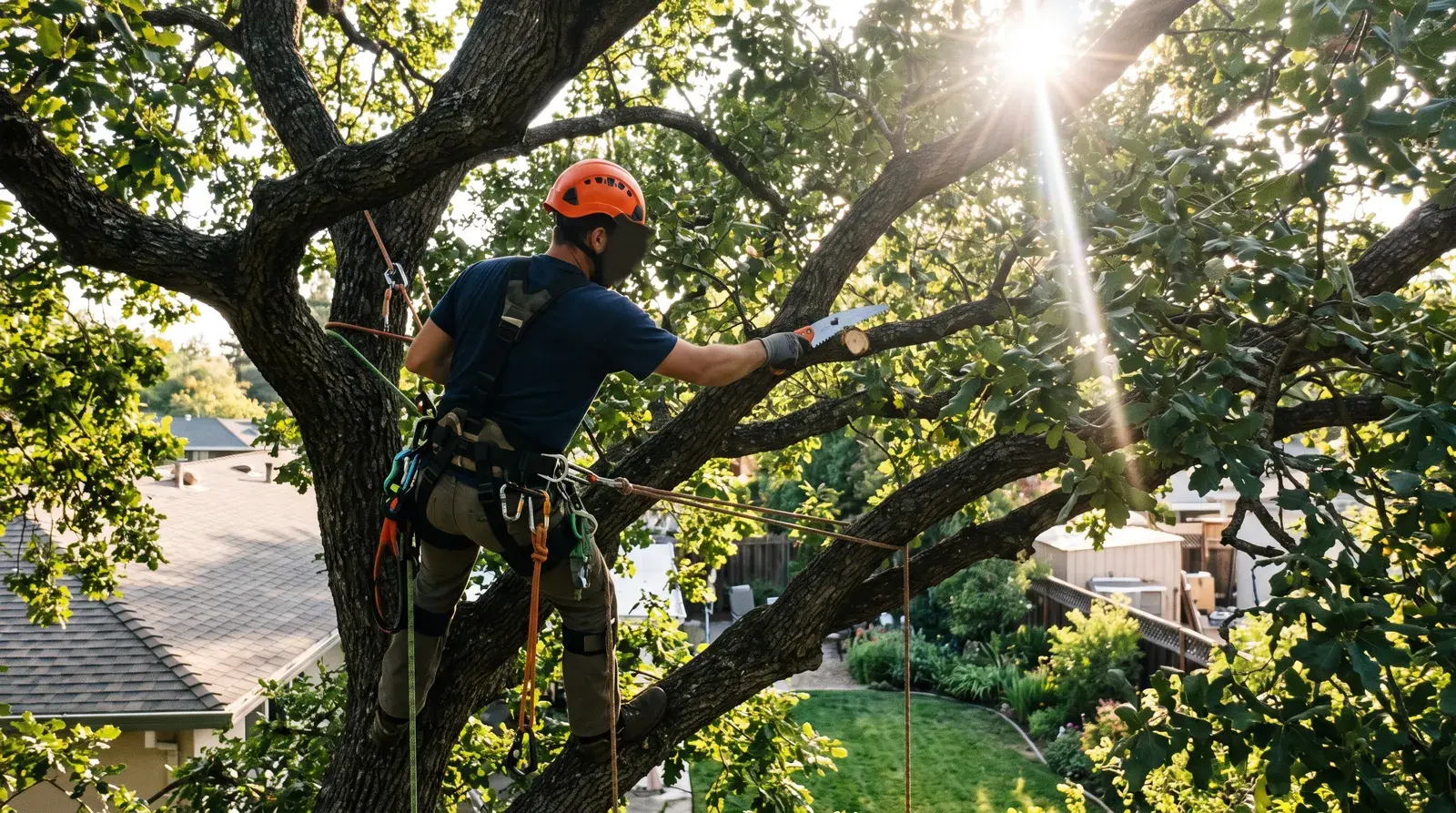
Reduction is climber's work. There's no way to make hundreds of judged cuts through an outer canopy from the ground, so a climber works the tree section by section on rope, rigging larger pieces down when structures sit below. Expect a full crew for most of a day on a big tree.
- Walkthrough first: agree on the target outline, the limbs of concern, and what's protected below
- Climber sets lines and works top-down, cutting each stem to its chosen lateral
- Limbs over roofs and fences are roped and lowered, never free-dropped
- Ground crew chips as the tree comes down to size; wood hauled or left as firewood rounds per your preference
- Final walkaround comparing the result to the agreed outline
Cost and What Drives It
Broad Sacramento-region ranges: mid-size trees typically $600–$1,200, large mature shade trees $1,200–$3,000+. Reduction costs more than routine trimming because nearly every cut is a decision made in the outer canopy, often over something expensive.
Estimates are free and site-specific. If reduction can't make the tree acceptably safe where it stands, we'll say so and price the alternatives instead of selling you a haircut on a hazard.
- Canopy size and height — more outer edge means more cuts and more rope time
- Rigging — working over roofs, pools, and glass slows everything down for good reason
- Species response — oaks get conservative staged reduction; vigorous regrowers tolerate more per visit
- Combined scope — pairing reduction with cabling or a full crown clean changes the day
The same crew from estimate to cleanup.
No juggling separate contractors for one tree. Tell us the address and what you're dealing with, and we'll come back with a written, site-specific number.
- Removal, trimming, stumps, and cleanup handled by one crew
- Free, site-specific estimates — priced to your tree, not a flat rate
- Sacramento, Placer, El Dorado, and Yolo counties
Protected Trees: Check Before Reducing
Significant canopy reduction can count as major work under local tree ordinances. City of Sacramento Heritage Trees are protected under City Code Chapter 12.56, street trees are City Trees, and Sacramento County's ordinance protects native oaks in unincorporated areas — permits can apply before heavy pruning, not just removal.
- Heritage or protected-species trees: confirm permit requirements at cityofsacramento.gov or your county before scheduling
- Native oaks: reduction stays conservative and dry-season timed — see oak tree care
- We flag likely permit situations during the free estimate rather than discovering them mid-job
Related services
Tree Trimming
Trimming for clearance, appearance, and long-term health — deadwood removal, canopy shaping, and structure on a sensible cycle.
Structural Tree Pruning
Structural pruning that builds sound branch architecture — training young trees and correcting weak, crowded, or co-dominant limbs.
Tree Cabling & Bracing
Structural support for co-dominant stems and heavy limbs — hardware that helps preserve mature, valued trees.
Related guides
9 Signs a Tree Needs to Come Down
Nine warning signs a tree is hazardous or dying — and when removal is safer than trying to save it.
Tree Fell? What to Do After Storm Damage
The safe, step-by-step response after a tree falls in a storm — downed lines, insurance documentation, triage, and how to avoid storm-chaser scams.
Keeping Trees Alive Through Sacramento Summers
Deep watering at the dripline, real mulch, and the heat-stress signs that matter — how Sacramento trees survive months of triple-digit heat.
Before you book crown reduction & thinning
What it runs, where permits bite, and how crown reduction & thinning stacks up against the alternatives.
Want to see what this looks like on a real property? Browse the crown reduction & thinning jobs we take on, or read how our crew scopes and prices work before you call anyone out.
Frequently asked questions
What's the difference between crown reduction and topping?
Both make a tree smaller — that's where the similarity ends. Reduction cuts each stem back to a live lateral at least about a third the diameter of what's removed, so an existing branch takes over as the new end and the wound seals. Topping cuts to arbitrary stubs with nothing to take over; the tree answers with weakly attached sprouts and decay running down from every stub. Reduction keeps the tree's structure and natural form. Topping destroys both.
How much can a crown be reduced?
Practically, about 10–20% of the canopy in one pass — occasionally more on vigorous species, less on mature or stressed trees. Reduction is limited by where live laterals exist to cut back to. If someone promises to cut a 60-foot tree down to 30 feet, that isn't reduction, it's topping with better marketing. When a tree needs to be half its size to be safe where it stands, the honest conversation is usually about removal and replanting the right species.
Will reducing the crown stop my tree from dropping limbs?
It substantially lowers the odds, which is the realistic goal. Reduction shortens the lever arm on long limbs and thinning trims the sail the wind pushes on, so the same storm puts less load on every attachment. Sacramento's summer pattern of sudden limb drop on mature oaks and elms — green limbs failing on hot, still days — also correlates with long, end-heavy horizontal limbs, which is exactly what end-weight reduction targets. No pruning makes a tree risk-free.
What does crown reduction cost in the Sacramento region?
It's among the more labor-intensive pruning services because a climber makes many careful cuts through the outer canopy, usually with rigging over structures. Broad regional range: $600–$1,200 for a mid-size tree and $1,200–$3,000+ for large mature oaks, planes, or eucalyptus with difficult access. Estimates are free and site-specific — canopy size, targets underneath, and how much reduction the species tolerates all move the number.
How often does a reduced crown need maintenance?
Plan on a follow-up every 3–5 years. A properly reduced tree regrows at a normal pace from intact laterals — unlike a topped tree, which erupts in fast sprouts and needs work within 2–3 years just to stay safe. Follow-up visits are lighter and cheaper than the first reduction: maintaining the established outline and re-thinning where growth has closed back in.