
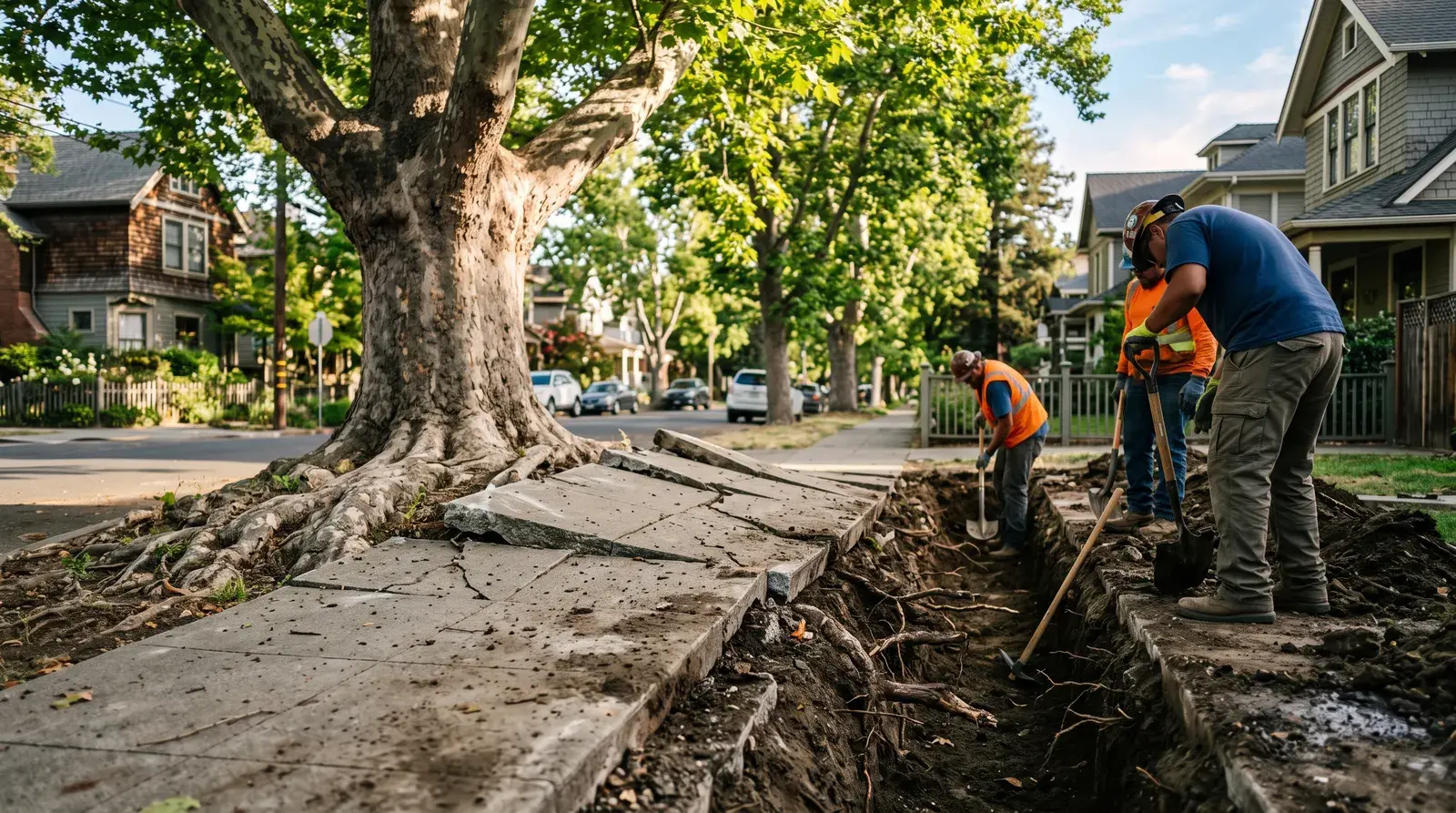
Why Roots Lift Sacramento's Sidewalks and Driveways
Sacramento's mature-canopy neighborhoods — East Sac, Land Park, Curtis Park, Carmichael, Fair Oaks — pair big 60- to 100-year-old trees with narrow parkway strips and concrete poured decades ago. Roots grow in diameter every year, and shallow roots under a slab lift it a little at a time until the trip hazard shows.
- Shallow-rooted species do most of the damage: camphor, Modesto ash, liquidambar, London plane, and fruitless mulberry are the region's usual suspects.
- Compacted clay soil and summer irrigation pull roots toward the surface, where moisture and oxygen are — right under the sidewalk.
- Small parkway strips force street-tree roots under the sidewalk on one side and the curb on the other; there's simply nowhere else for them to go.
- Heaved concrete is a symptom, not the disease. Grinding the trip edge or replacing the panel without addressing the root puts you on a repeat cycle every few years.
Root Pruning: What Gets Cut and What Doesn't
Root pruning means exposing the specific roots causing the damage — usually by careful excavation along the slab edge — and cutting them cleanly, then deciding whether a barrier goes in behind the cut. It is targeted surgery, not trenching a line through the root zone and hoping.
- Expose first, cut second — we excavate along the hardscape edge (air excavation or hand digging near valuable trees) so we can see root size before committing to a cut.
- Clean cuts on the smallest roots that solve the problem — smooth saw cuts heal; torn, backhoe-ripped roots invite decay into the root system.
- One side per season — pruning roots on multiple sides of a tree at once multiplies the stress and the stability risk.
- Timing — late fall through winter dormancy is the best window in the Sacramento Valley; heavy root cutting going into a 105-degree July is asking the tree to run a marathon dehydrated.
- Aftercare — pruned trees need deep watering through the following summer while they regrow feeder roots.
Root Pruning & Root Barriers across Sacramento, Placer, El Dorado, and Yolo counties.
The Structural Limit: When Root Cutting Becomes Tree Removal by Installments
The roots nearest the trunk are the tree's anchor and its plumbing. Cut them and the tree may look fine for two or three years, then fail at the root plate in a winter windstorm. Knowing where the no-cut zone sits is the difference between root management and slow-motion removal.
- Working rule — keep structural cuts outside a radius of three to five times the trunk diameter, and treat anything larger than about 2 inches in diameter inside that zone as an arborist question.
- Windthrow risk — Sacramento's saturated-soil south-wind storms are when root-pruned trees fail. A tree that lost anchor roots on its windward side is the one that ends up on the house.
- One-sided loss — cutting a large fraction of roots on one side can also starve that side of the canopy, showing up as dieback a season or two later.
- Utility trenching counts — a contractor cutting a trench for sewer or fiber through a root zone does the same damage as bad root pruning. If a trench went through your tree's roots, get it assessed.
- The honest answer — sometimes the sidewalk fix that spares the tree is redesigning the sidewalk: ramping, bridging, meandering the path, or replacing concrete with permeable pavers over the root zone.
Root Barriers: How They Work and Where They Belong
A root barrier is a vertical membrane — rigid panels or heavy HDPE — set in a narrow trench between the tree and whatever you're protecting, typically 18 to 36 inches deep. Roots that meet it turn downward and pass beneath, deep enough that they stop lifting the slab above.
- After root pruning — a barrier installed along the cut line keeps the regrowth from heading straight back under the concrete you just repaired.
- At planting time — the cheapest barrier is the one installed with a new tree. Our tree planting service installs barriers with street-side and patio-side plantings by default when species and spacing call for it.
- Along new hardscape — pouring a new driveway or patio near an existing tree? Trench and barrier the edge before the pour, not after the first crack.
- Depth and continuity matter — barriers that are too shallow, or that leave gaps at panel joints, get outflanked. Roots take the path of least resistance, and they have decades to find it.
- Limits — a barrier won't stop a mature valley oak's established root system, and encircling a tree with barrier on all sides is just a slow planter box. Barriers are for redirecting growth, not imprisoning it.
Need root pruning & root barriers on your property?
Share the address and project details — we'll come back with a scoped, site-specific estimate.
Roots vs. Foundations, Pools, and Sewer Lines
Hardscape lifting is visible and fixable. The below-ground conflicts — foundations, pools, and sewer laterals — are where root problems get expensive, and where guessing wrong costs the most.
- Foundations — in the region's expansive clay soils, a big tree near the house dries the soil unevenly in summer, which can contribute to differential settling. Roots also follow existing cracks and moisture. The fix is a joint call between a foundation contractor and a tree assessment, not a chainsaw.
- Sewer laterals — roots don't crush intact pipes; they invade joints and cracks in old clay and Orangeburg lines, common in pre-1970s Sacramento neighborhoods. Repair the pipe and the root problem usually ends; cutting the tree without fixing the pipe doesn't.
- Pools and spas — root pruning plus a deep barrier along the pool deck is standard protection when a vigorous tree stands within 15–20 feet of the shell.
- Irrigation mains and valve boxes — roots crushing shallow PVC are a routine find during root excavation; we flag them so your landscaper can reroute.
Street Trees, City Rules, and Protected Oaks
Before anyone cuts roots, figure out whose tree it is. In the City of Sacramento, the tree in your parkway strip is a City Tree even though you rake its leaves, and root work on it goes through the city. Protected species add another layer.
- City of Sacramento — street trees are City Trees, and Heritage Trees are protected under City Code Chapter 12.56. Root pruning that could injure a protected tree can require city sign-off. Verify current rules at cityofsacramento.gov.
- Sacramento County (unincorporated) — the Tree Preservation and Protection Ordinance protects native oaks, and significant root-zone work on a valley oak, interior live oak, or blue oak can fall under it in Carmichael, Fair Oaks, Orangevale, and Arden-Arcade.
- Other cities — Folsom, Roseville, Elk Grove, and the Placer and El Dorado jurisdictions each set their own rules for street trees and protected species. Always verify locally before cutting.
- Construction near protected trees — grading, trenching, and paving inside a protected oak's root zone is exactly what these ordinances regulate. Our arborist report service handles the documentation development projects need.
The same crew from estimate to cleanup.
No juggling separate contractors for one tree. Tell us the address and what you're dealing with, and we'll come back with a written, site-specific number.
- Removal, trimming, stumps, and cleanup handled by one crew
- Free, site-specific estimates — priced to your tree, not a flat rate
- Sacramento, Placer, El Dorado, and Yolo counties
When to Bring in an Arborist Assessment First
Plenty of root jobs are straightforward: expose, cut small roots, set a barrier, repair the concrete. But some situations need a tree health and stability assessment before a single root is cut, because the downside of guessing is a tree through the roof.
The assessment isn't a sales step — sometimes the answer is that the tree can't afford the cuts, and the better money goes to redesigning the hardscape or, occasionally, to removal and replanting the right species in the right spot. We'd rather tell you that up front. Estimates and honest answers are free.
- Cuts inside the three-to-five-times-trunk-diameter zone, or any root over about 4 inches in diameter.
- Trees with a lean, visible decay, mushrooms at the base, or a history of dropping limbs — root loss on a compromised tree compounds the risk.
- Mature protected oaks, where both the tree's tolerance and the ordinance question need answers in writing.
- Trees that already lost roots to trenching, grading, or a neighbor's project — the next cut may be the one that matters.
- Disputes and liability — when the tree is on a boundary line or a city strip, a written assessment protects you if the work is ever questioned.
Related services
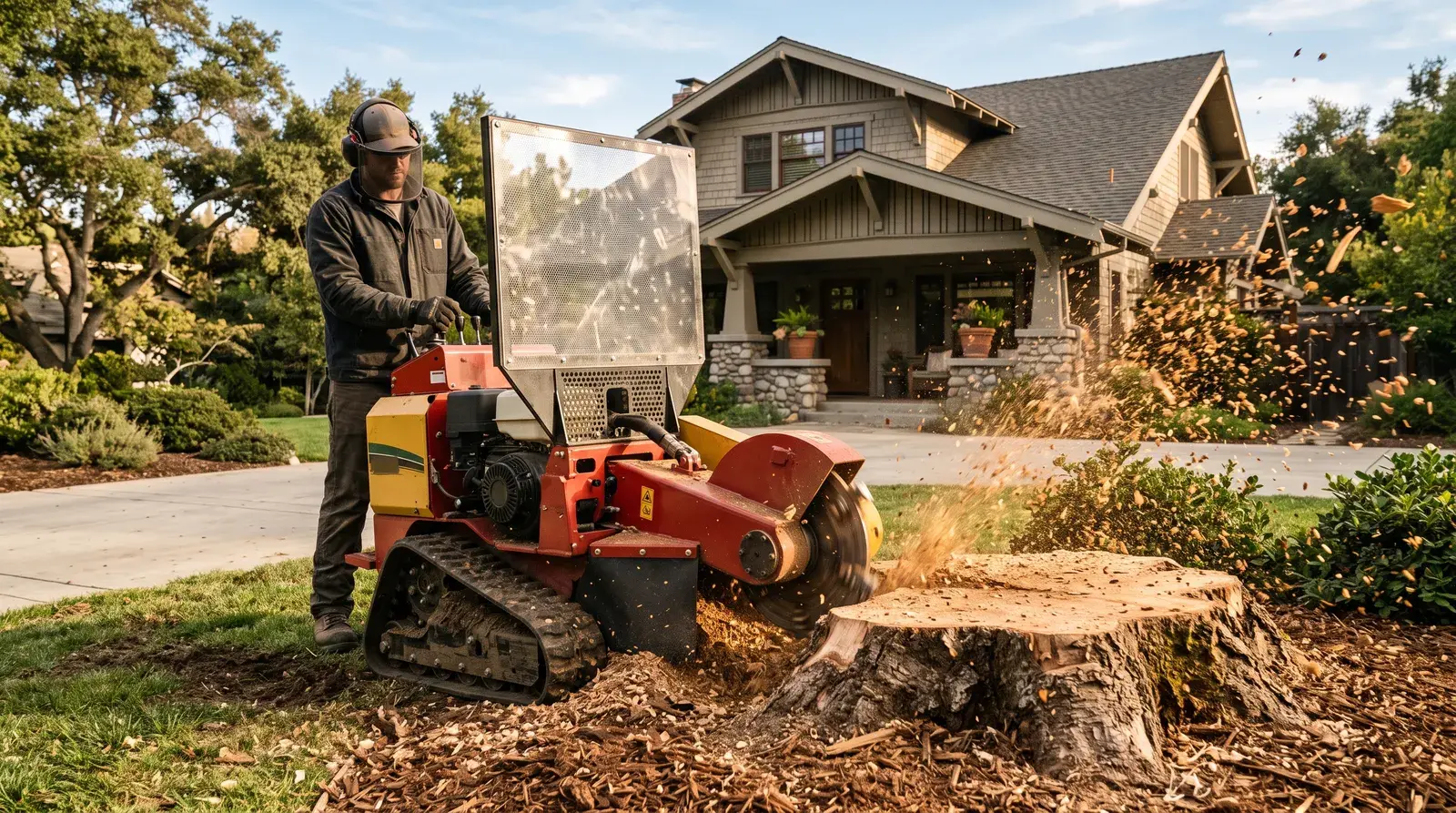
Stump Grinding & Removal
Grinding stumps below grade so you can replant, pave, or reclaim the space — chips and surface roots handled.
Tree Health Assessment
Diagnosing disease, pests, and structural risk — with an honest plan to treat, monitor, or remove.
Tree Planting & Replacement
Right-tree, right-place planting and replacement — good species choices for Sacramento's heat, soils, and space.
Before you book root pruning & root barriers
What it runs, where permits bite, and how root pruning & root barriers stacks up against the alternatives.
Want to see what this looks like on a real property? Browse the root pruning & root barriers jobs we take on, or read how our crew scopes and prices work before you call anyone out.
Frequently asked questions
Can you cut tree roots without killing the tree?
Yes, if the cuts are small enough, far enough from the trunk, and limited to one side. Trees tolerate losing a portion of their fine feeder roots, but the large woody roots near the trunk are structural — they hold the tree up. Cutting those, or trenching around multiple sides in one season, can starve the tree or set up a windthrow failure years later. That's why we map what's actually lifting the concrete before anything gets cut, and why big roots close to the trunk trigger an arborist assessment instead of a saw.
How close to a tree can you cut roots?
The common working rule is to stay outside a radius of three to five times the trunk diameter — so for a 24-inch-diameter oak, no structural cuts within roughly 6 to 10 feet of the trunk. Species, lean, soil, and the tree's condition all move that line. A healthy young Chinese pistache tolerates more than a mature Modesto ash with decay in the base. When a lifted sidewalk demands cuts inside the safe zone, the honest options are ramping or bridging the concrete, rerouting it, or removing the tree — not gambling on its stability.
Do root barriers actually work?
Yes, when they're installed correctly and matched to the situation. A root barrier is a rigid or panel-type membrane set vertically in a trench, typically 18 to 36 inches deep, along the edge of the hardscape being protected. Roots that hit it deflect downward and grow deeper before continuing. Barriers work best for new plantings and after root pruning of younger trees; they're less useful against a mature valley oak whose root system already occupies the whole yard. Shallow or gapped installations fail — roots find the way around.
Are tree roots damaging my foundation?
Roots rarely break a sound foundation directly — they're better at exploiting problems that already exist. In Sacramento's clay soils, large trees close to a house can dry the soil unevenly in summer, which contributes to settling and hairline cracking, and roots will follow existing cracks and plumbing leaks. Lifted patios, walkways, and driveways are far more common root damage. If you're seeing foundation movement near a big tree, get both a foundation contractor and a tree assessment; cutting roots blindly can destabilize the tree without fixing the house.
Who is responsible for tree roots lifting the sidewalk in Sacramento?
It depends on jurisdiction and whose tree it is. In the City of Sacramento, trees in the strip between sidewalk and street are City Trees, and root work on them is the city's call — don't cut roots on a street tree without checking with the city first. Sidewalk repair responsibility varies by city and often lands partly on the adjacent property owner. For trees on your own property lifting your own concrete, it's your project. We flag the ownership question during the estimate before any cutting is scheduled.