
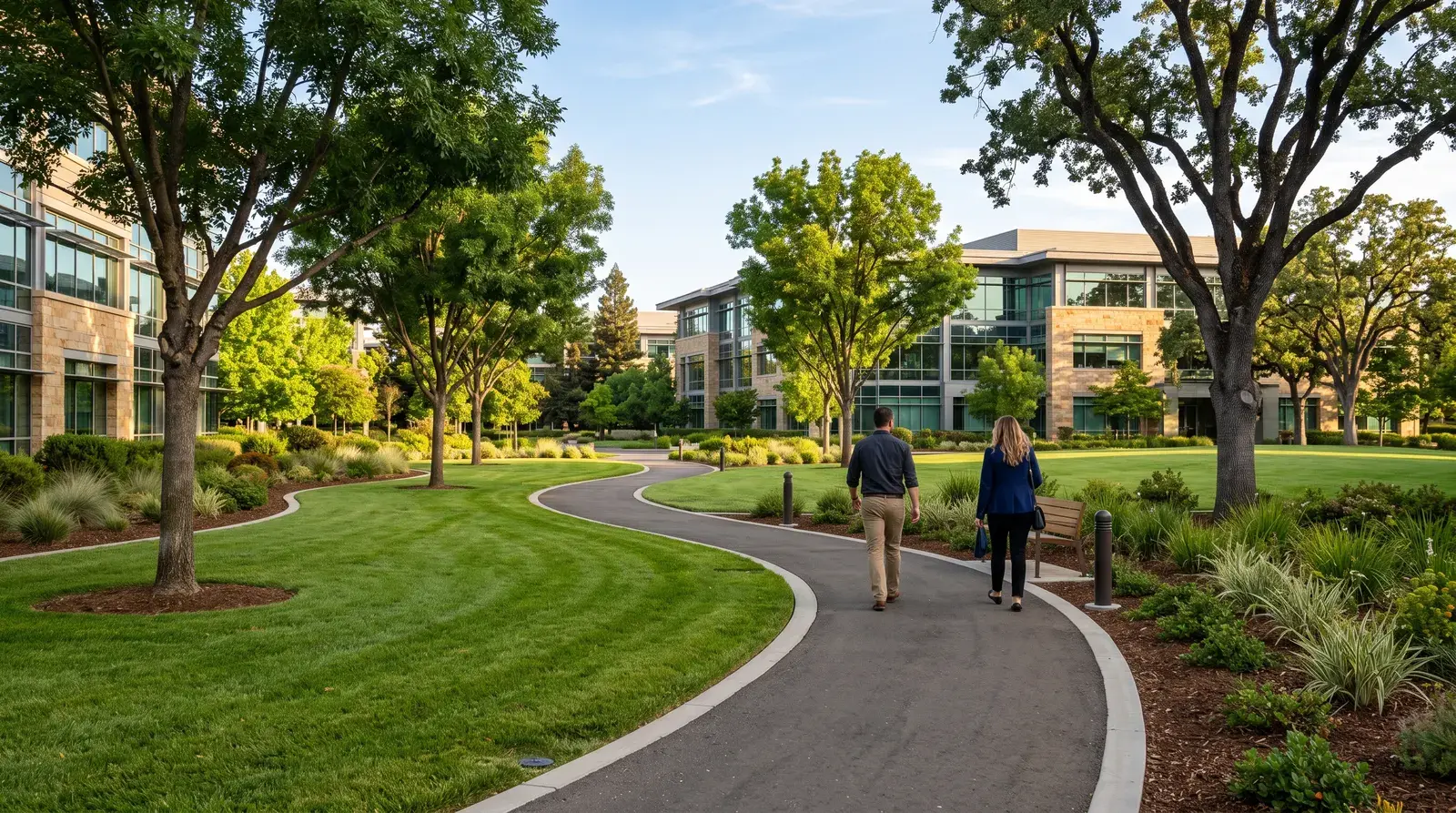
Who We Work With
Commercial tree work is a different job from residential work: more stakeholders, more liability, more scheduling, and a budget that has to be defended to a board or an owner. We structure the work so the manager's side of it is easy.
- HOAs and community associations — common-area trees, greenbelts, entry monuments, and street-tree rows in planned communities from Elk Grove to Roseville.
- Property management companies — portfolios of rentals, multifamily buildings, and mixed-use sites that need one vendor, one invoice format, and consistent turnaround.
- Retail centers and office parks — parking-lot shade trees, sign and light clearance, and storefront visibility trimming done around business hours.
- Churches, schools, and private campuses — large mature trees over play areas and gathering spaces, where documented inspections matter.
- Apartment and condo communities — carport and roofline clearance, walkway safety, and storm response with residents on-site.
What a Maintenance Contract Covers
A good contract is specific: which trees, what work, on what cycle, at what price. We build scopes zone by zone so the board can see exactly what it's buying and spread cost across budget years instead of absorbing it all at once.
- Rotational trimming — property split into zones on a one- to three-year cycle, with clearance standards for roofs, walkways, drives, signs, and lights written into the scope.
- Annual hazard review — a walk-through before storm season flagging deadwood, decay, lifted root plates, and failing co-dominant stems, with a prioritized punch list.
- Removals and replacements — dead and hazardous trees taken out under the contract rate, with replanting options so the property's canopy doesn't thin out over time.
- Palm maintenance — annual skinning and seed-pod removal on Mexican fan palms and queen palms, common at Sacramento-area entries and pool areas.
- Storm response — priority scheduling for contract properties after wind events, triaged to open drives, entrances, and parking first.
- Debris handling — chipping and haul-off included, with the site raked and blown down before the crew leaves.
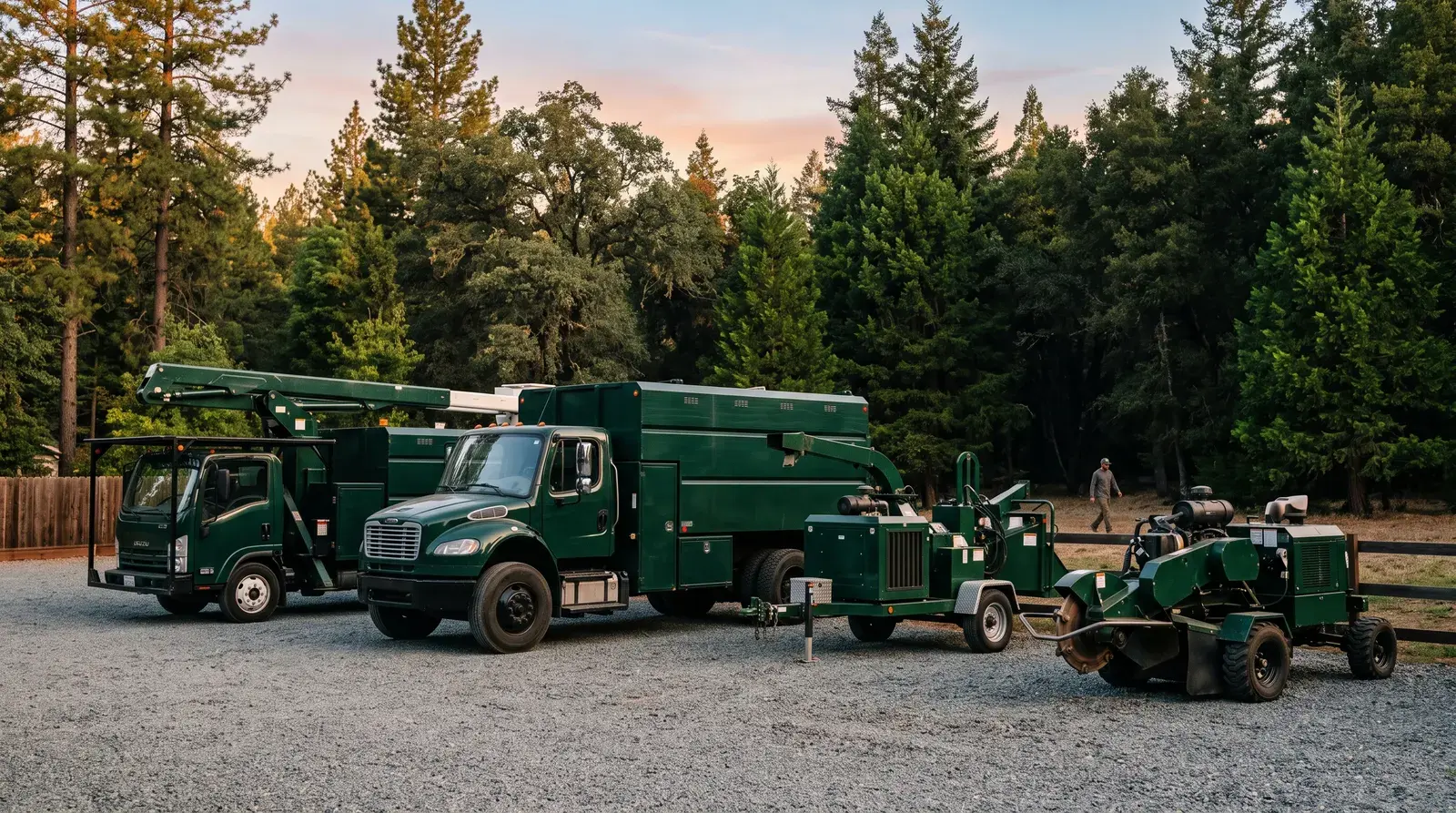
Commercial & HOA Tree Service across Sacramento, Placer, El Dorado, and Yolo counties.
Liability: The Real Reason Commercial Trees Get Maintained
For a manager, tree work is risk management with a chainsaw. A limb that drops on a parked car or a root-heaved sidewalk that trips a resident turns into a claim, and the first question is always whether the hazard was known and ignored.
None of this requires over-pruning. Topping and excessive thinning create weakly attached regrowth that raises risk within a few seasons — the goal is structurally sound trees on a documented schedule, not scalped ones.
- Documented inspections — dated condition notes on flagged trees, so the association can demonstrate reasonable care if something fails anyway.
- Deadwood over targets — dead limbs above walkways, play areas, and parking rows are the highest-frequency failure and the easiest to eliminate on a rotation.
- Sidewalk and hardscape conflicts — surface roots from camphors, liquidambars, and sycamores lift panels; root pruning with barriers often beats removal.
- Aging plantings — 1970s–90s subdivisions and centers across Carmichael, Citrus Heights, and Rancho Cordova are full of Modesto ash and mulberry hitting brittle old age at the same time.
- Storm-season prep — crown thinning and weight reduction before winter cuts the failure rate when saturated soil meets a south wind.
How the Bid and Scope Process Works
Vague bids are how boards end up comparing numbers that don't describe the same work. Our process produces a scope specific enough that any competing bid can be checked against it line by line.
- Site walk — we walk the property with the manager or a board member, note priorities, and inventory the trees that carry work or risk.
- Written scope — work described per tree or per zone: what gets trimmed to what standard, what comes out, what gets monitored.
- Line-item pricing — trimming, removals, stump grinding, and haul-off priced separately so the board can phase work across fiscal years.
- Ordinance check — likely-protected trees (native oaks especially) flagged before the scope is finalized, so permit lead time is built into the schedule.
- Certificate of insurance — issued to the association or management company before work starts, naming additional insureds as your contract requires.
- Completion documentation — photos and a signed-off punch list per visit, which most management companies file with the work order.
Need commercial & hoa tree service on your property?
Share the address and project details — we'll come back with a scoped, site-specific estimate.
Scheduling Around Tenants, Traffic, and Seasons
The work itself is half the job; the other half is doing it without shutting the property down. Chippers are loud, drop zones need space, and every closed parking row costs somebody something.
- Phased closures — we cone off and clear one zone at a time so parking and access stay mostly open, coordinated with manager notices to residents or tenants.
- Hours matched to the site — early starts for retail before doors open; reasonable daytime hours for residential communities.
- Seasonal sequencing — native oaks pruned in the dry season and dormancy; deciduous street trees in winter when structure is visible; palms ahead of summer seed drop.
- Storm windows — hazard work scheduled before Sacramento's November–March wind season, not after the first failure.
- Clean handoff — no piles left 'for the next trip.' Debris leaves with the crew, and walkways get blown down the same day.
Common Trees on Sacramento Commercial Properties
Commercial and HOA landscapes in the region were planted in waves, and each wave brings its own maintenance profile. Knowing what's on the property tells you most of what the contract needs to cover.
- Valley oak and interior live oak — anchor trees in greenbelts and older centers; high value, often protected, pruned conservatively in the dry season.
- Modesto ash — everywhere in mid-century plantings and now brittle with age; the most frequent limb-failure call we get from managers.
- Bradford pear and other ornamental pears — parking-lot staples with notoriously weak branch unions; they split in wind without periodic structural pruning.
- Crape myrtle — low risk but high visibility at entries; needs correct pruning, not the topping ('crape murder') that ruins its form.
- Mexican fan palm and queen palm — entry and pool-area plantings that need annual skinning and seed removal to stay clean and safe.
- Liquidambar and camphor — heavy shade producers whose surface roots drive most sidewalk and curb claims on older properties.
The same crew from estimate to cleanup.
No juggling separate contractors for one tree. Tell us the address and what you're dealing with, and we'll come back with a written, site-specific number.
- Removal, trimming, stumps, and cleanup handled by one crew
- Free, site-specific estimates — priced to your tree, not a flat rate
- Sacramento, Placer, El Dorado, and Yolo counties
Why One Crew Beats Calling Around Every Time
Properties that bid every tree job separately pay more over time and know less about their own trees. A standing relationship converts tree care from a series of emergencies into a line item.
If your property's trees are currently managed by whoever answered the phone last, a free site walk is the easy first step. We'll tell you what's urgent, what can wait, and what a sensible rotation looks like for your budget.
- Institutional memory — we know which trees were flagged last year and whether they've declined, which is how removals get caught before they become storm calls.
- Predictable budgets — rotation pricing lets the board plan reserves instead of approving surprise invoices.
- Faster storm response — contract properties get priority when a wind event hits the whole region at once and every tree service's phone is ringing.
- One point of contact — a named person who knows the property, not a new estimator every visit.
- Consistent standards — the same clearance specs and pruning quality across every zone and every year.
Related services
Tree Trimming
Trimming for clearance, appearance, and long-term health — deadwood removal, canopy shaping, and structure on a sensible cycle.
Tree Removal
Safe removal of hazardous, dead, or unwanted trees — including permit help, cleanup, and haul-off across the Sacramento region.
Wood Chipping & Debris Hauling
On-site chipping plus haul-off of logs, chips, and green waste — the cleanup half of any tree job, done to a clean-site standard.
Before you book commercial & hoa tree service
What it runs, where permits bite, and how commercial & hoa tree service stacks up against the alternatives.
How Much Does Tree Trimming Cost in Sacramento? (2026)
Regional range $300–$2,500 — and what moves the number on a real job.
How Much Does Tree Removal Cost in Sacramento? (2026)
Typical 2026 Sacramento tree removal price ranges by tree size, the factors that move the number, and how to read a quote before you sign it.
Want to see what this looks like on a real property? Browse the commercial & hoa tree service jobs we take on, or read how our crew scopes and prices work before you call anyone out.
Frequently asked questions
How does bidding work for HOA and commercial tree contracts?
It starts with a site walk. We inventory the trees that matter — species, size, condition, and what each one can hit — then write a scope that lists the work per tree or per zone, not a vague lump sum. Boards and managers get a line-item proposal they can compare against other bids apples-to-apples, plus a recommended rotation so the whole property isn't billed in one budget year. Estimates and site walks are free.
Can you put our property on a scheduled maintenance rotation?
Yes, and for most properties it's the cheapest way to run trees. A typical rotation splits the property into zones trimmed on a one- to three-year cycle: fast growers like Modesto ash and mulberry more often, oaks less often and in the dry season. Scheduled work costs less per tree than one-off calls, keeps clearance and appearance consistent, and gives us a standing record of which trees are declining before they become emergency removals.
How does tree maintenance reduce our liability exposure?
Most tree claims trace back to a known, documented hazard nobody acted on — a dead limb over a walkway, a lifted sidewalk panel, a leaning tree by the parking row. A maintenance program creates the opposite paper trail: regular inspections, dated work orders, and prompt action on flagged trees. We document conditions and completed work so the association or management company can show it exercised reasonable care. That record matters after a limb failure far more than any single trim.
Do you work around tenants, residents, and business hours?
That's standard for this work. We coordinate parking closures and cone-offs with the manager in advance, keep walkway and entrance access open in phases, and can schedule noisy chipping for hours that suit the site — early for retail, mid-day for residential communities. Storm cleanup is triaged so blocked drives and entrances open first. You get a named contact on our end, not a dispatch queue.
Who handles permits for protected trees on commercial property?
We flag them and prepare the paperwork support. Commercial parcels and HOA common areas carry the same ordinance exposure as homes — often more, because older centers and greenbelts hold mature valley oaks and interior live oaks. City of Sacramento heritage trees fall under City Code Chapter 12.56, and unincorporated Sacramento County protects native oaks under its Tree Preservation and Protection Ordinance. We identify which trees are likely regulated during the site walk and can provide arborist documentation for permit applications.