
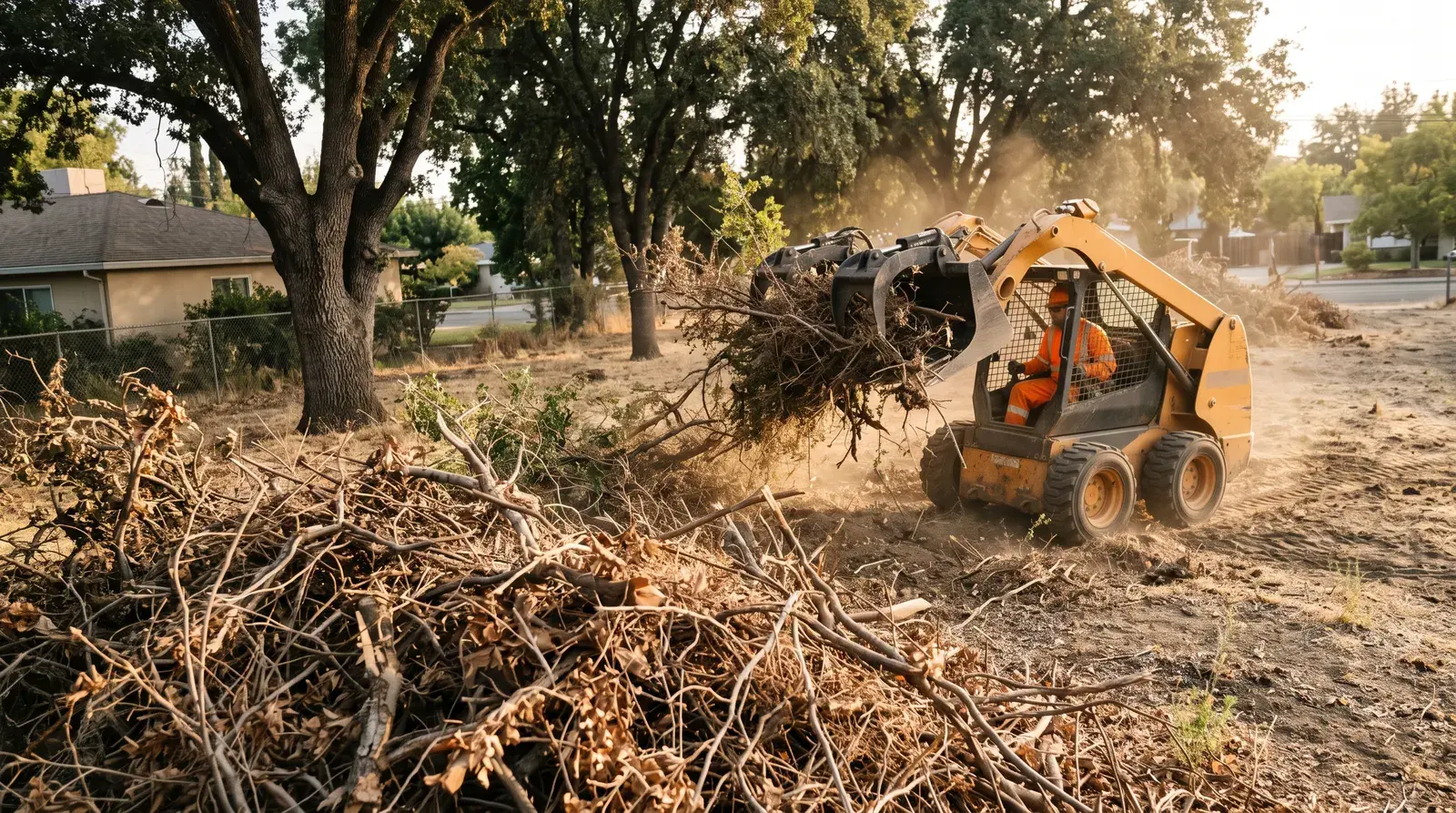
What Lot & Land Clearing Includes
Lot clearing is the whole vegetation package on one mobilization: tree removal, stump grinding, brush cutting, and haul-off, sequenced so the parcel is genuinely build-ready or usable when we leave. You define the end state; we scope the work backward from it.
- Tree removal — from small volunteer trees to full-size oaks and pines, felled whole where there's room or rigged down in sections where there isn't.
- Stump grinding — standard grinds run 8–12 inches below grade; deeper grinds where foundations, slabs, or utility trenches are going in.
- Brush and undergrowth — blackberry, scotch broom, privet thickets, and volunteer saplings cut and cleared to bare or near-bare ground.
- Chipping and haul-off — brush chipped on-site, trunk wood loaded out, and the parcel left raked, not piled.
- Selective retention — keeper trees flagged and protected so equipment doesn't compact their root zones or scar their trunks.
Protected Trees Come First — Check Before You Clear
The fastest way to blow up a building project in the Sacramento region is to clear a native oak without checking the ordinance. Fines and mandatory mitigation plantings are real, and they land on the property owner. Every clearing job we scope starts with a protected-tree walk.
None of this means the trees can't come down — it means the sequence matters. Flag protected trees at the estimate, get the permit or the exemption in writing, then clear. We would rather lose a week to review than leave you holding a violation.
- Sacramento County (unincorporated) — the Tree Preservation and Protection Ordinance protects native oaks, including valley oak, interior live oak, and blue oak. Carmichael, Fair Oaks, Orangevale, and Arden-Arcade parcels fall under it.
- City of Sacramento — heritage trees are protected under City Code Chapter 12.56, and street trees are City Trees regardless of who planted them. Verify at cityofsacramento.gov.
- Placer and El Dorado counties — foothill parcels in Auburn, Newcastle, Cameron Park, and Placerville often carry blue oak and interior live oak; each jurisdiction has its own review thresholds. Always verify locally.
- Development projects — cities commonly require a tree inventory or arborist report with the building application. Our arborist report service handles that paperwork.
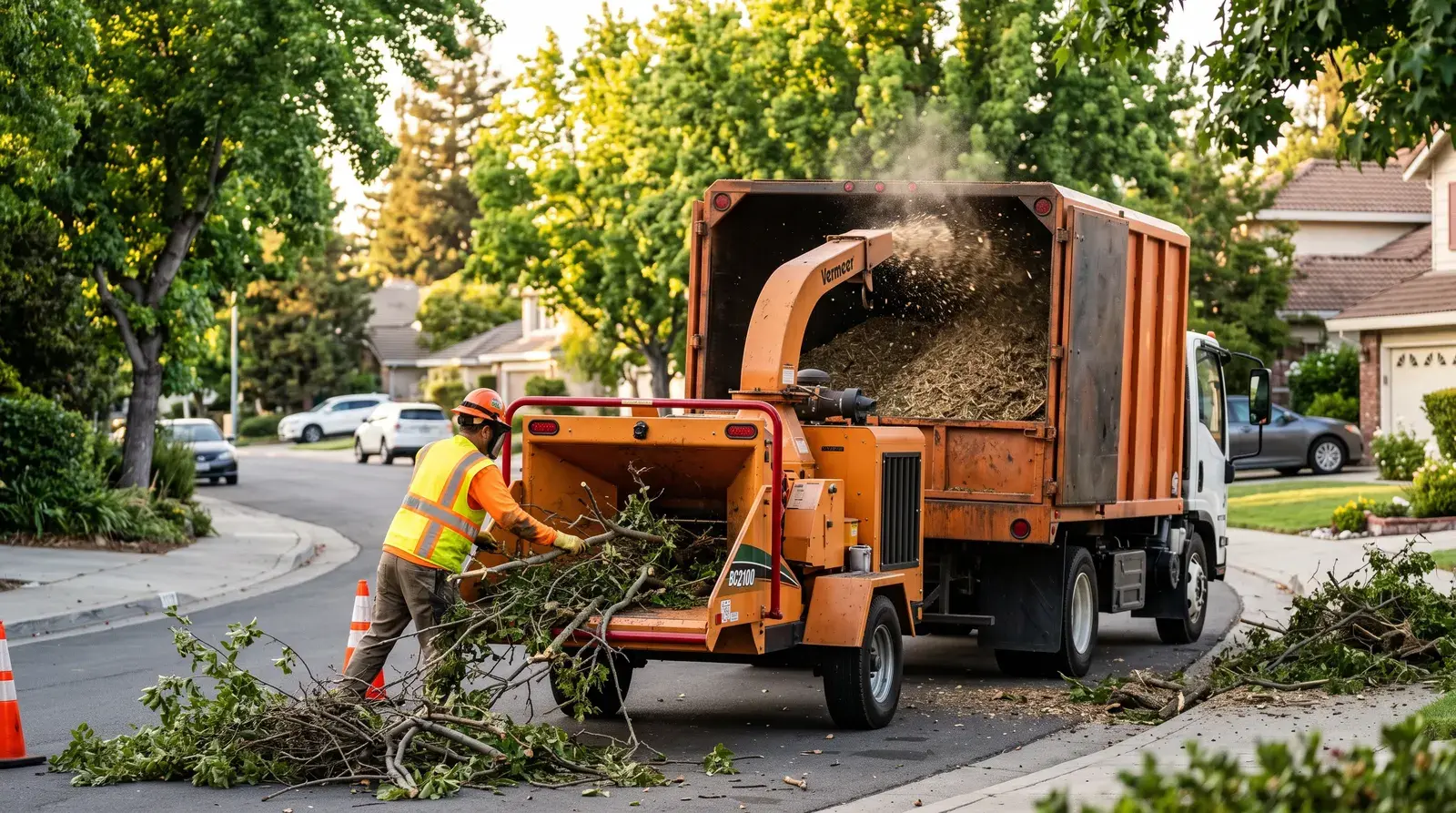
Lot & Land Clearing across Sacramento, Placer, El Dorado, and Yolo counties.
Clearing for ADUs and Backyard Construction
ADU projects are the most common clearing call we get inside the urban core. A 1950s Carmichael or South Sacramento backyard usually has forty years of tree growth sitting where the unit, the trench, and the concrete truck all need to go.
One planning note from experience: settle the tree question before your ADU plans are final. Shifting a footprint ten feet at the design stage is free; discovering a protected oak in the pad after permits are pulled is not. We clear the trees, stumps, and brush; the dirt work that follows — pad grading, compaction, and subgrade prep — is an earthwork contractor's scope, and NorCal Earthworks does site preparation across the same counties.
- Footprint clearing — trees and stumps removed from the building pad, with grinds deep enough that footings don't hit root mass.
- Utility corridors — roots and stumps cleared along sewer, water, and electrical trench lines from the main house to the unit.
- Access routes — side-yard and alley access opened up for excavators, concrete trucks, and material deliveries.
- Canopy conflicts — limbs pruned back where a keeper tree overhangs the new roofline, so you're not paying for a trim six months after move-in.
- Timing — clearing scheduled ahead of your grading and foundation contractors so the pad is ready when they are.
Overgrown and Neglected Parcels
Not every clearing job is a building site. Inherited lots, long-vacant infill parcels, and rural properties that got away from their owners all need the same reset: cut the overgrowth, remove the dead and hazardous trees, and make the ground visible and walkable again.
- Vacant-lot cleanups — overgrown parcels draw code complaints, dumping, and fire risk; a cleared lot is cheaper to hold and easier to sell.
- Estate and pre-sale clearing — buyers and appraisers see the lot, not the potential. Clearing before listing routinely pays for itself.
- Dead tree removal — drought-stressed pines and declining Modesto ash on neglected parcels are the trees that fail in winter wind; they come out first.
- Fence-line and boundary clearing — vegetation cut back so surveyors, fence crews, and neighbors can actually find the line.
- Follow-up plan — cleared ground regrows fast in the Sacramento climate; we'll tell you honestly what maintenance the parcel will need.
Need lot & land clearing on your property?
Share the address and project details — we'll come back with a scoped, site-specific estimate.
Foothill Acreage and Fuel-Heavy Parcels
On wooded parcels in Placer and El Dorado counties — Auburn, Newcastle, Cameron Park, Shingle Springs — lot clearing overlaps heavily with fuel reduction. The same work that readies a building envelope also thins the ladder fuels that carry fire into tree canopies.
If the parcel already has a home on it, look at our defensible space clearing service — it targets the 0–100 foot zones around the structure specifically, and pairs naturally with broader lot work.
- Thinning over scraping — foothill clearing usually means opening up spacing between trees and removing understory, not stripping the parcel bare.
- Ladder fuel removal — brush, low limbs, and small conifers under the oak and pine canopy come out so ground fire can't climb.
- Building envelope prep — a cleared, defensible pad site for future construction, tied into PRC 4291 defensible space zones if a home already stands on the parcel.
- Slope and access — steep ground changes equipment choices and cost; we scope that honestly at the walk rather than surprising you later.
- Seasonal timing — dry-season work needs fire-safe practices (spark watch, water on hand); wet-season work needs ground protection. Both are workable.
What Drives Lot Clearing Cost
Clearing quotes range widely because parcels do. Two half-acre lots can differ by thousands of dollars depending on what's growing on them and what has to happen to the debris. These are the levers that move the number.
Every estimate is free, written, and based on walking the actual parcel. Photos help us prep, but nobody can price acreage from the street.
- Tree count and size — a lot with three mature oaks and twenty volunteer trees costs more than an acre of light brush.
- Stump work — grinding every stump below grade adds real cost; leaving stumps on a non-building parcel saves it.
- Access and slope — open, flat ground where a chipper and loader work freely is the cheap end; steep, tight, or soft ground is not.
- Debris volume and destination — chips left on-site cost less than full haul-off; green waste disposal fees scale with tonnage.
- Permits and reports — protected-tree applications and arborist reports add lead time and a line item when they apply.
- End state — 'walkable and safe' is a lighter scope than 'ready for a grading contractor.' Tell us the goal and we'll scope to it.
The same crew from estimate to cleanup.
No juggling separate contractors for one tree. Tell us the address and what you're dealing with, and we'll come back with a written, site-specific number.
- Removal, trimming, stumps, and cleanup handled by one crew
- Free, site-specific estimates — priced to your tree, not a flat rate
- Sacramento, Placer, El Dorado, and Yolo counties

How a Clearing Job Runs, Start to Finish
A clearing project follows a fixed sequence: walk and scope, resolve permits, mobilize, clear in order, then finish the ground. Doing it in that order is what keeps the schedule honest and the keeper trees standing.
- Site walk — we flag protected trees, mark keepers with you, identify hazards, and confirm equipment access.
- Permit resolution — any protected-tree removals go through the local process before work is scheduled.
- Brush and understory first — clearing the small material opens sight lines and safe footing for the tree work.
- Tree removal — felled whole where the lot allows, rigged down in sections near structures, lines, or keeper trees.
- Stumps and finish — grinding where specified, chips spread or hauled, wood loaded out, and the parcel raked and ready for whatever comes next.
Related services
Brush & Vegetation Clearing
Cutting back overgrown brush, weeds, and undergrowth for access, code compliance, and reduced fire fuel.
Defensible Space Clearing
PRC 4291 fuel reduction — limbing up, thinning, and clearing the defensible space zones around foothill homes.
Tree Removal
Safe removal of hazardous, dead, or unwanted trees — including permit help, cleanup, and haul-off across the Sacramento region.
Related guides
Do You Need a Permit to Remove a Tree in Sacramento?
Which Sacramento trees need a removal permit, how city and county rules differ, and how to check before the saw comes out.
How Much Does Tree Removal Cost in Sacramento? (2026)
Typical 2026 Sacramento tree removal price ranges by tree size, the factors that move the number, and how to read a quote before you sign it.
Stump Grinding vs. Stump Removal
The difference between grinding and full stump removal, what each costs, and which one you actually need.
Before you book lot & land clearing
What it runs, where permits bite, and how lot & land clearing stacks up against the alternatives.
Defensible Space Clearing Cost in the Sacramento Foothills (2026)
Regional range $1,000–$10,000 — and what moves the number on a real job.
How Much Does Tree Removal Cost in Sacramento? (2026)
Typical 2026 Sacramento tree removal price ranges by tree size, the factors that move the number, and how to read a quote before you sign it.
Want to see what this looks like on a real property? Browse the lot & land clearing jobs we take on, or read how our crew scopes and prices work before you call anyone out.
Frequently asked questions
Can you clear a lot that has oaks on it?
Yes, but the oaks get checked before anything else happens. Sacramento County's Tree Preservation and Protection Ordinance protects native oaks in unincorporated areas, the City of Sacramento protects heritage trees under City Code Chapter 12.56, and Placer and El Dorado county jurisdictions have their own rules. Many clearing projects keep the healthy oaks and clear around them — a mature valley oak adds value to a building site. We flag every protected tree during the walk-through and point you to the right application when removal is justified.
How much does lot clearing cost in the Sacramento area?
It varies more than any other service we offer because parcels vary so much. A brush-choked quarter-acre infill lot with a few small trees is a very different job from two wooded foothill acres. Tree count and size, stump grinding, slope, access for equipment, and haul-off volume drive the number. As a broad frame, light clearing on a small lot can run in the low thousands, while heavily wooded acreage runs well beyond that. We quote from a site walk, and estimates are free.
Do you clear lots for ADU construction?
Regularly. ADUs are going into Sacramento, Carmichael, Fair Oaks, and Citrus Heights backyards at a steady clip, and most of those yards have mature trees in exactly the wrong spot. We remove or prune trees in the building footprint, grind stumps deep enough for foundation and utility trench work, and clear access for the concrete and framing crews that follow. If a protected oak sits in the footprint, we help with the permit question early — before your plans are locked.
Do you take everything, or can you clear selectively?
Selective clearing is the norm, not the exception. On most residential and foothill parcels we mark keeper trees with the owner — usually the healthy natives — then remove the dead wood, hazard trees, brush, and volunteer growth around them. Keeping the right trees preserves shade, screening, and property value, and it keeps you on the friendly side of the oak ordinances. Full scrape-downs happen too, mostly on small building sites, but we always ask before assuming.
What happens to the trees and brush you clear?
Brush and small wood get chipped on-site — you can keep the chips for mulch or erosion control at no charge, or we haul them. Trunk wood gets hauled off or bucked into firewood rounds if you want to keep it. Stumps are ground and the grindings can backfill the hole or be removed if you're building over the spot. The goal is a parcel that's actually ready for the next contractor, not a lot with piles on it.